Why the cavalier treatment of the Turin Shroud at Chambery in 16th century France - folding the presumed holy relic down its midline, from head to foot?
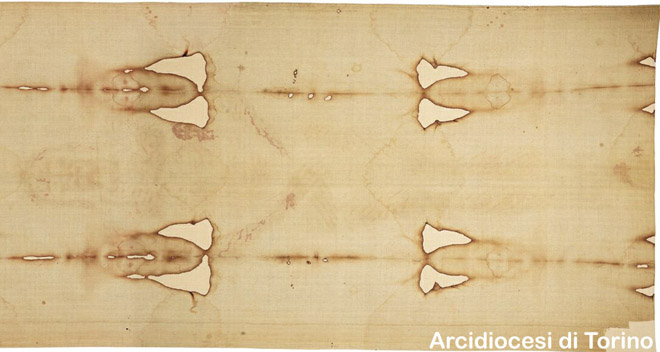
Familiar image of the Shroud with those burn holes (trimmed of burnt edges)
Here is the familiar image of the Shroud, shown with the roughly triangular burn holes that we are told resulted from the Chambery fire in 1532, AFTER the Shroud had been intermittently on display in the sacristy chapel as a revered “holy icon”.
The holes we are told were patched over two years later by nuns; this photograph was taken after the 2002 "restoration", after the patches had been removed, and a backing sheet stitched in place. Nevertheless burn holes are all too apparent, and were the result we are told of molten silver penetrating the Shroud.
Note the holes form an approximately symmetrical pattern, so clearly the Shroud had been folded for storage –- presumably with great care and reverence one would have assumed – but all it took was a single blob of molten silver penetrating several layers of folded cloth to cause the extensive damage that intruded on the image, especially at the shoulders.
So how precisely had the Shroud been folded? It is easy to reproduce the pattern with a single sheet of A4 paper and a pair of scissors. My starting point was a cropped image of the shroud, removing as much as possible of the burn holes (since I wanted to add my own!).

Laterally-cropped image of the Shroud printed onto A4
Here is a sequence of 6 steps that ends up with cut (rather than burn) holes in approximately the right position and arrangement. Notice it took only one initial cut triangular hole to end up with 8.

Lower half folded to long-dimension midline

Upper half now folded to midline also

Fold in half again along long dimension midline - ie. FOLDING THE MAN'S IMAGE IN TWO

Fold again, this time along the short-dimension midline

Cut out a single triangle through all 8 folded layers to simulate a single burn hole

As above, oblique view

Final pattern of "burn holes" matching that of the Shroud below:
Reminder: the Shroud (again)
Notice anything? It is simply not possible to achieve the pattern and symmetry without at some stage folding the Shroud lengthwise down its midline, i.e. folding the image of the face and body in two equal halves (!)
Is that not extraordinary – that a supposedly revered image of the crucified Christ was treated in this manner? What’s more, it is not just a picture we are told, but the actual burial shroud of Christ, preserved from the first century AD, but curiously only coming to public attention in the 14th century (but see literature concerning Edessa and the "Mandylion").
I don’t know about you, dear reader, but I frankly find it inconceivable that something believed to be Christ’s own burial shroud would have been treated in so cavalier a fashion, folding, indeed creasing Christ’s face in two. Surely care would have been taken to avoid any folding in the region of the face especially? It would have been folded scrupulously to avoid anything that could be viewed as disrespectful. Would it not have been rolled up rather than folded to avoid introducing any creases – ones that would have needed to be pressed out afterwards to maintain the Shroud in tip-top display condition?
So why was the Shroud folded in this disrespectful manner? I have reached a (tentative) opinion on that, but invite others to state theirs before revealing mine (which regrettably risks antagonising those who might see this line of enquiry as constituting an attack on their religious beliefs, which it most certainly is not).




3 comments:
I'm not quite following your argument here, but perhaps I've missed some key piece of evidence. Is there some biblical prohibition on folding Christ's body vertically down the center as opposed to horizontally? Or did the church publish some rule about that? And if there were, wouldn't it be just as wrong for a painting as it would be for something miraculous? I guess, without that, I can't really see what you're getting at or why one type of fold is cavalier but the others are OK.
There's no doctrinal principle here - merely respectfulness. If you have have a supposed imprint of Jesus of Nazareth, complete with his blood, scourge marks etc, and you want to display it, and preserve it for posterity, you don't fold it down the middle of the face, leaving a disfiguring crease. If you are going to fold (as distinct from roll, which would seem the more sensible option) you frame the important parts. That after all was the supposed link with the early centuries AD, when it was said to have been the Mandylion or Image of Edessa, and folded to frame the face, as if a portrait.
Thanks for the reply. I was intrigued by the lengthwise folding you illustrated so effectively.
While I share your sense that there's something not quite right about folding an image of any person right down the middle, I can't say for certain how anyone in the 16th century would have regarded this question. I'd prefer to establish a firmer evidentiary foundation before making such an argument.
In trying to anticipate the inevitable riposte: couldn't the exact opposite claim be made just as easily? Something along the lines of:
1) The body is already 'divided' once, yielding the anterior and posterior aspects. So, the next 'division,' if one is to be made, should similarly bifurcate the image, this time on the vertical axis.
2) Far from having no meaning, this would be consistent with Christian doctrine regarding the hypostatic union.
3) It ensures the image area is on the inside of the folded cloth, giving it better protection.
4) When the cloth is unfolded, there is a kind of 'revelation' of the image -- a small Epiphany.
I could see a medievalist arguing there is actually a stronger christological and aesthetic argument in favor of the lengthwise fold. Bringing the edges inward, followed by the centerline fold, seemed to me resonant with triptych icons -- as well as the design of some tabernacles and even Gothic cathedrals. I'm wary of walking into the historian's fallacy here. I don't share the thoughts or motivations of medieval clergy, so I'm trying to assess this question on the basis of what they said they believed, rather than my own aversion to folding people in half.
Post a Comment