Showing posts with label linen. Show all posts

Sunday, May 3, 2015

Modelling the Turin Shroud: my flour/nitric acid vapour model looks better and better with each passing day.

Here's a quickie progress report, so for now I'll simply post pictures with captions only. Profoundly deep and penetrating physicochemical insights and analysis, guaranteed (says he) to knock your socks off, can wait till later.

The previous posting reported the use of a cooked paste of white flour and water in the initial imprinting of my own hand. But  there are theoretical advantages in using a dispersion of raw, uncooked flour (intact endosperm cells, enclosing native starch granules,  bla bla, less risk of reverse side penetration and image, bla bla).


Fig. 1: OK, so here's that hand again, but this time it's been painted with a thin slurry of uncooked white flour and water. (I might experiment with additives later to get a more even coating, but if the procedure works without them, albeit sub-optimally, then it makes for a more credible model.


Fig.2: If I had to choose just one picture to illustrate the power of the new technique (at Stage 1 imprinting) this would be it. Look how well the linen moulds to the hand. It's almost as if it had been painted white, instead of being covered with fabric. Why?


Fig 3: Here's the same in a separate experiment. Amazing, yes? Even the surface veins, sinews and fingernails show up.
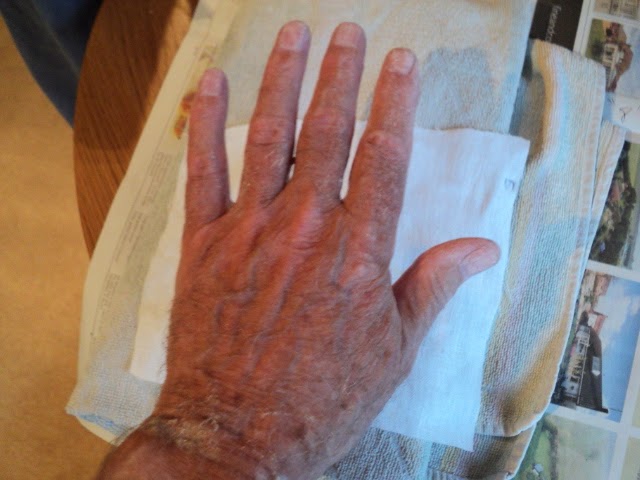


Fig 4: This picture too is amazing in its own way, except that the reason is not self -evident unless you do the experiment for yourself. When one goes to lift off the linen, one finds it is STUCK onto the hand, and that considerable force is needed to peel it off, and that one's hand at the end is almost bone dry, with flecks of dry flour here and there. In other words, flour slurry behaves like superglue when it meets linen. (I predicted that in the previous posting, but let's not bother with the reasons why, except to say that like attracts like in organic chemistry, which accounts for the phenomenon of surface ADHESION, a neglected factor that needs to be considered in imprinting by physical contact).


Fig 5: So much effort is needed to peel back the linen (at least with raw flour) that the fibres of the linen become pulled away from their threads to form a sort of fluffy fleece. One can just about make out adhering particles of flour in the picture above. Might the boosted  'fleece' have something to do with the subtlety of the TS image, its indistinct boundary between image and non-image areas?  Or the ease of detaching image fibres vis-a- vis non-image (see STURP's Raynond N.Rogers)? Maybe, maybe not, but the results so far underline the importance of doing open-ended experimentation that just once in a while can throw up effects that are largely unpredicted, yet may or conceivably might play a key role in understanding the 'iconic' or 'enigmatic' TS image.


Fig.6: We've now moved from Stage 1 (imprinting) to stage 2 (image development). The imprint of my hand has been folded into a compact bundle (with securing stitches of cotton thread) and suspended over a tank containing conc (70%) nitric acid. It's the vapour that develops the image (see previous posting). Yes, nitric acid was known in the 13th/14th century (see my earlier posting on the writings of Pseudo-Geber, probably one and the same as the Franciscan monk/alchemist Paul of Taranto)


Fig.7: Well, that was a most welcome result, showing that the raw wheat flour worked as well, if not better than the cooked flour, despite having an entirely different consistency (the raw dispersion was thin and milky, nothing like to the thick gooey paste from boiled flour).  Predictably, there was less reverse side penetration and imaging.


Fig.7: Here's the linen being steeped in sodium bicarbonate solution to neutralize the surplus of nitric acid vapour adhering to the linen. (On this occasion, the linen had not been noticeably weakened by overnight exposure to nitric acid vapour, as checkied later).


Fig.8: Although not obviously weakened, the linen had acquired a faint beige coloration ("aged look"?). That can be seen in this photograph, where it has been placed on top of the same untreated linen.


Fig.9: Yes, there is a faint reverse side image (unwelcome for modelling purposes, though whether it would be so obvious against a centuries-old ageing is a moot point). But beware artefacts: one is seeing it here  against the same white background. See my previous posting for the false impression that can be created by back-reflection of filtered/coloured light from white of light-coloured backgrounds. Reverse-side images should always be checked against matt black backgrounds that prevent back-reflection through the interstices of the weave.


Fig 10: Here's the topside image, viewed against a black background, after neutralizing acid, rinsing, drying, and ironing.


Fig 11: Here's the reverse side, against the same black background. There is scarcely any reverse side image. Might the traces be removable, e.g. with soap and water, while still leaving front side image?


Fig.12: I had earlier wondered whether the nitric acid step in the new procedure could be replaced by plain-old oven incubation.  The answer would appear to be no. Oven temperatures in the region of 200 degrees Celsius that turn the flour imprint into a yellow/brown image also have an excessive darkening effect on the linen itself.  (The test was done with a metal template loaded with flour slurry at decreasing solid/water ratio: imprints were nothing like the TS image, being scab-like, and vigorous brushing failed to 'soften' the images).


Fig 13: At this stage I decided to do some before-and-after tests on the hand image. Thus the vertical cut to divide it into two approximate halves.


Fig 14: it's maybe not easy to spot, but a length of sticky tape between labels A and B has been pressed onto the image/non-image areas, which was then stripped off and stuck onto a glass slide  for later microscopy. The triangular notches were to remind where the sticky tape had been applied.


Fig.15: That's the slide with sticky tape. Shame about the air bubbles, but one can see stripped-off linen fibres peeping out from the tape at the top. They don't look highly coloured (but then this a more subtle model system than contact scorching).

Fig. 16: We're now about to see how much of that flour/nitric acid image can be washed out with soap AND vigorous rubbing. Is the image simply adhering flour (nitric acid-modified) or are there grounds for thinking that the technique has also chemically modified and coloured the linen fibres per se?


Fig 17: Here we are an hour or so later. The quality of the photo is not that good, with the (artefactual?) vertical,banding that might have been a trick of the light. Nevertheless, if one looks closely one sees that the image has NOT been completely washed out with soap and vigorous rubbing. There is a faint yellow DIFFUSE image area, ie. my fingers, suggesting that the technique has resulted in coloration of linen fibres, despite using an external agent (white flour) to kick start the process of coloration.


Fig 18: Finally, when one turns the linen over, against the black background, there's scarcely any reverse side imaging.maybe not suprising given the particulate nature of the imprinting medium (whole endosperm cells of wheat flour that don't readily penetrate the weave, even from a thin dispersion).

However, the key finding of this exercise must surely be the way that the linen moulded itself to the contours of my hand, despite using a thin milky flour dispersion, so as to show up an amazing degree of detail. that has surely to be a big plus in any model that relies on contact-imprinting. That same capture of detail is then apparent in the final developed imprint. We seem to have a highly promising model here that challenges the pro-authenticity view that the TS image is too subtle to have been produced by conventional physics and chemistry. Never write off conventional physics and chemistry. The ability of molecules to interact and self-organize should NEVER be under-estimated. It's almost as if they have minds of their own (in a sense they do, given their quantized energy levels that became permanently imprinted at an early stage in the history oif the Universe (stellar nucleosynthesis).

Update:Monday May 4

I flagged up this posting yesterday on Dan Porter's  shroudstory site, currently celebrating its 3,000,000 views, with this comment:

May 3, 2015 at 5:24 pm
Hello again folks. Have today found that the results with the new model can be obtained using a thin slurry of white flour with COLD water with a consistency intermediate between that of milk and single cream. Have today posted 18 new photos.
http://colinb-sciencebuzz.blogspot.co.uk/2015/05/modelling-turin-shroud-my-flournitric.html
While I had predicted earlier on theoretical grounds that native wheat endosperm cells, such as exist in uncooked white flour, would bond well to linen fibres (due to like-for-like attraction of primary cell walls of similar chemical composition) I never for a moment imagined just how well. Not only does the flour dispersion behave like an instant adhesive, bonding the linen to skin, but it also makes the linen conform closely to body relief:


Isn’t that amazing?
It then took a bit of effort tearing the linen away from my hand for Stage 2 development (nitric acid vapour, as before). Superficial linen fibres were broken in the process, creating a kind of fleece. Might a similar bonding at the imprinting stage have contributed to the ‘iconic’ nature of the TS image (i.e.fuzzy, ghostly quality) one wonders?
I’m thinking of doing a facial selfie using the new technology, but may have to cut the imprint into quarters for separate development, given the limited capacity of my developing tank (the size and shape of a goldfish bowl).

Here's the response from my friend DavidG (who seems uncharacteristically to be having an off day) and my reply:

  • May 3, 2015 at 8:04 pm
    Paper mache? I too am amazed at the result of your experiment but we aren’t looking for a 3 dimensional image model, just one that photographs that way. Or is this merely a stage which leads to that model later?
May 3, 2015 at 11:20 pm
Oh dear. Methinks you need to visit my site, DavidG, and remind yourself of how the new (old?) technology works. ;-)
In brief: paint a portion of one’s own or someone else’s anatomy with a milky-white suspension of white wheat flour in water. Press the painted part of that anatomy into linen to leave a very faint, indeed near-invisible imprint. Leave the imprint to dry, then suspend the linen above conc. nitric acid taking all the necessary precautions (gloves, eye protection, face mask, ventilation, lab technician training etc etc). The HNO3 vapour reacts chemically with flour constituents (proteins, carbohydrates etc) to ‘develop’ the latent image. Not for nothing do I call it “chemography” which, like pre-digital photography, is a two-step procedure: capture of latent image, followed by chemical development.
I say that 13th/14th century alchemists (especially) had the technology, given that flour was a dietary staple, and Pseudo-Geber/?Paul of Taranto had described the preparation of nitric acid vapour by heating a mixture of saltpetre (potassium nitrate), Cyprus vitriol (copper sulphate) and alum (potassium aluminium sulphate). The imprinted linen could have been suspended in the hot vapour to get rapid yellowing and image development. Alternatively, the vapour could have been condensed in a cooled collecting vessel to get conc. nitric acid, and the linen suspended in the cold vapour above the liquid to get slow colour development as in my procedure, which takes several hours.


Update: Monday May 4

Decided to do a selfie this morning, using the new technology.

Surprisingly, it needs only a thin smear of flour slurry on one's face to get a decent imprint.


Yes, I used a mirror to get this pre-breakfast picture of the slurrified me, immediately before pressing my face down into linen, underneath which was a cushion and several layers of bath towel. Yup, I used LUWU geometry for starters (more predictable, the degree of contact being determined mainly by the deformability of the underlay, there being no manual moulding as in LOTTO. (LUWU = Linen Underneath, Then Underlay; LOTTO= Linen On Top, Then Overlay).


Here's the resultant imprint, before development. shown 'as is' (no photoediting).


Here's the same, after some minor adjustments to contrast and brightness. Note the apparent moustache, and beard and bushy eyebrows. Hmmmm. 


The linen has been folded twice to make a more compact package, using a few stitches of red cotton and is now ready to be suspended in nitric acid vapour.


 Here's the linen inside the vapour chamber. Once can just make out a red stitch. Unfortunately one corner dipped briefly into the nitric acid solution , but that was spotted before there was too much capillary uptake.

All we have to do now is wait. Started vapour treatment at 7:10 am. It's now 13:45, and there's an easily visible browning. I shall leave it for another hour or two before removing, airing, neutralizing  excess acid in bicarb solution, rinsing, drying and ironing.  We shall see what we shall see.

Update  16:10 May 4

OK. Here's the result of my first facial imprinting, using LUWU geometry:


That's the 'as-is' imprint. Anyone would think I had a beard and moustache.
 See my posting from 10 months ago:

http://colinb-sciencebuzz.blogspot.co.uk/2014/07/does-man-on-turin-shroud-really-have.html

 (See there for what happens to the little girl's face when pressed up against glass, such that the photograph taken from the other side becomes an 'impactogram')

Pity about the nose - it may have looked better if the linen had not dipped briefly into the acid solution.


That's a Secondo Pia style inversion of tones (positive to pseudo-negative) using ImageJ Edit Invert.


That's the image after applying some 3D enhancement in ImageJ.


That's the same as above, applying autocorrect in my photoediting program.


Conclusions: the technique shows promise, but falls well short of the TS image characteristics. Next step: I shall have to switch from LUWU to LOTTO. It's almost certainly the passive imprinting technique, relying solely on deformation of the underlay to give moulding of cloth to linen that is responsible for the rather inferior result. LOTTO involves manual moulding, which ensures that important relief is not missed, while at the same time risking excessive capture of sides, resulting in lateral distortion. But then Luigi Garlaschelli believed that a bas relief had to be used for the face. Maybe he's right.


Late addition: I realize from holding the imprint up to the light that there has been failure to develop the brow ridges:
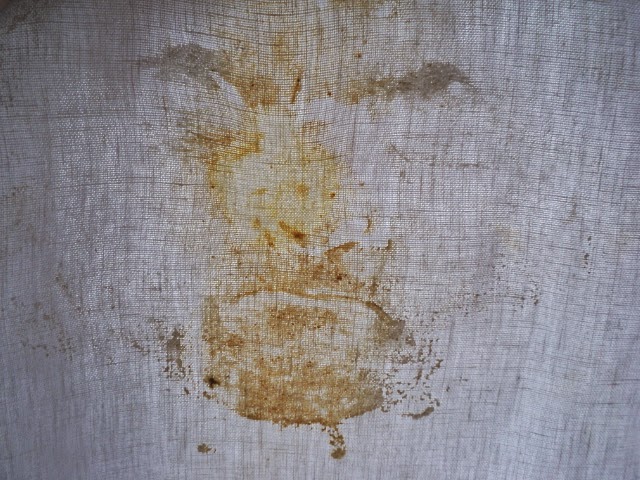


I say failure of development, because they were clearly imprinted with flour, as one can see above. Those missing brows make the image look incomplete.

The linen will now go back in the vapour chamber in an attempt to produce complete development. It may have been the way the cloth was folded that resulted in only partial development.

Result: comparing one with two nitric acid exposures:


How strange. One of the missing "eyebrows" (more correctly brow ridges) has now imaged (viewer's right), but not the left (which shows white due to uncoloured flour).  The reasons for the failure to image first time (both brows) and the second (one brow) are many, due to technical as well as scientific reasons. The whole face imprint is really too big for my vapour chamber if the truth be told.  If only I had one of those tall,  thick-walled glass chromatography tanks. One needs to be more modest with plans right now,  switching to a smaller, less ambitious, less demanding template.

New addition: 17:00 May 5

I was asked by piero on shroudstory a day or two ago whether I'd considered the targets for nitric acid in flour and linen. Lignin was one he mentioned. I'll try and track down the thread in question. Suffice it to say that there's a handy model system I mentioned for checking out lignin. It's pear flesh, the slightly granular feel of which in the mouth is due to clumps of lignified cells ("stone cells"). If nitric acid goes for lignin, those stone cells should show up.

Well, they do:


Pear flesh was crushed onto a strip of linen, and after drying the strip was cut vertically into two sections. The left half was the control (no nitric acid vapour) and the right half was the test. Prediction confirmed: the stone cells show up clearly after nitric acid. Lignin, of which there's substantial amounts in linen,  is indeed a target.  Follow-up studies will be done using the microscope, but not immediately.

Here's the thread in question:

piero
April 29, 2015 at 9:33 am
Colin,
Where are the controls on linen fibrils (= inspections under a microscope)?
We have not yet seen the controls at “sub-fibre level” …
You know that Shroud image reproduction fails if the features of linen fibril is not the same of the linen fibrils of the Shroud…
Until we have not seen what are the true features (remember also the question of colorless medulla) we cannot speak about the interesting experiments you have done.
— — —
B.T.W. I have read that :
>cold nitric acid, i. e. at ordinary room temperature, either alone
or in combination with certain other acids, will not deleteriously attack
the fiber of flax straw or tow but will attack and reduce the woody portion or shives,
which, as is well known, comprise cellulose fibers associated
with encrusting or adsorbed lignin.
So…
Have you studied the nitric acid action (reaction) on lignin ?
— —
Perhaps we can also try to detect where are (= maps)
the reacted lignin constituents (during the controls on linen fibrils)…
— —
I’m too impatient, I’m sorry…
— —
In any case I believe that new AFM controls on linen fibrils
are based on something more substantial
than the Mark Evans photomicrographs.

  • April 29, 2015 at 9:58 am
    Piero:I shall be doing all the tests you suggest and more besides, but all in good time. For now I have been content to flag up the results of my pilot experiments with the new two stage imprinting/developing methodology. They show how it’s possible to get a yellow-brown negative imprint from a real person that shows some 3D-properties.There’s a little reverse side colour, but less than I expected, and simple modifications may be able to prevent it altogether. Image superficiality has still to be determined, but then chemical degradation does not always show itself as visible discoloration: there may be less superficial damage to the SCW core of the fibre, the hemicelluloses especially, that are not easily visible, maybe not visibly affecting the ‘medulla’, i.e. most central part, thus distinguishing the new technique from the alleged defect of the contact-scorch model.
    Being aromatic, lignin is a possible target for nitration as well as oxidation. I’m thinking of using the stone cells of pear fruit as a model system for looking at linen lignin, given the ease of seeing them under the microscope. However, it’s not impossible that the result obtained with nitric acid could be reproduced using acid-free thermal development alone, given the right imprinting agent, perhaps not the wheat flour paste used in my preliminary experiments. There’s a vast number of variables and combinations thereof that need to be tested. It will take time.

    Update: Tuesday May 5,  07:00

    Yes, the face is difficult, at least a fully 3D face, as on a real person or 3D effigy thereof, whether bust/statue/dummy etc As mentioned earlier, Luigi Garlaschelli abandoned attempts to imprint off a real face with his powder frottage model, opining that in a medieval provenance, a bas relief would have been used for the face. Certainly that TS face has a mask-like character, noting especially the abrupt cut-off between cheek and hair (which some explain away as a banding-effect in the linen, a view this blogger has refused to buy into for various reasons).

    So where do we go from here?

    First, I'm not entirely certain that 100% flour is the optimum imprinting medium (while attractive in pilot experiments for its simplicity). Already there's a hint that an excess of flour tends to cake-on at pressure points, notably the brow ridge, and then for some reason that I cannot explain, resists colour development with nitric acid (I suspect it's something to do with the balance between water vapour and nitric acid vapour: if water vapour cannot readily penetrate the hard cake, then the nitric acid cannot do its job). So today I am going to compare three mixes, using a smaller 3D template than a face or hand. The mixes?  100% flour/water; 100% beaten egg yolk ("egg tempera" as used by medieval artists before the arrival of Renaissance oil piants), and a 50/50 mix of each.

    3D template, choosing a new site with  mainly flat (tish) surfaces with interesting detail? I've decided to use my toes. I'll paint the underside with the mix, then the topside, then step onto linen to get a LUWU imprint, then turn the surplus of linen up and over the end of the toes, and mould gently to the top surface to get a LOTTO imprint. It's a model version of the TS itself, note, but using the opposite extremity of the body for the up-and-over reversal of cloth direction. It will also make a more compact package than a face or hand in my vapour chamber!

    Update: Tuesday May 5, 19:00

    Here's an image I shall shortly post to shroudstory.


    It's one of some 200 pages in a 9th century gospel that is still in almost perfect condition. The idea that age always degrades inks and pigments is clearly mistaken. An image that is not due to ink or pigment, but a chemical modification of the matrix itself, is likely to be even more permanent.


Monday, April 6, 2015

Might fumigation with nitric acid vapour and NOx gases have been used to artificially age the Turin Shroud? Just an idea at this stage.

Chemical prologue (for those with limited chemistry, this introduction can be ignored down to the REAL INTRODUCTION below).

 
Discovered on googling (nitric acid stains clothes). Click to enlarge.

OK, it's a bit small. What it says is "Spilled some dilute nitric acid on my clothes in chem lab, is there any way to get the yellow stain out?"
My answer (here only): "Nope, except maybe in the same chem lab (using sodium dithionite  for instance as reducing agent to convert to a near colorless amine)."      

                                 R-NO2  + 6[H] -> R-NH2 + 2H2O

Or one could go for the diimide reagent (nascent NH=NH) that Adler and Heller finally resorted to in order to achieve bleaching of the Shroud body image (lesser reducing agents having been found wanting, at least the ones that were tried - although apparently not dithionite).   Correction: 12 April:  Nope. On reading I find that diimide is very specific in its action, targeting -CH=CH- double bonds for hydrogenation to -CH2-CH2-. I was wrong to assume that it would reduce R-NO2 to R-NH2.

REAL INTRODUCTION

One of the curious features of the Shroud is the exceedingly weak contrast between the body image and the background. It's said one has to stand 3 or 4 metres away to discern the image...

Shroud of Turin (from the Turin custodians' own site)


The image colour appears to be an intensification of the background colour, rather than a distinct colour in its own right.  This has led to comments like "image formation is the result of accelerated ageing of the cloth". It's easy to say, but is it true, and if it were, what possible mechanism could be operating to make an image behave in that manner?

Then there's the logistics that any medieval forger had to address in order to pass off a 14th century length of linen  as 1st century. Surely the cloth would have to be artificially aged, but how? If one knew how, then it might be possible to conceive of an imaging system that accelerated in the body image area the chemistry of what was happening in the larger non-image area.

It was a problem that Luigi Garlaschelli addressed in his modelling of the TS image by capturing and imprinting images off live volunteers by powder frottage and variants thereof. He pre-roasted linen in a heated  oven  and there was additional roasting later after application of powder (or slurry). Straightaway one can see how "accelerated ageing" becomes possible in a forgery scenario. Conceiving of a mechanism is a pro-authenticity scenario is another rmatter.

G.Fazio is another author who makes frequent references to the development of colour in background as well as image, with "latency" and "stochastic imaging" being referred to constantly (though I suspect I am not the only one to wish that he would enlarge some more on precisely what he thinks is happening on a physical, chemical and biological level).

More recently, the Dutch sindonological scholar and pro-authenticist Adrie van der Hoeven has devoted a vast open-access paper - some 260 pages no less- to the question of the Shroud blood that is "too red". Her solution? She proposes that the cloth had been impregnated before use with an extract of a yellowish dye (madder), and that blood subsequently mordanted to that dye to produce the permanent colour we see today, 2000 years later (in her view). There is much about that paper and its claims I find interesting and perplexing at the same time, despite (or because of) the wealth of documentation. I only mention it here as yet one more instance in which there has been a focus not only on the image characteristics, but on the phenomenon of a 'pre-conditioned' background for that image. I'll be returning to Adrie's paper again, probably in the third posting in this 'nitric acid' series.

So the question of dual colour, maybe of the same provenance but occurring at different rates, or maybe something more complex (two different mechanisms that just happen to look the same) cannot be avoided.

I propose to address it in two parts, using my new model (see posting immediately previous to this one) - namely the HNO3 (and NOx) fumigation model, and to address background colour first, then image colour, and see if linkage between the two, albeit at different rates OR extents, can be rationalized.

Let's take the Garlaschelli model as our starting point. Heating linen in air to get a discoloration almost certainly involves oxidation. What's more, infrared and other spectral analysis of Shroud image AND non-image areas  has detected the kind of functional groups that are consistent with oxidation, namely carbonyl functions (  ) etc,

But is atmospheric oxidation the only means of oxidizing organic compounds?

Answer: most definitely no. The common mineral acid studies in the last but one posting - sulphuric acid - is an oxidizing as well as dehydrating agent   - but only when its close to its maximum concentration (98%) and HOT. But there's another common mineral acid, namely nitric, HNO3, which is oxidizing over a much wider range of concentration, and which importantly can act at low temperatures too, albeit more slowly that hot. As the previous post relates. nitric acid was known as early as the 13th century in Europe. What's more, it was first prepared in vapour form, albeit contaminated with oxides of nitrogen, by heating a particular mixture of solid mineral salts (nitrates and sulphates) at high temperature. Might the fumes from that reaction have been used to artificially age linen as a first step in faking a 'relic' without even bothering to condense the fumes as recoverable liquid ("concentrated nitric acid" + NOx contaminants).

I propose that the linen was suspended horizontally in a pit (probably) over a retort that was generating fumes from the aforementioned  reaction mixture.  It was withdrawn when the linen was judged the right aged-look colour. (The body image - next posting- may or may not have been exposed to the fumes at the sane time).

So what's the chemistry?  Oxidation of sensitive carbohydrates, especially the more superficial ones of the PCW, could account for the background colour. We'll deal with the spectral analysis later (a tricky area, one I'm not looking forward to, but the nettle will have to be grasped). However, there's a second way that nitric acid can operate, especially when it's concentrated and/or relatively water-free in the vapour state - namely by nitration of protein, notably of aromatic amino acid side groups. Tyrosine is the one that dominates the literature, but tryptophan and phenylalanine occasionally  figure too.

Here's a schematic diagram of the end-result of nitration  (e.g. substitution of NO2 for H) of tyrosine in a protein.

Nitrated tyrosine side group in a protein - colour coded


There are two systems where protein nitration occurs to make a yellow colour - one wll known, one less so, except to clinical biochemists.

Concentrated nitric acid acid quickly does this to unprotected skin. It looks like a burn, but is in fact a xanthoproteic reaction to produce nitrotyrosine and other nitrated proteins that are bright yellow in colour.

The other, which I merely flag up at this stage, is the modern focus on nitrotyrosine as a marker for the overproduction of active oxygen and nitrogen species in a range of disease conditions. on which there is a growing literature. In brief, the gas nitric oxide, NO, is an important regulator in our body tissue. affecting for example the tone of smooth muscle in our arteries and thus blood pressure. However, an excess of NO can react with the active oxygen species superoxide,  O2-,  to form the peroxynitrite , ONO2-,  which can then attack a number of sites including the tyrosine residues of proteins, forming the same nitrated entity that caused the yellow skin in the above photograph. Should my current hypothesis ever find traction (these are early days)  be prepared for some pro-authenticists to seize upon in vivo nitration as a marker for what I call crucifictional physiology, comparable to Adler's outrageous ideas on 'trauma bilirubin', mere airy-fairy speculation that far too many, the STERA president included, tout as if established fact.

Enough of the chemistry. Let's look at more practical details of what's being proposed. Might the Shroud linen have been fumigated before acquiring the body image in order to give it an aged look? If so, how would that have been achieved in practice to ensure an even coloration, with no tell-tale defects that would arouse suspicions?  Let's imagine that a pit was dug into the ground, into which NOx and nitric acid fumes were led from a chemical retort, and that a pole had been placed or inserted over the top on which to peg or drape over the linen (later covered with a lid of some kin or large sheet (or sheets) of glass through which to check on progress. There's a problem. Pegs, if used, would have protected part of the linen, leaving pale areas that look like 'negatives' of the pegs. If draped over, there would also be a contact zone that was protected from the fumes.Might we perhaps have a novel explanation for the Shroud's mysterious so-called 'side-strip', or 'selvedge' as referred to by Adrie van der Hoeven. It's just visible in the photo at the top of this posting as a faint line extending horizontally from the corners of the cut-out portions of the fabric, some 8cm across its small dimension. It's in fact a seam that can be unpicked. Importantly, it's the same fabric both sides of the seam.

Anyone who's anyone in Shroudology has pondered on that side strip and offered opinions, and there's no time to discuss them all. Let's take just two of them. First, there was Bernard Power's. He thought the Shroud linen's width was too wide for the slab on which the body of the crucified Jesus lay in its rock tomb, so part of it draped vertically over the side facing the viewer. He proposed that an 8cm wide strip was removed from the edge of the long dimension (i.e. 4.4m x8cm) and then sewn back onto the opposite side.

Adrie rejects that explanation, claiming that the continuity of weave both sides of the seam is too good for Power's scenario to be true. She claims the strip was cut off, then immediately re-attached by stitching. Why would anyone do that? Her explanation? What we called the Shroud linen was originally intended to be a garment, and 1st century Jewish/Pharisaic law required that garment cloth had at least one seam.

I have a rather more mundane explanation, which can be accommodated to Power's side-to-side switch OR to Adrie's in situ detachment/re-attachment. Let's suppose the Shroud linen had been pegged out and fumigated, and then the unsightly peg marks discovered. Solution: cut off and discard the border with the peg marks, and replace with the same width cut from the opposite side. How will one explain away the seam? We'll come to that in a minute.

In the Adrie scenario, the problem of peg marks was foreseen. How can one suspend the linen in fumes to get even coloration without peg marks (or pole-marks)? Answer. Cut a strip off the edge, then re-attach loosely by lengths of strong thread, and use those threads to support the linen  - main section and strip - during fumigation. Later, the bridging threads are removed and the strip re-attached.

How to explain the border with the seam? The Lirey Pilgrim's badge, circa 1357, issued to commemorate the first undisputed exposition of the Shroud in a tiny French hamlet provides the answer, It is being held out vertically for display by hands that can an be seen gripping the edge. The owners of those hands are missing, due to that part of the badge being missing, but the Machy mould for a second Lirey badge shows the hands are those of men in clerical attire. It would have been an easy matter  to explain why there should be a segregated part of the Shroud set aside for gripping manually, citing reasons to do with this or that practical consideration for safe or respectful handling of an allegedly 1300 year old burial shroud.

There;s another practical aspect that needs addressing: the suitability of using a strong oxidising acid and its precursors (NOx) to age linen. Wouldn't that damage the fabric, making it later prone to disintegrate, comparable to the effect that evaporating sulphuric acid had on linen (not cotton) in my recent experimentation (see last but one posting)?

There's a big difference between sulphuric and nitric acids. Soak linen in dilute sulphuric acid, and will still look wet days later, and indeed is wet, as can be confirmed by touching (then quickly rinse off with runnin g water). Why is that? It's because dilute sulphuric acid becomes more concentrated on evaporation, due to evaporation of water, while the relatively involatile H2SO4 stays behind. That is far less likely to happen with nitric acid - HNO3 being more volatile (prone to evaporate) than H2SO4.


Boiling points: nitric acid: 83 C.  Sulphuric acid: 337 C.

Even pure sulphuric acid has a vapour pressure of less than 0.001 torr at 25 °C and 1 torr at 145.8 °C. (That's tiny, considering that a torr is a unit of pressure equivalent to just 1 mm of mercury in a barometer. Typical atmospheric pressure is a whopping 760mm mercury).


Even if there were traces of HNO3 left in the cloth days or weeks after fumigation, there are chemical mechanisms too that remove it. HNO3 is prone to decompose, not only when heated but when exposed to light. It breaks down to gaseous end-products that can escape:

4HNO3 (liquid)  ->  4NO2 (gas) + O2 (gas)  + 2H2O(liquid) 

(Terms in brackets indicate physical states at normal temperature and pressure).

As the above process occurs the acidity will gradually decrease. But in any case, the ageing process on fumigation would have been closely monitored to achieve minimal discoloration only . That would have limited the amount of unreacted nitric acid left in the fibres of the cloth. It's not inconceivable either that the treated cloth would have been treated with an agent or treatment known to neutralize and decontaminate acid, e.g. a light dusting with chalk. (There we have, in passing, an alternative explanation  for the allegedly high levels of calcium on the TS).

OK, that's do for now. The next posting(s) will be asking if and how the body image could have been imprinted using HNO3/NOx  chemical technology as well, either subsequent to pre-ageing of linen, or even simultaneously. At some stage the known visible and infrared reflectance spectra of the TS image and background will need to be matched against available literature values (limited!) for yellow nitrated tyrosine and other aromatic amino acids in proteins. We'll then need to consider what the target proteins are or were.

Here's a screen shot preview for starters (the full version is behind a paywall). It's the infrared absorbance spectrum of free nitrotyrosine (in acid) versus tyrosine. Click to enlarge.


Personal credo of this retired science bod: we scientists exist primarily to propose plausible and testable hypotheses. I offer that as a plausible hypothesis, as indeed I offer my novel but as yet untested nitric acid/NOx fumigation model of the Turin Shroud. It may or may not stand up to testing. If it doesn't, I'll simply abandon it, and try to think of something else. Anything's better than simply resorting to "Oh, it had to be supernatural". My beef is not with the supernatural as such. It's with those who use pseudo-science to push their agendas (any agendas), or who simply have lazy minds, or who despise scientific curiosity (or "meddling")...

Finally, there have been many false dawns for this blogger since beginning his Shroud project at the tail end of 2011 (some 250 postings to date, here and on his main specialist Shroud site.  In fact there have been so many false dawns that he's occasionally felt the need to install  motion sensor night lights in his head simply to see where he's going 24/7, if only to avoid bumping into solid fixtures and fittings in the all-pervading gloom. Maybe the HNO3/NOx hypothesis will turn out to be yet another false dawn, like thermostencilling, thermal contact imprinting, Maillard-assisted imprinting, alum-mordant -assisted imprinting etc etc.

But kindly note one thing, .Joe Marino: he has not yet reached a dead end, as you so engagingly put it. There are always new avenues to explore, and NO - (that's NO the negative, not nitric oxide) invoking the supernatural is not one of them. Now that's what I call a dead end, at least in experimental/scientific terms. One shouldn't need to remind him of that.

Update, Tuesday 7th April

Response so far to the new thinking? Absolutely none,  despite posting the following to the shroudstory site two days ago. Yes - a complete silence reigns. It's eery!

April 5, 2015 at 8:42 am
The timing is unfortunate (this being Easter Sunday). However, having spent 3 years in attempting to suss out the peculiar TS image, and been told by fellow scientists (well, some at any rate) that it has to be “supernatural” I can scarcely contain my growing conviction that a solution is finally within reach. A hint was provided in the previous comment or two. The question is: how to communicate the new idea? A fait accompli set out point by point? Sorry, not my style. I don’t do fait accompli Science works by hypothesis, experiment, interpretation, modification of hypothesis etc etc. There’s no room there for springing a fait accompli on folk. Better to build the story in easy instalments, ones that address the many disparate peculiarities of the TS image that have to be accounted for. (The new “hunch” could of course be wrong, and quickly demonstrated to be so, given it is capable of immediate testing by existing means were there free access to the Shroud. But there’s not, and indeed this blogger/retired biomedical scientist is not even able to wander into that Turin Cathedral simply to see the TS with his own eyes, so feels it’s not a huge and shameless imposition on folk, certainly on this ‘cutting edge’ site to say what’s in his mind, and to do so sooner rather than later.
There are two ways I can lift the lid on the new thinking. One is to post on my own site, and (no disrespect to Dan) hope it gets reported here with no details neglected or glossed over – detail being crucial in scientific research. The alternative is to drip-feed the new model here as a series of comments, as a continuation of this particular thread (why not, since Dan’s posting links to my site?) and not bother composing a posting to my own site until the feedback here has appeared. Might that not be a more internet-friendly and democratic way of doing things, while admittedly a far cry from the traditional route via peer-reviewed publication in journal articles (abstract only, cough up $$$ to get behind the paywall). What do folk think? Fait accompli on my site, or drip feed to this one?
Title for the new idea? How about: “A novel NOx/protein fumigation model for the Turin Shroud.” NOx represents the binary mix of nitrogen oxides (NO and NO2) that react together with water and oxygen to form nitrous and nitric acids (HNO2 and HNO3 respectively), or alternatively are generated in a reverse reaction when preformed HNO3 from a reaction mixture in a distillation flask dissociates at high temperature. Nitric acid reacts quickly with proteins that contain aromatic side chains (tyrosine, tryptophan etc) to form yellow ‘xanthoproteic’ reaction products. Both light sepia TS non-image background or darker, more intense TS image could be xanthoproteic reaction products formed by NOx fumigation of intrinsic linen OR extrinsic non-linen protein, or both. Several boxes can be ticked (e.g. lack of image fluorescence, even the Shroud’s mysterious side strip).
Comments invited re the best strategy for reporting a distinctly new angle on the TS body image – blood will have to wait until later. Happy Easter.

Further thought- 7pm Tuesday

Some might consider, with some justification, that too many eggs are being placed in the one basket. What if the spectral characteristics of the image and/or background do not fit with nitrotyrosine, or any other 'nitrated' entity? Does that mean having to abandon completely the nitric fumigation model (which has quite a lot going for it in general terms, as far as producing a 'ghostly' image is concerned). In fact there's at least one other chemical system/interaction that could deploy nitric acid, but which does not require protein or any other 'nitratable organic compounds. It uses green vitriol, known to medieval alchemists, and indeed conjectured to be the source of the first sulphuric acid. Green vitriol  is known today as iron (II) sulphate heptahydrate, i.e. FeSO4.7H2O, and I already have a large bag of it in the garage (it's cheap to buy as moss killer for lawns) and in fact used it 3 postings back to test out Joe Accetta's ideas re ink imprinting (the iron forms an intense black solution when added to extracts of plants tannins, like boiled/sieved pomegranate rind in my experiments - a substitute for medieval oak galls). Nitric acid turns green iron(II)sulphate brown. It's a simple oxidation of iron(II) to iron (III), or ferrous to ferric in the older system of chemical nomenclature. It might be possible to devise an imprinting medium based on iron(II) sulphate that is then "developed" by exposure to nitric acid fumes until the desired colour is achieved. Admittedly one would then have to find a way to remove the unreacted iron (II) while leaving the iron(III) in the fibres of the cloth,  but that's not impossible (washing etc).


Later still, 8:20pm  This posting with a video clip (which I'll view later) has just appeared on shroud story.com. It's a puff for Professor Fanti of Padua University and his claim, based on (dubious) chemical alternatives to radiocarbon dating, that the TS is much older than its apparent C-14 content would indicate. His new date range? It centres on 33BC +/- a few centuries either side. Well well.

But there's a snag, if one assumes for the sake of argument that my model is correct. Exposure to nitric acid fumes would wreck all his chemical clocks that rely on natural oxidation and ageing. That's especially true of the test, one of 3 as I recall,  that measures fibre mechanical strength. Two seconds of exposure to fumes might do more oxidative damage than two centuries exposure to atmospheric oxygen!  One could go further and say that the assumed correctness of the radiocarbon dating (1260-1390)  and the evidence for 'super-aged' fibres is supportive evidence for a manufacturing process that employed a powerful chemical oxidant. Sorry Prof Fanti.  You win some, you lose some, as every scientist knows only too well.


10:00 pm  One thing I've been keeping on the back burner while writing this and recent blogs is a hunch I acquired about a year ago as to the way the Shroud was supposed to be interpreted by the first cohorts of pilgrims arriving at Lirey. No, it was not meant to be seen as a "painting", as suggested by Charles Freeman, and certainly not executed as such. It was meant to be seen as a bodily IMPRINT (thus the negative light/dark reversed character) and, more specifically as a SWEAT imprint acquired when the NEWLY crucified Jesus was transferred from cross to Joseph of Arimathea's linen., the latter serving as a kind of makeshift stretcher or body bag or transport. Here's a link to a late Nov 2014 posting, just one of many on the sweat imprint idea:.

In other words, our medieval artisan set out to SIMULATE a sweat (and blood) imprint, and did so using the most up-to-date chemical, or rather alchemical knowledge available at that time, say late 13th to early 14th century. Tomorrow's post will flag up out some ideas about how that may have been done, using nitric acid fumes as a "chemical developer" for the artificial sweat to create what might be termed a 'chemograph', fumes that may have chemically modified the blood at the same time to account for its odd character ("too red" etc).

Who might have had both the alchemical technology AND the audacity to produce a fake relic that still holds millions in thrall to this very day?  The answer I believe is obvious. See the posting that precedes this one. The Shroud was I suggest the work of the Franciscan monk  Paul of Taranto, the same man as the one previously described as Pseudo-Geber according to some modern scholars. It was  made possible by Paul's technology for generating nitric acid either as fumes or condensed liquid. Whilst I've so far been able to find next to nothing about Paul the man, or even his birth and death dates, there's plenty on his philosophy and world view, and some of it looks very, very interesting.  Expect a posting at some stage that puts together these hunches, together with further findings for or against the hypothesis.


Update: Wed 8th April

Have just responded to Max Patrick Hamon on shroudstory.com with this:

Max patrick Hamon
April 8, 2015 at 4:41 am
Is it for convenience’s (or gross approximation’s) sake too you keep asserting a medieval super-genius

forged the TS image?
April 8, 2015 at 5:09 am 
In fact there is a possible candidate for that ‘medieval genius’ . Max, provided you accept an alchemist with a sideline in deep philosophical discourse. I refer to the 13th century (pseudo) Geber.
Geber, who in his day was regarded as an alchemist, and thus viewed with deep disapproval by the Church, had used Geber as a pen name (it’s complicated, being an attempt it would appear to pose posthumously as an much earlier Arab alchemist). However, a strong case has been made for identifying the pseudo-Geber as the Franciscan monk, Paul of Taranto.

Geber/Paul are credited with the first clear recipe for generating nitric acid and accompanying oxides of nitrogen by calcining a mixture of metal nitrates and sulphates, initially in the form of fumes from the reaction vessel. I am coming round to the view that those fumes could have been used to produce the image we see on the Shroud – as oxidation products of carbohydrates – and possibly even nitrated products of protein (yellow xanthoproteic products can be formed by nitration of aromatic side chains of tyrosine, tryptophan and phenylalanine).
See my most recent two postings for details.
(Links inserted)

Conc.nitric acid is on order. Rest assured I’ll be testing the hypothesis at the earliest opportunity, at some risk to my lungs.

Wednesday, April 1, 2015

What does sulphuric acid do to linen fibres? Might it provide us with clues to the Turin Shroud?


Introduction and Summary: It was supposed initially to be a pot-boiler of a posting, describing what a strong solution of sulphuric acid (H2SO4) i.e. "battery acid" does to linen when it becomes more concentrated by slow unaided evaporation.  I needed to know in order to evaluate a current hypothesis regarding the Shroud of Turin and its 'enigmatic' image.

 It then turned into something different - and hopefully more significant - when I found  different results with cotton from those with linen, and began doing some reading (including my own half-forgotten postings from as long as two years ago).

I shall stick with the original idea of showing the results of my experiments in a series of photographs - that being the raison d'etre of this site - to allow the reader to see things through the eyes of a retired researcher - albeit  one who makes no claims to experimental sophistication, restricted as he is to a kitchen (or in this case garage) laboratory, dependent on internet suppliers for chemicals etc.  But here first is a short summary for the benefit of those who simply want a take-away message:

Summary: evaporation of initially approx 35% sulphuric acid, H2SO4, on white linen resulted after 2 days or more in loss of mechanical strength, with only slight darkening of the fabric. A cotton sample similarly treated retained its colour and mechanical strength. The difference may be due to the presence in the central  cores of linen fibres (secondary cell wall) of appreciable amounts of hemicelluloses that are more chemically reactive than cellulose and essentially absent from cotton.

These results raise the possibility that the difference between the Turin Shroud's coloured image v non-image fibres are NOT confined to the highly superficial primary cell wall (estimated 200-600nm thickness) and may extend to the central core of the fibres too, resulting in loss of physical and chemical integrity, explaining perhaps the relative mechanical weakness of image fibres reported by STURP's Raymond N.Rogers in his sticky tape sampling. If so, the process that gave rise to image imprinting on the TS may not have been as subtle as previously claimed, making it possible perhaps to model using technology that was available in the 14th century, corresponding to the radiocarbon dating.

Now for the experimental details:

The label says it's "100% linen". It's about to be cut into strips.

Strip cut away, with handy ribs that act as guidelines for what follows


The strip has been used to make the chemical formula for sulphuric acid. The cable ties are for dipping in battery acid (see unopened container in background).
Here's a close-up. It states the specific gravity. One has to assume it's the standard concentration for battery acid (usually around 35% H2SO4)


Here's a long-shot of the experiment set up in the garage. Note the polyethylene box to contain any spills.

Ready for dipping in acid


The cotton shown here is being used as a support only. The linen cut outs are to be dipped in the battery acid (see shallow dish with skull and crossbones).

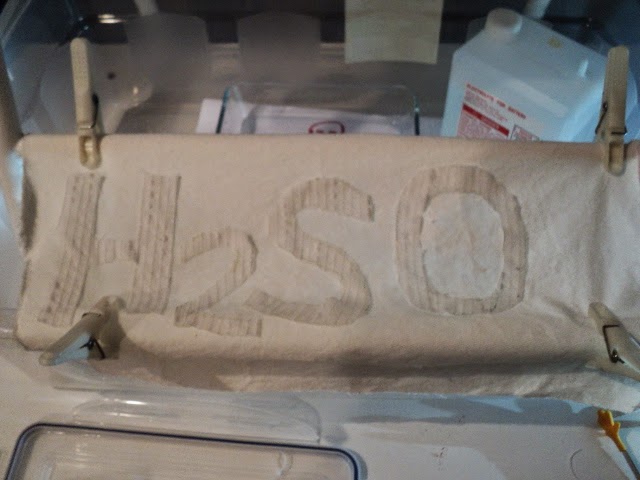
Here's the O of H2SO4 in the acid, with attached cable tie


Laying out the formula on the cotton support after dipping in acid.


Formula complete. Now all we have to do is wait.
Here we are two days later, and at first sight there appears to be no obvious change. But beware. Those letters still feel damp (wash hands immediately after doing a touch test). Water controls dry out in less than 2 days.

Look more closely, and one sees there is a change. for a start the treated linen is now a light beige colour, while the untreated control  (removed centre of the O) is the original white.


Here's visual proof that the linen is still wet. It's translucent. Note how one can see the red tape through the treated linen but not the untreated control. That linen is a biohazard needless to say (kept well away from other occupants of the house).


Here one can see clearly the beige colour of the acid-treated linen against the original linen shirt.

Here's a supplementary test that was most revealing. The "2" of H2SO4 has been placed on a hot radiator (which will be wiped with bicarbonate later to neutralise acid contamination).


The "2" quickly darkens still further at the higher temperature. Note the difference between it and  untreated linen.

When the heated "2" was replaced, something unexpected happened. When trying to position it correctly, it fell apart!

Here's the same against the same original black background. Gentle prodding with a pencil showed that all the linen was now highly fragile, while still relatively "white" (something of a surprise).

Here's the fragmented "O" with untreated control. The colour change is subtle, but there's no doubting that the acid has seriously degraded the linen while not greatly altering its appearance.

What I haven't said is that two squares of cotton fabric were also steeped in the same battery acid, and also exposed to air for the same period. Surprise finding: they not only looked the same as untreated cotton (no surprise, in view of above) but seemed just as strong as the original cotton. They could be stretched with maximum force and did not tear!

Why should that be? Why should linen be chemically attacked by  H2SO4, of concentration intermediate between battery acid and conc.H2SO4 (after evaporation of some water) but not cotton?

The original purpose of the experiment was to test the hypothesis that sepia Shroud image might have been formed from dye mordants (alum, iron sulphates) releasing sulphuric acid into the fibres of the linen which on evaporation of water produced local high concentrations of H2SO4 leading to discoloration of the cloth. That hypothesis was NOT confirmed in these experiments with actual high strength H2SO4. Instead there was a totally unexpected finding that linen differs from cotton in being highly susceptible in some way to acid, losing its tensile strength,and indeed disintegrating under light tension. Why? Might that finding have something to say about the nature of the TS image?

Hypothesis

Firstly: can the difference between linen and cotton be rationalized. Yes. I believe it can. Cotton is well known as the purest source of cellulose in nature (the figure generally quoted is 90%). Cellulose is celebrated for its resistance to chemical attack (being made use of in chemical laboratories for filter paper able to withstand a wide range of harsh reagents). Cotton contains virtually no hemicelluloses, which despite their name have virtually nothing in common with cellulose. Hemicelluloses are chemically far more reactive than cellulose.

Now let's consider linen, or the bast fibres from the stem of flax plants from which it is derived. Linen is generally quoted as having 5-15% of polysaccharides that are NOT cellulose, comprising mainly hemicelluloses and pectins.

 Late addition: a literature source found by googling (linen hemicellulose) that confirms the major difference regarding linen and cotton re the major difference re hemicellulose content.


 (References to detailed carbohydrate compositions have proved elusive, but if I find any more, I'll add them here).


Like: this passage from Caspar von Uffhofen in 'The Mystery of the Shroud"


Linen yarn is quoted above as having 11-17% hemicellulose, and a mere 1.8% pectin. How strange that the hemicellulose of linen is rarely if ever mentioned in Shroud image literature, especially as cellulose is chemically so inert by comparison. Some sources, naming no names, discuss linen as though it were 100% cellulose. I have even seen the hemicellulose referred to as "an impurity"

A general description of flax fibres is that they comprise a cellulose-hemicellulose cross-linked combination embedded in a gel matrix of pectins (though some perhaps most of the pectin is lost when flax fibres are retted to make linen).

The presence of hemicelluloses could explain why linen is greatly weakened by sulphuric acid, whereas  cotton is not. What's more the acid must affect the entire fibre to account for mechanical weakening - not just the most superficial part of the fibre. Those reading this who are familiar with the literature on the Turin Shroud image will no doubt be aware of where this is all leading.

Here's an image I showed in a posting over 2 years ago on my specialist Shroud site:

The core of a linen fibre is not purely unreactive cellulose. There are reactive hemicelluloses there too that are susceptible to thermal or chemical change without (perhaps) becoming highly coloured, due to dilution effect of unaltered cellulose.

In fact, i returned to the same theme again and again a year later. See this one in particualr entitled: Why are Shroud image fibres mechanically weaker than non-image bearing fibres? Pyrolysis of core hemicelluloses?

My proposal that core hemicelluloses might have a role to play in explaining the weakness of Shroud image fibres sadly failed to attract attention elsewhere. Maybe it didn't fit with the prevailing narrative that the Shroud image and associated chemical modification is entirely confined to the most superficial part of the linen fibre, typically quoted as 200nm thick, and that absence of colour in the core of the fibre means there has been no physical or chemical change there (despite the mechanical weakness of TS image fibres discovered by Raymond N.Rogers in his 'sticky tape' sampling of TS fibres, relative to non-image fibres). Or maybe it was the tying of the core susceptibility idea to the scorch hypothesis that guaranteed that even if seen and commented upon, it would be quickly dismissed and forgotten.

Takeaway message? Too much emphasis has been placed on visual coloration in image fibres, as if chemical changes to flax or linen carbohydrates always produce a yellow colour. That's led to the paradigm that the Shroud image is incredibly superficial and so, ipso facto, the totality of physical and chemical changes must also be restricted entirely  to the most superficial part of the fibre, corresponding roughly with the primary cell wall. One simply cannot make that assumption, given that chemical change, sufficient to weaken fibres, need not be accompanied by a handy self-indicating colour change. Example from this posting: there was only a slight darkening of linen fibres when exposed to sulphuric acid despite massive weakening of fibre tensile strength, but only in linen - not cotton. So who's to say that the process that produced the image on the TS was not - as is generally maintained -  one that was too subtle to be explained by conventional physics or chemistry, and was instead  one that degraded linen fibres, notably the core hemicelluloses, producing major changes at the chemical and mechanical level, but ones that are not obvious under the microscope?

There is every reason to put the uv excimer lasers away, at least for now, and consider all the various ways in which a medieval artisan might have set about imprinting an image onto linen, one that he and his masters could claim was that left on Joseph of Arimathea's linen.


Update: here's a comment I posted earlier to shroudstory.com, essentially addressing the point raised here - namely changes to SCW on image capture that are maybe not as visible as those to the superficial PCW:

April 1, 2015 at 4:30 am
Forgive my saying, Piero, but you are making the same error as Paolo Di Lazzaro and his ENEA colleagues in assuming that because the TS image COLOUR is superficial, confined (maybe) to the PCW or a Rogers’ type coating, then ipso facto there are no changes to less superficial parts of the fibre.
Are you not forgetting something? Image fibres are weaker than non-image fibres. That was shown by the ease with which they could break off and stick to Rogers’ Mylar adhesive tape. It would take more than changes in the PCW – an ultra- thin skin on a much thicker mainly SCW fibre – to render the entire fibre brittle and prone to fracture. (Let’s not forget that the Mylar initially stripped off entire fibres – not image “ghosts” – the latter not being seen/inferred until image fibres were subsequently pulled away from the tape).
Try by all means to get the Vatican to consider your AFM scanning. But let’s dispense with the notion that the imaging process affected only the most superficial parts of the fibre. The core of a linen fibre is not entirely crystalline cellulose. There are significant amounts of hemicelluloses and pectins there too – the so-called non-cellulosic polysaccharides (NCPs).Their physical and/or chemical disruption could compromise the strength and integrity of the entire fibre. Being in a minority relative to cellulose microfibrils means that changes to those NCPs might not be so readily visible as coloration, which is where we came in.


Update: Thursday 2nd April

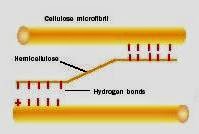
Here's a schematic diagram found by internet search that shows the inferred relationship between cellulose microfibrils and hemicellulose crosslinking 'bracing'. (It's part of a discussion of expandable primary cell walls but there's every reason to suppose that it applies equally well to the secondary cell wall, despite the PCW and SCW fulfilling different roles at different points in the plant cell's life history).


Note that the bonding between cellulose and hemicellulose is not via permanent covalent chemical bonds. It's via hydrogen bonds, the weaker nature of which (individually) can be more than compensated by their numbers. The crucial difference where susceptibility to thermal and chemical treatments are concerned is that it's relatively easy to break hydrogen bonds which may or may not subsequently return to their original geometry. So we have here a possible mechanism by which  image imprinting could seriously impair the tensile strength of linen image fibres  without producing colour, and without affecting cellulose crystallinity, the latter inferred by Rogers from unaltered birefringence pattern under crossed-polaroids,. There's an analogy that can be made with double-stranded DNA, the two strands of which are held together in the double helix via hydrogen-bonding between base pairs. Once can separate the stands by heating and "melting". However, to get them to return to their original correctly base-paired configuration one has to "anneal",  ie. cool very slowly, which allows the separated strands  to 'experiment' with different arrangement until the optimum most-stable pattern is restored.

Conclusion: imprinting linen with a superficial image using one or other technology may not result in visible change to the inner core, but that does not preclude serious disruption occurring at the molecular level that may not be visible either to the unaided eye or under the microscope. In short: superficiality of visible coloration does not necessarily mean that the input energy was of an exceptionally subliminal kind (e.g. high energy/short pulse) unknown to science. Maybe Shroud image fibres are more seriously compromised than their faint yellow colour would indicate. Their mechanical weakness is the clue to more profound physical or chemical disruption having occurred within the SCW cores of the fibres. Maybe medieval technology was capable of producing that particular presentation known to paramedics of  minor superficial change concealing more serious 'internal injury'.

Further update: have just this minute googled (shroud turin image fibres weaker):


Am I the only one to consider that altered mechanical strength to be an important pointer to change at the molecular level (as important, if not more so, as change in visible colour, reflectance spectrum, uv fluorescence, dichroism under crossed polaroids etc etc)? Yup, the first 6 listings above are all to my own postings (but then I have been muttering about fragile SCW hemicelluloses for well over two years now).

Technical footnote regarding different grades of sulphuric acid

The so-called "concentrated sulphuric acid" is purchased as a dense oily liquid, which is 98% H2SO4, 2% H2O.  It is highly dangerous, and not the sort of chemical one wants around the house or even garage. It's to do with its avidity (old-fashioned chemical term) for water. One gets a hint if one dilutes it with water following the safe and correct technique, which is add the con acid in a thin stream to water with constant stirring.  The temperature rises quickly (one may see steam) and one may hear a rumbling sound  (from cavitating steam bubbles). Never ever imagine one can dilute by adding water to conc H2SO4. Try doing that and the whole lot is liable to come back in your eyes and face in short order: hot sulphuric acid is not to be recommended. Why the projectile event?  Because of density differences the water initially sits on top of the denser H2SO4. There's then the violent heat of dilution at the interface that then causes greater contact, more heat, more contact etc etc, and steam propulsion out the beaker does the rest. This blogger was once a few yards from a lab technician who did it the wrong way (I blame the researcher who failed to enquire ahead of time as to the level of her chemical -handling credentials). Fortunately no permanent injuries resulted, but there was a lot of unpleasant clean up and neutralisation (sodium bicarbonate) to be done of splattered acid - over bench surfaces, reagent bottles, lab notes and lab coats.

I shall return shortly to discuss what happens when conc. sulphuric acid is allowed to stand (in a safe place) exposed to moist air, and compare with the experiment described above when pre-diluted acid of battery strength (approx. 35%) is similarly exposed.

Back again. Yes, it's not hard to find references to the volume increase that is seen when conc.H2SO4 is exposed to air, and neither is it difficult to find references to solutions of dilute(d) sulphuric acid becoming more concentrated as they evaporate and shrink in volume. What I have not been able to find thus far is quantitative data. One would like to know the final concentration of sulphuric acid after conc.H2SO4 has picked up the maximum amount of water vapour, and conversely the final concentration of H2SO4 after the dilute acid has evaporated to its maximum concentration of H2SO4. One assumes the two acids - conc. and dilute-  converge to the same figure for a given atmospheric moisture content. It's obviously somewhere between 35% and 98%, but I have no information on whether it's nearer 50% or 90%. However- one things for certain: the concentration never reaches 98% for physical reasons, due to the aforementioned hygroscopic nature of 98% H2SO4, and never acquires the ability to cause rapid charring of fabric, as seen when it is treated with conc.(98%) H2So4, recalling the findings above of at best a faint beige color on standing for 2 days in air (with non-evaporated liquid still visible).

Reminder from a previous posting here on what can happen when fabric is treated with conc.(98%) H2SO4.

Final addition: what about the initial hypothesis - namely that traces of sulphuric acid from mordants may have caramelized the linen to produce the TS image we see today(maybe as a ghost). Well, there was a very slight colouring of the linen exposed to H2SO4 over 2 days, more beige than yellow or sepia, but hardly enough one would think to account for the TS image, faint though it is. If a high concentration of H2SO4 on its own cannot produce a reasonably visible sepia coloration, then it's unlikely that trace amounts can do so, unless one invokes catalysis from other constituents (Occam's Razor!).

Never mind. The H2SO4 hypothesis has led me to consider another chemical scenario that is not too far removed from H2SO4,  and one moreover that would seem to tick a lot of boxes, even the tricky ones like ultra-superficiality/confinement of image to the PCW, half-tone effect, bleaching with diimide, even Adler and Heller's "blood-first" conclusion that has always been an Achilles heel for  a medieval provenance.

So what's the new idea? Be patient, folks. It will be the subject of my  next posting, arriving in the next few days.

Nope, this is the final addition, added Friday 24th April, some 3 weeks and 5 postings after the one above.  It's my response to the ludicrous accusation (same old, same old) from the Usual Suspect on Dan Porter's shroudstory site that I have "recycled" his ideas. The crucial word is "fumigation". No sooner had I hit on the idea that HNO3 vapour (as distinct from liquid solution) might be less problematical as a chemical developing agent than I quickly adopted the term "fumigation". What are the one-word alternatives? I can't think of any off the top of my head, and fumigation is easy to understand. But the usual suspect has also used that term, albeit in an entirely different pro-authenticity context for post-mortem imaging in a 1st century tomb that was carried out, he claims, according to a complex routine (I shall spare readers what for me is eye-glazing detail), and in any case has never been put his model to the experimental test, the relying he says on "thought experiments".

Anyway, just to let folk know that I  was doing some house-keeping in my work area today, and came across this note that I wrote to myself, almost certainly in the first few days of April when I realized I had reached the end of the road with sulphuric acid, and was wondering where to go from there:


Here it is verbatim, faulty punctuation, crossings-out an' all, but no deployment of the f word at this stage.

"Time for a total rethink on the TS image. Maybe there is was a gas or vapour exposure. Acid gas: to explain weakening of fibres - prob by acting on SCW hemicelluloses. Action of acid gas in non-image areas as well. Some kind of target molecule but few lower density?  Protein.  Relatively few acid gases. /vapours  HNO3 - has a lot going for it."