Important update (13 May): for a 16 point summary of the new nitric acid model, see the new posting on my specialist Shroud site.
 | |||||
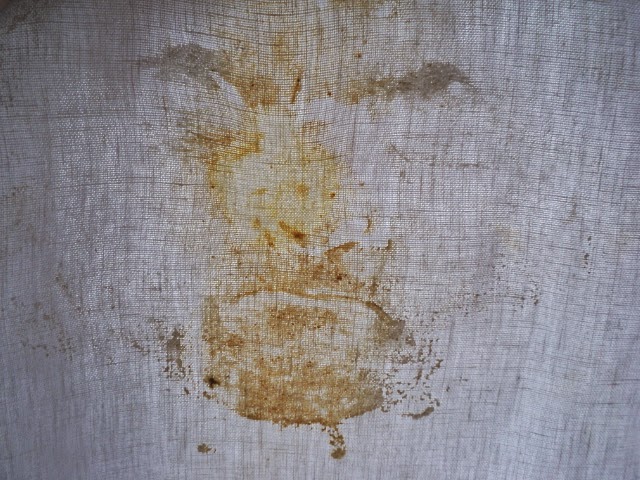
| It's said that a picture is worth a thousand words. Here's a flour/egg yolk imprint done just two hours ago, photographed here after removal from the nitric acid bath, neutralized with bicarbonate, rinsed with water, shown here drying on the radiator, ready for processing in Image J (tone reversal as per Secondo Pia followed by 3D rendering). |
 | |
| Here's the above after further processing (click to enlarge). Top left: the dried image after ironing flat. Bottom left: conversion to B/W, then a Secondo Pia style tone-reversal. Right: the secondary B/W image after 3D rendering (Image J). |
It's taken over 3 years of almost non-stop experimentation, but this blogger/retired science bod is now able to explain how the faint negative image of the Turin Shroud was obtained (as a feat of medieval technology, aided by alchemists).
The task: produce a contact image that could be claimed to be that left by the crucified Jesus on Joseph of Arimathea's 'fine linen'.

It's incredibly simple in principle (why didn't I think of it sooner?):
1. Paint an adult human male (alive or dead) with an organic paste or slurry as imprinting medium (in other words, turn them into a giant rubber stamp). My preferred medium right now is a dispersion of white flour in cold water, but that could change).
2. Press linen against the subject (or subject against linen) to leave a moist imprint. Dry.
3. Develop the image chemically using a suitable reagent , one that converts the organic material to tan (yellow-brown) oxidation products (less probably Maillard reaction products).
My preferred reagent right now is nitric acid vapour, the means of production were known to medieval alchemists (notable "Pseudo-Geber" who may have been one and the same as an obscure Franciscan monk known as 'Paul of Taranto'
4. The yellow-brown aka sepia imprint will be a 'negative' of the subject, inasmuch as the light/dark tones one sees in photograph are reversed. In other words, the highest relief (nose, chin, forehead etc) will be dark, not light, and the lowest relief (eye hollows etc) will be light, not dark. They are light in a photograph as a result of reflecting most light. In an imprint, they are darkest through making best contact with a surface.
So I maintain that the plausible science is established - at least in principle- so far as producing a negative sepia 2D image from imprinting off a 3D subject is concerned. Whether it matches all the additional or peculiar characteristics of the TS image (extreme superficiality, lack of reverse side image, lack of uv fluorescence, microscopic characteristics etc.) remains to be seen. However, let's insert a note of caution: not all those listed characteristics were necessarily there immediately after image formation, regardless of age - centuries or millennia. Some of those characteristics may be a result of ageing. At present it seems sensible to adopt a broad-brush approach, attempting to accommodate only those 'headline' characteristics of the TS that have led to its being described as iconic or enigmatic. Where the latter are concerned, the prize for the most 'iconic' must surely go to the pioneering 1898 photography by Secondo Pia, which converted the Shroud negative back into a positive (by innocently treating the TS as a positive and convereting to a negative!).

It is the conversion one sees above that led to what must surely be the sound conclusion that that the TS negative image must be an imprint, probably a contact-imprint, one that on tone reversal allows one to see the 'real life' (or death!) appearance of the imprinted subject. It's for this reason alone that the dismissal by Charles Freeman of the TS as 'just another medieval painting' that has simply (and conveniently) lost its pigment over the centuries is so hopelessly blind to the implications of the negative image and Secondo Pia's spectacular discovery.
It's not sufficient, needless to say, to establish a scientific framework. There has to be a sizeable input of technology too. While history provided one or two pointers to the likely science (alchemy etc) there is no such assistance where attempts are made to deduce the technology employed, i.e. applying the science in the manner that achieves the best end result. One does not even know for certain what the desired end-result was, or for what purpose, though I've believed it to be an attempt to simulate an ancient sweat imprint, ever since spotting that Veil of Veronica-like motif labelled SUAIRE on the Machy Mould for a Mark 2 (or Mark 1) Lirey Pilgrim's badge. (It was that discovery more than anything that decided this researcher to abandon the idea that the TS was a thermal scorch, designed perhaps to symbolize the slow-roasting of the Templar leaders in 1314 for alleged heresy and other indiscretions. That seemed plausible given that one Geoffroi de Charney died alongside Jacques de Molay (Grand Master), de Charney being thought by genealogist Noel Currer-Briggs to have been uncle to his near-namesake, Geoffroi de Charny, Lord of Lirey, first recorded owner of the Shroud in western Europe).
So the working hypothesis IS that the TS is a simulated sweat imprint, that an imprinting procedure using an organic material was devised, probably with input from an alchemist, to develop the imprint chemically so as to produce a more intense, more easily visible yellow or yellow-brown colour. What we see now may of course be a pale shadow of the original, given centuries of fading, image fibre attrition etc. But there's an upside to that: one does not need to be too concerned about one's pilot techniques producing images more prominent and/or well-defined than those on the Shroud.
After preliminary and somewhat unsatisfactory attempts to image from first my hand (reasonable result) and then my own face (the less said the better - see preceding posting) I decided to use up-and-over imaging of the toes on one foot. The scale is handy for the size of my jars with the wide necks and ground-glass stoppers for nitric acid vapour. One can compare LUWU and LOTTO imprinting in the same experiment (which may or may not be relevant to the imprinting of the real Shroud). LUWU = Linen Underneath With Underlay; LOTTO = Linen On TOP, With Overlay).
I'll conclude this verbiage with photographs of results with this new tootsie test system as they come. Here's are some photographed just an hour or so ago. More will follow later. There are no plans to write any new postings until the current round of technology-testing is complete. Whole face imaging has been shelved for now. (Maybe Luigi Garlaschelli was right - a bas relief was needed for the face).
 |
| Imprint of toes onto linen (left) versus cotton (right). Imprinting medium: white flour/cold water only. |
 |
| As above, after use of autocorrect in MS Office Picture Manager. |
The lower half is a classical "footprint" obtained using LUWU configuration. The upper half is an imprint of the tops of toes obtained by turning the linen up and over, and gently pressing (LOTTO configuration).
More pictures to come (testing of egg tempera as imprinting medium etc).
Yes, egg tempera was the vehicle used as vehicle for paint pigments in medieval times before the appearance of oil paint in the Renaissance. Despite being primarily egg yolk egg tempera not only attaches well to surfaces but is surprisingly durable. If searching blind for technology that might have been used to add flesh, so to speak, to the fundamental science, it would be unwise to ignore so common a commodity as tempera. In fact, there's one compelling reason for thinking why it may have been used, if only as part of a mix of ingredients: if the aim was to simulate a sweat imprint, it helps to have a visible yellow imprint before the chemical development (or indeed as a Mark 1 undeveloped imprint) given its yellow colour.
Here's the result of imprinting onto linen with a mix of flour, egg yolk and a little milk as extender.

...

Here's a comparison of three imprinting media:left- flour ; centre: egg yolk; right: flour + egg yolk. All had a little extra milk as extender (having been added to egg yolk to bump up the volume I decided the others should have it too).
Note the poor imprint on this occasion from flour "only". Well, as stated, is wasn't flour only. It was flour with a little milk. An immediate difference was noted compared with flour without milk - there was much less adhesion to the skin, much less force needed to pull the linen away from the skin.
The adhesion effect has been commented on earlier, with the observation that adhesion helps produce an instant high-fidelity imprint. That's due to the amazing ability of flour paste or slurry to stick onto so many different surfaces (this blogger has a photo album he made as a small child in which flour was used as an austerity-era paste - most of the photos are still where they were stuck). A reasonable working hypothesis might be that milk has weakened the adhesive power of the flour. Good or bad thing? At first sight bad, because it means less flour attaches to the linen (probably) giving a weaker imprint. But might there be an upside? Possibly, as will be discussed shortly.
Yes, one encounters something quite unexpected when imprinting with flour paste. The linen quickly absorbs the liquid when pressed against the skin, such that the latter seems almost dry when the linen is peeled off. That makes for a good imprint, obviously, with so much flour transferred from skin to linen. But there's a possible downside. If transfer is complete, or nearly so at all contact sites, regardless of applied pressure, angle of contact etc, then how can the image be expected to show the 3D properties of the TS image. For 3D properties there needs to be some systematic factor at work such that variations in relief (height above a reference plane obviously, but maybe more subtle factors too) are captured in an analogue process to give variations in image intensity and subsequent 'apparent 3D' properties. That cannot happen if the medium transfer is too efficient at all points. So it may be necessary to include an additive, one that our medieval artisan might have included if only to make the adhesion weaker (he would not have been worrying about final 3D properties!).
Reverse-side imaging? Yes, there's some at present, as the next pictures will show. But a medieval forger would probably not have wanted it either, if it gave the slightest clues to how an image was faked. This is where technology as distinct from science needs to be harnessed: finding simple ways of reducing or eliminating reverse-side imaging in the proposed flour/water model.
Here are some thoughts for a model system that focuses specifically on efficacy of medium transfer as a function of 3D relief:
I would use the knuckles of my clenched fist as the 3D subject I'd paint the knuckles with various imprinting media (flour +/- milk +/- egg yolk etc) that had been coloured up with some ink or pigment, then press into fabric (probably re-using linen from previous experiments). The aim would be to find a mix where the knuckles were imprinted more prominently than the rest of the fist, through having the highest relief. It would probably need to be a stiffish mix, whatever the ingredients, so as to avoid the mix being squeezed off the extremity down into the furrows between knuckles - not what one wants when trying to capture 3D relief!
Update Thursday 19:14

The footprint (mine!) top left was imprinted onto linen using a mix of white flour, egg tempera and a little milk. The image has been tone-reversed in ImageJ (bottom left). The latter has then be 3D rendered (right).
The initial imaging was performed by standing on one foot, with a view to getting the best impression, but that was maybe not a good idea in retrospect: pressure would have forced the imprinting medium off the highest relief, eg the flat of the toes, resulting in less-than-satisfactory 3D-imaging.
Here's the result of my fist-imprinting experiment. The result was disappointing, as will be seen, probably through an inappropriate choice of imprinting configuration (LUWU instead of LOTTO) that will not be repeated. Iwill show it, however, and for 2 reasons. First, this is a real-time account of a research project, warts 'n' all. Second, as is so often the case in reseacrh, while an experiment may fail in its primary purpose, it can lead to unexpected and interesting side-observations. There was not just one, but two of those in the "Fist 1" so I'll now provide an, er, blow-by-blow account.
bbbb

Here's the consistency of the highest of 5 concentrations of flour/water dispersion tested.

Paint fist.
bbb

Press fist into strip of linen, starting at the far left.
bbb

Here's the imprint on the linen.
bbb

bbb

Now repaint the fist with the runnier mix.
Repeat the process of diluting and re-imprinting 3 more times, working left to right along the strip.

Here's the final strip, with its 5 scarcely visible flour imprints. They will first be left to dry on radiator, and the linen then sewn to make a flat hoop, imprint on outside, to be suspended in nitric acid vapour over conc. nitric acid solution.

Here's the strip inside the 'developing tank', with a glass plate over the top. The clothes pegs were intended to keep the linen clear of the liquid acid.


Here was the linen after image development in nitric acid vapour, with the 5 fist imprints going from left to right.

Here's the same, with added yellow lines to act as dividers.
And here's the reverse side of the linen, with very little 'reverse-side image' - confirming that flour/water is a good imprinting medium in principle, despite there being much R&D still needed to produce a TS-like image.
Discussion
While the method works reasonably well for flat(tish)parts of the anatomy (see earlier results with the back of my hand, sole of foot) it does not like complex relief (face, clenched fist).
So those imprints above of my clenched fist are maybe difficult to recognize as such. But as hinted at earlier, it was a mistake to have adopted the LUWU mode of imprinting. I had thought that passive pressure would give the simplest most recognizable imprint, but that was not to be, probably due to the right-angle turn at the knuckles , but other factors too, like excessive give in the underlay, and a possible rocking action. Never mind: the experiment yielded useful data in other respects as regards the possibility of using solution as a fast-acting alternative to vapour, and the virtual absence of reverse-side imaging.
The experiment also got me thinking about engineering the 'ideal' imprinting medium likely to yield the best 3D result.
The ideal mix will probably still flour as a major ingredient (large intact endosperm cells help reduce penetration and reverse-side imaging). It will perhaps have egg tempera too, if only for its yellow colour, making it easy to know where to paint blood stains on top of body image. But it has (probably) to be paint-like in consistency and covering power, attaching first to skin, whether unwashed, with skin oils present, or washed (leaving unobstructed keratin, i.e. protein), but then transferring cleanly onto linen. There is now work to be done in identifying that mix, while at the same time maintaining credibility re the options that would have been considered in a medieval workshop.
Comparing nitric acid vapour and liquid solution as image developing agents

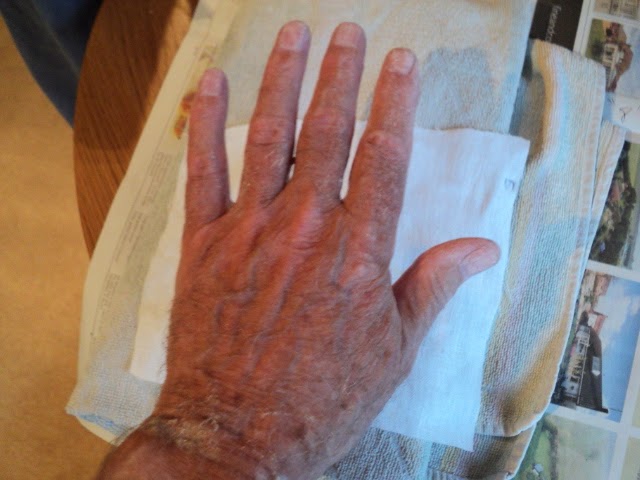
I reverted to LOTTO mode for this test. First paint back of hand with flour slurry (no additives).

Here again is that amazing 'cling film look one gets when placing linen on top, then pressing gently.

Here's the negative imprint - scarcely visible.

Now turn the imprint into a simple jigsaw puzzle. 2 pieces will developed in HNO3 vapour, two in conc HNO3 solution (70%).

Here I am adding the acid to one of those two pieces. Image development is seen almost immediately.

Here we are a few minutes later, with image development without noticeable leaching of colour, or migration from image to non-image areas. Success!

Here's the downside of using solution. There's a lot more acid that has to be neutralized before the linen can be removed for drying, ironing and photography.

here are the 4 developed pieces re-assembled. The image of the back of my hand is complete. There seems to be no reasons for thinking that vapour is superior to solution or vice-versa, at least where image-development is concerned.

And as before, there is scarcely any reverse-side coloration.
Next question: does one need concentrated nitric acid for development, if used as liquid? Might a lower concentration work too, albeit more slowly, but without the same degree of hazard?
Some quickie tests are in order, making serial dilutions of the conc acid, e.g. 70%, 35%, 17.5%, 8.75% for a quick idea.
Come to think of it, use of nitric acid solution raises new technological possibilities. Let's suppose that the essential ingredient of the imprinting medium - provisionally white flour - is fixed instantly to the linen. But suppose there were additives in the medium that gave it a more functional paint-like consistency that were undesirable as left-overs in the final image. What is they were not fixed by the acid? Maybe they could leach out into the liquid acid (not possible if vapour used), so that one was left with the just the chemical constituents needed for the 'right' kind of image.
Results: testing nitric acid solution as developer, with a range of concentrations:

First, a paintbrush loaded with white flour dispersion was used to make a trellis pattern on linen. After drying squares were cut out for immersion in different concentrations of nitric acid solution.

Here are the squares in pots with the indicated concentrations of nitric acid (w/v). This was after about 30 minutes of contact. Pronounced orange colour has developed not only at the top concentration (70%), but at half that (35%) and half that again (17.5%). Only at the lowest concentration tested (8.75%) was there no unequivocal colour development.

Here are the same samples after 1 hour in acid, neutralization with sodium bicarbonate and partial drying on a towel.
Conclusion: the model works with nitric acid solution as well as vapour. What's more it's not necessary to use concentrated nitric acid (gives off fumes, hazardous). It works well (and fast) with nitric acid diluted with water to 4 times its initial volume, i.e. to 8.75%, which at approx. 2.75M is only a little higher than the concentration of bench dilute nitric acid (generally 2M).
Imaging of forefinger using the new quickie liquid developer (nitric acid SOLUTION) to compare different imprinting media.
Here's the final 3d-rendered image (posted first to allow transfer to shroudstory as progress updateI.

The stages in obtaining that image will be added later.
May 8, 19:12
The above 3D image was obtained while the test linen was still wet and drying on the radiator. (Man in a hurry).
The sample has now fdired and been pressed with a steam iron. Here are the definitive pictures:

The as-is imprints, after development in nitric acid solution.

As above, after tone reversal in ImageJ. (A Secondo Pia transformation of a negative imprint back to a positive - or at least a pseudo-positive).

As above, after 3D rendering in ImageJ.
Now, back to the start:

Ready to start imprinting: flour slurry in the pie pot, egg yolk in the glass, and a 50/50 mix of the two in the egg cup.

After imprinting, drying on a radiator before chemical development. Note however the almost photograph like character of the egg yolk imprints, especially on the left. There's absolutely no reason why medieval folk should not have seen that kind of realistic imprint, albeit as a negative image. All that was need to produce trhe TS was to think up a way of fixing that egg yolk (or similar) image to make it permanent, maybe with some colour reinforcement.

And here's the new simplified image development step - simply immersing in nitric acid solution, 10% w/v and upwards. The lower end of the range is recommended to reduce fumes.
Update Saturday May 9
Feedback from Dan Porter's shroud story site (from Thibault Heimburger MD) and my response:

Thibault HEIMBURGER
May 8, 2015 at 4:52 pm
I have to admit that Colin’s work is very interesting.
In fact, it is the best work (still in progress) I ever seen, based on the “chemical imprint” hypothesis.
The fact is that the TS image is an “imprint”, not a paint, is obvious.
The fact that the TS image is a contact-only imprint rather than a contact+non-contact imprint is still undecidable.
Hopefully, at the end, we will see if the best contact-only hypothesis (the “chemical imprint”) can match or not at least the macro properties of the TS image.
Colin wrote (see his blog): “The task: produce a contact image that could be claimed to be that left by the crucified Jesus on Joseph of Arimathea’s ‘fine linen’.
Not only that.
The TS IS such an image. But this image has some fundamental properties.
So, we will see.
Sincerely, good luck.
In fact, it is the best work (still in progress) I ever seen, based on the “chemical imprint” hypothesis.
The fact is that the TS image is an “imprint”, not a paint, is obvious.
The fact that the TS image is a contact-only imprint rather than a contact+non-contact imprint is still undecidable.
Hopefully, at the end, we will see if the best contact-only hypothesis (the “chemical imprint”) can match or not at least the macro properties of the TS image.
Colin wrote (see his blog): “The task: produce a contact image that could be claimed to be that left by the crucified Jesus on Joseph of Arimathea’s ‘fine linen’.
Not only that.
The TS IS such an image. But this image has some fundamental properties.
So, we will see.
Sincerely, good luck.

May 9, 2015 at 12:07 am
Thanks Thibault. Your comment is most gratifying, and shows true generosity of spirit, given our differences in the past.
In an earlier comment here yesterday, I was deliberating on what should be the ideal consistency of the imprinting medium in order to achieve best 3D effects. I said it should be paint-like, i.e. tacky and viscous, so as to stay where applied on the 3D subject, since if runny, it would flow off the highest points of the relief down into the hollows and mess up the 3D rendering.
Oops. I was forgetting that gravity can be made to work for one. If you want a liquid imprinting medium to stay put on the highest relief, and indeed concentrate at the highest points, then turn the subject (or template) upside down before imprinting, and press it DOWN into linen.
There are two types of subject-to-linen presentation one can use when imprinting, what I have previously called LUWU (Linen Underneath, With Underlay) and LOTTO (Linen On Top, Then Overlay).
Use the LUWU configuration(even if easier said that done where real people are concerned). That requires painting the subject with imprinting material, then lying face DOWN into the linen to imprint the FRONTAL surface. If the medium is fairly runny and mobile, then in the brief time the subject positions himself face DOWN, the medium runs to the LOWEST points of the relief, due to gravity, which would have been the HIGHEST points when face up. It is the concentration of medium at the new lowest relief that might generate most if not all of the negative and 3D properties of the final 2D imprint.
OK, so it might be tricky to get a clean imprint via LUWU. However, the purpose in hinting at a gravity-aided model is not to suggest this was how imprinting was actually achieved, but simply to flag up the wealth of options on offer. Yes, one risks attracting unflattering references to Occam’s Razor. But having a range of options for modelling is not the same as needing to attach a host of qualifying assumptions to a model through having a limited range of options.
In an earlier comment here yesterday, I was deliberating on what should be the ideal consistency of the imprinting medium in order to achieve best 3D effects. I said it should be paint-like, i.e. tacky and viscous, so as to stay where applied on the 3D subject, since if runny, it would flow off the highest points of the relief down into the hollows and mess up the 3D rendering.
Oops. I was forgetting that gravity can be made to work for one. If you want a liquid imprinting medium to stay put on the highest relief, and indeed concentrate at the highest points, then turn the subject (or template) upside down before imprinting, and press it DOWN into linen.
There are two types of subject-to-linen presentation one can use when imprinting, what I have previously called LUWU (Linen Underneath, With Underlay) and LOTTO (Linen On Top, Then Overlay).
Use the LUWU configuration(even if easier said that done where real people are concerned). That requires painting the subject with imprinting material, then lying face DOWN into the linen to imprint the FRONTAL surface. If the medium is fairly runny and mobile, then in the brief time the subject positions himself face DOWN, the medium runs to the LOWEST points of the relief, due to gravity, which would have been the HIGHEST points when face up. It is the concentration of medium at the new lowest relief that might generate most if not all of the negative and 3D properties of the final 2D imprint.
OK, so it might be tricky to get a clean imprint via LUWU. However, the purpose in hinting at a gravity-aided model is not to suggest this was how imprinting was actually achieved, but simply to flag up the wealth of options on offer. Yes, one risks attracting unflattering references to Occam’s Razor. But having a range of options for modelling is not the same as needing to attach a host of qualifying assumptions to a model through having a limited range of options.
Further update Saturday May 9
Have just this minute taken a picture of the latest experiment in progress (imprinting off a plastic 'Galaxy Warrior" from Poundland), and inserted it as opening graphic (with a cut-and-paste to shroudstory which has just done an agreeable and benign cover on this posting).
Here's the same image after drying and pressing briefly with an electric iron:

Yes, as I said in the caption, the two heads - frontal v dorsal - should have been separated (a little) and the two images, frontal and dorsal, should have been perfectly aligned on the long axis. As the sign used to say above the maintenance workshop at a student hall of residence I once stayed at: "The impossible we do immediately. Miracles take a little longer."
Update: 12May 2015
Here's a new result, hot from the press, correction, garage.

It's posted here first as a 'linkable' graphic. It will then be posted to Dan Porter's shroudstory site, so as to keep folk there in the picture. Where next? Maybe write a post on my specialist shroud site that's been dormant since December last year, saying why I think this result is important. The colour you see in that pot with the handle, bottom left, may well be the one that is on the TS, albeit faded with time.
What's in the pot to give it that red-brown colour? It's the isolated gluten (the viscoelastic protein that is responsible for breadmaking dough) from wheat flour, washed free of its starch granules, then treated with nitric acid. It's maybe a bit soon to be speculating on what is in wheat gluten protein to give so strong an orange colour with nitric acid (the so-called xanthoproteic test). My guess, for what it's worth, is the high tyrosine content of wheat gluten. It readily nitrates with nitric acid to give the 'sepia' colour, as per TS.
The small glass dish on the right has the starch that was washed out of the wheat flour dough. It does NOT give the same red-brown colour, merely a faint yellow coloration, possibly, probably due to starch granule protein (friabilin etc, as discovered by my colleague Philip Greenwell at the previous FMBRA i.e. Flour Milling and Baking Research Association, developer of the Chorleywood breadmaking process, now part of the Chipping Campden and Chorleywood Food Research Association.
Posted to shroudstory:
May 12, 2015 at 12:13 pm
It says “figured out, sort of maybe” in the title. Might I humbly suggest there’s a bit less “maybe” now.

That’s isolated wheat flour gluten in the bowl at the back. That’s a portion of it treated with nitric acid to get the sepia (red-brown) TS-like colour in the dish bottom left. That’s the flushed-out, then gravity-sedimented starch fraction in the glass dish on the right, also treated with nitric acid, with faint yellow coloration only.
Why should wheat gluten (the protein fraction) of flour produce a orange colour with nitric acid? Answer: it’s almost certainly due to its high content of the phenolic amino acid tyrosine that readily nitrates with nitric acid in the so-called xanthoproteic reaction (used as a test for proteins).
In other words, the TS sepia colour is NOT due to dehydrated, oxidized carbohydrates, as suggested in the STURP summary. It’s due to nitrated protein formed by secondary chemical development with nitric acid of a contact imprint made from a human subject (dead or alive) using a slurry of white flour as imprinting medium.
That’s isolated wheat flour gluten in the bowl at the back. That’s a portion of it treated with nitric acid to get the sepia (red-brown) TS-like colour in the dish bottom left. That’s the flushed-out, then gravity-sedimented starch fraction in the glass dish on the right, also treated with nitric acid, with faint yellow coloration only.
Why should wheat gluten (the protein fraction) of flour produce a orange colour with nitric acid? Answer: it’s almost certainly due to its high content of the phenolic amino acid tyrosine that readily nitrates with nitric acid in the so-called xanthoproteic reaction (used as a test for proteins).
In other words, the TS sepia colour is NOT due to dehydrated, oxidized carbohydrates, as suggested in the STURP summary. It’s due to nitrated protein formed by secondary chemical development with nitric acid of a contact imprint made from a human subject (dead or alive) using a slurry of white flour as imprinting medium.