It's two postings for the price of one today: here's the first. Scroll down to the
RED for the start of the second.
This posting comprises the thread of comments on a recent posting on Dan Porter's shroudstory.com site. The graphic you see above was my last 'voluntary' comment over there (though I'll respond to direct questions).
That posting is worth a cover version here in its own right, being
a rare and workmanlike summary of the anti-authenticity case from 3 distinguished Italian scholars.
Some of their numerous points are ones this blogger has been pressing himself these last few months, notably the idea that regardless how executed, the TS image was intended to be seen as a contact imprint from a body onto linen, in sweat as well as blood, and that it's simply not credible that knowledge of so charismatic an image as the TS (double image, head to head) could have been totally suppressed for some 1300 years by one or more secret fraternities of Shroud custodians.
(See my comments on this earlier posting, Feb 4.
and
on this one three days later.)
Having wasted thousands of words pressing simple straightforward logic, and getting little back by way of return except ridicule and insults (the few exceptions to that broad-brush description know who they are) I decided to bow out, and do so in a way that makes a point. I posted images instead of text. Any words of my own, the minimum needed, were incorporated into the images to create a series of cartoons, billboards etc. Images are more powerful than words.
Images imprint onto the visual cortex, a major part of the hind-brain with a minimum of pre-processing that is in any case not under conscious control.
Words on the other hand get consciously pre-processed in many subjective ways, so much so that where Porter's site is concerned, 99% or more of one's words either fall on deaf ears or get hopelessly scrambled and
commuted comminuted within seconds of receipt.
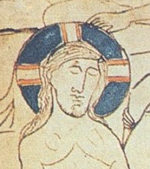
Here's the thread in question. It's missing one image, which the site's host felt obliged to delete in response to a complaint. I will attach it to the end later, together with its few added words of relevant "message" re the nature of TS image as a special kind of imprint. I'll also add a small section pointing out the bankruptcy of the pro-authenticity tendency which routinely flaunts the late 12th century Hungarian Pray Codex with its oh-so-twee alleged L-shaped poker holes as trophy evidence for the TS being older than the radiocarbon dating. Meanwhile, it has been totally unable to find or adduce evidence elsewhere in the entirety of Western art for the distinctive TS 'double' image appearing before the 1355 (approx.) Lirey Pilgrim's badge.
As I say, bankruptcy. Bankruptcy on stilts.
Late addition: Rather than offend those finer sensibilities again, here's a clue to the deleted image. If Kim Kardashian had been a car, she might have looked something like this (note shiny bodywork, raised rear chassis)
Response to this posting:
February 14, 2015 at 8:26 am
Colin’s leap of faith that the shroud is a fake – is quite a
leap. There should be an Olympic medal for the kind of leaps Colin
makes. He believes the shroud is a fake – but UFOs and All Star
Wrestling is for real.
My reply:
Next please.
Second posting:
How’s this for a coincidence. Just an hour ago I was
composing thoughts for a future posting, and had decided to deliver a broadside
on those seeking evidence to fit a preconception, and kidding themselves that was
in the finest traditions of sound scholarship.
Then a new posting appeared on shroudstory.com (see cut-and-paste below) which
purports on first reading to report an objective research exercise by a teacher and his/her charges, though one very
perceptive student at the end considered otherwise, and said why: “We found
things because we were looking for things”.
I’ll cut-and-paste my own thought first, set down before the
posting, and with no further refinement, and then copy-and-paste the Porter/school teacher
posting.
Here's my jottings, warts an'all:
Analysis and synthesis
Porter’s site is all analysis, no synthesis. What’s more,
the analysis, at least the pro-authenticity so-called analysis is for the most
part agenda-driven.
There is no coherent theory to support a 1st
century provenance. The science to support this or that theory for image
imprinting is for the most part scarcely distinguishable from science fiction, the
attempts to explain away the radiocarbon dating are rarely if ever followed
with an appeal for the test to be repeated, the attempts to ‘demolish’
scorching and/or other medieval origins are token, superficial or
crudely-designed so as to be virtually guaranteed to give the “right” answer,
and reported in such a way as to soothe and reassure the faithful that all is
well, with little or no attempt to impress the sceptics.
Humanities
Compare the amount of time spent in EITHER:
(a) browbeating us
into accepting that the Pray Codex constitutes
incontrovertible evidence that the TS existed before the Lirey display,
i.e. late 12th, not mid-14the century approx 1192-1195, some 150 years pre-Lirey?
(Thinks: why don’t I scour 12th century religious art and
look for signs of the TS? Or even 13th century?)
OR:
(b) proactive searching image files of pre 14th
century art for what is indisputably a representation o0f the TS image (e.g.
double man, frontal v dorsal view of same man etc).
Why not search and achieve a coup? Fame awaits the man or
woman who can locate that image. Nope, they don’t search and we all know why.
It’s because they know or suspect that there’s no image to be found. And why
not let someone else do the searching, since their failure to find an image can
always be explained away, and if they do find an image, then it’s a windfall
for authenticity at no time or effort on their party.
Would the Veil of Veronica have been the most celebrated
icon in the 14th century if there had been the slightest hint that
it was bettered by a whole-body imprint, and one that did not require
miraculous post-processing? Why did it take
decades for the TS gradually to supplant the Veronica?
There needs to be a grown-up debate about what
constitutes evidence.
Like how legitimate is it to select one, just one artefact
that has a handful of details that one can claim are “points of correspondence”
with the TS? Yup, a sample size of 1, the very thing that causes all the
breast-beating and vehement condemnation re radiocarbon dating, yet resorted to
quite happily where the Pray Codex is concerned?
Then look at the so-called points of correspondence and ask:
what weight can be attached to this kind of “evidence”
Take that vague blotch on the head
that’s supposed to be a proxy for the epsilon-shaped blood stain, except
this one is not epsilon-shaped. It’s Jesus, the crucified Jesus. He had worn a
crown of thorns, so the artist needed to make a decision.
Do I show the crown
still in place? (No). Do I omit all trace of blood? (No). Do I show a great
deal of blood? (No). Or do I just hint at blood? (Probably yes).
Far from being
a point of correspondence, it’s a point of NON-correspondence, given that while
some blood needed to be shown, there was a missed opportunity to depict it as
epsilon-shaped if the intent had really been to show a Shroud-inspired image.
As I say, it's neither a point of correspondence nor weak correspondence, but in
reality a point of NON-correspondence given that blood in some shape or form
was fairly likely to be shown on head (especially as some had been shown on the
hands). Speaking of which – those hands: there was an opportunity to show it on
the wrists in any of the 4 pictures – again not taken.
 |
| Pray 4th: blood on subject's left palm (NOT wrist), no blood on forehead, lots of the little circles in various patterns that on Pray 3 are seen as "L-pattern" and thus TS-inspired (!). You couldn't make it up, unless you're a Shroud detective (M.Clouseau, not Sherlock Holmes). |
Another missed opportunity, another point of
non-correspondence. The latter grow like topsy if one looks hard enough,
instead of selectively.
What we see with the Pray Codex is sloppy third
rate, agenda-driven so-called scholarship. I for one
am not wasting time arguing with folk whose only concern is to fit
the facts to fit their preconceptions, then walk away with a smug, self-satisfied grin on
their faces.
A teacher in Indianapolis
writes:
 I conducted an experiment with 12 high school
students. I gave the group one large picture of the Shroud (as it is, not
tone reversed into a positive image) and an enlargement of the weave pattern
that I did not describe other than to say it was the weave pattern of the
Shroud. I also gave them a copy of the Hungarian Pray Manuscript drawing. I
asked them if they thought it was inspired by or derived in part from the
Shroud of Turin. They were given
thirty minutes to discuss this question among themselves. I listened and tried
to not show any expression on my face.
This is
not a scientific experiment. The population is too small. There are no
controls. Students were not interviewed. The only criteria for
selection was that the student had not heard of or seen a picture of the
Hungarian Pray Manuscript and that they had heard of the Shroud of Turin even
though some of them were not sure what it was. Two, other students, not
selected for this experiment, thought that a shroud was part of an automobile’s
cooling fan, which it is.
After only
three minutes a majority of the students decided that the weave pattern was
symbolically depicted in the HPM. I recognize that bias caused by the
photograph of the weave pattern played a role in this identification. There was
no other way.
They all
spotted the mark on the forehead and the crossed hands. It took several
minutes to spot the four holes in an L-shape pattern. Eight of the twelve
thought the holes were meaningful.
They never
mentioned the nude body on the Shroud or the HPM. Nor did they notice the
absence of thumbs.
At the end
of thirty minutes, nine students were sure the HPM portrays the Shroud and
Jesus as seen on the Shroud. That is how they put it, which was better than the
“inspired” or “derived” wording I used. Two students remained unconvinced
but remained open to the possibility. One student was certain that any
similarities were merely coincidental because, “We found things because we were
looking for things.”
I conducted an experiment with 12 high school
students. I gave the group one large picture of the Shroud (as it is, not
tone reversed into a positive image) and an enlargement of the weave pattern
that I did not describe other than to say it was the weave pattern of the
Shroud. I also gave them a copy of the Hungarian Pray Manuscript drawing. I
asked them if they thought it was inspired by or derived in part from the
Shroud of Turin. They were given
thirty minutes to discuss this question among themselves. I listened and tried
to not show any expression on my face.
This is
not a scientific experiment. The population is too small. There are no
controls. Students were not interviewed. The only criteria for
selection was that the student had not heard of or seen a picture of the
Hungarian Pray Manuscript and that they had heard of the Shroud of Turin even
though some of them were not sure what it was. Two, other students, not
selected for this experiment, thought that a shroud was part of an automobile’s
cooling fan, which it is.
After only
three minutes a majority of the students decided that the weave pattern was
symbolically depicted in the HPM. I recognize that bias caused by the
photograph of the weave pattern played a role in this identification. There was
no other way.
They all
spotted the mark on the forehead and the crossed hands. It took several
minutes to spot the four holes in an L-shape pattern. Eight of the twelve
thought the holes were meaningful.
They never
mentioned the nude body on the Shroud or the HPM. Nor did they notice the
absence of thumbs.
At the end
of thirty minutes, nine students were sure the HPM portrays the Shroud and
Jesus as seen on the Shroud. That is how they put it, which was better than the
“inspired” or “derived” wording I used. Two students remained unconvinced
but remained open to the possibility. One student was certain that any
similarities were merely coincidental because, “We found things because we were
looking for things.”
I’m convinced. And I know about the absence of thumbs. I like
the wording: “[T]he HPM portrays the Shroud and Jesus as seen on the Shroud.”
------------------------------------------------------------------------
So will this curiosity-driven blogger/retired science bod be posting that first draft response to shroudstory.com, in any shape or form?
Nope. He's ceased wasting words on that site.
If he were to send anything, it would be this: