Showing posts with label sarsen stones. Show all posts

Tuesday, March 13, 2018

So why does Stonehenge looks the way it does? Try imagining a bird's eye view. It was clearly intended to serve as a megalithic bird perch!

I've taken an artist's impression from the English Heritage website of how Stonehenge may have looked shortly after completion, circa 2500BC, with those mighty but mysterious sarsen-stone lintels in place. The latter have been colour coded - yellow for the TOPS of the 5 arch-like  trilithons, and pink for approx half of the  TOPS of surrounding stone circle.

I've added a token seagull (sorry it's upside down!). Why? Because what you see is a bird's eye view of Stonehenge that conveys a crucial aspect of that unique and stunning structure, one that is not immediately obvious to a tourist or other visitor viewing from ground level.


STONEHENGE IS ESSENTIALLY A GIANT PERCH FOR BIRDS!

Why? Followers of this blog will be aware of the scientific "model" that has been developing here and on my specialist Stonehenge/Silbury Hill site these last 6 years.

I believe that Stonehenge was created as a "pre-crematorium", where the newly deceased were first subject to what is euphemistically termed "sky burial", aka excarnation, aka de-fleshing. (Or, as I prefer to call it, AFS (avian-facilitated skeletonization) - as still practiced in Tibet and elsewhere.

More to follow.


Addendum: March 16, 2018

Sorry to repeat myself, but I've decided to add the same image you see above as an addendum to ALL my Stonehenge postings (some 24 in all, here and on my specialist Stonehenge site). Why not – since it’s my considered answer to the ‘mystery’ of the monument’s peculiar architecture, the conclusion to some 6 years of  deliberation?
Reminder*
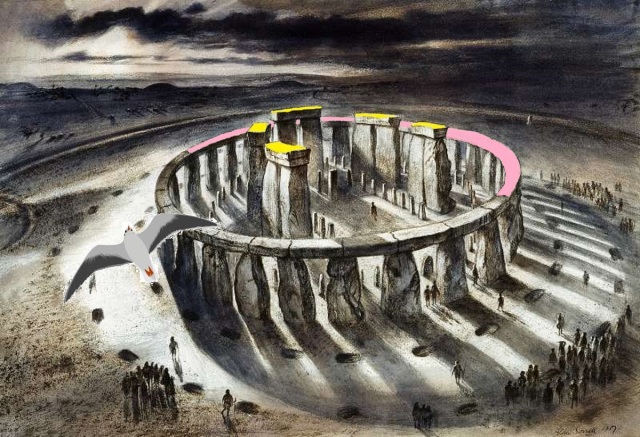

I say Stonehenge was designed as a giant bird perch, a ceremonial monument dedicated to ‘sky burial’, i.e. soul release from mortal remains to the heavens via AFS (avian-facilitated skeletonization, considered the height of fashion (and practicality) in Neolithic-era 2500BC! The stripped remains were then cremated, so an apt description of Stonehenge might, as previously suggested, be PRE-CREMATORIUM.


Saturday, April 9, 2016

Neolithic Silbury Hill: communal earthworm-implanted compost heap for freeing trapped souls from mortal remains?


Screen grab of this blogger's article on the Ancient-Origins website, published April 7, 2016

Title: Was Neolithic Silbury Hill Designed as a Welcoming Home for Omnivorous, Upwardly-Mobile Earthworms?


Google has been quick to pick up my solution to the Silbury enigma: here's what one currently sees when entering (silbury hill) into the search engine.


More will follow here in a few days time, after I've had an opportiunity to deal with any comments that may appear on the ancient-origins site (though none as yet!).

The basic idea: Silbury Hill was designed as a community necropolis with multiple interments of one or more vital organs of the recently deceased (heart especially), together with soil from the deceased's locality, with intentional inclusion of EARTHWORMS. Composting action served to biodegrade the soft tissue, freeing the soul from mortal remains. Discussion of the fate of the skeleton, disposed of elsewhere, i.e. not within the hill, will be deferred for now.

Here again is a link to the article:

 Here's the URL in full:

http://www.ancient-origins.net/opinion-editorials/was-neolithic-silbury-hill-designed-welcoming-home-omnivorous-upwardly-mobile-020800

Today's task (Sunday 10 April) will be to update my Silbury Hill/Stonehenge site that blossomed briefly in the spring of 2012 - yes 4 years ago no less! It was a brief diversion from this blogger's long-running interest/research programme to do with the Turin Shroud.


Home page: this blogger's specialist Shroud of Turin site, 10th April 2016, with its posting summarising the proposed "flour-imprinting" model.

(Yes, I think I know how it was done by one very determined, very focused medieval entrepreneur).

Here's how the Home page of that Silbury site of mine looks right now, showing the last of 4 postings on 8th April 2012:
Shortly to be reactivated - this blogger's long-neglected specialist Neolithic Wiltshire site (Stonehenge AND Silbury Hill).


New topics to be addressed over there?  We, there will be some ideas/explanation for the mysterious sarsen stones (portable variety) that stud the interior of Silbury Hill, which have been likened to "raisins in a cake", not ignoring the presence of animal bones (ox ribs) next to one such stone. Yes, their presence, and orientation (concave side down) fits beautifully with my theory that Silbury Hill evolved incrementally as a communal necropolis for interring  human remains! The site will also be the logical place to recount details of my recent visit with wife to Silbury Hill, West Kennet Long Barrow and Avebury stone circle, but also Silbury Hill's smaller little-known sister a few miles east in the grounds of Marlborough College.

Marlborough Mound (this blogger's own photograph taken 22nd March 2016)


(Fortunately my wife and I arrived at the gate out of term time, and were allowed in where I was able to take pictures, and have since learned that Dr.Jim Leary of the University of Reading's Archaeology Dept., co-author with David Field of the excellent book on Silbury Hill, did some recent test borings into the so-called Marlborough Mound, confirming it be of Neolithic-era origin, not just a country squire's self-indulgent garden feature as some had imagined).

Late addition (April 12, 2016): see the latest posting on my re-activated Silbury/Stonehenge site, the first since 2012, but still "preaching the same message" re the utilitarian role that the proto-Silbury Hill appears to have played  on the chalk uplands of Neolithic Wiltshire.:

Link:


Here's a follow-up to the above posting, on the same site, posted earlier today (April 12): it addresses the question of why Silbury Hill is studded with rounded sarsen stones (local silicified sandstone), scores of them,   "like raisins in a cake" to quote the words of the distinguished archaeologist Richard Atkinson who oversaw the 1968 "dig", if tunnelling can be so described.

Link: