Above is a screen grab of the 1981 STURP SUMMARY (available on the site of STURP's Documenting Photographer)
CLICK TO ENLARGE!
Below is my annotated version, showing how I think it should have been presented, given the yawning gaps and uncertainties in the data, given the blind spot for the negative image, given the infatuation with 3D-rendering software, given the tunnel vision where alleged yellowing of largely inert cellulose is concerned as a mechanism for creating the body image ...
STURP's original: black font. My preferred version - blue italics!
(Photo-gallery to follow)
STURP Summary
No pigments, paints, dyes or stains have been found on the fibrils. X-ray, fluorescence and microchemistry on the fibrils preclude the possibility of paint being used as a method for creating the image. Ultra Violet and infrared evaluation confirm these studies.
No conventional pigments, paints, dyes or stains have been found on the fibrils. X-ray, fluorescence and microchemistry on the fibrils preclude the possibility of an artist's paint palette playing a role in creating the image. Ultraviolet and infrared evaluation confirm these studies.
What cannot be ignored is the negative (tone-reversed) nature of the body image. Artists would hardly elect to paint a subject as a negative unless wishing to suggest the image had been IMPRINTED onto the linen. But a better more convincing representation of an imprint is obtained, not with freehand brush, loaded with paint, but by actual IMPRINTING. How? Answer: by coating the subject from head to foot with a suitable imprinting agent, and either pressing subject onto linen, or, more probably, vice versa - by pressing linen down firmly onto the subject!
(Note: nowhere does the STURP Summary make any mention whatsoever of (a) the tone-reversed negative or (b) the likelihood of a negative image having been acquired via imprinting- as distinct from painting . Bizarre! Truly bizarre! )
Computer image enhancement and analysis by a device known as a VP-8 image analyzer show that the image has unique, three-dimensional information encoded in it.
Computer image enhancement and analysis by a device known as a VP-8 image analyzer show that the 2D image responds well to 3D-rendering computer software. However, that is equally true of imprints generally, and indeed any 2D figure or graphic with variations in image intensity, the latter being elevated proportionately onto an imaginary z axis. That is not say there won't be distortions etc, especially where paintings and photographs are concerned, due largely to shadowing (equally responsive as main image to 3D software!). Summary: the 3D-response contributes nothing to one's understanding as to how the body image was produced.
Microchemical evaluation has indicated no evidence of any spices, oils, or any biochemicals known to be produced by the body in life or in death.
Microchemical analysis has failed to detect the presence of any spices, oils, or indeed any biochemicals known to be produced by the body, either in life or in death.
That could be seen as further evidence against the Linen being a burial shroud, whether authentic or simulated, and by default, supplies circumstantial evidence in favour of it as Joseph of Arimathea's actual transport linen, or more probably a medieval mock-up thereof.
It is clear that there has been a direct contact of the Shroud with a body, which explains certain features such as scourge marks, as well as the blood.
It is clear there has been a direct contact with a body - or a facsimile thereof - given the dimensions, negative image etc.
Features such as blood and scourge marks, while serving to reinforce that impression, need to be treated with caution: none of the blood stains, scourge marks included, display any indication of torn or punctured skin in the body image, and may accordingly have been applied separately, either as genuine blood, artificial blood, or a combination of the two, not necessarily simultaneously (e.g. either real or artificial blood as later touching up to restore or enhance colour, given that blood darkens with age).
However, while this type of contact might explain some of the features of the torso, it is totally incapable of explaining the image of the face with the high resolution that has been amply demonstrated by photography.
One noteworthy feature deserving of comment is the imprint of the face: it displays a superior definition than the rest of the body, even if some aspects are distorted - notably a flattened and somewhat distorted nose.
It is possible that the imprinting procedure for the face differed from that used elsewhere. Reasons? One can only speculate, but if the body image was of medieval fabrication, as seems likely (see above), a compromise was reached between conveying the notion of a seemingly realistic albeit somewhat fuzzy whole body imprint left in age-yellowed sweat and blood to signal a victim of crucifixion, while communicating greater detail in the face alone to signal that it was indeed a particular victim of crucifixion with beard, moustache, shoulder length hair etc.
The basic problem from a scientific point of view is that some explanations which might be tenable from a chemical point of view, are precluded by physics. Contrariwise, certain physical explanations which may be attractive are completely precluded by the chemistry.
Omit - lacking specifics
For an adequate explanation for the image of the Shroud, one must have an explanation which is scientifically sound, from a physical, chemical, biological and medical viewpoint. At the present, this type of solution does not appear to be obtainable by the best efforts of the members of the Shroud Team.
Omit - lacking specifics
Furthermore, experiments in physics and chemistry with old linen have failed to reproduce adequately the phenomenon presented by the Shroud of Turin.
Omit - lacking specifics
The scientific concensus is that the image was produced by something which resulted in oxidation, dehydration and conjugation of the polysaccharide structure of the microfibrils of the linen itself. Such changes can be duplicated in the laboratory by certain chemical and physical processes. A similar type of change in linen can be obtained by sulfuric acid or heat.
The most immediate and obvious recipient of the body image is the linen itself, comprising mainly cellulose, but with minor components as well (hemicelluloses, lignin etc).
Endowing cellulose with colour is not easy, needing not just dilute sulphuric acid to model in the test-tube, but concentrated acid (both a powerful chemical dehydrating agent as well as oxidizing agent as well - if hot)- but scarcely realistic or credible.
So a question mark needs to be placed over chemical modification of the major linen component, and by the same token, heat alone. In the context of medieval fabrication, in which an imprinting medium may have been deployed, consideration needs to be given to extraneous non-linen components. Candidates? One can but speculate.
However, there are no chemical or physical methods known which can account for the totality of the image, nor can any combination of physical, chemical, biological or medical circumstances explain the image adequately.
There is a possible clue that might guide future research. It is the finding that the body image fibres are bleachable with any of three different chemical reagents - namely diimide, hydrazine and alkaline hydrogen peroxide - all having something in common (they interrupt colour-conferring conjugated systems of single and double bonds in organic molecules). Firstly that finding should serve to exclude from consideration inorganic paint pigments referred to earlier. The chromophore is organic, i.e. carbon-based. Dr.Walter McCrone please note!
Thus, the answer to the question of how the image was produced or what produced the image remains, now, as it has in the past, a mystery.
The question as to how the image was produced or what produced the image remains a matter of speculation unless or until that is we have more detailed chemical information on the nature of the body image chromophore.
Modified cellulose? Improbable! Maybe a type of extraneous addition to the linen that lends itself better to introduction of conjugated double bonds, maybe via thermal or chemical input, and thus development of yellow coloration. Melanoidins? (High molecular weight i.e. particulate solid endproducts of complex Maillard reactions between reduciong sugars and amines involving repeated chemical condensation and polymerization).
We can conclude for now that the Shroud image is that of a real human form of a scourged, crucified man.
We can conclude that the Shroud image is a representation of the crucified Jesus, imprinted onto Joseph of Arimathea's transport linen. Authentic (1st century)? Or a medieval simulation thereof? The essential next step is radiocarbon dating.
It is not the product of an artist.
It is not the product of an artist (but possibly/probably that of one or more medieval artisans who have deployed whole body imprinting, using an unknown imprinting medium, maybe heat or chemically-assisted to generate a faint tan colour as if ancient age-yellowed sweat.
The blood stains are composed of hemoglobin and also give a positive test for serum albumin.
The blood stains appear to contain hemoglobin and also give a positive colorimetric test for serum albumin, based on dye-binding.
The image is an ongoing mystery and until further chemical studies are made, perhaps by this group of scientists, or perhaps by some scientists in the future, the problem remains unsolved.
Insufficient data are presently available to identify the image chromophore with certainty, or even to rule in or rule out chemical modifcation of the cellulose or some other linen constituent.
Further chemical studies are required. All one can say with certainty is that the chromophore relies on conjugated double bonds for its colour (thus accounting for the bleaching action of the three highly specific double-bond targeting reagents): inorganic paint pigments can be firmly excluded.
If I had to sum up the '81 STURP Summary in just two words, what would they be?
Answer: woolly obscurantism... yet we're told recently by STURP's Documenting Photographer (now STERA President and the owner of the shroud,com site) that it was a model for good science, a shining example for us modern day scientists to follow!
Er no. The project was shot through from the word go with preconceptions and inner contradictions. (Like later claiming that contact imprinting was out of the question, that it was imprinted photograph-like across air gaps, due to lack, we're informed, of inescapable lateral distortion, despite the body image having no sides!
Further reading: https://shroudofturinwithoutallthehype.wordpress.com/2018/10/05/no-mr-barrie-m-schwortz-sturp-did-not-provide-an-example-that-future-shroud-researchers-can-use-to-carefully-plan-their-own-work-sturp-showed-how-not-to-plan-or-execute-objectiv/
Photo Gallery to follow! (Yes, this posting is a work in progress)
Photo Gallery
 |
| Fig 1 : Left: a negative image of my own hand (but NOT a photograph in the first instance - merely recorded as such for posterity). Right: the same image after tone-reversal (which can be achieved either by photography or via digital computer software). So how was the initial negative image captured, if not by photography? Answer: as a CONTACT IMPRINT. I simply wetted my hand, and pressed it down onto dark-coloured fabric. (Note the absence of so-called "lateral distortion" which we were told by STURP's Director precluded imprinting by contact in the case of the so-called Shroud of Turin. Nonsense! Complete and utter nonsense! One simply keeps the sides of the imprinted item away from the cloth: no side contact, no lateral distortion!) Fig.2: Performance of those hand imprints of mine (negative and tone-reversed positive) in modern-day 3D-rendering software (ImageJ)  Observe that both the original negative and the tone-reversed positive display a 3D appearance after applying the 3D software. The 3D-rendering is due to the software - not the input image. All the latter has to do is supply variations in 2D image intensity, no matter how acquired. The claim in the '81 STURP Summary that the so-called Shroud of Turin body image displays "unique encoded 3D" is also total nonsense. That fallacious claim is trotted out even now, nearly 40 years later as if established fact. Nothing could be further from the truth. Shame on you STURP for foisting your pseudoscience on the world at large, and continuing to do so, such of you as are still around... Fig.3: Here's another negative image, again of my hand, and its tone-reversed positive. But on this occasion it was not by liquid - which tends to spread too far - but by SOLID imprinting, using powdered charcoal. Note the near photograph-like quality of the imprint!  Might a powder have been used to capture the body image on the so-called Shroud of Turin? I say YES! Which powder? Answer: plain white flour, as used for breadmaking. How was the yellow colour produced? Answer: via heat-treatment of course (roasting the imprinted linen in an oven, or even over the glowing red hot embers of a flame-free open fire). |
Fig.4: Here are some flour imprints of my hand (not my best, not my worst) obtained with two different variants of the imprinting technique:
Fig.5: Here's an imprint of my face, obtained using the wet slurry technique.

No heat development was needed: photoediting alone was sufficient to enhance the natural faint yellow colour of plain white flour:
Who says the nose makes it impossible to imprint the face? Not if one presses hard to flatten and distort the nose - as appears to have happened to the nose of the Man on the Linen!
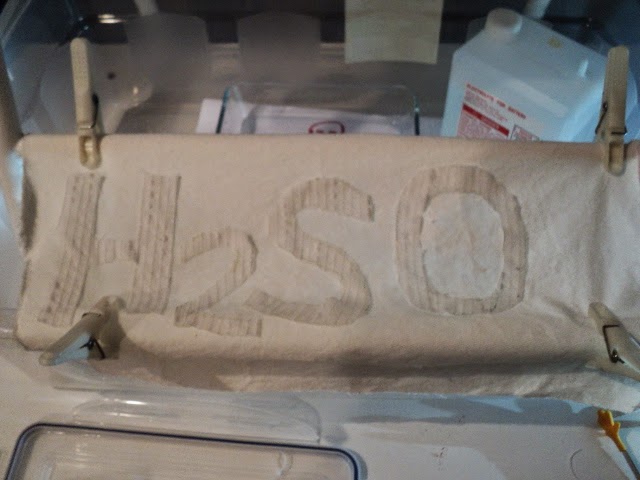
Fig 6: contact imprint from a miniature plastic figurine, just 14cm in size, obtained via the dry-flour imprinting technique onto wet linen followed by heating of the imprinted linen.

Observe absence of any "lateral distortion" of the image. Why? Because the figurine was first smeared with vegetable oil, and the flour then sprinkled vertically from above, making scarcely if any contact with the sides (which could have been wiped off had that been the case). As before, the flour imprint was heated in an oven to develop the colour of the negative imprint. The negative, tone-reversed image you see is, I consider, a miniature of that on the Turin Linen, obtained via essentially the same procedure. In short, it is wrong for numerous websites to claim, as they do, that the body image on the so-called Shroud continues to elude science, 40 years post that hugely flawed STURP investigation . No it does not. It is easily explainable as a contact imprint, one whose colour has been developed by thermal means.
Fig.7: Imprinting with sweat and blood (whether authentic or 14th century simulation) not a new idea:
See this paper by Dorothy Crispino, with its reference to Cardinal Gorrevod implicating sweat and blood as early as the late 15th century:

Fig.8: Indeed, the idea of imprinting by contact immediately after descent from the cross, and receiving into Joseph of Arimathea's "fine linen" (whether with bodily sweat, or possibly anointing oils - see pot in foreground) was taken up by early painters, notably Roviere in the 16th century:

So what happened to cause the immediate post-crucifixion First Day imprinting narrative to be summarily dismissed, and be replaced by supernatural Third Day resurrectional auto-photography (mediated we're told by a burst of corpse-generated radiation).
Answer: look to STURP, notably its Director and prime initiator, John Jackson PhD plus colleagues, and their allegedly cause-and-effect correlation of image intensity with "cloth-body distance".
Fig.9:

The key sentence in the above paper is this one: "The frontal image on the Shroud of Turin is shown to be consistent with a body shape covered with a naturally draping cloth in the sense that the image can be derived from a single global mapping function of distance between these two surfaces".
Yes, but stating something to be consistent is not the same as demonstrating a real cause-and-effect relationship. Most if not all textbooks of statistics include a warning about the the danger of spurious correlations (my Yule and Kendall back in the 1960s illustrated with a graph showing a near perfect correlation between year-on-year increase in alcohol consumption and that of schoolteachers' salaries!).
There is an alternative explanation for the APPARENT correlation between image intensity and cloth-body distance, measured on a subject with loosely-draped linen. It's the model that's wrong, assuming that loosely-draped linen. See my earlier 2018 posting on the subject, one in which linen is pressed firmly down on the subject, with imaging at the contact points ONLY!
Fig.10: Quickie comparison of two rival imaging models:

(A) the quasi-photographic model of Jackson et al featuring pro-authenticity loosely-draped linen, permitting imaging across air gaps, see red pointers, albeit weaker; (B) the non-authenticity medieval-imprinting model, strictly imaging-by-contact only, where prominences like the nose are subject to greater contact pressure , see yellow pointers, to permit physical contact with lower relief.
Fig.11: Here's a current Page 5 entry under a Google Any Time search for (shroud of turin).

Click on the above link to the Chicago-based McCrone Research Institute, and what do you find? Be prepared for a surprise. Correction - a cobweb-festooned 40 year old surprise that should by rights have departed gracefully from the literature decades ago!

Fig 12: Yes, McCrone, or rather his survivors, are still maintaining that the tan-coloured body chromophore is "red ochre", i.e. inorganic iron oxide, Fe2O3, would you believe it?
Here's a copy of an email I sent the McCrone Research Institute 6 days ago (blue font, thus far no reply or acknowledgement):
Title: Er, why do you continue to promote your founder's fallacious iron oxide paint pigment claim re Turin Shroud body image?
From: sciencebod01@aol.com>
To: info@mcri.org>
Date: Fri, 16 Aug 2019

 |
(For some reason the following stays red in red font, despite several attempts to replace red with black!) The one on the left employed a thick slurry of flour in water. That on the right was obtained by dusting the oil-smeared hand with dry flour, shaking off excess flour, then imprinting onto wet linen. Both imprints were then developed with heat to generate the negative images as Maillard browning products.
Note the different character of the two imprints as regards overall definition, sharpness of image boundaries etc
|
Fig.5: Here's an imprint of my face, obtained using the wet slurry technique.

No heat development was needed: photoediting alone was sufficient to enhance the natural faint yellow colour of plain white flour:
Who says the nose makes it impossible to imprint the face? Not if one presses hard to flatten and distort the nose - as appears to have happened to the nose of the Man on the Linen!
Fig 6: contact imprint from a miniature plastic figurine, just 14cm in size, obtained via the dry-flour imprinting technique onto wet linen followed by heating of the imprinted linen.

Observe absence of any "lateral distortion" of the image. Why? Because the figurine was first smeared with vegetable oil, and the flour then sprinkled vertically from above, making scarcely if any contact with the sides (which could have been wiped off had that been the case). As before, the flour imprint was heated in an oven to develop the colour of the negative imprint. The negative, tone-reversed image you see is, I consider, a miniature of that on the Turin Linen, obtained via essentially the same procedure. In short, it is wrong for numerous websites to claim, as they do, that the body image on the so-called Shroud continues to elude science, 40 years post that hugely flawed STURP investigation . No it does not. It is easily explainable as a contact imprint, one whose colour has been developed by thermal means.
Fig.7: Imprinting with sweat and blood (whether authentic or 14th century simulation) not a new idea:
See this paper by Dorothy Crispino, with its reference to Cardinal Gorrevod implicating sweat and blood as early as the late 15th century:

Fig.8: Indeed, the idea of imprinting by contact immediately after descent from the cross, and receiving into Joseph of Arimathea's "fine linen" (whether with bodily sweat, or possibly anointing oils - see pot in foreground) was taken up by early painters, notably Roviere in the 16th century:

So what happened to cause the immediate post-crucifixion First Day imprinting narrative to be summarily dismissed, and be replaced by supernatural Third Day resurrectional auto-photography (mediated we're told by a burst of corpse-generated radiation).
Answer: look to STURP, notably its Director and prime initiator, John Jackson PhD plus colleagues, and their allegedly cause-and-effect correlation of image intensity with "cloth-body distance".
Fig.9:

The key sentence in the above paper is this one: "The frontal image on the Shroud of Turin is shown to be consistent with a body shape covered with a naturally draping cloth in the sense that the image can be derived from a single global mapping function of distance between these two surfaces".
Yes, but stating something to be consistent is not the same as demonstrating a real cause-and-effect relationship. Most if not all textbooks of statistics include a warning about the the danger of spurious correlations (my Yule and Kendall back in the 1960s illustrated with a graph showing a near perfect correlation between year-on-year increase in alcohol consumption and that of schoolteachers' salaries!).
There is an alternative explanation for the APPARENT correlation between image intensity and cloth-body distance, measured on a subject with loosely-draped linen. It's the model that's wrong, assuming that loosely-draped linen. See my earlier 2018 posting on the subject, one in which linen is pressed firmly down on the subject, with imaging at the contact points ONLY!
Fig.10: Quickie comparison of two rival imaging models:

(A) the quasi-photographic model of Jackson et al featuring pro-authenticity loosely-draped linen, permitting imaging across air gaps, see red pointers, albeit weaker; (B) the non-authenticity medieval-imprinting model, strictly imaging-by-contact only, where prominences like the nose are subject to greater contact pressure , see yellow pointers, to permit physical contact with lower relief.
Fig.11: Here's a current Page 5 entry under a Google Any Time search for (shroud of turin).

Click on the above link to the Chicago-based McCrone Research Institute, and what do you find? Be prepared for a surprise. Correction - a cobweb-festooned 40 year old surprise that should by rights have departed gracefully from the literature decades ago!

Fig 12: Yes, McCrone, or rather his survivors, are still maintaining that the tan-coloured body chromophore is "red ochre", i.e. inorganic iron oxide, Fe2O3, would you believe it?
Here's a copy of an email I sent the McCrone Research Institute 6 days ago (blue font, thus far no reply or acknowledgement):
Title: Er, why do you continue to promote your founder's fallacious iron oxide paint pigment claim re Turin Shroud body image?
From: sciencebod01@aol.com>
To: info@mcri.org>
Date: Fri, 16 Aug 2019
Hello folks
I've just been reading, correction, re-reading your founder's views re that so-called "Shroud", still prominent in Google rankings.
They start with this statement:
"The faint sepia image is made up of billions of submicron pigment particles (red ochre and vermilion) in a collagen tempera medium. The pigments red ochre and vermilion with the collagen tempera medium was a common paint composition during the 14th century; before which, no one had ever heard of the Shroud."
I can understand the image chromophore being mistaken for iron oxide (aka red ochre) 40 years ago. But why is that view still being promoted?
40 years ago, STURP's Adler and Heller showed that the image chromophore was organic, i.e. carbon-based, through being bleachable by reducing agents (diimide, hydrazine, alkaline hydrogen peroxide) that act on conjugated C=C double bonds . One cannot expect an inorganic metal oxide like Fe2O3 to be bleached by any of those three agents!
So why continue to promote an early misidentification, even if understandable at the time?
I personally (a retired PhD biomedical scientist) have been researching the so-called Shroud for well over 7 years. I too believe it to be of medieval manufacture, but NOT a painting (instead a roasted organic whole-body negative IMPRINT, where the final sepia-coloured chromophore is almost certainly a mix of high molecular weight melanoidins, as first proposed by STURP's Chemical Director, Raymond N.Rogers). However, I consider your founder was correct about one thing - in identifying the chromophore as solid and microparticulate (sub-micron in size).
So how about publishing an updated version of your founder's message, ensuring that his particle microscopy does not get dismissed through having been over-hasty with the chemistry?
Let me know if you would consider a joint paper between myself and your research institute as an updated corrective.
Do you by any chance still have any of Walter McCrone's image fibres from 1978? If so, they could be the basis for a new round of microscopy - focused on the precise location of the body image chromophore (which I maintain to be inside the SCW cores, not restricted to the PCW as maintained by modern-day sindonologists, keen to promote their miraculous pro-authenticity image-formation mechanisms (corona discharges, uv pulsed laser beams, sub-atomic particles, earthquakes etc etc).
Kind regards
Colin Berry
Herts, UK
So then, what is the way ahead assuming (a) Turin allows a limited STURP Mk2 (?) and (b) it it's restricted, as before, to - at best - individual image fibres, maybe dissected out with a blade rather than contaminated with sticky tape?
Answer: not easy, given the likely paucity of specimen for analysis. As before, microscopy would seem to bw the best bet, also given priority in STURP Mk 1 with the dispatch of Rogers' stripped-off sticky tape sample to microscopist Walter McCrone in the first instance. However, what mustn't be repeated in a second round is the exclusive focus, at least initially, on microscopy, unaided by microchemistry. (Thank goodness for Adler and Heller's later testing, notably the image bleaching studies, when they finally received samples from McCrone).
So is there a straightforward, previously omitted chemical test that can be applied to image fibres, not to exclude iron oxide (already performed, hat tip to Adler and Heller) but to confirm Rogers' alternative to oh-so-speculative prematurely-aged cellulose, namely those high molecular weight Maillard browning products, aka melanoidins? I wish I could say there was, but years of literature searching have failed to unearth a simple or even involved test for those pesky entities we call "melanoidins" (read: chemical Mount Everest).
So what's the stand-in solution(s) where any STURP Mk2 is concerned?
There are two that come to mind.
The first is to acquire some tentative evidence at least for a melanoidin chromophore. Methodology? Still at the planning stage, maybe exploiting two known properties of melanoidins: (a) their anionic character - due to negative electric charge (carboxyl groups?) and (b) linked to that same anionic character, their ability to bind metal ions, which might conceivably be exploited to develop a colorimetric or fluorimetric test.
Fig. 13: Here's what I consider might be a useful and potentially informative way forward worth considering for STURP Mk 2. It's a graphic from a posting I did way back in late 2012:

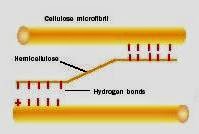
Cellulose, the incredibly resistant polymer that makes up the bulk of the plant kingdom (as cell walls) CAN be dissolved, or at any rate disaggregated as semi-solubilized. How? By adding a solution of copper (II) hydroxide in excess ammonia, which contains the Cu (NH3)4 ++ ion ("cuprammonium ion". What's more, the cellulose fibres can be re-precipitated, merely by acidification.
So how might that chemistry come in handy? It was McCrone's belief that the body image chromophore on the Linen was in the form of minute sub-micron particles, and while his attempts to identify those particles as iron oxide came to naught (and rightly so) Raymond N.Rogers later offered an alternative more credible explanation - the particles comprise high molecular weight melanoidins , i.e. Maillard browning products. This scientist will go one stage further and propose that those particles are locked away inside the cores of the SCW (secondary cell wall) of linen fibres. How did they get there? Answer: by entering the fibre cores as a liquid at high temperature, released from roasting white flour imprint, whereupon that liquid then rapidly polymerised and became entrapped in the SCW cores. That's what McCrone saw through his microscope!
Testing the hypothesis: take image-bearing fibres from the Linen. Disperse in the cuprammonium reagent to "dissolve" the cellulose of the SCW, releasing the chromophore particles. Spin off those solid micro-particles to separate from the solution. One then has free liberated chromophore that can then be tested with this or that chemical reagent - or examined with one or other physical technique - in order to pinpoint more precisely the chemical nature of the chromophore.
Fig.14: Here's a pair of graphics I posted in 2017 to the International Skeptics Forum site, greeted with much derision (that, namely derisive catcalling, being the speciality of that now abandoned site !).

Why? Because I deployed a filter available in Windows 10 called "Zeke". What it does is to accentuate anything that is already particulate in nature, whether body image or blood, allowing it to stand out better from background (artefactual maybe, but useful nonetheless - a kind of contrast-enhancement tool).
Fig.16: As stated elsewhere on many occasions, this investigator believes that the Linen with its imprinted image (as if left on Joseph of Arimathea's 'transport' stretcher) was inspired, nay prompted, by the pre-mortem Veil of Veronica. Here's a few lines from the wiki entry:
"During the fourteenth century it (the Veil of Veronica ) became a central icon in the Western Church; in the words of art historian Neil Macgregor: "From [the 14th Century] on, wherever the Roman Church went, the Veronica would go with it." The act of Saint Veronica wiping the face of Jesus with her veil is celebrated in the sixth Station of the Cross in many Anglican, Catholic, Lutheran, Methodist and Western Orthodox churches."
There's a large number of artistic representations of the Veil. I've chosen just one.

Note the way the face responds to 3D-rendering in ImageJ software! "Unique encoded 3D" as baldly declared by STURP for the Linen of Turin?
Fig 17: See how an imprint of a 14cm plastic figurine responds to ImageJ software.

Unique encoded 3D?
Final summary of posting:
The Linen (no, NOT Shroud!) of Turin, fabricated in the mid- 14th century as a bigger and better rival to the Veil of Veronica, was NOT intended to be seen as the final burial shroud.
(So let's forget about resurrection imaging on the Third Day etc).
No, it was created as a trompe d'oeil, intended to represent the kind of image that might have been left on Joseph of Arimathea's "fine linen", deployed in transport mode from cross to tomb.
Why is the body image a tone-reversed image?
Answer: because it it was intended to be seen as a body IMPRINT, created in bodily sweat in the first instance, then yellowed by centuries of ageing.
(Explaining the blood is a little more problematical: it does not appear to solely blood, or as some might say "blood". Other ingredients appear to be present (red clay according to microscopist Lucotte and Paris-based colleagues). Yes, they can be explained, including the "blood first, image second" chronology deduced by Adler and Heller's experiments with blood-digesting enzyme.
A possible scenario is as follows: an adult human male was first smeared lightly with vegetable oil from head to foot, then sprinkled lightly FROM ABOVE (while in recumbent, i.e. lying down mode) with plain white flour. The excess of flour was then shaken off, then a slurry of red clay trickled on to represent blood "in all the right places" to identify the mode of death (crucifixion) and what preceded it (scourging, crown of thorns etc) thus identifying the individual's fate according to Holy Scripture.
The imprinted linen was then roasted, maybe in a bread-making oven, maybe over the glowing embers of a charcoal fire - responsible incidentally for those otherwise mysterious "poker holes" - to develop the body image colour as Maillard browning products. The clay areas were then overlaid with blood (real blood, or something that resembled it closely).
The final step, post-roasting, pre-addition of ';real' blood, was to wash vigorously with soap and water to remove thick surface encrustation, leaving just a faint, dare one say ghostly image of a man's naked crucified figure.
Scourge marks? As with bloodstains from "nails", "crown of thorns" etc, they too show no presence in the body image, i.e. are entirely blood (or "blood"). They could have been added at any time (one still awaits data on whether they too are underneath or, conversely, on top of the body image).
Claims that the Linen could simply have been "painted" to create the body image overlook one crucial feature - namely the negative (tone-reversed) body image. STURP itself gave priority to the oh-so- tiresome "just a painting" claim, which was correctly rejected.
What was less understandable was the omission of any reference in the '81 Summary to the negative image, or to Adler and Heller's hugely significant finding that the body image chromophore was bleachable by 3 different chemical reagents, known to act on colour-conferring conjugated double bonds, i.e. organic, NOT inorganic chromophores.
The bleaching discovery should (by rights) have consigned the red ochre (iron oxide) claim of Walter McCrone immediately to the dustbin of history (but for unfathomable reasons did not do so, his successors at the Chicago McCrone Research Institute robotically continuing to trumpet it 40 years later on their founder's website!).
Let's not beat about the bush: the Turin Linen is a fraud, albeit a very clever one. Its creators tried to conjure up a "1st century" reproduction of Joseph of Arimathea's 'transport linen' that was as realistic as possible, one that looked as if it had been created 1300 years earlier, one that looked as it it had naturally aged for the following 1300 years prior to its (unexplained) appearance at a tiny Champagne village, albeit with a monarch-funded private chapel attached to the property of one of his leading knights in the land (read: King's favourite!)
The Linen of Turin is by far and away the most successful forgery in entire human history.
Why? Because it wasn't content to "paint" a facsimile version of Joseph of Arimeathea's transport linen.
Oh no! It set out to reproduce the manner of its making in as realistic a manner as possible, namely by whole-body imprinting, followed by an artificial ageing procedure. In short, it was meticulous in its attention to detail. In modern terminology it was 'nerdy' and thus 'detail-obsessed' in the extreme.
But then bored under-occupied clerics attached to Geoffroi de Charny's chapel, apparently 6 of them no less (link), employed merely to pray constantly for his warrior soul, forever at risk of being detached from his body in knightly mortal combat alongside his King, had to find ways to occupy their time...
They certainly made their mark on history - both 20th and 21st century. They opened the door to endless pseudoscience, introducing a cautionary note to the manner in which modern-day "science" can either be applied - or MISAPPLIED!
Any time you, dear reader, suspect that "science" is being misapplied, ask yourself the following question: is the proponent of this or that seemingly-unscientific proposition addressing IN DETAIL objections from sceptics and other critics?
Or is their "science" in fact pseudoscience, mere window-dressing intended as part of a marketing exercise, inviting no comment, no objections?
Personal note (added 8th September 2019)
Here's a link to my attendance yesterday at a Bishopshalt School Reunion, just 6 days short of my 75th birthday. (I was a pupil there between 1956 and 1963).
End of posting... (Aug 23, 2019)
Update: March 30, 2020:
Here's a screen grab of my latest Shroud posting:

Here's the link:
https://shroudofturinwithoutallthehype.wordpress.com/2020/03/30/de-mystifying-the-allegedly-authentic-shroud-of-turin-heres-my-current-10-point-action-plan-posted-march-2020-some-8-years-in-the-making/
Enjoy (or not) as the case may be!
Colin Berry (retired PhD biomedical scientist)
....
Answer: not easy, given the likely paucity of specimen for analysis. As before, microscopy would seem to bw the best bet, also given priority in STURP Mk 1 with the dispatch of Rogers' stripped-off sticky tape sample to microscopist Walter McCrone in the first instance. However, what mustn't be repeated in a second round is the exclusive focus, at least initially, on microscopy, unaided by microchemistry. (Thank goodness for Adler and Heller's later testing, notably the image bleaching studies, when they finally received samples from McCrone).
So is there a straightforward, previously omitted chemical test that can be applied to image fibres, not to exclude iron oxide (already performed, hat tip to Adler and Heller) but to confirm Rogers' alternative to oh-so-speculative prematurely-aged cellulose, namely those high molecular weight Maillard browning products, aka melanoidins? I wish I could say there was, but years of literature searching have failed to unearth a simple or even involved test for those pesky entities we call "melanoidins" (read: chemical Mount Everest).
So what's the stand-in solution(s) where any STURP Mk2 is concerned?
There are two that come to mind.
The first is to acquire some tentative evidence at least for a melanoidin chromophore. Methodology? Still at the planning stage, maybe exploiting two known properties of melanoidins: (a) their anionic character - due to negative electric charge (carboxyl groups?) and (b) linked to that same anionic character, their ability to bind metal ions, which might conceivably be exploited to develop a colorimetric or fluorimetric test.
Fig. 13: Here's what I consider might be a useful and potentially informative way forward worth considering for STURP Mk 2. It's a graphic from a posting I did way back in late 2012:

Cellulose, the incredibly resistant polymer that makes up the bulk of the plant kingdom (as cell walls) CAN be dissolved, or at any rate disaggregated as semi-solubilized. How? By adding a solution of copper (II) hydroxide in excess ammonia, which contains the Cu (NH3)4 ++ ion ("cuprammonium ion". What's more, the cellulose fibres can be re-precipitated, merely by acidification.
So how might that chemistry come in handy? It was McCrone's belief that the body image chromophore on the Linen was in the form of minute sub-micron particles, and while his attempts to identify those particles as iron oxide came to naught (and rightly so) Raymond N.Rogers later offered an alternative more credible explanation - the particles comprise high molecular weight melanoidins , i.e. Maillard browning products. This scientist will go one stage further and propose that those particles are locked away inside the cores of the SCW (secondary cell wall) of linen fibres. How did they get there? Answer: by entering the fibre cores as a liquid at high temperature, released from roasting white flour imprint, whereupon that liquid then rapidly polymerised and became entrapped in the SCW cores. That's what McCrone saw through his microscope!
Testing the hypothesis: take image-bearing fibres from the Linen. Disperse in the cuprammonium reagent to "dissolve" the cellulose of the SCW, releasing the chromophore particles. Spin off those solid micro-particles to separate from the solution. One then has free liberated chromophore that can then be tested with this or that chemical reagent - or examined with one or other physical technique - in order to pinpoint more precisely the chemical nature of the chromophore.
Fig.14: Here's a pair of graphics I posted in 2017 to the International Skeptics Forum site, greeted with much derision (that, namely derisive catcalling, being the speciality of that now abandoned site !).

Why? Because I deployed a filter available in Windows 10 called "Zeke". What it does is to accentuate anything that is already particulate in nature, whether body image or blood, allowing it to stand out better from background (artefactual maybe, but useful nonetheless - a kind of contrast-enhancement tool).
Fig.16: As stated elsewhere on many occasions, this investigator believes that the Linen with its imprinted image (as if left on Joseph of Arimathea's 'transport' stretcher) was inspired, nay prompted, by the pre-mortem Veil of Veronica. Here's a few lines from the wiki entry:
"During the fourteenth century it (the Veil of Veronica ) became a central icon in the Western Church; in the words of art historian Neil Macgregor: "From [the 14th Century] on, wherever the Roman Church went, the Veronica would go with it." The act of Saint Veronica wiping the face of Jesus with her veil is celebrated in the sixth Station of the Cross in many Anglican, Catholic, Lutheran, Methodist and Western Orthodox churches."
There's a large number of artistic representations of the Veil. I've chosen just one.
Note the way the face responds to 3D-rendering in ImageJ software! "Unique encoded 3D" as baldly declared by STURP for the Linen of Turin?
Fig 17: See how an imprint of a 14cm plastic figurine responds to ImageJ software.
Unique encoded 3D?
Final summary of posting:
The Linen (no, NOT Shroud!) of Turin, fabricated in the mid- 14th century as a bigger and better rival to the Veil of Veronica, was NOT intended to be seen as the final burial shroud.
(So let's forget about resurrection imaging on the Third Day etc).
No, it was created as a trompe d'oeil, intended to represent the kind of image that might have been left on Joseph of Arimathea's "fine linen", deployed in transport mode from cross to tomb.
Why is the body image a tone-reversed image?
Answer: because it it was intended to be seen as a body IMPRINT, created in bodily sweat in the first instance, then yellowed by centuries of ageing.
(Explaining the blood is a little more problematical: it does not appear to solely blood, or as some might say "blood". Other ingredients appear to be present (red clay according to microscopist Lucotte and Paris-based colleagues). Yes, they can be explained, including the "blood first, image second" chronology deduced by Adler and Heller's experiments with blood-digesting enzyme.
A possible scenario is as follows: an adult human male was first smeared lightly with vegetable oil from head to foot, then sprinkled lightly FROM ABOVE (while in recumbent, i.e. lying down mode) with plain white flour. The excess of flour was then shaken off, then a slurry of red clay trickled on to represent blood "in all the right places" to identify the mode of death (crucifixion) and what preceded it (scourging, crown of thorns etc) thus identifying the individual's fate according to Holy Scripture.
The imprinted linen was then roasted, maybe in a bread-making oven, maybe over the glowing embers of a charcoal fire - responsible incidentally for those otherwise mysterious "poker holes" - to develop the body image colour as Maillard browning products. The clay areas were then overlaid with blood (real blood, or something that resembled it closely).
The final step, post-roasting, pre-addition of ';real' blood, was to wash vigorously with soap and water to remove thick surface encrustation, leaving just a faint, dare one say ghostly image of a man's naked crucified figure.
Scourge marks? As with bloodstains from "nails", "crown of thorns" etc, they too show no presence in the body image, i.e. are entirely blood (or "blood"). They could have been added at any time (one still awaits data on whether they too are underneath or, conversely, on top of the body image).
Claims that the Linen could simply have been "painted" to create the body image overlook one crucial feature - namely the negative (tone-reversed) body image. STURP itself gave priority to the oh-so- tiresome "just a painting" claim, which was correctly rejected.
What was less understandable was the omission of any reference in the '81 Summary to the negative image, or to Adler and Heller's hugely significant finding that the body image chromophore was bleachable by 3 different chemical reagents, known to act on colour-conferring conjugated double bonds, i.e. organic, NOT inorganic chromophores.
The bleaching discovery should (by rights) have consigned the red ochre (iron oxide) claim of Walter McCrone immediately to the dustbin of history (but for unfathomable reasons did not do so, his successors at the Chicago McCrone Research Institute robotically continuing to trumpet it 40 years later on their founder's website!).
Let's not beat about the bush: the Turin Linen is a fraud, albeit a very clever one. Its creators tried to conjure up a "1st century" reproduction of Joseph of Arimathea's 'transport linen' that was as realistic as possible, one that looked as if it had been created 1300 years earlier, one that looked as it it had naturally aged for the following 1300 years prior to its (unexplained) appearance at a tiny Champagne village, albeit with a monarch-funded private chapel attached to the property of one of his leading knights in the land (read: King's favourite!)
The Linen of Turin is by far and away the most successful forgery in entire human history.
Why? Because it wasn't content to "paint" a facsimile version of Joseph of Arimeathea's transport linen.
Oh no! It set out to reproduce the manner of its making in as realistic a manner as possible, namely by whole-body imprinting, followed by an artificial ageing procedure. In short, it was meticulous in its attention to detail. In modern terminology it was 'nerdy' and thus 'detail-obsessed' in the extreme.
But then bored under-occupied clerics attached to Geoffroi de Charny's chapel, apparently 6 of them no less (link), employed merely to pray constantly for his warrior soul, forever at risk of being detached from his body in knightly mortal combat alongside his King, had to find ways to occupy their time...
They certainly made their mark on history - both 20th and 21st century. They opened the door to endless pseudoscience, introducing a cautionary note to the manner in which modern-day "science" can either be applied - or MISAPPLIED!
Any time you, dear reader, suspect that "science" is being misapplied, ask yourself the following question: is the proponent of this or that seemingly-unscientific proposition addressing IN DETAIL objections from sceptics and other critics?
Or is their "science" in fact pseudoscience, mere window-dressing intended as part of a marketing exercise, inviting no comment, no objections?
Personal note (added 8th September 2019)
Here's a link to my attendance yesterday at a Bishopshalt School Reunion, just 6 days short of my 75th birthday. (I was a pupil there between 1956 and 1963).
End of posting... (Aug 23, 2019)
Update: March 30, 2020:
Here's a screen grab of my latest Shroud posting:

Here's the link:
https://shroudofturinwithoutallthehype.wordpress.com/2020/03/30/de-mystifying-the-allegedly-authentic-shroud-of-turin-heres-my-current-10-point-action-plan-posted-march-2020-some-8-years-in-the-making/
Enjoy (or not) as the case may be!
Colin Berry (retired PhD biomedical scientist)
....
Postscript, added April 17, 2020

Yes, 3 days ago I added a new posting to my specialist Shroud site. It offers a prize of £100 for the best 200 word Summary of the present status of the Turin Shroud (with the emphasis on, wait for it, HARD SCIENTIFIC EVIDENCE!).
See this link to the posting.
https://shroudofturinwithoutallthehype.wordpress.com/2020/04/14/100-prize-on-offer-for-best-short-summary-of-the-shroud-of-turin/
https://shroudofturinwithoutallthehype.wordpress.com/2020/04/14/100-prize-on-offer-for-best-short-summary-of-the-shroud-of-turin/
Submissions are needed in the next 28 days. My wife of 50 years (come July) has been appointed final arbiter...
...