|
| The difference between those areas within the blue and red rectangles may possibly have theoretical significance as regards the mechanism of imaging (stochastic v deterministic, if you'll pardon the jargon). Why? Read on... |
I won't pretend that I understand the papers by Giovanni Fazio and his colleagues in Sicily, claiming that the Shroud image is the result of 'stochastic' processes, ones that rule out certain image-forming mechanisms, and render others more probable
(see link below).
So what are
stochastic processes? One could give a textbook answer and say they are the opposite of "deterministic" ones, that they incorporate an element of randomness, as distinct from being totally predetermined. The analogy that is generally given is that of rain falling on a pavement. Gradually a pattern of drops develops, but the location of each drop is not pre-determined, but random.
Here's another attempt to convey the difference between the situations, free from as distinct from incorporating a random element, cribbed from internet image files: chess v snakes and ladders (the latter requiring dice)
So how is that relevant to the Shroud image? Again, I don't pretend to follow the authors' line of reasoning, but gather it's related to what's been called the 'half-tone effect', a topic I was
discussing not so long ago. The half-tone effect is a shorthand term for a peculiar feature that is claimed for the Shroud image, namely that regions of differing image intensity do not have linen threads and fibres of differing colour intensity. There are either uncoloured fibres, or fully-coloured ones
with no in-betweens. A region that looks dark has a higher proportion of coloured to uncoloured fibres compared to one that looks pale. Think of it if you like as comparable to analogue versus digital stereo. The analogue audio signal can take a whole range of values across a smooth continuum, whereas the digital signal is simply a series of binary digits, either 0 or 1.
So where does Thibault Heimburger MD, Paris-based French physician and member of the Shroud Science Group enter this story? Some might be surprised to find his views being favourably received on this site, given there is so much on which we differ, notably the contact scorch hypothesis (one that TH rejects). But that does not mean he's wrong - or right- on everything, far from it, as my follow-up to a recent comment on his on shroudstory.com will now show.
TH appeared on the recent thread, the latter flagging up the presence of a
Fazio et al paper recently published in Mediterranean Archaeology and Archaeometry. He queried the claim (or supposition?) that yellowed fibres were randomly distributed across Shroud image-bearing regions, stating that they could appear together
in bundles (see copy/paste below). Were that correct, it would deal a devastating blow to any theory that required the coloured fibres to be randomly distributed (though occasional clumping is not totally ruled out, albeit being of low expected frequency).
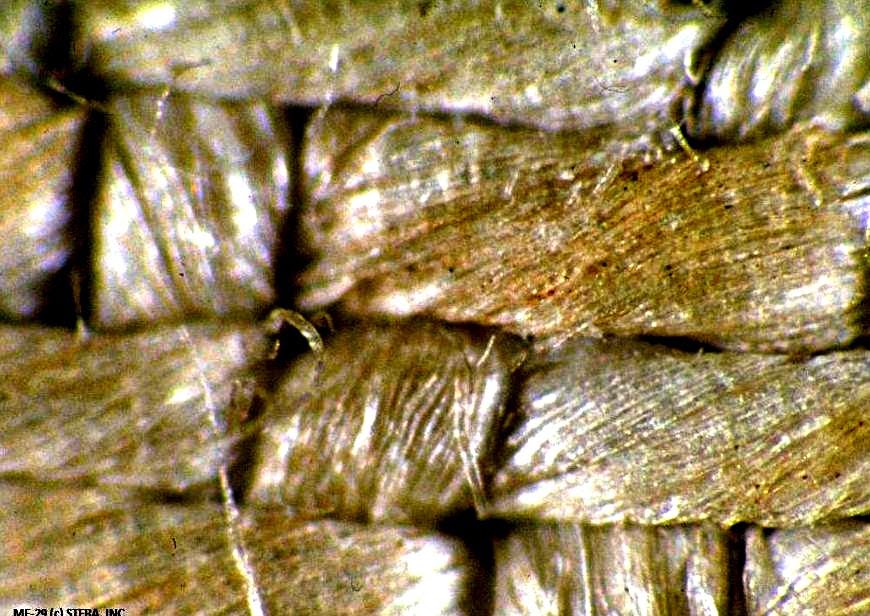
I recalled that TH had recently acquired from STERA's Barrie M.Schwortz a collection of Mark Evans photomicrographs of Shroud magnified close-ups, e.g. x64, and have just spent the last few minutes perusing them, and selecting one in particular for enhancement in my MS Office Picture Manager.
Here's one in particular that backs up TH's claim for "bundles".
That's an "as-is" image, from the TS nose region, magnified x64.
It seems fairly clear that one has two adjacent threads, one comprising mainly yellow fibres, the other largely uncoloured ones. The chances of that happening via random processes must surely be vanishingly small.
Here's the same picture after adjusting brightness and contrast that makes it easier to see the difference.
Sorry, Dr.Fazio, but I think your focus on supposed "stochastic" processes is simply unwarranted, and have TH to thank for making that point. Apologies to the latter for possibly pre-empting him, had he been intending to publish pictures from the same Evans archive.
But there's a sting in the tail for TH: juxtaposition of coloured v non-coloured threads, such as we see above, is I believe entirely consistent with contact-scorching, e.g. from an apposed heated metal template, and is difficult if not impossible to fit into any other of the proposed models that I'm aware of, especially ones that involve radiation of some sort, or diffusion of gases.
Copy/paste of TH comment.
June 14, 2014 at 4:10 pm
In my opinion this paper needs to be read carefully.
I do not not if the term “stochastic” is the best one.
The main problem comes from the fact that the surface distribution of the color in the Body image areas is not easy to describe.
With the help of the analogy with the effect of low doses of
radiations in a large population, one can understand what the authors
have in mind.
It is true that low doses of radiations have the properties described by the authors:
1) There is no minimal level of radiations (except zero, which does not exist) without effect
2) The number of tumors increases with the time/level exposition
3) it is impossible to predict who will have a tumor in this population.
This is only an analogy.
Is the TS image color distribution like a “stochastic “process ?
In my opinion, not exactly.
Why ?
It is true that the color distribution in a given image area depends
only on the number of colored fibers having the same density (+/- 10%)
and not on the density of the fibers (the half-tone effect).
But the colored fibers are not randomly colored.
In a colored thread, there are BUNDLES of colored fires adjacent to bundles of uncolored fibers
If there is a stochastic process, it is at thread level and not only at fiber level.
In other words, a stochastic process at fiber level does not explain
the fact that the colored fibers are bulked together in bundles adjacent
to uncolored bundles of fibers in a given image thread.
Update: Tuesday 17 June. One of the difficulties I have with the proposed (or should that be "prescribed") stochastic mechanism, apart from the problem already noted on overt non-randomness in pigment distribution, is the paucity of chemical detail. The thesis appears to depend primarily on a blend of physics and statistics, leaving the reader to fill in the chemical gaps as best he can with little more than hints re the essential chemical detail. Matters are not helped by the authors' carelessness with the chemical detail where, rarely, it does make an appearance. For example, they cite the active oxygen species- singlet oxygen - as playing a role at some point or in some instances, but with precise details being omitted. But they refer to singlet oxygen "atoms" or to it being a "free radical". It is neither. There is no such thing as a singlet oxygen atom. It is only intact oxygen molecules, O2, in which bonding electrons can be promoted to the excited singlet state. No, it's not a free radical either, despite the chemical reactivity of singlet oxygen, in which all the electrons are spin-paired (free radicals by definition have one or more unpaired electrons).
Despite the simplicity of its chemical formula, oxygen (O2) is a peculiar molecule. We tend to think of it as being chemically reactive, based on its role in combustion and respiration, but the oxygen around us is reluctant to enter into chemical reaction, except slowly in most instances, until it is activated in some way. In the case of combustion, that requires raised temperatures to give the reaction a kick-start. In the case of respiration it is the iron-containing cytochromes of the mitochondria that are needed as catalysts.
Curiously, it is ground state unreactive oxygen that is the free radical, more correctly a diradical (with two unpaired electrons per molecule) and with
three degenerate molecular orbitals for the so-called p-type bonding electrons. Thus the description of ground-state O2 as
triplet-state oxygen. In singlet oxygen the two unpaired electrons are promoted to an excited higher-energy level, but in the process become paired.
 |
| Red spots represent electrons able to flip between two energy levels. Note the two unpaired electrons in ground state (triplet) oxygen at the top. The arrows show they have "parallel spins". In singlet oxygen the corresponding electrons are paired, i.e. have opposite spins. |
So how does one convert triplet to singlet oxygen? There's a very simple and pretty way of demonstrating the conversion in the laboratory. One bubbles chlorine gas through an alkaline solution of hydrogen peroxide in the dark.
The reaction mixture becomes chemiluminescent, i.e. light-emitting, giving off a red glow. That's due to production of singlet oxygen which then slowly reverts back to triplet oxygen by a complex mechanism, emitting visible red light in the process. The typical survival time of singlet oxygen as a gas can be an hour or more - in contrast to most free radicals that exists for a fraction of a second.
In everyday life, singlet oxygen can be formed more silently and surreptitiously by processes that involve sensitization to visible or uv light by the presence of dyes and/or other molecules, the classic one being methylene blue. It then attacks and degrades biomolecules (lipids, proteins etc) in the vicinity, the process being referred to as photodynamic action., Plants have to protect themselves against singlet oxygen formed "accidentally" during photosynthesis in chloroplasts. It's been suggested that accessory pigments like carotenoids are there to mop up singlet oxygen.
Singlet oxygen may be generated in the cytotoxic armoury of some killer immune cells that stop invading bacteria in their tracks. Sadly it has also been implicated in some cancer aetiology. Singlet oxygen is a big subject. Anyone proposing a role for it in Shroud studies should first take the trouble to get acquainted, if not with its electronic configuration in molecular orbital terms, at least its broad chemical character and classification, certainly before referring to it as a "free radical", or oxygen "atoms" or to others as "self-styled scientists".
Incidentally, anyone who has worked with singlet-oxygen mediated reactions, as I did in
Philadelphia, 1970-72, will know that far from inducing yellow coloration in organic matter, the end-result is usually to bleach it. It's not rocket science. Colour in organic compounds is often due to conjugated double bonds
( -C=C-C=C- etc). Singlet oxygen, by adding across the double bonds to form dioxetanes etc, destroys one or more double bonds that comprise a delocalised system of electrons resulting in LOSS of colour.
 |
| Conjugated diene (left side) reacts with singlet oxygen (above first arrow) to form an adduct that has only one double bond instead of two, with less absorption in visible or near uv spectrum. (In other words, the tendency is for singlet oxygen to bleach, not to make yellow). |
Bleaching of fabrics, paper etc by light has been ascribed in some cases to self-sensitized production of singlet oxygen.
Here's an ad' for teeth whitener.
Note the ranking of 'active oxygen' species according to bleach power. Note which one tops the chart. Yes, it's singlet oxygen. It's especially effective the accompanying words say against the stubborn yellow stains of tetracyclin antibiotic.
PS: I see that Fazio et al are citing Mills
et al* as the proponents for a role for singlet oxygen, which they describe as imparting "energy" to the fibres, resulting in yellowing while being more circumspect themselves, They prefer to play safe, and refer to an "unknown source" of energy triggering off immediate and subsequent lag-phase reactions to produce yellowing maybe years or decades later. Would it be uncharitable to suggest that a hypothesis that depends on an "unknown" source of input energy hardly ranks as a hypothesis, or at any rate a scientific hypothesis? Hypotheses in science have to be testable. How can one hope to test a hypothesis that is based on an unknown source of energy?
*
Mills, A.A. (1995): Image formation on the Shroud of Turin. The reactive oxygen
intermediates hypothesis. Interdisciplinary Science Reviews, vol. 20, 319 - 326.