Summary: This blogger’s hunch, indeed, growing conviction that Stonehenge, Avebury and other Neolithic sites were purpose-built for what is euphemistically called "sky burial" of the dead (er, by scavenger birds) has been met with a wall of silence (or nearly so).
Is it because of the manner in which the case has been
presented – as a protracted series of multiple bite-size instalments over many postings, starting 4
years ago? Has one painted oneself into
a corner, through deploying a superfluity of words spread over too long a time?
 |
| My own speech bubble reads: "Standing stones were bird perches - for 'sky burial' of the dead." |
Or is the answer much simpler: is “sky burial” simply a taboo concept,
especially when referred to by its more scientific or explicit synonyms –
excarnation, defleshing, or as I prefer to call it, AFS (avian-facilitated
skeletonization) ? And not just in the popular press, but the internet
(blogosphere, wiki, Google and other search engines) too, and even by
academia, present day archaeologists
especially, at least in their press reports?
 |
| Nope, Maybe it was not I who did the painting into the corner. Sky burial is strictly taboo, at least in the UK... |
(One, who shall not be named,
recently began a 108 page pdf by
explicitly ruling out "excarnation" at a well-known stone circle then failing to
make any further reference to it). The exact words were:"... the practice of excarnation is no longer a tenable
interpretation" .
But what AFS, aka sky burial, is the explanation for ALL standing stones circles and avenues in Britain and further afield (e.g. Carnac
in Brittany, those concentric stone circles in the Golan Heights*, the T-shaped "pillars" or as I would say "free-standing posts" (ideal bird perches) in SE Turkey etc etc?).
Ought the idea not be at least flagged up and addressed
fairly and squarely, instead of being consigned to occasional asides and
footnotes, as if something unspeakable that warrants scarcely a mention?
" notable for a mention of the taboo term in the headline, but trumpeted as "gruesome sky burial".
Background:
1. Some 4 years ago, taking a break from a new but strenuous
project involving the enigmatic' Turin Shroud, this blogger’s interest returned to an
older longer-standing interest – the unsolved mysteries of Stonehenge, SilburyHill and Neolithic sites in general.
Without going into detail, there was a sudden falling of
scales from eyes. “Sky burial” and possibly other more “barbaric” means of
disposing of the dead were practised in Neolithic Britain, probably well into
the Bronze Age. What’s more, the relics of those practices adorn (or in some
cases litter) the countryside to this day, in the form of Stonehenge, Avebury and scores of smaller other circles of
standing stones. Yet one would not know that from reading the tourist
literature, media reports or even press releases from our leading
archaeologists. While all make reference to standing stones as sites for what
loosely is described as “burial” of “cremation” (being vague, often
infuriatingly so, as to what precisely,
was being buried or cremated
It is
exceedingly rare to see an mention of “sky burial” or the more explicit terms
, i.e. “excarnation”, far less “defleshing”. With scarcely a single exception, the ‘mysterious’ stone circles, enclosed within equally "mysterious" “henges” ie. a combination of ditch and bank, either with the ditch on
the inside (a genuine henge) or on the outside (a faux henge, as per Stonehenge),
appear with no explanation whatsover except to
say that the real henge configuration cannot play a defensive role. Yet I am the one repeatedly challengef to prove my case! (Reminder: science is not algebra or geometry - a proposition is falsified, not proved).
But what if the standing stones were the signature of
routine resort to that practice, namely that they served as perches for
scavenging birds?
There, I’ve said it, and if I’m not mistaken I’m the first to
have said it, here and on my specialist Neolithic blogsite. And the
response? Largely zilch. It’s been
presented formally on ancient-origins and Neolithic portal websites, attracting
little more than yawns or minor quibbles (“
“) from other commentators (A-O's editors being a notable exception – a constant
source of encouragement! Thanks to Liz especially!). It’s been transmitted to leading lights in
archaeology, usually eliciting no more than
a “hmmm, interesting”, but no considered response. It’s been flagged up
to contacts in the media, again, usually no response. I even contacted a news agency, which
while not giving me an immediate brush off has stalled, asking for evidence to back my case, to which
my reply has been “First, join up the dots, as I have, then look at received
wisdom on standing stones, seen as little more than “ritualistic” decoration of
the countryside, or at most a symbolic tribute to the dead, with few if any tangible
human remains, bar some “cremated bones”. Why not ask, nay demand, that the
purveyors of received wisdom, peppering their prose with “ritualistic” provide
evidence for that view, some might say cop-out, and, more importantly, provide grounds for excluding a utilitarian
role for standing stones, especially as ‘outdoor furniture’ designed
specifically to appeal to scavenging birds?
Wiki? Don’t ask. I’ve had previously run-ins with wiki
“editors” over their insistence that claims have to be backed by published,
peer review work, while merrily flagging up current affairs topics that appear
in the popular press, relaying whatever ideas and assumptions accompany those
articles, often from journalists etc with no special knowledge or even interest.
Submit one’s own edit? Talk about
entering a lion’s den... That’s even assuming one is willing to announce
oneself with the required ~~~~ ( “4
tildes”). Sorry, wiki, but you really
need to work on de-nerdifying your site if you wish to attract more input from
newcomers. Or is that the idea of the
~~~~ (to repel them, to keep the editing
a secret garden)?
As for search
engines, hoping they might help publicize one’s conclusions, at least to those who key in “Stonehenge”
without or without “new theory” etc, words fail me. One is far more likely to
be given links to hotels within a 20 mile radius, or be regaled with news of the forced relocation of a polystyrene foam version in the US.
The suspicion is now hardening that there’s a deliberate
attempt generally to suppress the “sky burial” angle, or as I would say,
original insight, by media, academia, tourist boards, search engines, historical
websites, private individuals. It’s considered taboo. Enter (stonehenge sky
burial ) into your search engine and look at the returns – probably me and one other – the erudite and articulate KenWest MBE, (whom I’ve previously acknowledged as a rare kindred spirit, eeeven if we we do not concur on all the details, notably
my view that the seagull - or as Ken
prefers to call it, simply “gull” - is the most likely facilitator in our breezy corner
of Europe with its maritime climate in which
vultures are rare sightings).
SO what does one do? Where do we go from here? Has the
blogosphere failed? Or is it my approach that is wrong?
Yes, it’s probably the latter. Why? Because I use the
internet as a worksheet, a progress report, while working towards a solution in
small incremental steps. Some say I leave my readers exhausted – or maybe just
plain bored. Yes, I probably do if the truth be told. It took 4 years of
research and over 300 postings to arrive at my white flour model of the Turin
Shroud. Glazed eyes across cyberspace? Yup, probably. But what if it’s THE solution,
the hard -won truth? What if “sky burial”, aka excarnation aka defleshing, or,
as I now prefer to call it, AFS (avian-facilitated skeletonization),
correction, semi-skeletonization, followed by end-stage fuel-efficient cremation, is basically what Stonehnge etc WERE FOR?
What if that was considered the only realistic, reliable, year-round option in
Neolithic times, one that could confidently allow for release of an otherwise
bodily-entrapped soul?
First response, understandable, is to declare AFS to be a
barbaric, and thus no part of our history, least of all heritage, correction, visible monumental heritage. Tut, tut. How can tourist honeypots like
Stonehenge continue to be promoted as lucrative operations on the back of mystery, precocious construction expertise etc
if all along they were simply to expedite a "barbaric practice?
Maybe we need to re-evaluate and then, dare one make so bold, to RE-EDUCATE.
The first step is to turn things on their head , to start
with the proposition that AFS was standard practice - not just in Central Asia,
the Middle East, continental Europe but Britain too, the principle being the
same while precise technologies differed, and then ask ourselves, is it really
barbaric?
Is it the means of converting a body to a skeleton the problem ? Or
is the thought that someone - even a member of a ‘closed order’ of funeral specialists
- is seeing it happen at close quarters. Would our views on cremation be
different if contemporary crematorium personnel had to monitor it visually,e,g via a heat-refractory quartz glass iwindow?
What about organ transplant surgery, especially from the dead to the living? That too might seem barbaric at first sight
were it to be witnessed at first hand by someone with no forewarning as to what was about to happen. Does it
become any more or any less barbaric once the purpose is explained, once the
motives are seen to be beyond reproach, a trade-off between aesthetics and
utility, ie. life-saving medical/surgical intervention?
I shall now do profiles in future postings on a number of Neolithic site sin Britain and further afield, focusing to start with on those that have attracted the most media
attention, with much touting and repetition of the word “mystery”, “ritual”
etc,. I shall be looking in detail at the likely link in each instance with AFS,
correction, AFSS/cremation.
Reminder: that's avian-facilitated semi-skeletonization, followed by end-stage cremation.
Will there be
details I’ve overlooked, ones that are damning to the theory on the table
(nope, I refuse to deploy hypothesis, given it’s the only substantive proposal
thus far with an inherent practicality and logic, lacking only in aesthetic
appeal and thus shunned by fainter hearts – or lack of intestinal fortitude)?
If so, rely on this blogger to flag them up. Indeed I shall regard “negative
evidence” as gold dust, that being the sine qua non of the scientific method –
falsifying , or attempting genuinely to do so,
one’s own or others’ models of reality, whether called hypotheses or
theories.
That's not to overlook the more positive approach, indeed obligation, which is to
show one’s model has predictive utility. Granted, that’s more by way a counsel of
perfection where archaeology is concerned, where there’s been 4,500 years or
more for evidence to be erased from the record by natural processes, whether by
human agency or the common earthworm.
Here’s a
prediction: suppose one were to model the cremation of whole body versus
semi-skeletonized remains using Neolithic era technology (open wood fire).
Suppose one finds differences in the appearance of the end result, e.g. the
ratio of carbonized organic matter to mineral (calcium phosphate etc). I predict that the cremated remains at Stonhenge
etc will match more closely those of the
largely excarnated remains. They will be more completely mineralised, with less
carbonized material, the carbon having had more exposure to higher temperatures
and having burned off.
Sites will be
examined in this carefully-chosen order. The last, an afterthought, has I freely admit has been chosen to
build a case that points to evolution and progressive refinement of the “sky
burial” mode of corpse disposal (and perceived soul release), using timber posts, not stone.But then the standing stones at Stonehenge were preceded chronologically by timber posts in a variety of locations and arrangements (hardly "architectural", hardly "ritualistic".
 |
| Sites with standing stones for special attention as purpose-built for taboo "sky burial" with notional bird perches in all instances. |
A. Gobekli Tepe, Turkey
B. Golan Heights (Israeli-occupied Syria).
C. Carnac, Brittany
D. Ring of Brodgar, Orkney
E. Arbor Low, Derbyshire,UK
F. Avebury, Wiltshire, UK
G. Stonehenge, Wiltshire,UK
X. Not shown on map, surely the 'clincher': Seahenge, Norfolk, UK (perfectly-preserved timber posts,in place of standing stones)
The first
and last, will appear here in a day or two on this posting, the others over the next few weeksas new postings.
Update: Thursday May 19th
I just tried to post the following as the primer comment to my own site (with an apologetic note re the remalfunctioning new widget -affecting other bloggers' sites too I see), only to be told on hitting Send that I had exceeeded a 4,096 character limit! Why was that not flagged up at the start?
Here it is again, unedited, here in the main posting, despite being over-long already:
I shall prime my own Commnents (and attempt to kick-start that imported "Latest Comments" widget back into action) by restating the gist of the current posting, in particualr the disappointing response thus far to my ideas re the 'universality' of sky burial in the Neolithic era. I shan't pull my punches:
No instant putdowns from any of the following to my proposal that Stonehenge and Avebury were excarnation sites (and Silbury Hill too, as an adjunct for ritual interment of the heart and/or other soft, non-bony tissue).
Repeat:
Ancient-Origins. No putdowns.
Neolithic Portal. No putdowns, though some minor flak and quibbles.
(Stonehenge and Ice Age - scarcely consulted, accepting its interests are peripheral to the purpose of Stonehenge)
Leading archaeology academics: ProfD, ProfG, ProfL, ProfP, (by email with summary and/or links to my postings). No putdowns. One expression of interest only.
No interest (indeed, no acknowledgement) from 2 major media outlets, both of whom invite suggestions online for “new stories”). Procrastination and stone-walling from 1 especially proactive story-seeking news agency over lack of “evidence”.
Are we saying there’s no place for the amateur, gifted or otherwise? What about retired science professionals, not just with an extensive bibliography of their own peer-reviewed work, but years and years of unpaid hours spent refereeing the papers that others submit to peer-review? Are they deemed to be amateurs as well? Is this how our liberal arts-dominated media treats the scientific community – with ill-concealed indifference bordering on contempt, failing to comprehend the constant exercise by science and other professionals of patient enquiry, self-restraint and indeed occasional self-censorship?
Yet the media routinely give archaeology academics, operating at the interface of the liberal arts and science, free rein to articulate airy-fairy ideas that are invariably site-specific, based on fragmentary evidence, with no wider applicability. Contrast that with my unifying idea, dare one say paradigm, that the diverse architecture at numerous different sites from Seahenge in Norfolk through Avebury and Stonehenge to sites as far away as the Orkneys, Brittany, Turkey and the Golan Heights was designed specifically, i.e. purpose-built for excarnation, specifically to attract and retain scavenging birds, that preliminary excarnation was the accepted norm over much of the Neoithic/Bronze Age world. But that simplifying overview now needs I am told to win “official” backing or evidence, whatever that is. Yeah, right... Is there a form that one can fill out and send to a particular address? Central or East London postcode? Group Think House?
Google quickly filters out i.e. censors my postings from main category non-narrowed down search – most recently within 30 mins of its crawler/algorithm allowing this latest one to be listed under search term (Stonehenge) Past Hour only, (then failing to appear under Past 24hrs, Past Week etc. That’s despite my postings being the only new thinking to appear on the web that day, that week, etc etc. That kind of negates the whole point of publishing a blog to the internet, as my sitemeter demonstrates all too clearly.
Wiki: I gave up on wiki a long time ago. It has pretensions to being a free encyclopaedia of strictly peer-reviewed knowledge, while freely under its Byzantine “Talk” and “Edit” acting as judge and jury over embryonic new thinking that has not yet reached the stage of formalised investigation and peer review. (In any case, the detailed findings of most peer-reviewed publications exist behind a pay wall, with, one suspects, most of the cited papers being unread, merely flagged-up, leaving the internet the vital default medium for getting new ideas into the public domain, but which wiki then attempts, Google-like, to filter and block.)
Generalization: where the internet is concerned, all new ideas that don’t come out of California are deemed potentially dangerous ideas, to be suppressed until such a time as they are deemed to be safe for public consumption, read smug, self-satisfied, globally- outreaching corporatist profit-repatriating e-commerce.
As the nameless wit once observed: "All generalizations are dangerous (including this one)."
12:35: First, here's some light relief. This item has just appeared in the London Evening Standard (free newspaper, help yourself at tube stations!):
Link to article:
This blogger managed to get in with the first comment!
 Have discovered I missed two responses to my Big Idea re Stonehenge etc on the Neolithic Portal site (having failed to spot the somewhat inconspicuous tab at bottom that showed the comments ran over onto a second page). I'll copy my hastily-penned holding response to my own Comments thread here, by way of 'maintaining the archive'. Again, it's uncomplimentary to Google Search (creepy controlling Californians).
Update Friday 20 May late afternoon
I just tried to post the following as the primer comment to my own site (with an apologetic note re the remalfunctioning new widget -affecting other bloggers' sites too I see), only to be told on hitting Send that I had exceeeded a 4,096 character limit! Why was that not flagged up at the start?
Here it is again, unedited, here in the main posting, despite being over-long already:
I shall prime my own Commnents (and attempt to kick-start that imported "Latest Comments" widget back into action) by restating the gist of the current posting, in particualr the disappointing response thus far to my ideas re the 'universality' of sky burial in the Neolithic era. I shan't pull my punches:
No instant putdowns from any of the following to my proposal that Stonehenge and Avebury were excarnation sites (and Silbury Hill too, as an adjunct for ritual interment of the heart and/or other soft, non-bony tissue).
Repeat:
Ancient-Origins. No putdowns.
Neolithic Portal. No putdowns, though some minor flak and quibbles.
(Stonehenge and Ice Age - scarcely consulted, accepting its interests are peripheral to the purpose of Stonehenge)
Leading archaeology academics: ProfD, ProfG, ProfL, ProfP, (by email with summary and/or links to my postings). No putdowns. One expression of interest only.
No interest (indeed, no acknowledgement) from 2 major media outlets, both of whom invite suggestions online for “new stories”). Procrastination and stone-walling from 1 especially proactive story-seeking news agency over lack of “evidence”.
“What evidence do you have of your theory? It's not to say that I don't believe it could be true, but for the national papers to be able to write about it, there has to be some official backing/evidence etc.”Reply: what is “official backing and evidence”. Since when has the world of ideas required that final seal of approval before being allowed to engage with the public domain, and who precisely has the final say?
Are we saying there’s no place for the amateur, gifted or otherwise? What about retired science professionals, not just with an extensive bibliography of their own peer-reviewed work, but years and years of unpaid hours spent refereeing the papers that others submit to peer-review? Are they deemed to be amateurs as well? Is this how our liberal arts-dominated media treats the scientific community – with ill-concealed indifference bordering on contempt, failing to comprehend the constant exercise by science and other professionals of patient enquiry, self-restraint and indeed occasional self-censorship?
Yet the media routinely give archaeology academics, operating at the interface of the liberal arts and science, free rein to articulate airy-fairy ideas that are invariably site-specific, based on fragmentary evidence, with no wider applicability. Contrast that with my unifying idea, dare one say paradigm, that the diverse architecture at numerous different sites from Seahenge in Norfolk through Avebury and Stonehenge to sites as far away as the Orkneys, Brittany, Turkey and the Golan Heights was designed specifically, i.e. purpose-built for excarnation, specifically to attract and retain scavenging birds, that preliminary excarnation was the accepted norm over much of the Neoithic/Bronze Age world. But that simplifying overview now needs I am told to win “official” backing or evidence, whatever that is. Yeah, right... Is there a form that one can fill out and send to a particular address? Central or East London postcode? Group Think House?
Google quickly filters out i.e. censors my postings from main category non-narrowed down search – most recently within 30 mins of its crawler/algorithm allowing this latest one to be listed under search term (Stonehenge) Past Hour only, (then failing to appear under Past 24hrs, Past Week etc. That’s despite my postings being the only new thinking to appear on the web that day, that week, etc etc. That kind of negates the whole point of publishing a blog to the internet, as my sitemeter demonstrates all too clearly.
Wiki: I gave up on wiki a long time ago. It has pretensions to being a free encyclopaedia of strictly peer-reviewed knowledge, while freely under its Byzantine “Talk” and “Edit” acting as judge and jury over embryonic new thinking that has not yet reached the stage of formalised investigation and peer review. (In any case, the detailed findings of most peer-reviewed publications exist behind a pay wall, with, one suspects, most of the cited papers being unread, merely flagged-up, leaving the internet the vital default medium for getting new ideas into the public domain, but which wiki then attempts, Google-like, to filter and block.)
Generalization: where the internet is concerned, all new ideas that don’t come out of California are deemed potentially dangerous ideas, to be suppressed until such a time as they are deemed to be safe for public consumption, read smug, self-satisfied, globally- outreaching corporatist profit-repatriating e-commerce.
As the nameless wit once observed: "All generalizations are dangerous (including this one)."
12:35: First, here's some light relief. This item has just appeared in the London Evening Standard (free newspaper, help yourself at tube stations!):
 |
| London Evening Standard, May 19, 2016 |
Link to article:
This blogger managed to get in with the first comment!

Update Friday 20 May late afternoon
Have just had a very useful and friendly exchange of emails with UCL's PhD student, Barney Harris, organizer of next week's lifting project in Gordon Square, London. He has given permission for me to reproduce it here.
Subject: Gordon Square project
Hello Barney
So how did things go yesterday? Successful or not?
Did you see my comment (only 1 so far) on the Evening Standard?
(Link to Standard)
So what do you reckon on the feasibility of enclosing the monolith first in netting, then attaching multiple handholds of different lengths? Might that not be a space-efficient means of mustering 40 (or more) lifter/transporters per tonne of stone?
Kind regards
Colin Berry
xxxxxxxxxxxxxxxxxxxxxxxxxxxxxx

xxxxxxxxxxxxxxxxxxxxxxxxxxxxxxxxxxxxx
Here's a graphic that neatly sums up the response thus far to my new tell-it-the-way-it-is "model", the one in which AFS (avian-facilitated skeletonization) plays a key unifying role across any number of Neolithic and Bronze Age sites:
Progress report: Sat May 21
Am going great guns with the Big One, scheduled for this coming Monday. It will propose a unifying narrative for 10 different iconic Neolithic/Bronze age sites,
 namely that they were all designed and equipped for AFS ("sky burial"), with end-stage cremation a likely postscript, at least for inland sites. Yup, a graphic (left) has been prepared, which will needless to say appear full size on the next posting. I shall send one final round robin to the dozen or so folk on my contact list, alerting them to my Go For Broke thesis, one that's been 4 years in the making.
Subject: Gordon Square project
Hello Barney
So how did things go yesterday? Successful or not?
Did you see my comment (only 1 so far) on the Evening Standard?
(Link to Standard)
So what do you reckon on the feasibility of enclosing the monolith first in netting, then attaching multiple handholds of different lengths? Might that not be a space-efficient means of mustering 40 (or more) lifter/transporters per tonne of stone?
Kind regards
Colin Berry
xxxxxxxxxxxxxxxxxxxxxxxxxxxxxx
Reply:
Hi Colin,
The experiment is this coming Monday. I think there'll be
some more reporting on it so keep your eyes peeled to hear how it went.
I did see you comment - interesting - and yes, nothing
to prevent this technique being used for small loads in Neolithic Britain. In
fact, a similar approach has been used in recent times to lift and shift large
stones in Mexico (see image).
(B/W image from Mexico, 1955 shows use of long timber poles, bridging
many shoulders (some two dozen men at
least) lined up both sides of a 1.5 tonne block, the latter slung in some kind
of netting it would appear, being used to support and transport it.)
This image is from the paper listed below. If you're
interested you should take a read of it - still very relevant many years on.
Heizer, R.F. 1966. Ancient Heavy Transport, Methods and
Achievements Science 153. New Series: 821–30.
Sadly what's lacking is not the devising of new ways to move
and lift stones but archaeological evidence that confirms one method over
another.
All the best,
xxxxxxxxxxxxxxxxxxxxxxx
Thanks Barney
Apols for not reading the Standard article more closely. I may look by on Gordon Square on Monday, camera at the ready.
Yup, I should have guessed that the netting idea had been deployed previously. I have to say it sounds more like appropriate Neolithic technology than some of the other ideas one encounters (ballbearings in grooves etc). Thanks for the handy link.
Is it OK if I copy your reply to my blogsite, and maybe to Brian John's as well (I tipped him off yesterday re your project, and said I'd emailed, so it would be nice to be able to say you'd responded)?
I'd have thought the chances of finding archaeological evidence to support one or other mode of transport of bluestone from Wales, or sarsens from closer to hand, were pretty remote. But I personally am warming to low tech human lift-and-carry transport of igneous rock from Wales, having a rationale for that particular rock in the context of my excarnation scenario (igneous rock easier to keep clean) so like the idea of selectivity (choosing the nearest igneous rock, even if west Wales, not counting glitzy Dartmoor granite - not to everyone's taste). Brian J's glacial transport ideas appealed initially, but I'm seeing too many flaws, like why isn't Salisbury Plain littered with a much greater diversity of Welsh stone....?
Kind regards
Colin
Apols for not reading the Standard article more closely. I may look by on Gordon Square on Monday, camera at the ready.
Yup, I should have guessed that the netting idea had been deployed previously. I have to say it sounds more like appropriate Neolithic technology than some of the other ideas one encounters (ballbearings in grooves etc). Thanks for the handy link.
Is it OK if I copy your reply to my blogsite, and maybe to Brian John's as well (I tipped him off yesterday re your project, and said I'd emailed, so it would be nice to be able to say you'd responded)?
I'd have thought the chances of finding archaeological evidence to support one or other mode of transport of bluestone from Wales, or sarsens from closer to hand, were pretty remote. But I personally am warming to low tech human lift-and-carry transport of igneous rock from Wales, having a rationale for that particular rock in the context of my excarnation scenario (igneous rock easier to keep clean) so like the idea of selectivity (choosing the nearest igneous rock, even if west Wales, not counting glitzy Dartmoor granite - not to everyone's taste). Brian J's glacial transport ideas appealed initially, but I'm seeing too many flaws, like why isn't Salisbury Plain littered with a much greater diversity of Welsh stone....?
Kind regards
Colin
xxxxxxxxxxxxxxxxxxxxxxxxxxxxxxxxxxxxx
Here's a graphic that neatly sums up the response thus far to my new tell-it-the-way-it-is "model", the one in which AFS (avian-facilitated skeletonization) plays a key unifying role across any number of Neolithic and Bronze Age sites:
 |
| See no excarnation, hear no excarnation, speak no excarnation... |
Progress report: Sat May 21
Am going great guns with the Big One, scheduled for this coming Monday. It will propose a unifying narrative for 10 different iconic Neolithic/Bronze age sites,

Addendum: March 16, 2018
I've decided to add this latest image of mine as an update to ALL my Stonehenge postings (some 24 in all, here and on my specialist Stonehenge site). Why not – since it’s my considered answer to the ‘mystery’ of the monument’s peculiar architecture, the conclusion to some 6 years of deliberation?
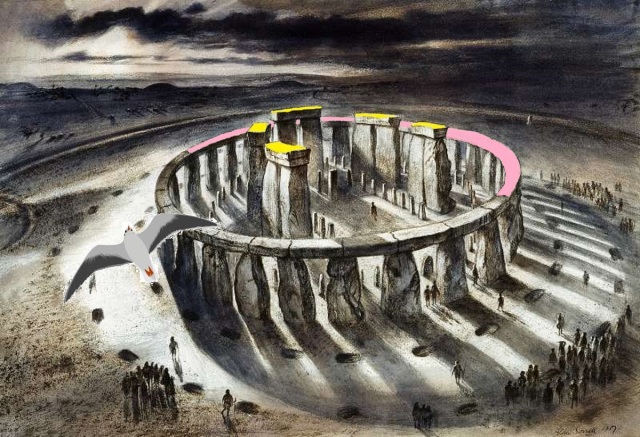
I say Stonehenge was designed as a giant bird perch, a ceremonial monument dedicated to ‘sky burial’, i.e. soul release from mortal remains to the heavens via AFS (avian-facilitated skeletonization, considered the height of fashion (and practicality) in Neolithic-era 2500BC! The stripped remains were then cremated, so an apt description of Stonehenge might, as previously suggested, be PRE-CREMATORIUM.
I've decided to add this latest image of mine as an update to ALL my Stonehenge postings (some 24 in all, here and on my specialist Stonehenge site). Why not – since it’s my considered answer to the ‘mystery’ of the monument’s peculiar architecture, the conclusion to some 6 years of deliberation?
I say Stonehenge was designed as a giant bird perch, a ceremonial monument dedicated to ‘sky burial’, i.e. soul release from mortal remains to the heavens via AFS (avian-facilitated skeletonization, considered the height of fashion (and practicality) in Neolithic-era 2500BC! The stripped remains were then cremated, so an apt description of Stonehenge might, as previously suggested, be PRE-CREMATORIUM.
The sills of the inner 5 trilithons have been colour-coded yellow, while pink has been used to partially colour-code the outer stone circle (believed to have once been continuous as shown in this artist's impression from an English Heritage site). In addition to the colour-coding, I've also added a token gull (sorry it's upside down!).




http://www.ancient-origins.net/comment/18675#comment-18675
A full posting will follow in a day or two. Suffice it to say I reckon there's a simple rationale for all those standing stones, without or without lintels.
They served simply as perches for scavenger birds (crows, ravens, seagulls). What were they scavenging, within a Neolithic funereal context (excarnation, sky burial). Go figure.
The ideal material for a bird perch is one that is easily cleaned (non-porous rock...).
Colin Berry