Showing posts with label sand bed. Show all posts

Thursday, March 27, 2014

Dear critics. Please be on the look-out for a Mark 3 model for how the Shroud image was produced (the “pseudo-bas relief”/sand bed model).


There have been two interesting responses from (gastroenterologist) Steve Hammond and (pharmacist) Mike M- see tail end of previous posting re the chin level crease on the TS. (I maintain the latter gives important clues as to how the image was imprinted).

Rather than respond to them in detail (which I was minded to do, but am presently a bit pushed for time) I’ll simply say this.

The objections they raise would be serious ones if the model I propose for Shroud imprinting were either of the two  previously described, set in concrete. But they are not,  (phew, with a single bound he was free) since for some time I have been moving towards a third model that constitutes effectively a fusion of the two, i.e. incorporating elements of both in such a way as to address suspected weak points in both AND provide an important plus point.

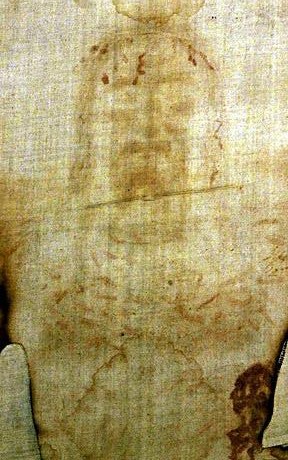
What prompted the new thinking? There were a number of things, but this particular image below from shredstory   shroudstorydotcom that I referred to (and recommended recently) probably lodged in the subconscious and began gradually to link up with other inklings:

It's the way that face appears to be semi-embedded in a plane (or should one say plain?????), that appearance being accentuated by the oblique viewing option thoughtfully provided  by the ImageJ software).

I hope my two thoughtful critics won’t mind if I use this post to flag up the genesis of a new “improved” model, one l which I consider can provide satisfactory answers to their reasonable and indeed perceptive objections, but leave the details for a day or two, once they have recognized that this blogger’s ideas are evolving by the day. (And sometimes it takes a little flak to move things along at maybe a faster pace than I might have wished!).

The gist of the two objections to my “baked-in crease” idea was as follows. First the allegedly baked-in crease (one of them) extends beyond the body image onto supposedly blank image-free background where there is presumably nothing behind the linen to provide either a hot surface or resistance to imprinting pressure. Second, the twin track crease, with a pale centre, still has some coloration in the central area, suggesting it did not escape scorching through being out of direct contact with hypothetical hot template. Why not?

OK, here’s a hint to the way my thoughts are now going  (just a hint in case I change my mind). If things gel after looking at more images (newly enhanced Shroud Scope and Shroud 2.0)  I will hopefully have something more concrete to say in a day or two.

First: the Mark 1 model, proposed on this site over 2 years ago, was described as the ‘sand bed model’. Linen was placed over cold sand, and the hot template thrust in from above, with semi-yieding sand providing resistance and thus contact pressure. But there were drawbacks (temperature control, not  knowing the progress of scorching, too much risk of over-scorching or getting edges that were too well-defined, not “fuzzy” etc etc ).

More recently, I turned that mechanism on its head, literally, by proposing the 'LOTTO' model.  There, the heated template was laid on a support, linen was spread on top, then a damp overlay (e.g. sacking) and the latter then patted around the highest relief of the template. That made for easier temperature control (being judged by finger tips), the ability to mould linen manually around relief, and a fuzzier end-result, confirmed by experiment.

But there is still a drawback using either of these methods – excessive imprinting of the sides of a 3D template (unless a customised bas-relief were fabricated and used) with unsightly lateral distortion.

The new model combines elements of the two. I call it the “pseudo-bas relief” model (hint hint) , in which an essential role for a sand bed (or similar) is restored.

I believe there is corroborating evidence on the TS image for a role for some grainy material (like SAND)  in the imprinting process, one that might meet the objections raised by my two sharp-eyed critics. Be on the lookout for another posting in the next few days. First I must do a belated short posting on the three-instalments Psychology Today attack on Shroud pseudoscience, and bemoan yet again the not-fit-for-purpose Google search engine.

Monday, February 6, 2012

Why does the Turin Shroud appear to have scorched-in crease marks? Tell-tale signature for medieval forging?


 The standard model - linen draped loosely over the body contours

I had an idea this morning while out on a stroll. Most of the Shroud literature refers to a cloth that is loosely draped over the supposed body of the crucified  Christ. That is then the starting point (all too often) for some frankly amazing speculation about an image being projected onto a cloth (Quite how that is supposed to happen without an imaging system – converging lens etc – or a source of (non-supernatural) radiation is anyone’s guess). Some even seem to imagine that loosely draped cloth being at least momentarily and miraculously spread out flat immediately prior to capturing the image, or so it would seem when one encounters references to "foreshortening" and other effects borrowed from photography and optics generally.

But my model, or rather John Jackson’s plus a supporting bed of sand (the latter being my finishing touch –  does not have a real person, 1stcentury AD or otherwise, but a metal replica, e.g. a bronze statue, one that is heated and then thrust DOWNWARDS with a degree of force into the linen with that all-important backing bed of sand. 

Now think about it: a loosely draped-over sheet creates at most gentle folds, without creases, but being forced into a bed of sand where the cloth gets pushed first this way, then another, is likely to create creases. And those creases, or at any rate some of them, might be captured for all time, so to speak, were they to be forced to make contact with hot metal and then scorched along the new apposed edges. Where would such creases be most prominent? Surely over those parts of a bronze where there is the most abrupt change of relief, e.g. at the end of the chin? 

I could not wait to get home and have another look at the Shroud images. Somewhere at the back of my mind was a recollection of having seen just such creases.

Hallelujah – exactly as predicted. There are indications of prominent crease-like marks in the head region alone – one at the base of the chin, and one where the temple turns through almost 90 degrees to become the top of the head (the latter being un-imaged – worthy of a post in itself). 

Negative image (as seen by eye). Note prominent line at chin level, and a fainter one at the top of head


Here's a comparison of negative v positive images. Both lines are now clearly visible.


Obviously I am restricted to available images of the Shroud, but is there any other useful information that might be gained by looking at those crease-like marks at greater magnification?

Here’s a close -up:


 Seems to be a double-track, like a railway line, rather than a single line

Further magnified
(Note the interesting extra kink in the middle that widens the "track")

Notice that the mark is a railway track-like feature with two outer dark lines and a lighter space in-between.(That's "railroad track" in US parlance).  The dark lines are presumably the result of the same scorching process that produced the main image - the one I call thermo-printing. The intermediate light area is presumably a non-scorched intermediate zone.   Already, and possibly prematurely, I found myself wondering about the geometry of creasing, i.e. which is “inside” and which is “outside” on that crease. Having done so, back-of-envelope style (I reserve the right to have second thoughts) and this being a blog that describes a journey, not the final destination, which incidentally I shamelessly edit and re-edit, I decided to go for broke and add a last paragraph.

Here’s a little piccy I’ve just knocked off on MS Paint to indicate how think those two crease (?) marks could have arisen in a sand bed model. The linen has got rucked slightly to form invaginations, i.e. “creases” in common parlance (sorry ladies, but that seems the most apt appropriate terminology) the U-shaped  interiors of which are protected from conducted heat by slight separation from hot metal, so would appear as that white strip between the two parallel tracks when the cloth is flattened out. 


 Modelling the origin of two scorched-in creases in the Turin Shroud: green - head of heated bronze effigy; white- linen shroud; brown - scorch mark (note two interruptions); blue - cold spot in crease; yellow - sand bed

The aim is to illustrate beyond any shadow of doubt that a 3D object pushed into sand-supported linen can produce scorched-in creasing around major and abrupt changes in relief, and importantly ONLY at those regions.

Conclusion: I regard those two crease marks as evidence for the image having been formed by applying force, consistent with my thermo-printing model, especially with a backing bed of sand. The scorched-in creases would seem to me to be inconsistent with any model that has fabric loosely draped over a 3D subject – living, dead or inanimate. Now please refer again to the title of this post.  Are those creases not a signature for the Shroud having been produced as a forgery, using a replica, e.g. bronze statue, of the crucified Christ?

Postscript: some further predictions that could be made from the sand bed model (although the fourth, a late addition, is perhaps more by way of explanation than prediction):

1. The weave would show greater separation, i.e. stretching,  of yarn fibres  - warp and weft - over the prominences of a metal effigy - the bridge of the nose etc.

2. There could be adhering or impressed sand (?) particles on the reverse side of each image region.

3. Image regions could have traces of metal oxides, eg those of copper and tin if a bronze effigy had been used

4.The ventral (frontal) image would have to inconveniently end at the tip of a toe with no surplus sheet beyond the foot  - since an overlong sheet would have risked imprinting both sides of the feet (think how it would respond to pushing into a sand bed)!  It does seem odd that the Shroud ends precisely at a foot in both ventral and dorsal views, which is somewhat unexpected, is it not? Would one not expect a burial cloth to have had sufficient surplus at the two free ends to permit easy sewing up.  The total length (over 14 feet) of linen was surely sufficient to allow that?

I have always felt there was something not quite right about the position of the feet, right at the end of the Shroud).