Showing posts with label avian-facilitated skeletonization. Show all posts

Friday, May 13, 2016

Was the Mark 1 Stonehenge, initially Chalkhenge, ingeniously designed to attract hungry crows and gulls at the crack of dawn? Why? Pre-crematorium?


Summary

Forget all the tosh about Stonehenge being a temple. Long before there were any stones, there was a laboriously excavated chalk circle, comprising a ditch and adjacent heap of spoil, i.e. raised bank, the two being collectively termed a “henge”.


Here's an artist's impression of the simple henge at Avebury, Wiltshire, comprising the ditch/bank excavation of chalk subsoil (left) preceding the installation of standing stones (right).  See this blogger's modelling of the crucial SHADOW-CREATING EFFECT OF THE BANK at dawn especially (below).


Preview: modelling 'Chalkhenge'  and its shadow-creating potential with low-angle dawn sunlight coming in from the right. (The pink disc is just 2mm thick!). See below for more details of this simple experiment.

Henges must have had a purpose, even if archaeology seems largely uninterested in why there were - and still are - so many henges dotted across Britain. 


BBC feature from 1999 on Seahenge (despite there having been no henge, merely a timber circle and that central inverted tree trunk -almost certainly an AFS site.).

In fact, archaeology even seems uninterested in the timber poles that appeared  within the chalk circle at Stonhenge BEFORE any standing stones, despite timber poles atSeahenge (still surviving to this day) having a fairly obvious purpose alluded to briefly in the 1999 BBC report. (Shhh. Don’t mention the E word, or animals that have wings – and sharp beaks).

This blog post tells you what archaeology is not terribly keen for you to know about the proto-Stonehenge, indeed the Non-Stone-henge, the simpler Chalkhenge, preferring to hurry you along to the megaliths, with a narrative in which the word “temple”  is invoked, even pre-cathedral, with much about pre-Druids, early pagan ritual etc etc.  This blog post is about the initial role of Chalkhenge, the same as that inferred for numerous other sites with a few human bones, sometimes “cremated bones” as at Stonehenge. But it was almost certainly not the energy-wasteful whole-body cremation requiring a huge pyre of bone-dry timber (tarpaulins being unavailable). It was end-stage cremation of the deceased following what might be termed “avian-facilitated skeletonization” (AFS). Yes, we’re talking about “sky burial”, or, as archaeology generally refers to briefly in passing (if at all) as excarnation, or defleshing. Chalkhenge (proto-Stonehenge) was cleverly designed to attract the right kind of scavenging birds, one that could  quickly reduce a body to a near-skeletonized state, one that could then be quickly and efficiently end-cremated to noffensive minerals (cremated bone being little more than calcium phosphate, the stuff that gardeners use as fertilizer).

Here’s a brief account of an experiment I have just done, this very morning, to model Chalkhenge using white flour. ( I am developing a soft spot for flour, it having provided a solution to the Turin Shroud, starting about a year ago).

Here's  an artist's impression of "Chalkhenge"  which I've photographed from the English Heritage guide to Stonehenge (Page 33, "The First Stonehenge").

  
The bright spot is the refected camera flash, but is fortuitously at the major entrance, the one that faces north-east. It's from that direction (north-east) ones sees the sunrise at the summer solstice. (Thanks to Judith Dobie?)

Here's the same image swung round to orient the entrance "north-east", with the ground-skimming incoming first light of day from the horizon shown by the yellow arrow. See the publisher's guide to compass directions (lower right, yellow rectange). The yellow is my addition.


It's the image directly above that I set out to model, using a torch to simulate the rising sun.

Place inverted saucepan on board. Sprinkle flour around the circumference. Remove saucepan.

Angle the  torch to represent the instant of sunrise (the summer solstice providing the ideal geometry). Note how the henge bank creates a zone of shadow that better demarcates the illuminated zone within the circle


Here's a close-up of the above, with a little photoenhancement.


One need hardly say that anything placed in the central zone would be highly conspicuous, not viewed from ground level outside the henge, but from above, e.g. by a hungry bird!

And what might that something be?  Do I need to spell it out? Yes, the body of a newly-deceased individual, intended for "pre-cremation". Attract the scavenger birds at the crack of dawn, so as to make maximum use of daylight (assuming that birds are probably not nocturnal feeders for fear of ground-based predators).

In the model thus far, there is nowhere for the birds to roost or feed on stripped flesh except on the crest of the henge. The next step in the evolution of Stonehenge was the installation of timber posts (see the EH guide for the complex multi-stage history of timber insertion which may or may not have involved the ring of so-called Aubrey holes close to the bank).

I'll stop here for now. Google will probably ignore this posting, the way it has my earlier ones, preferring to grow Google Search as a glorified trade directory, dedicated to the promotion of e-commerce and Google's bottom line.

Regard this posting  then as mainly archival (initial instalment).  What you see so far is the nucleus. Immediate afterthoughts will be added under Comments, if only to prime the latter and encourage readers to place their own comment here rather than elsewhere.

I may return in a few days to add substantial new content here. but won't do that right now, knowing or at least suspecting it will scare off the finnicky search engine crawlers that prefer to have everything set in concrete from the word go on the assumption we're all peddling a commercial product and need to present a  polished fait accompli at first attempt.

Sorry, I'm a retired scientist. I don't do the fait accompli. Everything is a work in progress. It's the nature of research - venturing into uncharted territory. What a shame, nay scandal,  that Google and the other search engines fail to make allowance for that fact, treating us all as if scam artists, despite track records going back for hundreds of postings over a decade or longer (longer in my case). Why is so much of the internet in the hands of a certain brand of creepy, controlling Californian?

 Nope. This blogger is a humble seeker after truth, and if the truth be told, neither Stonehenge, nor a myriad of other henges were intended as "temples" or "pre-cathedrals" as so many in 'mainstream' archaeology would have us believe (or worse still assume). Stonehenge was certainly designed as a pre-something in my humble opinion - ingeniously so if my model above is correct.  as I believe it to be. The proto-Stonehenge was designed as a pre-crematorium, letting wildlife on the wing do most of the defleshing of the dead, saving crematiion as the final clean-up stage. Relatives could then be presented  with  a compact package of clean hygienic remains either to inter on site if  permitted to do so  (there being no shortage of cremated bones at Stonehenge) or to take away for storage and veneration elsewhere, confident in their assumption that AFS had freed the spirit from the corpse. It's not so very different from modern-day cremation when one thinks about it, except for the way no one dwells on the details of what happens inside the gas-fired incinerator whereas "excarnation" , on the rare occasions it reaches the MSM, still attracts adjectives like "grisly", "gruesome", "bizarre" etc, That's despite the likelihood of the sharp end of the procedure having been overseen by a specialist cadre of hardened professionals , protected from public gaze by the henge banks at least, and later by a forest of timber posts, and later still, those final standing stones...,


Addendum: March 16, 2018

 I've decided to add this latest image of mine as an update  to ALL my Stonehenge postings (some 24 in all, here and on my specialist Stonehenge site). Why not – since it’s my considered answer to the ‘mystery’ of the monument’s peculiar architecture, the conclusion to some 6 years of  deliberation?
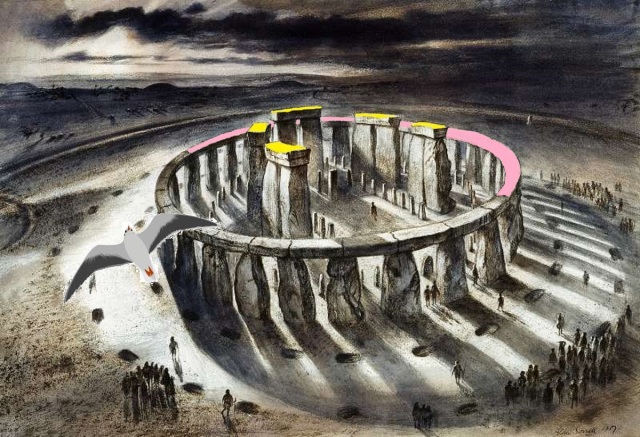


I say Stonehenge was designed as a giant bird perch, a ceremonial monument dedicated to ‘sky burial’, i.e. soul release from mortal remains to the heavens via AFS (avian-facilitated skeletonization, considered the height of fashion (and practicality) in Neolithic-era 2500BC! The stripped remains were then cremated, so an apt description of Stonehenge might, as previously suggested, be PRE-CREMATORIUM.

The sills of the inner 5 trilithons have been colour-coded yellow, while pink has been used to partially colour-code the outer stone circle (believed to have once been continuous as shown in this artist's impression from an English Heritage site). In addition to the colour-coding, I've also added a token gull (sorry it's upside down!).

Saturday, May 7, 2016

Thanks Energyman: the lintels of Stonehenge would indeed have protected sky burial birds from ground-based predators.

Latest comment on the Megalithic Portal site re this blogger's theory for Stonehenge etc:


Energyman: "Well yes, and if you take it a step further, the horizontal lintels of Stonehenge would offer a superb 'sky burial' platform away from ground feeders". My reply: hearty approval...


Next posting? Seahenge - surely the clincher where Stonehenge is concerned. They probably used the same avian species too - the seagull - for the purposes of AFS.

There will also be a flyer for my hunch that a certain Neolithic site in S.E.Turkey, reckoned to go back to 9000BC or earlier (!) and described as the "first temple" was in fact a site for AFS. That would explain all the T-shaped pillars (bird perches!!!)  the carvings of assorted predatory and scavenger wildlife, vultures included.

Here's my comment placed this morning on the Megalithic Portal site:

Re: Signs of world’s first pictograph found in Göbeklitepe (Score: 1)
by ColinBerry on Sunday, 08 May 2016
(User Info | Send a Message)
Yes, it's an excarnation site. That was my first thought when seeing the layout with those "T-shaped pillars" read bird perches and concentric dry stone walls, reminiscent of that site in the Golan Heights investigated by Rami Arav. I can't for the life of me understand why it's being described as "the first temple" when there are vultures in the ornamental artwork!

Was Seahenge a temple?

http://news.bbc.co.uk/2/hi/science/nature/388988.stm

What that article omits to mention is that the gull probably served as a substitute on the Bronze Age Norfolk coast for the vulture, equally effective for AFS (avian-facilitated skeletonization), my prefered term for excarnation, provided one could attract a sufficient horde of frenzy-feeders (thus the multitude of timber posts to serve as perches).


The site in question "Göbeklitepe" bears a name that translates as "potbelly hill"!

Finally, there's a third site that is interesting this blogger right now, one that is causing some out-of-the-box thinking. It's the Ring of Brodgar and the nearby Ness of Brodgar with the stone walls. A commentator on the Megalithic Portal site had cited the Ring of Brodgar as evidence that Neolithic man could hew his way through solid rock with nothing except antler picks! (He omitted to mention that mauls - rounded stones- were used at least for shaping rock, like those monoliths at Stonehenge). Well, I have an entirely different explanation for how and why that ditch in the "solid sandstone" was created, and it did not involve cutting through solid rock. I can also account for why there's no accompanying bank of excavated "rubble", there being rubble and rubble.  Not all rubbles were born equal!  I may do a separate posting in the next week or two, setting out these totally new ideas (or so it would seem from googling) and ask Prof.Jane Downes and her colleagues at the Orkney Archaeology Institute to take a look and give a frank opinion. Nothing ventured, nothing gained.

New update: Comment addressed to energyman on the Megalithic Portal thread:

ColinBerry


Joined:
03-05-2016


 Posted 08-05-2016 at 17:08   


See my current posting, energyman, with thanks, nay relief, that there are kindred spirits out there. willing as I am to 'go the extra mile', sorry kilometre, albeit at the risk of occasionally going in the wrong direction (nothing ventured, nothing gained).

(Link to this posting)


There's also a partial response there (OK, a tease) to Runemage re the Ring of Brodgar.

Nope, the ditch was not cut through "solid" rock. It was created by forceful delamination of stratified sandstone, deploying a patient, resourceful if somewhat slow combination of Mother Nature, read frost action, and gentle leverage. The compact uplifted small slabs then found a use nearby (thus no bank of rubble!).

You read it here first! More later. 

Wednesday, May 4, 2016

The true purpose of Stonehenge was avian-facilitated skeletonization, aka "sky burial" (which we don't hear from either English Heritage or the UK’s squeamish media).


Stonehenge, Avebury Henge and their stone circles, indeed henges and standing stones generally,  were ALL places designed to attract and retain scavenger birds – the kind that could efficiently skeletonize* the newly dead.

Stonehenge and visitors

The following landscape and monumental features can ALL be seen to have served a common utilitarian purpose unrelated to religious ritual, pagan worship etc – providing the scavenger birds (crows, gulls etc) an elevated place on which they could perch and feed, ensuring they felt secure, safe from predators:

1. Raised banks of the initial henges
2. The standing stones (which many consider were preceded by makeshift timber circles)
3. The crosspieces of dolmens
4. The lintel crosspieces of the massive Stonehenge trilithons.

Yes, put baldly, they all functioned, initially at any rate, as bird perches (single standing stones) or bird tables (trilithons with cross-piece lintels).The dead were probably laid out on the ground in the central area, probably screened-off  (see below) for skeletonization. Alignment of stones with summer and winter solstices? Some think with good cause it was just an accident of geomorphology (more later).

*I prefer the word “skeletonize” to “excarnate”, and especially to “deflesh”. It focuses on the desired outcome, as distinct from the means by which it was achieved. “Skeletonization”  will hopefully give the role attributed here to Stonehenge etc. a better reception in the media than the one seen thus far,  with bandying around of unhelpful adjectives like “grisly”, “gruesome”, “bizarre” etc.

Skeletonization via scavenger birds was simply the Neolithic equivalent of present day cremation. One does not dwell on the details as to how burial or cremation converts flesh and bone to bone only, so why do it for avian-facilitated skeletonization in the low-tech Neolithic era 4,500 years ago when there were no metal tools for digging graves, or lopping branches off trees for firewood?

Skeletonizing of the dead continues to this day, for a variety of legitimate purposes - scientific, educational, forensic etc etc, as the cropped image from the above commercial site shows.

Is it because it’s imagined  (mistakenly) that “sky burial”  (avian-assisted skeletonization) exposes the dead to public view for the duration of excarnation? Why suppose that, given that Stonehenge and Avebury were both enclosed in  (interrupted) circular chalk banks, surviving to this day, laboriously excavated from the adjacent ditch, the henge serving to screen off the central working-area of the site to all but specialist operatives (“mortuary attendants”)?

This will do for starters. At leisure, starting tomorrow (May 4) I shall be adding illustrations showing the supposed developmental stages of Stonehenge which strongly support its role in the first instance as a 'centre for skeletonization' of the newly-deceased. Many will be taken from the splendid site whose Home Page you see immediately below:

Chris Collyer's splendid site.

Second instalment Thur May 5:


Apols for the fuzzy captions. The graphic on the left is an artist's impression of the forerunner of a standing circle (Avebury in this instance)  namely the henge, i.e. a ditch and bank of excavated chalk. Purpose? We're not told, but it can hardly be defensive when the bank is on the outside, not inside. The schematic on the right is a bird's eye view of the corresponding henge installed 25 miles to the south on Salisbury Plain, the one we call "Stonehenge" oddly enough, where in this instance the major bank is inside the ditch. Aubrey pits aka holes? They will be addressed shortly. First let's take a look at a site in the Golan Heights that gives a clue as to the REAL purpose of the Neolithic henge, regardless of relative placement of ditch and bank.

Rujm el-Hiri in the Israeli-occupied portion of the Golan Heights.


Not for nothing has what you see above been called the "Stonehenge of the Levant" (see wiki entry) albeit with less-well established aligment with the solstices, that it was a place of worship, a burial place for the dead, surrounded by hundreds of dolmens (a mirror of Stonehenge's round barrows?) etc etc.  Sound familiar:  no end of speculation, but all somewhat vague and half-hearted, with little or nothing by way of sustained argument. 

It's the concrete views of US-based archaeologist  Dr.Rami Arav, a kindred spirit, expressed in Popular Archaeology back in 2011  that are one's that need to be flagged up (my bolding):

In an article published in the November/December, 2011 issue of Biblical Archaeology Review, Dr. Rami Arav, long-time co-director of the Bethsaida excavations northeast of the coast of the Sea of Galilee and Professor of Religion and Philosophy at the University of Nebraska, Omaha, has proposed that the site was built for both funerary purposes and as a means for "excarnation", the removal of flesh from the bones of the deceased for placement in ossuaries, or bone boxes, by the ancient Chalcolithic inhabitants of the area.  He begins his argument with a description of these small clay ossuaries discovered in the hundreds at various archaeological sites dated to Chalcolithic times.  Unlike the mortuary practices of the Jews in the Jerusalem area during the First Century B.C and First Century A.D., when the deceased were allowed to decay away to their bones for a year in rock-carved cavities in burial caves before deposition of the disarticulated bones into ossuaries, there is no evidence indicating how the earlier Chalcolithic peoples of the Rujm el-Hiri area reduced the bodies of the deceased to bones for placement in their ossuaries.  He suggests, based on the anthropological record of excarnation or "sky burial" practices of various cultures and civilizations, as well as his interpretation of archaeological finds at various sites, that the flesh of the bodies of their deceased were permitted to be consumed by birds of prey, specifically vultures, which can divest a body of its flesh within hours.  He points, for example, to the ancient Zoroastrian dokhmas, or "towers of silence", whereby vultures would eat away the flesh from the bones of the dead placed on raised platforms, at least partly as a means of protecting the soil environment from pollution by decaying bodies.  He suggests that the concentric walls of Rujm el-Hiri, which were built at progressively lower heights toward the central tumulus, allowed for vultures to easily view the laid-out bodies from their perches atop the walls.  After the vultures did their work, the bones could then be freed of their flesh and disarticulated and placed in ossuaries, many of which were designed like houses or miniature granaries or silos.
Note the close correspondence between a circle of heaped stones in the above photo, and the heaped-up chalk of the typical henge in Wiltshire. Were that the only correspondence, the case for both having a role in 'skeletonizing' of the dead would be weak. But EACH site offers supportive evidence for such a role that few if any have attempted to account for in those other narratives to do with pagan rituals, worship, cults of the dead etc etc. Arav has pointed out that the heights of the 5 concentric stone circles decreases towards the centre, ensuring that perched vultures are always  assured of an unobstructed line of sight. Well spotted, Dr.Arav. So what can Stonehenge offer that can match that kind of persuasive albeit circumstantial evidence?

Well, there's the placement of the bank inside outside the ditch at Avebury, allowing proximity and clear view (but only if  permitted by site guardians to first surmount the slope!) . But there's only the one henge, not a concentric series. However, there's something at Avebury (and Stonehenge) that the Golan site did not offer, which is an alternative choice of perch locations, superior ones to the crests of chalk banks one might feel, namely timber posts, later to be followed by standing stones, for which no coherent explanation has been offered other than  (yawn...) "ritual".


Ah yes - timber posts. They get a tentative mention early on (and at plenty of other sites close to Stonehenge, the appropriately named Woodhenge especially, about which more later). Here's another artist's impression from the Chris Collyer site:

Yes., it's strongly suspected that  the so-called Aubrey Holes (or pits) named after their 17th century discoverer first had timber posts at the start of their chequered history, as shown above. Now why put in timber posts? They are hardly architectural features, comparable to the bluestones that followed.

Thinks, what possible purpose might timber posts have served? Might Mother Nature provide a clue, one that exists to this day?

Standing room only (or perching as the locals would say)

 Third instalment: Friday May 6

Today's task will not be easy. I will attempt to summarize what English Heritage refers to as Stonehenge's "timber phase" in its tourist guide.

From "Stonehenge", page 34 (English Heritage). Please ignore my earlier colour-coded highlighting - for personal convenience,


Why not easy? Because on close reading one finds there were at least 3 different timber phases and/or timber locations, each with its own particular complexity and uncertainty.

But let's waste no time in making a serious criticism of English Heritage: despite describing Stonehenge from Page 1 as "Britain's greatest temple", nowhere, I repeat NOWHERE, does it attempt to explain why the standing stones were preceded by timber, and/or why timber was considered appropriate for something that was a "temple" as distinct from serving some more mundane role that was then continued in more durable form with stone instead of timber. I say EH is attempting to impose a cramping narrative, which it has no business doing. It's role is stewardship (which most visitors consider leaves much to be desired) NOT the proselytizing of a vague, unsubstantiated  airy-fairy narrative that attempts to impose or prempt alternative interpretations.

But Stonehenge is surely a place for pre-Christian worship of the sun, given the alignment of the the standing stone circles, the Avenue etc?  It's surely a "temple", an unquestionable given?

Nope: Read what the fleeting reference in the EH tourist guide (page 33) has to say (my bolding):

"Recent excavations have provided the first clues as to why Stonehenge is located where it is. The Avenue may originally have been marked by parallel natural gullies created at the end of the last Ice Age, which were visible in the landscape and coincidentally aligned on the winter and summer solstices.  There is also the possibility that the Heel Stone is a rare local sarsen, discovered very close to where it now stands. A combination of these two striking natural phenomena may well have provided the impetus for the work that followed."


Apols for not getting back today to complete the 'timber phase'. Apart from being out visiting old friends with a rural location, a crop of comments has appeared on the Megalithic Portal site addressed to this blogger's theory re Stonehenge, which I'm now inclined to refer to as AFS (Avian-Facilitated Skeletonization). See the site for comments/criticisms and my response.

Yes, AFS (Avian-Facilitated Skeletonization) - the key to understanding the existence and purpose of Stonehenge and similar sites (Avebury, Woodhenge and possibly much further afield). Consider it a more scientific version of "sky burial", again without specifying the precise agent that converts a body into a skeleton.

But if someone has a funeral urn in their modern-day home for preserving the cremated mineral remains of a loved-one, do we immediately round on them for perpetuating an ancient barbaric practice, laced with those terms so beloved of our media like "gruesome", "grisly", "bizarre" etc, with references to "defleshing of the dead"? No. We don't. So shame on our rush-to-judgement media for their attempts to besmirch a Stonehenge-era funeral practice that was closely related to modern day cremation, albeit using unsophisticated biotechnology in place of modern high-temperature technology. Indeed,  I suspect they probably deployed cremation as an end-stage, ie. incinerating the incompletely-isolated skeleton as a final clean-up rather than entire body, it being far more economical and less polluting.

Who said some methods of disposing  of the dead were easier and more aesthetically pleasing  than others? No one that I recall. There are no easy options, and the options in 2500BC were more restricted than they are today.

You just can't get the journalists these days....

Saturday May 7

Change of mind. this posting is long enough as it is, and in any case I've had my time cut out responding to the 10 or so comments thus far on the Megalithic Portal site.

The priority right now is not delving into the complexities of Stonehenge's timber precursors, which attract no interest or speculation whatsoever from mainstream archaeology. It's getting across the basic message arrived at thus far, spelled out on the Megalithic Portal site, namely that what took place at Stonehenge, Avebury and other associations of outer henge with inner standing stones was essentially AFS (avian-facilitated skeletonization, aka sky burial) probably in most instances with a final cleaning up via TFS (thermally-facilitated skeletonization, aka end-stage cremation of bone, largely depleted of soft tissue).

 I shall also be setting out formally the reasons why the new hypothesis/theory fills in numerous gaps in our understanding of the various Neolithic sites. (That's historic, not internet sites). Everything as they say now falls into place (at least for this jaded science bod, long accustomed to being wrong-footed and fed fake narratives - ones that are more by way of lazy or wishful thinking than serious analysis based upon hard evidence).