There remains a deadly silence as to the precise mechanism by which the, er, 'non-obscured' parts of the image came to be imprinted, though it's apparently something to do with radiation (usually unspecified). Sorry, I'm only here for the science, and refuse to discuss the Shroud except with those who are prepared to offer some kind of model that does not defy the basic laws of physics and chemistry. Let them nitpick my model (contact scorching from a hot lifesize metal template) to their heart's content, claiming that it fails to explain every minute detail of the Shroud image at the macroscopic or microscopic level. Those details in my experience are poorly if at all documented, and are all too often reeled off mantra-like, rarely if ever qualified with the indisputable fact that the TS image is many centuries old, so one can't expect it to look like a model scorch, created in a laboratory (or my kitchen) in the last few days or weeks.
What I have done thios morning is take another look at the feet on the Shroud's frontal image using Shroud Scope, applying my now standard procedure of increasing the image contrast. Result: I think I can see feet, correction, mainly the toes viewed almost orthogonally from the main body plane - exactly as one might expect from the human body or an effigy thereof. In other words, feet protrude from the heel roughly at right angles with the legs and torso, and that remains true when a subject, living or dead, or cast or sculptured representation thereof, e.g. bronze statue, is recumbent. My contact-scorch model obviously has to account for the image characteristics of the TS, and I do believe it does, as the following photos, taken just a few minutes ago will reveal.
Where shall we start? Model scorch or Shroud Scope?
Let's do the model first. It's easier to take in the detail when one has template and scorch imprint side-by-side.
 |
Model scorch v brass crucifix side-by-side. Click to enlarge. Note the way the tips of the toes are imaged (not entire feet).
Now let's have a look at the imprint of those toes in close-up
 |
| It's the tips of the toes that are best imprinted, with a mere hint of rest of the toes and feet. |
Now let's look at the entire frontal TS image at maximum contrast in MS Office Picture Manager. This is the Durante 2002 horizontal image from Shroud Scope.
 | ||||||
| At first sight, one could be forgiven for thinking that one of the feet is missing, and the other hard to make out, i.e. "obscured" in some fashion. |
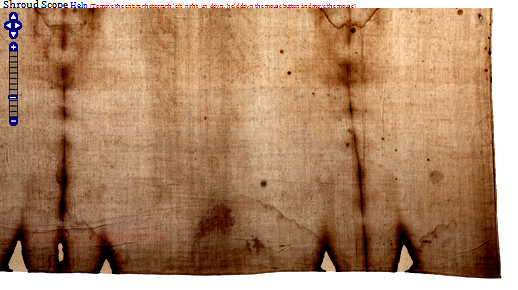 | ||||||||
| Here are those lower legs and feet magnified (image now turned vertical|) Note carefully the red brown areas at the very end of the fabric, beneath the bloodstains. What is responsible for that coloration, dare one say 'scorch-like'coloration? |
 | |||
| Here's the same at higher magnification. Note the presence of a dark-light-dark-light alternation of red-brown coloration close to and parallel with the lower edge of the TS. (Note too the annoying presence of some longitudinal banding that accentuates image intensity - a well-known effect ). |
Would I be correct in my supposition that most see that red-brown coloration as some kind of smearing out of the image of the feet, due to accidental scorches acquired in the Shroud's history, assisted perhaps by water damage? Would I be correct in thinking that few if any have looked at that red-brown region in the past and said "Ah yes, one can see the imaging of toes, albeit bunched toes, especially the tips of toes?
 |
| Region of interest inside blue rectangle (putative imaging of the extreme tips of toes). There are corresponding 'jointed' regions above the rectangle that are probably the less distal parts of toes. |
I'll be subject to the usual charges of "patting myself on the back" if I say that I see tips of toes, intensely red-brown in colour, because I have an advantage over most others - namely a model, one that also shows clearly how tips of toes can come to be imaged, in contrast with the rest of the toes and feet where there has been poor contact between cloth and template.
 |
| Here's another at maximum magnification in which I have tweaked the settings in MS Picture Manager in an attempt to optimise the differentiation with respect to background and/or bloodstains of those interrupted areas of red-brown image density, i.e. "toes". Click to ENLARGE. |
Now there are all kinds of caveats, needless to say. Some of the distribution of image (dark-light-dark etc) appears to correspond with longitudinal banding, perhaps due to batch-to-batch variation in yarn for whatever reason (bleaching differences etc). But that banding is unlikely to account for all, or even a substantial fraction of the image intensity.
Then there are the methodological aspects. Even with scorching from a template, there are different ways in which it can be done to get better or worse contact between fabric and all the contours. In the above imprinting from my crucifix I used my 'Mark 1' procedure that involves pressing the heated template down into fabric (cotton on this occasion) with a soft yielding underlay. That method tends to produce tenting of fabric between prominences so one sees gaps in the image (but then there are gaps in the TS image too). I did not use my Mark 2 "LOTTO" method in which the template is laid onto a surface, and fabric placed on top, manually moulding the fabric through a protective overlay to the desired features, maybe some, maybe not all.
Irrespective, the take-away message of this posting should be clear. No, the feet are not completely imaged, but for reasons to do with the 'awkward' nature of the feet being orthogonal to the longitudinal plane of legs and torso.
The linen of the TS failed to make contact with the main part of at least one of the feet, whereas good contact was made with the tips of the toes of BOTH feet.
 |
| Orthogonality rules, OK? |
The linen of the TS failed to make contact with the main part of at least one of the feet, whereas good contact was made with the tips of the toes of BOTH feet.
My scorch model is consistent with the empirical evidence that is there for all to see on Shroud Scope. What is more, it's been shown, after a fashion, to have predictive utility - I predicted that the toes would be imaged, when others are saying the feet are "obscured" by water stains etc.The ball is now in their court to explain how toes come to be imaged in their mechanistic models (assuming they have one).
I was going to add a section on a noteworthy feature - namely that the red-brown coloration is stronger for the toes than virtually any other part of the TS image, frontal or dorsal. That's except for the "beard", or should that be "bearded chin"? However, that would get me into some areas possibly even more contentious than those raised by this posting, so will be kept for another time.
Postscript 1: anyone here who is new to 'Shroudology' may be wondering why there is no mention of the feet on the dorsal image.
Answer: there is no problem where the imaging of dorsal feet is concerned. One sees clearly and unambiguously on Shroud Scope that it is the sole of at least one foot that is imprinted. Failure to see full imprints of both soles is usually interpreted as due to a crossing of the feet, with the suggestion that a single nail had been used in a crucifixion narrative to secure both feet to the timber work.
It is nevertheless a matter of interest as to how the soles of even one foot came to be imaged, given that it's the heels only of a recumbent 'subject' that make contact with the fabric. One has to envisage some surplus fabric being turned through 90 degrees so as to capture the image of the soles.
In my model scorch experiments with the dorsal side of the crucifix, I have images, either heels only, or heels and soles, depending on whether or not I wanted the soles to be imaged.
Postscript 2: Note that the first two 'toes' on the left are outside the water-stained area, and the 'ribbed' sequence (light-dark-light) continues into the stained area.
For a fuller exposition of this blogger's ideas re the Shroud of Turin, especially his 'hot template/contact-scorch model' see his specialist Shroud site:

Late addition: Sunday 8th June
I had rather hoped to reinforce the perception that the tips (at least) of toes were imaged on the frontal side of the Shroud. But when entered into ImageJ the results were disappointing, and I decided to dwell on it for a bit.

Note however that the image turns through right angles back to the base plane at the base of the shroud, close to those toes.
Independent work earlier today with split images and ruled lines convinced me that one "lost" valuable image due to this kind of edge effect.

Split image after 3D enhancement. Note "cut edge" with loss of border strip of image to vertical plane.
Might one also be losing image quality too, close to this turn-down of image? If so, what can one do to get those toes further from the edge of the shroud?
I tried overlapping the end of the shroud with mid-regions to avoid white space, but it wasn't terribly successful. Thus the hiatus while I had a think.
A possible solution occurred to me this morning, which was to create a mirror image of the end of the TS, and align the two as if two identical men were lying end to end, with feet almost in contact.

Here's the result of doing that exercise:

Note the two parallel ridges of "nobbles" either side of the central long axis. I do believe one is now looking at 3D imaged toes, or at any rate tips of toes, that are better delineated now that the edge effect has been dealt with.OK, so it's not entirely convincing, but better that there be something visible, or a mere hint thereof, than be left with the worrying thought that what one thought might be toes, if totally resistant to 3D imaging, might possibly be just smeared-out detritus of one kind or another.
Here's the same graphic, with an outlining of the toe region, with its mirror-image counterpart in blue. Sorry about the faintness of the lines.

Postscript 1: anyone here who is new to 'Shroudology' may be wondering why there is no mention of the feet on the dorsal image.
Answer: there is no problem where the imaging of dorsal feet is concerned. One sees clearly and unambiguously on Shroud Scope that it is the sole of at least one foot that is imprinted. Failure to see full imprints of both soles is usually interpreted as due to a crossing of the feet, with the suggestion that a single nail had been used in a crucifixion narrative to secure both feet to the timber work.
 | ||||
| Feet, dorsal image, with bloodstains. |
It is nevertheless a matter of interest as to how the soles of even one foot came to be imaged, given that it's the heels only of a recumbent 'subject' that make contact with the fabric. One has to envisage some surplus fabric being turned through 90 degrees so as to capture the image of the soles.
In my model scorch experiments with the dorsal side of the crucifix, I have images, either heels only, or heels and soles, depending on whether or not I wanted the soles to be imaged.
Postscript 2: Note that the first two 'toes' on the left are outside the water-stained area, and the 'ribbed' sequence (light-dark-light) continues into the stained area.
 |
| Black hashed line indicates boundary of the water stain. |
For a fuller exposition of this blogger's ideas re the Shroud of Turin, especially his 'hot template/contact-scorch model' see his specialist Shroud site:
Late addition: Sunday 8th June
I had rather hoped to reinforce the perception that the tips (at least) of toes were imaged on the frontal side of the Shroud. But when entered into ImageJ the results were disappointing, and I decided to dwell on it for a bit.
Note however that the image turns through right angles back to the base plane at the base of the shroud, close to those toes.
Independent work earlier today with split images and ruled lines convinced me that one "lost" valuable image due to this kind of edge effect.
Split image before 3D enhancement

Split image after 3D enhancement. Note "cut edge" with loss of border strip of image to vertical plane.
I tried overlapping the end of the shroud with mid-regions to avoid white space, but it wasn't terribly successful. Thus the hiatus while I had a think.
A possible solution occurred to me this morning, which was to create a mirror image of the end of the TS, and align the two as if two identical men were lying end to end, with feet almost in contact.
Here is the new contrived conjunction - the added yellow line being the junction. Note the mirror-image bloodstains above and below the line.
Here's the result of doing that exercise:
Note the two parallel ridges of "nobbles" either side of the central long axis. I do believe one is now looking at 3D imaged toes, or at any rate tips of toes, that are better delineated now that the edge effect has been dealt with.OK, so it's not entirely convincing, but better that there be something visible, or a mere hint thereof, than be left with the worrying thought that what one thought might be toes, if totally resistant to 3D imaging, might possibly be just smeared-out detritus of one kind or another.
Here's the same graphic, with an outlining of the toe region, with its mirror-image counterpart in blue. Sorry about the faintness of the lines.