I have been comparing the results of my “sandpit” modelling of the Turin Shroud (see two previous posts) with a magnified image from the Shroud fabric.
Here they are, one above the other:

"Modelling" of Shroud image by thermal imprinting off a metallic 3D object

Close up of image-region on Turin Shroud
Here is the text from the original article (my italics)
"Close up view of the Shroud cloth. Each thread is hand spun from cellulose fibers from flax. Notice golden color on some of the fibers. Spectral and chemical tests show that fibers are coated with a thin carbohydrate file. In places this film has turned a golden-brown color that seems to be the result of caramelization or a Maillard reaction.
The coating is superficial. It is only found on the outermost fibers at the crown of the threads. Pulling back individual fibers reveals that there is no image color below the outer threads."
Notice any resemblance?
Observe how the thermal footprint on my linen sheet accentuates the weave pattern on the linen.

Note selective scorching of the more superficial "crown" loops, especially in less-strongly printed areas.
Then look at the Shroud image, and read the account that accompanied it. Am I not correct in thinking that we are looking at the same highly superficial, selective scorch phenomenon – that it is only the most exposed part of the thread – the so-called “crowns” - where weft loops over warp, or warp loops over weft, that is scorched.

Know your jargon - warp versus weft

Here is a diagram off a Google image file that I have touched up with MS Paint to show those "crowns" that are most exposed and vulnerable to scorching by CONTACT/CONDUCTION. (Ignore the knots)
Parts of the same fibre, immediately adjacent, separated by a fraction of a millimetre, escape scorching.
What is that if not a signature in both cases of scorching by IMMEDIATE CONTACT, requiring CONDUCTED heat from the hot body. Radiant heat from the same body- at least below red heat - is not sufficiently intense to scorch, the latter requiring direct and intimate contact. Is the pattern I describe not a "designer label" in a manner of speaking - and I mean a human, not celestial designer- applying mundane earthly physics and technology... ?
Strangely there is a paucity of images available from the internet on magnified close-ups of the Shroud, but there seems no reason to doubt that the Shroud image bears a close resemblance to the one in my experiment, showing highly localised crown-scorching, with negligible scorching deeper into the weave.
This would appear to me (and earlier Ray Rogers ) to virtually exclude any mechanism for image-production that depends on radiant energy, regardless of the region of electromagnetic spectrum used – microwave, infrared, visible, ultraviolet, x-ray or gamma ray.
Paolo di Lazzaro and ENEA colleagues please note. Put your uv excimer lasers away – or at any rate use them for the originally-intended project. Some might think you are doing for Italian science what your countryman Captain Schettino did for Mediterarranean cruises, going way off course, and ending up grounded on rocks.

Those highly superficial scorch marks, corresponding with those weft and warp crowns, ones which others maintain as challenging the very foundation of modern science - simply indicate highly intimate ("tactile") contact with the fabric.
But how can a hot human body, alive or dead, scorch linen without scorching itself? It cannot, obviously, unless one engages in fantasies about spontaneous combustion (which would have set the Shroud alight).
It seems self-evident that Shroud image was made by close and intimate contact with a hot inanimate body. As before, I suggest that it was a bronze(?) statue of the crucified Christ, or possibly customised bas reliefs – one for the front, one for the rear, possible even separate ones for face, arms etc.
There’s more I could say on the details, implications, directions for future research with crucial tests of rival theories – but I shall stop here for now and invite comments. Comments are the lifeblood of blogs. Oh, and may I remind some folk that science buzz is a blogsite, with no ambitions or pretensions at being a dry and/or turgid scientific account, albeit with the loss of some "authority" - a drip, drip sometimes working as well - and more gently - in the long term than a sledgehammer. This blog exists to highlight GOOD science, and to expose BAD science... (regardless of religious side-issues).
Postscript added Feb 20: I thought it would be interesting to put the scorched weave photograph into a 3D imaging program. Here's the result:

Postscript added Feb 20: I thought it would be interesting to put the scorched weave photograph into a 3D imaging program. Here's the result:

Before turning up the relief gain control:
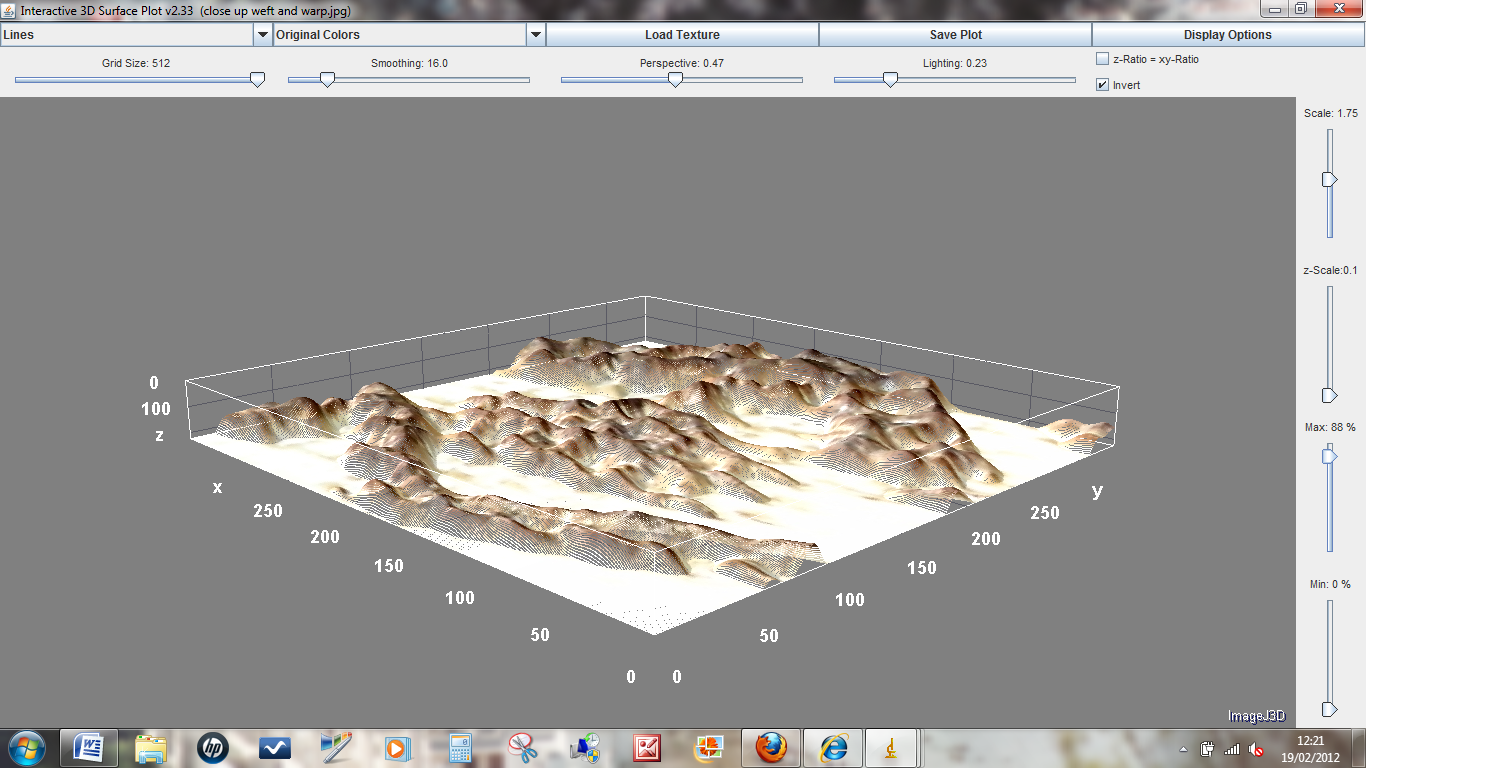
And after ...
Moral: there is no "science" here. All you see is the result of the (clever) software performing a mathematical transformation. Remember that next time you are presented with the 3D rendering of of the Shroud image, rather than the original "negative" with those staring eyes and that curiously flat facial image that ends abruptly at the cheekbones left and right, with front and rear aspects of a supposedly crucified body but no sides etc etc...