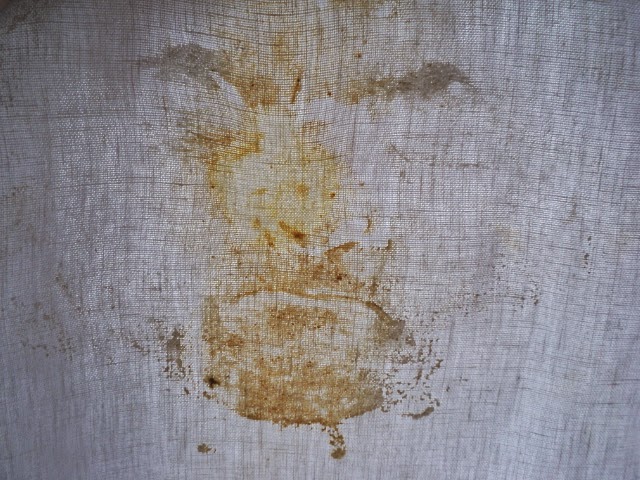
It's the first of a trio of papers addressing the fluorescence issue (allegedly ruling out any "scorch" mechanism for the Shroud body image).
Start of original posting (also with link to the same site):
Here's an image placed on my specialist Shroud of Turin ( TS) site just an hour ago. It's a distillation of some 40 months and more of virtually non-stop effort since Dec 2011 to 'model' the 'enigmatic' TS body image.

It would have been nice to use a real human subject instead of the plastic toy The technique lends itself to scaling up, and leaves the volunteer (?) unharmed, except for a coating of vegetable oil and plain white flour (most of that being imprinted onto linen, leaving less to be showered off).
Alas. I do not have a 4m x 1m length of linen, and even if I did, one suspects the sourpuss contingent of sindonology would waste no time in telling me it had to be herringbone weave, centuries or millennia old, traditionally-bleached, lacking modern-day optical brighteners etc etc etc ad infinitum, ad nauseam. Nope. This science bod is content to model the TS characteristics, showing that no fancy gee whizz 20th/21st century technology is needed, certainly not pulses of intense uv rays from excimer lasers or neutrons from rock-crushing tectonic activity etc.(the sort of things that could theoretically have affected a particular linen shrouds in a 1st century rock tomb we are solemnly assured).
Let's stick with the small scale model, and show how, step-by-step, the above image was created that, from where I'm standing, ticks an ever-growing number of boxes that says: YES - it is looking increasingly like a valid model, despite it using homely medieval technology that today's blog-readers can confirm for themselves in less than an hour in their own homes if so inclined. It requires nothing more than: (a) linen (I get mine from the clothes rack in charity shops, ladies' white summer trousers especially) (b) plain white flour (c) vegetable oil (d) a hot oven (e) a bar of soap. Yes - indcredibly, insultingly some might say, that's my DIY list for what's needed.
The rest of this posting will be in two instalments: first, the procedure for obtaining the above result, namely a faint, fuzzy, negative TS-like image and then, later, possibly tomorrow, the evidence from studies reported already on my other site that the image you see above meets many , possibly most, of the criteria of the TS image at both macroscopic and microscopic level.
Here are the pictures first:
 |
| Which to use as "subject" for contact imprinting with vegetable oil and white flour? The plastic toy or the brass crucifix? |
No contest: the first, since it allows one to model the head-to-head frontal/dorsal configuration of the Shroud (the one that screams CONTACT IMPRINT, but don't tell Charles Freeman). The outstretched crucifixion mode of the crucifix prevents getting a head-to-head configuration. Use of plastic also conveys the fact that it's the imprint that will be heated, not the subject.
 |
| The "subject" has been smeared with oil. Flour is then scattered across the surface (gravity alone, no brushing etc) and the surplus gently tapped off. |
The oil ensures that there will be adhering flour on the entire surface. The oil also assists image formation in the oven, as reported earlier on my other site.
 |
| Both sides of the "subject" have been oiled and dusted, but NOT the top of the head. The subject has been laid onto pre-soaked i.e. WET linen. |
 |
| Oops. I forgot to mention that oil/flour was wiped off the top of the head before imprinting. That is MOST IMPORTANT if one's to model the TS. It ensures the correct GAP between the two heads. |
 |
| The subject has been pressed down into the linen (with a soft underlay). The surplus of linen has then been turned back over the head and draped carefully over the frontal/ventral side.The wet linen is then patted gently down with one's hands. |
 |
| The linen has then been peeled back with the near-invisible flour/oil imprint on the left hand side. |
 |
| The subject has been carefully lifted off the linen, and the double imprint immediately transferred to a clean baking tray in a pre-heated fan oven (max temperature setting, approx 200 degrees C, air only, not glowing elements). |
 |
| Here's a fairly faint image that is probably best stopped at this stage, prior to final image-attenuation by washing to get a very faint TS-like image. |
 |
| Appearance after another 5 minutes in the hot oven. |
Note the discoloration of the linen now appearing, especially at the margins where the linen is not supported by the heat-conducting metal tray, but apart from that the linen stands up remarkably well to oven-heating.
 |
| The same experiment was used to create an image on cotton (right) as well as linen. |
Cotton imprints look different at the microscopic level, and may play a crucial control role in elucidating the highly subtle nature of the post-washed image on linen (about which more later).
 | |||||
| Original 'subject' shown slightly out-of-register with its dorsal imprint (left). The image on the right is the vitally important and arguably more relevant image (frontal) that survives vigorous washing wiith soap and water. |
That concludes the methodology. The next instalment will look at (a) macroscopic and (b) microscopic properties of the model image made by oil/flour imprinting, relative to the reported characteristics of the TS.
Watch this space
3D properties? Do the faint and fuzzy imprints you see above respond to 3D rendering in software programs like ImageJ? is that too much to hope, given typicaly awestruck observations such as this one from the shroudstory site:

 |
| 3D-rendered image of plastic toy(left) verus Shroud Scope image of TS (right). Note the embedded 2D reference (concentric circles with stepped intensity gradient) and the DEFAULT non-zero setting of z scale elevation setting (0.1) |
Late insertion: I'm saying there is no 3D mystique until proven otherwise. Right on cue we hear the rejoinder: "There is 3D mystique until YOU prove otherwise", adding technical details like RGB balance that were addressed previously in discussion with "OK" in Poland,.
Nope. i'm not buying into that pro-authencity attempt to shift the burden of proof. I repeat: there is NO 3D mystique until proven otherwise. The so-called "unique 3D encoding" of the TS image is pure agenda-driven moonshine.
See also this later comment from the inestimable Hugh Farey, with new 3D rendered images of this blogger's hand both in original colour AND grayscale. Both show 3D enhancement (needless to say). Thank you Hugh.
Update: 31 Aug 2015. Several references have been made to my specialist Shtoud of Turin site (or as I prefer to call it, "Shroud" of Turin, there being no biblical grounds for thinking that the "fine linen" Joseph of Arimathea brought to the cross to receive the ravaged body of Jesus was ever used, or intended to be used, as final burial shroud).
 |
| Home Page, my specialist Shroud site, currently 216 postings since early 2012. |
The site's homepage (above) was given a facelift yesterday to assert this blogger's growing conviction that the TS body image is a medieval flour/oil imprint that was taken from a real human subject that had then been roasted and subsequently attenuated by one or more laundering stages.
Update 31 Aug: this comment appeared from Thibault Heimburger MD yesterday:

He asks what is currently my best model? Isn't that obvious TH - you having visited this site yesterday (sitemeter ;-)?
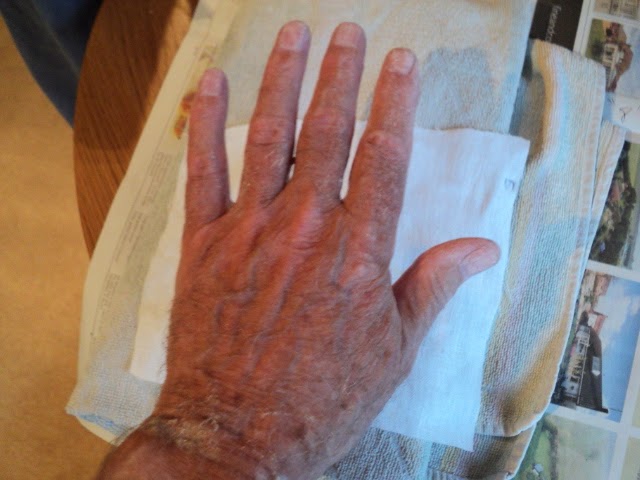
Your question can be answered in a few words, all being tried-and-tested methodology. Smear vegetable oil over the back of your hand evenly with a swab, removing the excess oil. Then sprinkle with plain white flour using a teaspoon or similar. When there are no bare patches, shake off the surplus of flour, leaving just a light oil-bound dusting of flour. Place your hand flat on a surface, then drape over a sheet of linen that has been pre-soaked in water for a few minutes and wrung out. Use your free hand to press the linen down onto your coated hand, maintaining a vertical action with no attempt to mould around the sides or between the fingers. Then peel back the linen, place imprint-side up on a clean metal baking tray, and place in a pre-heated fan oven at maxmium temperature. Check carefully at 2 minute intervals. After 5 -10 mins or so the imprints should be golden-brown, with little effect on the colour of strength of the rest of the linen.
Then soak the linen in warm water, soap thoroughly, then, taking a firm grip on image regions between two-closely-spaced hands and using a vigorous to-and-fro action use the flexing and friction to detach the surface encrustation. Think of it as forcible multi-U turn corrugation. When the images are finally faint and homogenous, rinse with fresh water and leave to dry. You now have your final look-alike TS image. Check it out, as I have, under the microscope, and you should see the image being primarily but not exclusively on the crown threads, as well as half-tone effect and discontinuities. Do you know of a modelled image that has a closer match with the TS? Did you agree with ENEA's Paolo Di Lazzaro when in an email interview with the Telegraph's Tom Chivers in December 2011 he wrote
: " The more one studies the Shroud from a scientific perspective, the clearer it becomes that this image could not have been made by a forger, either medieval or modern. This allows to come back to the “question of questions”: how was the body image on the Shroud made?"
I didn't (agree). In fact i disagreed violently, and still do. In fact it was that quotation, and the suggestion that his laser results should be the cue to consider 'philosophical and theological' implications that prompted this retired science bod to roll up his sleeves and get researching. In fact a synopsis of my first prediction, confirmed by experiment ('thermo-stencilling") was reported to the comments of that same Chivers blog posting under my then DT pseudonym 'newsjunkie'.The purpose of that posting was not to give support to his or any other radiation model, when the TS image is so obviously one made by contact: it was a gentle reminder to Di Lazzaro and his photochemically-illiterate ENEA chums that if one's going to invoke radiation, one's first task is to identify the radiation-absorbing chromophore, and not just assume as they did that it had to be "cellulose". First Law of Photochemistry: for light of any wavelength (visible, uv etc) to produce a chemical reaction, the radiation has first to be absorbed. Repeat: identify the light-absorbing chromophore as a first step. The wavelength of the radiation found most effective often helps narrow the options. Uv radiation is far more likely to be absorbed by molecules with C=C double bonds (lignin?) than by carbohydrates that are made entirely of single bonds, as you yourself acknowledged in 2012 (see comments).
New addition: a brief aside on microscope features of the roasted/soap-washed flour imprints.
I could have posted archive pictures, obtained in the last week or two, showing the appearance of the images under the microscope, with positive identification of the hallmark features of (a) half tone effect and (b) discontinuities in the linen samples.
Some of those pictures attracted comments that this retired biochemist did not know how to use the focus control of the microscope. One was from Paolo Di Lazzaro, holder of a scientific (technological?) doctorate, who addressed his comments to "Mr.Berry" an appellation which Dan Porter thoughtfully chose to include in a title. Those who know me well would I'm sure agree that I make only occasional references to my formal qualifications and research credentials, but I know of no worse insult in academe than for one PhD to address another as "Mr", and for that to be broadcast around the internet. But then I cannot say as I'm surprised that Paolo Di Lazzaro would stoop so low, given the insufferably arrogant posting he did on this blogger's initial scorch hypothesis, posturing as though he were the very first person to have tested it experimentally (sample size of 1) with a free lecture on physical chemistry (most of it second rate) thrown in for good measure.
I shall no longer be displaying photomicrographs, since what I see, carefully focusing in and out with a microscope having poor depth of field cannot be easily captured in a single image that tends invariably to look "blurred".
I have examined the latest linen imprints, and they too show the subtlety of the image fibres, being difficult to spot, despite the "brown" patch one sees with the naked eye, but where visible, with difficulty, one can see a half-tone effect and discontinuities. The internet will have to be content with that, I'm afraid. If bona fide photochemically and/or thermochemically -literate researchers wish to examine my samples under their microscopes, i am contactable at sciencebod01@aol.com. Agenda-driven Paolo Di Lazzaro and his photochemically-illiterate ENEA team members need not apply. I leave them to make their own flour imprints, using the instructions given above to TH.
Update: 20:40 Monday 31 Aug
Have just spotted this comment from Thibault Heimburger on the shroudstory site:
http://shroudstory.com/2015/08/31/colin-berrys-and-my-3d-plotting-problems/#comments
August 31, 2015 at 2:34 pm
THIS IS MY ANSWER TO COLIN I WISHED TO PUBLISH ON HIS SITE FOLLOWING HIS ANSWER TO MY QUESTION ABOVE.
http://colinb-sciencebuzz.blogspot.co.uk/2015/08/is-high-energy-laser-beam-really-needed.html
(Update 31 August)
Sorry Colin, but I am unable to post this comment on your site,
“Thanks Colin,
I’ll try it but probably without oil.
I do not understand why oil is needed in order to give the best shroud-like image.
In other words, what is not good enough with the dry-flour/wet linen model ?
You might be right or not.
At the end I will show my results, including microscopy.
And also after ageing the samples (why did not you try artificial ageing ?)
I need some weeks for this work.
You wrote: “Do you know of a modelled image that has a closer match with the TS?”
At first glance, no.
“Isn’t that obvious TH – you having visited this site yesterday (sitemeter ;-)?”
True.
Do you spy on me ? No problem ;-)
Thibault.
The oil was a hunch initially, a way of explaining the half tone effect and discontinuities. So in the best scientific tradition (I hope this doesn't sound too pompous) I made a prediction, namely that if imprinting was done with extra oil, over and above the 1.5% by weight in flour, there would be a better imprint.
Well, there was certainly a much faster development of the colour in the oven, which was good enough for me. Admittedly, that in itself might not be sufficient grounds to incorporate oil into the methodology. But there were perceived practical advantages too - flour would stick better to skin that had first been smeared with oil, and maybe give a more even coating. So oil first before flour is now part of my standard routine.
Oh, and there's a third reason for using oil. It fits with the idea that the TS was fabricated to represent/simulate a sweat imprint, so a substitute for skin oils would possibly have been part of the modelling in a medieval recipe, the latter in turn a modelling of the biblical account re J of A's linen being used for deposition and transport of a sweat and blood-covered body. Note that Sam Pellicori experimented with "perspiration, OIL and lemon juice".
That's three reasons then for using oil, somewhat messy though it may be.
Late late addition (1st September 2015) : there's a fourth reason for using oil. Earlier, on my other site, I had said that the microscopic appearance was different using cotton, lacking halftone effect and discontinuities. But the cotton in the present plastic toy imprinting looked very similar to the linen under the microscope, Initially i thought I would have to retract what I had said about the cotton 'anomaly' (maybe due to lack of lignin etc). But that earlier experiment was without added oil. Maybe oil supplementaion has an equalizing effect on linen and cotton that overides structural and/or chemical differences between the two fibre . I am now taking a break from experimentation AND internet discussion for a while - weeks rather than days - to return to some semblance of normality. When I return I shall be taking a closer look at the microscopy, maybe investing in a microscope with a better depth of field (while still having the USB "eye piece" sender for laptop viewing and screen-grabbing). But there will be no more sharing my photomicrographs on the internet. I learned my lesson the hard way - there are folk out there seeking to undermine one's scientific credentials, and I'm not falling for that a second time. I may decide to adopt the same policy as regards ImageJ renderings, not being able to rely on Hugh Farey as a permanent guardian angel.Thanks once again Hugh for showing that attempts to dismiss my de-mythologizing of 3D properties based on non-standardized RGB balance is a complete red herring (or alternatively mutant green or blue or grayscale herrring) it making scarcely any difference when one has the rest of the settings optimized, notably default z value, minimal smoothing, optimized lighting etc).
Ageing? Would that be exposure to the atmosphere at ambient temperature instead of oven roasting? How long did you have in mind? Weeks? Months? Years? I've already had my 3 score years and 10. Each extra month and year is a bonus .In any case I'm not trying to reproduce the TS in every detail, merely show how the 'enigmatic' image MIGHT have been the end result of a sequence of homely operations. Cooking, baking, roasting etc can involve some very subtle and complex chemistry. The internal structure of linen may also be a lot more complex than generally supposed, especially in the light of the Day et paper of 2005, reporting S1 ligninfication.
Spying? Not really. Given that my postings are almost instantly re-published on shroudstory, with folk content to make their views/misgivings/disgust/outrage/total apoplexy clear there, not here, the sitemeter is my only way of knowing that the site is getting visitors. It reveals approximate geographical location only, in your case "Ile de France, Paris" so there's no pressing need for you to instal extra intruder alarms in your house or surgery just yet.
No need to acknowledge. You might have to wait a while for a response if you do.
Postscript: 16th September 2015, 17:00 hours:
Here's a clip I've just uploaded to YouTube (1 min.15 secs) showing how blue-black -ink penetrates and migratesalong the cores of linen fibres (see correction below). The ink is a crude model for how my thermally-induced flour/oil model results in the subtle yellow-brown coloration of the interior of linen fibres:
https://www.youtube.com/watch?v=7APq01_H-tE
Enjoy.
Correction: added 17 September, 10:00:
Have just attached this to the Comments on the YouTube clip:
xxxx

(Update 31 August)
Sorry Colin, but I am unable to post this comment on your site,
“Thanks Colin,
I’ll try it but probably without oil.
I do not understand why oil is needed in order to give the best shroud-like image.
In other words, what is not good enough with the dry-flour/wet linen model ?
You might be right or not.
At the end I will show my results, including microscopy.
And also after ageing the samples (why did not you try artificial ageing ?)
I need some weeks for this work.
You wrote: “Do you know of a modelled image that has a closer match with the TS?”
At first glance, no.
“Isn’t that obvious TH – you having visited this site yesterday (sitemeter ;-)?”
True.
Do you spy on me ? No problem ;-)
Thibault.
The oil was a hunch initially, a way of explaining the half tone effect and discontinuities. So in the best scientific tradition (I hope this doesn't sound too pompous) I made a prediction, namely that if imprinting was done with extra oil, over and above the 1.5% by weight in flour, there would be a better imprint.
Well, there was certainly a much faster development of the colour in the oven, which was good enough for me. Admittedly, that in itself might not be sufficient grounds to incorporate oil into the methodology. But there were perceived practical advantages too - flour would stick better to skin that had first been smeared with oil, and maybe give a more even coating. So oil first before flour is now part of my standard routine.
Oh, and there's a third reason for using oil. It fits with the idea that the TS was fabricated to represent/simulate a sweat imprint, so a substitute for skin oils would possibly have been part of the modelling in a medieval recipe, the latter in turn a modelling of the biblical account re J of A's linen being used for deposition and transport of a sweat and blood-covered body. Note that Sam Pellicori experimented with "perspiration, OIL and lemon juice".
That's three reasons then for using oil, somewhat messy though it may be.
Late late addition (1st September 2015) : there's a fourth reason for using oil. Earlier, on my other site, I had said that the microscopic appearance was different using cotton, lacking halftone effect and discontinuities. But the cotton in the present plastic toy imprinting looked very similar to the linen under the microscope, Initially i thought I would have to retract what I had said about the cotton 'anomaly' (maybe due to lack of lignin etc). But that earlier experiment was without added oil. Maybe oil supplementaion has an equalizing effect on linen and cotton that overides structural and/or chemical differences between the two fibre . I am now taking a break from experimentation AND internet discussion for a while - weeks rather than days - to return to some semblance of normality. When I return I shall be taking a closer look at the microscopy, maybe investing in a microscope with a better depth of field (while still having the USB "eye piece" sender for laptop viewing and screen-grabbing). But there will be no more sharing my photomicrographs on the internet. I learned my lesson the hard way - there are folk out there seeking to undermine one's scientific credentials, and I'm not falling for that a second time. I may decide to adopt the same policy as regards ImageJ renderings, not being able to rely on Hugh Farey as a permanent guardian angel.Thanks once again Hugh for showing that attempts to dismiss my de-mythologizing of 3D properties based on non-standardized RGB balance is a complete red herring (or alternatively mutant green or blue or grayscale herrring) it making scarcely any difference when one has the rest of the settings optimized, notably default z value, minimal smoothing, optimized lighting etc).
Ageing? Would that be exposure to the atmosphere at ambient temperature instead of oven roasting? How long did you have in mind? Weeks? Months? Years? I've already had my 3 score years and 10. Each extra month and year is a bonus .In any case I'm not trying to reproduce the TS in every detail, merely show how the 'enigmatic' image MIGHT have been the end result of a sequence of homely operations. Cooking, baking, roasting etc can involve some very subtle and complex chemistry. The internal structure of linen may also be a lot more complex than generally supposed, especially in the light of the Day et paper of 2005, reporting S1 ligninfication.
Spying? Not really. Given that my postings are almost instantly re-published on shroudstory, with folk content to make their views/misgivings/disgust/outrage/total apoplexy clear there, not here, the sitemeter is my only way of knowing that the site is getting visitors. It reveals approximate geographical location only, in your case "Ile de France, Paris" so there's no pressing need for you to instal extra intruder alarms in your house or surgery just yet.
No need to acknowledge. You might have to wait a while for a response if you do.
Postscript: 16th September 2015, 17:00 hours:
Here's a clip I've just uploaded to YouTube (1 min.15 secs) showing how blue-black -ink penetrates and migrates
https://www.youtube.com/watch?v=7APq01_H-tE
Enjoy.
Correction: added 17 September, 10:00:
Have just attached this to the Comments on the YouTube clip:
Colin Berry
xxxx