Silbury Hill, Wiltshire, England (approx 1 mile from Avebury Stone Circle and 25 miles from Stonehenge). Communal organ reliquary?
Update: April 21, 2016: this posting was penned some 4 years ago, and while not retreating from any of its claims, this blogger's thinking re Silbury, and the nearby Avebury stone circles AND the not-so-nearby Stonehenge has evolved somewhat. See the end of this posting for links to currenrt thinking, notably that Stonehenge and Avebury were both purpose-built as giant perches for carrion-feeding birds (to facilitate rapid excarnation) and that Silbury was perhaps specifically a 'cardionecropolis' for interment of hearts alone.
Start of original posting:
Start of original posting:
From the Daily Telegraph, 2007: "The original purpose and use of the hill, which is south of the village of Avebury, is still a mystery. Theories suggest it was either a burial mound, a solar observatory or a representation of a Neolithic goddess. "It is very unlikely we will ever know why it was built," said Robert Bewley, English Heritage regional director for the South West."
Well, almost 5 years on from that article and its
pessimistic soundbite, I’ve been reading a highly factual account of man-made
Silbury Hill in Wiltshire, published in 2010.
The Story of Silbury Hill by
Jim Leary and David Field (foreword by David Attenborough), English Heritage
It gives a commendably detailed
account of the numerous excavations that have been made – right to the very
centre, tracking close to ground level to penetrate the original core.

The aim was to find what this enigmatic hill was for, what (if anything) it concealed,
and why anyone would go to so much trouble.
Well, I hope the authors will not mind if I provide a trailer, so to speak, of what lies between the covers of their fascinating book, and quote bits from some key passages (no pun intended).
What those miners and archaeologists did NOT find was what, for now, I shall refer to as "X", which I believe was
buried at Silbury a little at a time, plus a few baskets-full of soil or chalk to hide the evidence, then more X, then more
soil and chalk. Why not? Because X is biodegradable, highly so, and which millennia later would leave scarcely any evidence, if at all, of its existence.

Artist's impression - but based on the excavation evidence
Silbury Hill began as Silbury Mound, which we learn was simply as a heap of “sticky” (hmmm) gravel. Yup, that’s what they
found at Ground Zero, sticky gravel. Bit by bit the cone enlarged to make what a few
generations later was the highest man-made mound in Europe, as it remains to
this day.
So what was X?
I trust the authors do not mind if I turn this into a tease
for the reader by quoting some carefully selected passages from their book, highlighting certain words
and key phrases. I will then state simply what I consider was X, leaving readers
to recoil, cringe, feel nauseated whatever, and then proceed to write a follow-up post to
this missive, which goes on to suggest the real purpose of one of Silbury’ two sister
structures - Stonehenge, leaving Avebury for later.
Yup, despite being some 25 miles apart, I
believe the two are related – at least in a utilitarian sense - even if not operating as a dual unit. Indeed,
the idea for one may have evolved from the latter, or they developed as
different solutions to the same problem of being a settled Neolithic homesteader. The problem? Clue – it’s
one of everyday life – and what inevitably follows... And curiously it’s
centred on aesthetics – even if at first sight what I write here may seem to fly in the face of aesthetics.
Let’s now look at that book.
Page 96 under “The
earliest mound”
“Deep inside the tunnel...
it was possible to make out, dull, golden, sticky gravel resting on top
of the stripped surface. The gravel had clearly been piled up into a small
rounded mound a little less than 1m high and nearly 10m in diameter; hardly a
worthy predecessor to the giant mound we see today, but a mound nonetheless.”
Page 97 under “Pieces of Place”
(Around the gravel mound) ... a ring of stakes had been
hammered into the ground to define the perimeter of a larger 16 metre area.
Individual loads of mud and dark soils, probably carried in baskets or hides,
had been tipped into this space to create a mound that was about waist high...”
Facing page: an artist’s reconstruction with an interesting
caption: “The organic mound surrounded by stakes”. (what do you suppose the authors meant by
“organic”?).
Page 99: A few metres
away to the south and south-east, two smaller mounds were visibly outlined in
the section, and others may well exist beyond the confines of the tunnel. Made
from dark organic mud, these two small mounds stood less than half a metre
high. They were not natural features but deliberately constructed mounds that
were added to and modified over time, and one even had a tiny gully dug around
it; like a small scale model of the final Silbury. This is an entirely new
discovery, and we can now say that the early phases of Silbury do not comprise
just one monument, but a number of them that later became subsumed into a
single form.”
Further down:
“The soils from all these early mounds preserved organic
material astonishingly well... Insects
are ... staggeringly well preserved...
There is an abundance of weevils and some leaf beetles too, as well as a
variety of dung beetles, which feed on the droppings of animals such as cow and
sheep...”
“seeds and plant remains confirm evidence from the insects
that these early mounds were set in mature, well-grazed grassland...”
Page 102 “Mound building stops”
“... pits were dug
into the top and side of the central organic mound... These pits were not large
– around 1 metre in diameter and depth... their fill seems to have been little
more than the dug-out material pushed back in...”
Page 103 “... and then
resumes...” (i.e. mound building)
“Mound assembly continues, and these pits, along with the
organic mounds, became sealed under dumps of different materials that had been
tipped over the top. This was made up from basket-loads of top soil, chiefly
gathered from soil that directly overlay chalk, and therefore from beyond the
immediate clay-with-flints area...as well as basket-loads of chalk, clay,
gravel and more turf..”
“...turning to (famed Silbury/Stonehenge archaeologist)
Richard Atkinson’s evocative description helps to conjure the
image of a cross-section through these multi-coloured and interweaved layers :
"Seen in section, these upper layers have a stripe pattern, like a polychrome
tiger’s skin the white chalk contrasting sharply with the dark-grey soil and
the yellows and browns of the gravel and clay. Together these layers formed a
mound with an estimated diameter of 35m and which was perhaps as high as 5m or
6m... a number of ... sarsen boulders
were present as well ... deliberately incorporated within the body of the mound
as an element of its composition ... like raisins in a cake... The material for these early mounds had been
carefully chosen; this was no random spoil heap, but pieces of other places
carefully piled high."
Still on p 104 under “The white mound”
Once this intricate stack had been built up, chalk was then
added... sometimes mixed with clay... which would have formed rings round the
earlier monument...with the material engulfing the earlier organic mound and forming
successively larger white mounds...

Atkinson ... described Silbury Hill as ‘an enormously
complicated and highly-coloured layer cake’... and in The Listener the organic
mound formed ‘a kind of enormous biological club sandwich’.
Moving to p 106, and referring now to the encircling Silbury
ditch
“The unweathered sides of this ditch suggest that it had not
been open to the elements for long before it was, very deliberately, backfilled
and re-cut slightly further out. This happened not just once, but at least
three times, moving successively outwards with each cycle of backfill and
re-cut; the ditch, like ripples in in water,moving ever further out... no sooner had one ditch been dug, than it had
to be filled and cut slightly further out. Perhaps the bank and ditch enclosure
needed to move further outwards to make room for the ever expanding chalk mound
within it ... Silbury Hill was constantly being adjusted. There was no fixed
plan.”
All this is a far cry from any notion that someone once gave
the order – "build me the biggest hill ever". This was no ordinary hill. It was an organic
thing, that word again, though whether organic in the present context (meaning to grow
progressively) is what the authors mean by their term “organic” for the
original mound, I am not sure. In fact, I have scoured the earlier chapters of
the book for that term organic, but while doing so another meaning for the term
entered my head.
I refer to the one used by gardeners and farmers for “organic”
compost, i.e. dead and decaying plant and animal material that gradually rots
down to leave nothing resembling the original material, at least
in a well aerated heap, except dark, crumbly, wholesome-smelling humus.
By now, dear reader, you should have an idea as to the
direction in which my thoughts are going, especially when you see those bolded-up words for soil, dark soil, etc etc.
Thoughts of the imperatives for making a good compost heap were
reinforced by the following references to crushed chalk and chalk boulder walls
that were built within the mound as it progressed:
“The deposits on the top were made up of dumps of crushed
chalk, laid one on top of another, and held in place by large loose pieces of
chalk rubble... the walls were carefully
tilted inwards to hold the chalk in place, thus preventing collapse... The
rubble walls hold the horizontal chalk layers in place, making it extremely
stable. The voids left by the loose-fitting rubble allow rainwater to drain
freely through the great mound, thereby limiting erosion. It is the reason the
mound is still standing 4,500 years later.
Page 111: The shape of Silbury
“... the mound is not in fact truly circular, but built in a
series of straight lengths, and its outer shape may have been dictated by a
series of radial spines, between which are straight construction lines forming
something like a spider’s web ... it could have been dictated by a series of
buttresses that help tie the structure together... the idea that Silbury Hill
was (later) reconstructed as a garden mount... can be discounted. “
Page 112:
“The radiocarbon dates taken from the Hill suggest that its
overall construction was rapid, thrown up in the years between 2400 and 2300
BC, and therefore it perhaps took only three of four generations to go from
small gravel mound to the massive final chalk mound. Work on it, therefore, must
have been frenzied at times...”
Thanks Jim Leary, thanks David Field for that cogent and illuminating exposition. I wish I had your economy and precision with words.
So what is one to make of all that – a hill that began as a
mound, around which was constructed radial revetments ('retaining walls'?) of chalk boulders holding
back layer upon layer of soil, turf, crushed chalk - but what else (X??)
The only rational answer I can think of (while recognizing
that things did not always happen in prehistoric times for rational reasons) is
that something (X) was being deposited, covered over, then a new addition of that
something etc etc – rather like building a compost heap, but with no intention
of later harvesting (thus the chalk etc). What could that something X have been. Could it have been “organic” but
something that has rotted down so completely as to leave nothing except dark
soil?
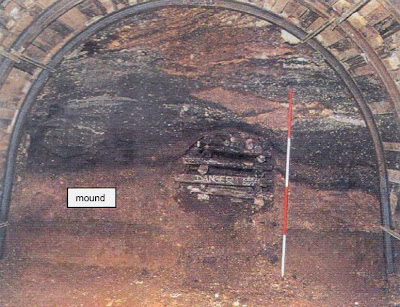
The centre of the 'organic' mound. Why is the soil so dark , and in layers?
One thing is for sure. It could not have been human corpses, or at
any rate intact corpses. That would have left skeletons or traces of bone.
Could it have been just part of a deceased person (or less
likely animal) which was the part our ancestors might have wished to dispose of quickly,
allowing them to delay subsequent disposal of the rest of a cadaver. Was it a
part that Neolithic man might have wished to dispose of quickly and
systematically to avoid attracting wild animals – rats, flies ,foxes, wolves etc - that would have
picked up the scent from afar, and come to investigate, posing a threat to
children, livestock, public health etc?
There is a part of the human anatomy that ticks these boxes,
and though
I hesitate to mention it, the internal organs - of the thoracic and abdominal cavities?
Is it possible that there was a passing fashion in
Wiltshire, lasting approximately 100 years,such that when there was a death in
the family, the first thing to be done was to convey the corpse to specialists
at the Mound(initially) and later the Hill, where the internal organs would be removed for immediate interment with due ceremony and ritual. They would have been quickly harvested, then covered over with soil and chalk, and the remaining cadaver, with better preserving characteristics, then handed back to
the grieving family for disposal at leisure (maybe taking what was left to
nearby Avebury or even Stonehenge for second-stage ceremonial disposal)?
Is it possible that
thousands, nay tens of thousands of such additions were made to Silbury Hill in
its relatively short life as a disposal site? Has the biodegradation of those organic
remains left small cavities that have contributed to the sharp drainage that
our two authors claim is the reason why the Hill has survived the downpours of
four and a half millennia?
“There is also an unknown degree of iron pan formation”.
Hmmm ? Degraded haemoglobin?
Addendum: . Francis Pryor
estimates that by 4000 BC the population of Britain was around 100,000 while
that of Ireland was some 40,000. For 2000 BC his estimates are 250,000 and
50,000 respectively. Reminder: Silbury Hill was constructed in a relatively short time span between 2400-2300BC, based on radiocarbon dating. That century coincided approximately with Stonehenge's "late stone phase", i.e. 2450BC according to the English Heritage visitor guide, but well before the "final stone phase" about 2000BC.
Probably most of those preferred to live on the chalk uplands, having given up a hunter-gatherer existence in the dense woodland that still covered most of southern England. That would mean an increasingly large number of mortalities per year in a relatively small area, creating a disposal problem. How many more barrows can be added to the landscape, taking up valuable land for livestock and crops?
Oh, and I see that one of our authors - Jim Leary - discovered a "sunken floor" in the foundations of the Marden Henge (of which only the bottom 15 cm remain), purpose unknown. Hmmm: was it the equivalent of a mortuary slab?
Finally: for a scientific hypothesis or theory to have value, it must have predictive utility. OK. I predict that the darker soil seams in that hill will be enriched in the chemical elements that are in human tissue. The soluble ones will probably have leached out, but given the alkaline conditions that pertain in chalk, I suspect there may be elevated levels of iron, deposited or precipitated as iron (III) oxide or hydroxides. Note the earlier comment/link re the 'iron pan' formation, which may simply be a consequence of local geology, or there again, maybe not.
It is also possible that there is still "fossil" carbon in the dark-coloured soil if the equivalent of plant humus. Radiocarbon-dating, matched against appropriate controls from non-dark clay and other debris could point to an exceptional contribution from a Neolithic carbon-rich source.
Could it be that ritualistic evisceration("cleansing") of the recently deceased was a de rigeur convention ("fashion statement") for a brief period (a century or thereabouts) in progressive Neolithic society? Or there again, a monument that contained the hearts of the deceased (and much else besides) may in time have come to be seen (from afar)as a powerful symbol of the continuity of life and society. Maybe the heart and soul were perceived as one for that brief period of history.
My theory for Silbury Hill: it served as a communal organ reliquary, or, more picturesquely, as a visceral Valhalla.
Oh, and I see that one of our authors - Jim Leary - discovered a "sunken floor" in the foundations of the Marden Henge (of which only the bottom 15 cm remain), purpose unknown. Hmmm: was it the equivalent of a mortuary slab?
Finally: for a scientific hypothesis or theory to have value, it must have predictive utility. OK. I predict that the darker soil seams in that hill will be enriched in the chemical elements that are in human tissue. The soluble ones will probably have leached out, but given the alkaline conditions that pertain in chalk, I suspect there may be elevated levels of iron, deposited or precipitated as iron (III) oxide or hydroxides. Note the earlier comment/link re the 'iron pan' formation, which may simply be a consequence of local geology, or there again, maybe not.
It is also possible that there is still "fossil" carbon in the dark-coloured soil if the equivalent of plant humus. Radiocarbon-dating, matched against appropriate controls from non-dark clay and other debris could point to an exceptional contribution from a Neolithic carbon-rich source.
Could it be that ritualistic evisceration("cleansing") of the recently deceased was a de rigeur convention ("fashion statement") for a brief period (a century or thereabouts) in progressive Neolithic society? Or there again, a monument that contained the hearts of the deceased (and much else besides) may in time have come to be seen (from afar)as a powerful symbol of the continuity of life and society. Maybe the heart and soul were perceived as one for that brief period of history.
My theory for Silbury Hill: it served as a communal organ reliquary, or, more picturesquely, as a visceral Valhalla.
Next post - Stonehenge. Complementary to Silbury - or a separate facility also centred on novel and evolving means for disposing of the mortal remains of the deceased in response to the pressure of growing population density?

Some might see parallels with the Buddhist stupa also described as a giant outdoor reliquary...
Colin Berry, aka sciencebod May 17, 2012
Update: Feb 25, 2016
Well, here I am, some 4 years later. I have just attached this comment to an article that appeared in December 2015 on the ancient-origins site (having previously bombarded it with my revisionist ideas re the Turin Shroud, receiving I have to say a most gratifying and appreciative response from staff writer Liz Leafloor).
The Great Stupa, Sanchi, India
"Stupas originated as circular mounds encircled by large stones" (wiki)
Colin Berry, aka sciencebod May 17, 2012
Update: Feb 25, 2016
Well, here I am, some 4 years later. I have just attached this comment to an article that appeared in December 2015 on the ancient-origins site (having previously bombarded it with my revisionist ideas re the Turin Shroud, receiving I have to say a most gratifying and appreciative response from staff writer Liz Leafloor).
COLIN BERRY WROTE ON 25 FEBRUARY, 2016 - 14:42
PERMALINK
Fascinating, especially the theory as regards the need for decarnation of the skeleton before the soul could be released.
One small gripe however, namely the idea that the largest man-made mound on Europe was constructed in a mere 10 years. What's the evidence for that?
Back in 2012 when this science blogger was writing on Silbury Hill (linking it with Stonehenge!), that excellent book by Jim Leary and David Field appeared (see link to my 'sciencebuzz' site below).
They too reckoned it had been constructed fast, amazingly so given the complexity of Silbury's structure, starting with a small starter mound with "sticky gravel", then the progressive addition of further mounds around the periphery, then on top, forever expanding, then addition of chalk and rock and ramparts for structural support and drainage, building it up like a layer cake. Let's not forget all the mysterious dark banding (decayed organic matter? soft issue remains?)
They reckon it took a century or thereabouts, an estimate I'm more inclined to believe.
So what was Silbury for, and why are there no recognizable human remains if it was used as suggested here for initial decarnation of the newly deceased?
Well, the idea of letting the soft tissues decompose, and then (presumably) removing the skeleton later is a neat suggestion. It's very close to my own hypothesis, namely that the internal organs - viscera, possibly including the heart too - which may or may not have been venerated, conceivably on a par with the soul - was what went into those individual mounds that gradually coalesced to become a giant super-mound.
What about the rest of the body, notable flesh, i.e. muscular tissue and bones? Ah, well that's where Woodhenge, Durrington Walls and finally Stonehenge enter the story, they being some 25 miles away, the sites we're told of communal winter feasting on roast pork. Or was it smoked bacon? And what were the pigs fed on (don't ask, unless interested in the gory business of ritualized, dare one say semi-industrialzed decarnation, 'secondary necrophagy even thanks to those unfussy pigs'!) ? Was Woodhenge (Stonehenge Mk1) designed to facilitate smoking and curing of hung meat? Was it later replaced by a more durable, less flammable structure, the one we call Stonehenge?
Yup,or should that be YUK, one can get a flavour of what may have been the REAL PURPOSE of Silbury Hill AND Stonehenge from thje link below. But you'll need a strong stomach, even for that fairly restrained posting (later ones being more explicit as regards detail):
Further update: March 30, 2016 (with "captive earthworms" added to the keywords that accompany this posting):
This comment was additionally posted to the same ancient-origins thread this morning, the purpose of which speaks for itself.
Since
posting this comment just over a month ago, an idea has occurred to me
that would explain the peculiar manner in which Silbury Hill evolved.
I have been in touch with the owners of this site, proposing that the idea in question be announced here, where it’s likely to attract far more attention than if published on my dormant Silbury blogsite.
But there’s a snag: even if the site were to agree to publish my article, that could take time, with the risk that I could lose publishing priority (“publish or perish” as they say).
While the idea is simple in principle, absurdly so, it could have important implications for the way in which one judges the level of technological development in late Neolithic society (circa 2500BC).
So, to establish priority (“you read it here first”) here’s my idea in telegraphic form.
Silbury Hill began as a gravel mound, with the underlying turf and top soil removed down to subsoil, and the turves and topsoil then placed back on top of the gravel.
I believe that was a device to create the beginnings of a compost heap, and that earthworms were deliberately introduced into what Leary and Field have described as the initial “organic mound”. The gravel heap with uninviting subsoil was a device to keep the earthworms captive within the mound, where they would then be given human mortal remains, namely selected internal organs and/or other soft tissue as primary input (while recognizing that earthworms are considered to obtain their major nutrition from the microorganisms – bacteria and fungi - that grow on the biodegrading organic detritus).
Silbury Hill can be seen as the end result of a coalescence of scores, perhaps hundreds of individual small ‘compost heaps’ each containing a deposition from one deceased individual, each “seeded” with a handful of earthworms that would reduce the soft tissue offering via aerobic (NOT smelly anaerobic) processes to something resembling inoffensive-looking, inoffensive smelling black soil.
Hopefully there will be an opportunity to back up the hypothesis at a future date with more information. In the meantime, I strongly recommend the book “The Story of Silbury Hill” by Jim Leary and David Field (English Heritage 2010) with its delightful artist’s impression of the early stages of construction provided by Judith Dobie (which can also be seen on the helpful display board at the visitor’s observation area).
I have been in touch with the owners of this site, proposing that the idea in question be announced here, where it’s likely to attract far more attention than if published on my dormant Silbury blogsite.
But there’s a snag: even if the site were to agree to publish my article, that could take time, with the risk that I could lose publishing priority (“publish or perish” as they say).
While the idea is simple in principle, absurdly so, it could have important implications for the way in which one judges the level of technological development in late Neolithic society (circa 2500BC).
So, to establish priority (“you read it here first”) here’s my idea in telegraphic form.
Silbury Hill began as a gravel mound, with the underlying turf and top soil removed down to subsoil, and the turves and topsoil then placed back on top of the gravel.
I believe that was a device to create the beginnings of a compost heap, and that earthworms were deliberately introduced into what Leary and Field have described as the initial “organic mound”. The gravel heap with uninviting subsoil was a device to keep the earthworms captive within the mound, where they would then be given human mortal remains, namely selected internal organs and/or other soft tissue as primary input (while recognizing that earthworms are considered to obtain their major nutrition from the microorganisms – bacteria and fungi - that grow on the biodegrading organic detritus).
Silbury Hill can be seen as the end result of a coalescence of scores, perhaps hundreds of individual small ‘compost heaps’ each containing a deposition from one deceased individual, each “seeded” with a handful of earthworms that would reduce the soft tissue offering via aerobic (NOT smelly anaerobic) processes to something resembling inoffensive-looking, inoffensive smelling black soil.
Hopefully there will be an opportunity to back up the hypothesis at a future date with more information. In the meantime, I strongly recommend the book “The Story of Silbury Hill” by Jim Leary and David Field (English Heritage 2010) with its delightful artist’s impression of the early stages of construction provided by Judith Dobie (which can also be seen on the helpful display board at the visitor’s observation area).
Since
posting this comment just over a month ago, an idea has occurred to me
that would explain the peculiar manner in which Silbury Hill evolved.
I have been in touch with the owners of this site, proposing that the idea in question be announced here, where it’s likely to attract far more attention than if published on my dormant Silbury blogsite.
But there’s a snag: even if the site were to agree to publish my article, that could take time, with the risk that I could lose publishing priority (“publish or perish” as they say).
While the idea is simple in principle, absurdly so, it could have important implications for the way in which one judges the level of technological development in late Neolithic society (circa 2500BC).
So, to establish priority (“you read it here first”) here’s my idea in telegraphic form.
Silbury Hill began as a gravel mound, with the underlying turf and top soil removed down to subsoil, and the turves and topsoil then placed back on top of the gravel.
I believe that was a device to create the beginnings of a compost heap, and that earthworms were deliberately introduced into what Leary and Field have described as the initial “organic mound”. The gravel heap with uninviting subsoil was a device to keep the earthworms captive within the mound, where they would then be given human mortal remains, namely selected internal organs and/or other soft tissue as primary input (while recognizing that earthworms are considered to obtain their major nutrition from the microorganisms – bacteria and fungi - that grow on the biodegrading organic detritus).
Silbury Hill can be seen as the end result of a coalescence of scores, perhaps hundreds of individual small ‘compost heaps’ each containing a deposition from one deceased individual, each “seeded” with a handful of earthworms that would reduce the soft tissue offering via aerobic (NOT smelly anaerobic) processes to something resembling inoffensive-looking, inoffensive smelling black soil.
Hopefully there will be an opportunity to back up the hypothesis at a future date with more information. In the meantime, I strongly recommend the book “The Story of Silbury Hill” by Jim Leary and David Field (English Heritage 2010) with its delightful artist’s impression of the early stages of construction provided by Judith Dobie (which can also be seen on the helpful display board at the visitor’s observation area).
I have been in touch with the owners of this site, proposing that the idea in question be announced here, where it’s likely to attract far more attention than if published on my dormant Silbury blogsite.
But there’s a snag: even if the site were to agree to publish my article, that could take time, with the risk that I could lose publishing priority (“publish or perish” as they say).
While the idea is simple in principle, absurdly so, it could have important implications for the way in which one judges the level of technological development in late Neolithic society (circa 2500BC).
So, to establish priority (“you read it here first”) here’s my idea in telegraphic form.
Silbury Hill began as a gravel mound, with the underlying turf and top soil removed down to subsoil, and the turves and topsoil then placed back on top of the gravel.
I believe that was a device to create the beginnings of a compost heap, and that earthworms were deliberately introduced into what Leary and Field have described as the initial “organic mound”. The gravel heap with uninviting subsoil was a device to keep the earthworms captive within the mound, where they would then be given human mortal remains, namely selected internal organs and/or other soft tissue as primary input (while recognizing that earthworms are considered to obtain their major nutrition from the microorganisms – bacteria and fungi - that grow on the biodegrading organic detritus).
Silbury Hill can be seen as the end result of a coalescence of scores, perhaps hundreds of individual small ‘compost heaps’ each containing a deposition from one deceased individual, each “seeded” with a handful of earthworms that would reduce the soft tissue offering via aerobic (NOT smelly anaerobic) processes to something resembling inoffensive-looking, inoffensive smelling black soil.
Hopefully there will be an opportunity to back up the hypothesis at a future date with more information. In the meantime, I strongly recommend the book “The Story of Silbury Hill” by Jim Leary and David Field (English Heritage 2010) with its delightful artist’s impression of the early stages of construction provided by Judith Dobie (which can also be seen on the helpful display board at the visitor’s observation area).
Since
posting this comment just over a month ago, an idea has occurred to me
that would explain the peculiar manner in which Silbury Hill evolved.
I have been in touch with the owners of this site, proposing that the idea in question be announced here, where it’s likely to attract far more attention than if published on my dormant Silbury blogsite.
But there’s a snag: even if the site were to agree to publish my article, that could take time, with the risk that I could lose publishing priority (“publish or perish” as they say).
While the idea is simple in principle, absurdly so, it could have important implications for the way in which one judges the level of technological development in late Neolithic society (circa 2500BC).
So, to establish priority (“you read it here first”) here’s my idea in telegraphic form.
Silbury Hill began as a gravel mound, with the underlying turf and top soil removed down to subsoil, and the turves and topsoil then placed back on top of the gravel.
I believe that was a device to create the beginnings of a compost heap, and that earthworms were deliberately introduced into what Leary and Field have described as the initial “organic mound”. The gravel heap with uninviting subsoil was a device to keep the earthworms captive within the mound, where they would then be given human mortal remains, namely selected internal organs and/or other soft tissue as primary input (while recognizing that earthworms are considered to obtain their major nutrition from the microorganisms – bacteria and fungi - that grow on the biodegrading organic detritus).
Silbury Hill can be seen as the end result of a coalescence of scores, perhaps hundreds of individual small ‘compost heaps’ each containing a deposition from one deceased individual, each “seeded” with a handful of earthworms that would reduce the soft tissue offering via aerobic (NOT smelly anaerobic) processes to something resembling inoffensive-looking, inoffensive smelling black soil.
Hopefully there will be an opportunity to back up the hypothesis at a future date with more information. In the meantime, I strongly recommend the book “The Story of Silbury Hill” by Jim Leary and David Field (English Heritage 2010) with its delightful artist’s impression of the early stages of construction provided by Judith Dobie (which can also be seen on the helpful display board at the visitor’s observation area).
I have been in touch with the owners of this site, proposing that the idea in question be announced here, where it’s likely to attract far more attention than if published on my dormant Silbury blogsite.
But there’s a snag: even if the site were to agree to publish my article, that could take time, with the risk that I could lose publishing priority (“publish or perish” as they say).
While the idea is simple in principle, absurdly so, it could have important implications for the way in which one judges the level of technological development in late Neolithic society (circa 2500BC).
So, to establish priority (“you read it here first”) here’s my idea in telegraphic form.
Silbury Hill began as a gravel mound, with the underlying turf and top soil removed down to subsoil, and the turves and topsoil then placed back on top of the gravel.
I believe that was a device to create the beginnings of a compost heap, and that earthworms were deliberately introduced into what Leary and Field have described as the initial “organic mound”. The gravel heap with uninviting subsoil was a device to keep the earthworms captive within the mound, where they would then be given human mortal remains, namely selected internal organs and/or other soft tissue as primary input (while recognizing that earthworms are considered to obtain their major nutrition from the microorganisms – bacteria and fungi - that grow on the biodegrading organic detritus).
Silbury Hill can be seen as the end result of a coalescence of scores, perhaps hundreds of individual small ‘compost heaps’ each containing a deposition from one deceased individual, each “seeded” with a handful of earthworms that would reduce the soft tissue offering via aerobic (NOT smelly anaerobic) processes to something resembling inoffensive-looking, inoffensive smelling black soil.
Hopefully there will be an opportunity to back up the hypothesis at a future date with more information. In the meantime, I strongly recommend the book “The Story of Silbury Hill” by Jim Leary and David Field (English Heritage 2010) with its delightful artist’s impression of the early stages of construction provided by Judith Dobie (which can also be seen on the helpful display board at the visitor’s observation area).
Since
posting this comment just over a month ago, an idea has occurred to me
that would explain the peculiar manner in which Silbury Hill evolved.
I have been in touch with the owners of this site, proposing that the idea in question be announced here, where it’s likely to attract far more attention than if published on my dormant Silbury blogsite.
But there’s a snag: even if the site were to agree to publish my article, that could take time, with the risk that I could lose publishing priority (“publish or perish” as they say).
While the idea is simple in principle, absurdly so, it could have important implications for the way in which one judges the level of technological development in late Neolithic society (circa 2500BC).
So, to establish priority (“you read it here first”) here’s my idea in telegraphic form.
Silbury Hill began as a gravel mound, with the underlying turf and top soil removed down to subsoil, and the turves and topsoil then placed back on top of the gravel.
I believe that was a device to create the beginnings of a compost heap, and that earthworms were deliberately introduced into what Leary and Field have described as the initial “organic mound”. The gravel heap with uninviting subsoil was a device to keep the earthworms captive within the mound, where they would then be given human mortal remains, namely selected internal organs and/or other soft tissue as primary input (while recognizing that earthworms are considered to obtain their major nutrition from the microorganisms – bacteria and fungi - that grow on the biodegrading organic detritus).
Silbury Hill can be seen as the end result of a coalescence of scores, perhaps hundreds of individual small ‘compost heaps’ each containing a deposition from one deceased individual, each “seeded” with a handful of earthworms that would reduce the soft tissue offering via aerobic (NOT smelly anaerobic) processes to something resembling inoffensive-looking, inoffensive smelling black soil.
Hopefully there will be an opportunity to back up the hypothesis at a future date with more information. In the meantime, I strongly recommend the book “The Story of Silbury Hill” by Jim Leary and David Field (English Heritage 2010) with its delightful artist’s impression of the early stages of construction provided by Judith Dobie (which can also be seen on the helpful display board at the visitor’s observation area).
I have been in touch with the owners of this site, proposing that the idea in question be announced here, where it’s likely to attract far more attention than if published on my dormant Silbury blogsite.
But there’s a snag: even if the site were to agree to publish my article, that could take time, with the risk that I could lose publishing priority (“publish or perish” as they say).
While the idea is simple in principle, absurdly so, it could have important implications for the way in which one judges the level of technological development in late Neolithic society (circa 2500BC).
So, to establish priority (“you read it here first”) here’s my idea in telegraphic form.
Silbury Hill began as a gravel mound, with the underlying turf and top soil removed down to subsoil, and the turves and topsoil then placed back on top of the gravel.
I believe that was a device to create the beginnings of a compost heap, and that earthworms were deliberately introduced into what Leary and Field have described as the initial “organic mound”. The gravel heap with uninviting subsoil was a device to keep the earthworms captive within the mound, where they would then be given human mortal remains, namely selected internal organs and/or other soft tissue as primary input (while recognizing that earthworms are considered to obtain their major nutrition from the microorganisms – bacteria and fungi - that grow on the biodegrading organic detritus).
Silbury Hill can be seen as the end result of a coalescence of scores, perhaps hundreds of individual small ‘compost heaps’ each containing a deposition from one deceased individual, each “seeded” with a handful of earthworms that would reduce the soft tissue offering via aerobic (NOT smelly anaerobic) processes to something resembling inoffensive-looking, inoffensive smelling black soil.
Hopefully there will be an opportunity to back up the hypothesis at a future date with more information. In the meantime, I strongly recommend the book “The Story of Silbury Hill” by Jim Leary and David Field (English Heritage 2010) with its delightful artist’s impression of the early stages of construction provided by Judith Dobie (which can also be seen on the helpful display board at the visitor’s observation area).
Since
posting this comment just over a month ago, an idea has occurred to me
that would explain the peculiar manner in which Silbury Hill evolved.
I have been in touch with the owners of this site, proposing that the idea in question be announced here, where it’s likely to attract far more attention than if published on my dormant Silbury blogsite.
But there’s a snag: even if the site were to agree to publish my article, that could take time, with the risk that I could lose publishing priority (“publish or perish” as they say).
While the idea is simple in principle, absurdly so, it could have important implications for the way in which one judges the level of technological development in late Neolithic society (circa 2500BC).
So, to establish priority (“you read it here first”) here’s my idea in telegraphic form.
Silbury Hill began as a gravel mound, with the underlying turf and top soil removed down to subsoil, and the turves and topsoil then placed back on top of the gravel.
I believe that was a device to create the beginnings of a compost heap, and that earthworms were deliberately introduced into what Leary and Field have described as the initial “organic mound”. The gravel heap with uninviting subsoil was a device to keep the earthworms captive within the mound, where they would then be given human mortal remains, namely selected internal organs and/or other soft tissue as primary input (while recognizing that earthworms are considered to obtain their major nutrition from the microorganisms – bacteria and fungi - that grow on the biodegrading organic detritus).
Silbury Hill can be seen as the end result of a coalescence of scores, perhaps hundreds of individual small ‘compost heaps’ each containing a deposition from one deceased individual, each “seeded” with a handful of earthworms that would reduce the soft tissue offering via aerobic (NOT smelly anaerobic) processes to something resembling inoffensive-looking, inoffensive smelling black soil.
Hopefully there will be an opportunity to back up the hypothesis at a future date with more information. In the meantime, I strongly recommend the book “The Story of Silbury Hill” by Jim Leary and David Field (English Heritage 2010) with its delightful artist’s impression of the early stages of construction provided by Judith Dobie (which can also be seen on the helpful display board at the visitor’s observation area).
I have been in touch with the owners of this site, proposing that the idea in question be announced here, where it’s likely to attract far more attention than if published on my dormant Silbury blogsite.
But there’s a snag: even if the site were to agree to publish my article, that could take time, with the risk that I could lose publishing priority (“publish or perish” as they say).
While the idea is simple in principle, absurdly so, it could have important implications for the way in which one judges the level of technological development in late Neolithic society (circa 2500BC).
So, to establish priority (“you read it here first”) here’s my idea in telegraphic form.
Silbury Hill began as a gravel mound, with the underlying turf and top soil removed down to subsoil, and the turves and topsoil then placed back on top of the gravel.
I believe that was a device to create the beginnings of a compost heap, and that earthworms were deliberately introduced into what Leary and Field have described as the initial “organic mound”. The gravel heap with uninviting subsoil was a device to keep the earthworms captive within the mound, where they would then be given human mortal remains, namely selected internal organs and/or other soft tissue as primary input (while recognizing that earthworms are considered to obtain their major nutrition from the microorganisms – bacteria and fungi - that grow on the biodegrading organic detritus).
Silbury Hill can be seen as the end result of a coalescence of scores, perhaps hundreds of individual small ‘compost heaps’ each containing a deposition from one deceased individual, each “seeded” with a handful of earthworms that would reduce the soft tissue offering via aerobic (NOT smelly anaerobic) processes to something resembling inoffensive-looking, inoffensive smelling black soil.
Hopefully there will be an opportunity to back up the hypothesis at a future date with more information. In the meantime, I strongly recommend the book “The Story of Silbury Hill” by Jim Leary and David Field (English Heritage 2010) with its delightful artist’s impression of the early stages of construction provided by Judith Dobie (which can also be seen on the helpful display board at the visitor’s observation area).
Since
posting this comment just over a month ago, an idea has occurred to me
that would explain the peculiar manner in which Silbury Hill evolved.
I have been in touch with the owners of this site, proposing that the idea in question be announced here, where it’s likely to attract far more attention than if published on my dormant Silbury blogsite.
But there’s a snag: even if the site were to agree to publish my article, that could take time, with the risk that I could lose publishing priority (“publish or perish” as they say).
While the idea is simple in principle, absurdly so, it could have important implications for the way in which one judges the level of technological development in late Neolithic society (circa 2500BC).
So, to establish priority (“you read it here first”) here’s my idea in telegraphic form.
Silbury Hill began as a gravel mound, with the underlying turf and top soil removed down to subsoil, and the turves and topsoil then placed back on top of the gravel.
I believe that was a device to create the beginnings of a compost heap, and that earthworms were deliberately introduced into what Leary and Field have described as the initial “organic mound”. The gravel heap with uninviting subsoil was a device to keep the earthworms captive within the mound, where they would then be given human mortal remains, namely selected internal organs and/or other soft tissue as primary input (while recognizing that earthworms are considered to obtain their major nutrition from the microorganisms – bacteria and fungi - that grow on the biodegrading organic detritus).
Silbury Hill can be seen as the end result of a coalescence of scores, perhaps hundreds of individual small ‘compost heaps’ each containing a deposition from one deceased individual, each “seeded” with a handful of earthworms that would reduce the soft tissue offering via aerobic (NOT smelly anaerobic) processes to something resembling inoffensive-looking, inoffensive smelling black soil.
Hopefully there will be an opportunity to back up the hypothesis at a future date with more information. In the meantime, I strongly recommend the book “The Story of Silbury Hill” by Jim Leary and David Field (English Heritage 2010) with its delightful artist’s impression of the early stages of construction provided by Judith Dobie (which can also be seen on the helpful display board at the visitor’s observation area).
I have been in touch with the owners of this site, proposing that the idea in question be announced here, where it’s likely to attract far more attention than if published on my dormant Silbury blogsite.
But there’s a snag: even if the site were to agree to publish my article, that could take time, with the risk that I could lose publishing priority (“publish or perish” as they say).
While the idea is simple in principle, absurdly so, it could have important implications for the way in which one judges the level of technological development in late Neolithic society (circa 2500BC).
So, to establish priority (“you read it here first”) here’s my idea in telegraphic form.
Silbury Hill began as a gravel mound, with the underlying turf and top soil removed down to subsoil, and the turves and topsoil then placed back on top of the gravel.
I believe that was a device to create the beginnings of a compost heap, and that earthworms were deliberately introduced into what Leary and Field have described as the initial “organic mound”. The gravel heap with uninviting subsoil was a device to keep the earthworms captive within the mound, where they would then be given human mortal remains, namely selected internal organs and/or other soft tissue as primary input (while recognizing that earthworms are considered to obtain their major nutrition from the microorganisms – bacteria and fungi - that grow on the biodegrading organic detritus).
Silbury Hill can be seen as the end result of a coalescence of scores, perhaps hundreds of individual small ‘compost heaps’ each containing a deposition from one deceased individual, each “seeded” with a handful of earthworms that would reduce the soft tissue offering via aerobic (NOT smelly anaerobic) processes to something resembling inoffensive-looking, inoffensive smelling black soil.
Hopefully there will be an opportunity to back up the hypothesis at a future date with more information. In the meantime, I strongly recommend the book “The Story of Silbury Hill” by Jim Leary and David Field (English Heritage 2010) with its delightful artist’s impression of the early stages of construction provided by Judith Dobie (which can also be seen on the helpful display board at the visitor’s observation area).
Since
posting this comment just over a month ago, an idea has occurred to me
that would explain the peculiar manner in which Silbury Hill evolved.
I have been in touch with the owners of this site, proposing that the idea in question be announced here, where it’s likely to attract far more attention than if published on my dormant Silbury blogsite.
But there’s a snag: even if the site were to agree to publish my article, that could take time, with the risk that I could lose publishing priority (“publish or perish” as they say).
While the idea is simple in principle, absurdly so, it could have important implications for the way in which one judges the level of technological development in late Neolithic society (circa 2500BC).
So, to establish priority (“you read it here first”) here’s my idea in telegraphic form.
Silbury Hill began as a gravel mound, with the underlying turf and top soil removed down to subsoil, and the turves and topsoil then placed back on top of the gravel.
I believe that was a device to create the beginnings of a compost heap, and that earthworms were deliberately introduced into what Leary and Field have described as the initial “organic mound”. The gravel heap with uninviting subsoil was a device to keep the earthworms captive within the mound, where they would then be given human mortal remains, namely selected internal organs and/or other soft tissue as primary input (while recognizing that earthworms are considered to obtain their major nutrition from the microorganisms – bacteria and fungi - that grow on the biodegrading organic detritus).
Silbury Hill can be seen as the end result of a coalescence of scores, perhaps hundreds of individual small ‘compost heaps’ each containing a deposition from one deceased individual, each “seeded” with a handful of earthworms that would reduce the soft tissue offering via aerobic (NOT smelly anaerobic) processes to something resembling inoffensive-looking, inoffensive smelling black soil.
Hopefully there will be an opportunity to back up the hypothesis at a future date with more information. In the meantime, I strongly recommend the book “The Story of Silbury Hill” by Jim Leary and David Field (English Heritage 2010) with its delightful artist’s impression of the early stages of construction provided by Judith Dobie (which can also be seen on the helpful display board at the visitor’s observation area).
I have been in touch with the owners of this site, proposing that the idea in question be announced here, where it’s likely to attract far more attention than if published on my dormant Silbury blogsite.
But there’s a snag: even if the site were to agree to publish my article, that could take time, with the risk that I could lose publishing priority (“publish or perish” as they say).
While the idea is simple in principle, absurdly so, it could have important implications for the way in which one judges the level of technological development in late Neolithic society (circa 2500BC).
So, to establish priority (“you read it here first”) here’s my idea in telegraphic form.
Silbury Hill began as a gravel mound, with the underlying turf and top soil removed down to subsoil, and the turves and topsoil then placed back on top of the gravel.
I believe that was a device to create the beginnings of a compost heap, and that earthworms were deliberately introduced into what Leary and Field have described as the initial “organic mound”. The gravel heap with uninviting subsoil was a device to keep the earthworms captive within the mound, where they would then be given human mortal remains, namely selected internal organs and/or other soft tissue as primary input (while recognizing that earthworms are considered to obtain their major nutrition from the microorganisms – bacteria and fungi - that grow on the biodegrading organic detritus).
Silbury Hill can be seen as the end result of a coalescence of scores, perhaps hundreds of individual small ‘compost heaps’ each containing a deposition from one deceased individual, each “seeded” with a handful of earthworms that would reduce the soft tissue offering via aerobic (NOT smelly anaerobic) processes to something resembling inoffensive-looking, inoffensive smelling black soil.
Hopefully there will be an opportunity to back up the hypothesis at a future date with more information. In the meantime, I strongly recommend the book “The Story of Silbury Hill” by Jim Leary and David Field (English Heritage 2010) with its delightful artist’s impression of the early stages of construction provided by Judith Dobie (which can also be seen on the helpful display board at the visitor’s observation area).
Since
posting this comment just over a month ago, an idea has occurred to me
that would explain the peculiar manner in which Silbury Hill evolved.
I have been in touch with the owners of this site, proposing that the idea in question be announced here, where it’s likely to attract far more attention than if published on my dormant Silbury blogsite.
But there’s a snag: even if the site were to agree to publish my article, that could take time, with the risk that I could lose publishing priority (“publish or perish” as they say).
While the idea is simple in principle, absurdly so, it could have important implications for the way in which one judges the level of technological development in late Neolithic society (circa 2500BC).
So, to establish priority (“you read it here first”) here’s my idea in telegraphic form.
Silbury Hill began as a gravel mound, with the underlying turf and top soil removed down to subsoil, and the turves and topsoil then placed back on top of the gravel.
I believe that was a device to create the beginnings of a compost heap, and that earthworms were deliberately introduced into what Leary and Field have described as the initial “organic mound”. The gravel heap with uninviting subsoil was a device to keep the earthworms captive within the mound, where they would then be given human mortal remains, namely selected internal organs and/or other soft tissue as primary input (while recognizing that earthworms are considered to obtain their major nutrition from the microorganisms – bacteria and fungi - that grow on the biodegrading organic detritus).
Silbury Hill can be seen as the end result of a coalescence of scores, perhaps hundreds of individual small ‘compost heaps’ each containing a deposition from one deceased individual, each “seeded” with a handful of earthworms that would reduce the soft tissue offering via aerobic (NOT smelly anaerobic) processes to something resembling inoffensive-looking, inoffensive smelling black soil.
Hopefully there will be an opportunity to back up the hypothesis at a future date with more information. In the meantime, I strongly recommend the book “The Story of Silbury Hill” by Jim Leary and David Field (English Heritage 2010) with its delightful artist’s impression of the early stages of construction provided by Judith Dobie (which can also be seen on the helpful display board at the visitor’s observation area).
I have been in touch with the owners of this site, proposing that the idea in question be announced here, where it’s likely to attract far more attention than if published on my dormant Silbury blogsite.
But there’s a snag: even if the site were to agree to publish my article, that could take time, with the risk that I could lose publishing priority (“publish or perish” as they say).
While the idea is simple in principle, absurdly so, it could have important implications for the way in which one judges the level of technological development in late Neolithic society (circa 2500BC).
So, to establish priority (“you read it here first”) here’s my idea in telegraphic form.
Silbury Hill began as a gravel mound, with the underlying turf and top soil removed down to subsoil, and the turves and topsoil then placed back on top of the gravel.
I believe that was a device to create the beginnings of a compost heap, and that earthworms were deliberately introduced into what Leary and Field have described as the initial “organic mound”. The gravel heap with uninviting subsoil was a device to keep the earthworms captive within the mound, where they would then be given human mortal remains, namely selected internal organs and/or other soft tissue as primary input (while recognizing that earthworms are considered to obtain their major nutrition from the microorganisms – bacteria and fungi - that grow on the biodegrading organic detritus).
Silbury Hill can be seen as the end result of a coalescence of scores, perhaps hundreds of individual small ‘compost heaps’ each containing a deposition from one deceased individual, each “seeded” with a handful of earthworms that would reduce the soft tissue offering via aerobic (NOT smelly anaerobic) processes to something resembling inoffensive-looking, inoffensive smelling black soil.
Hopefully there will be an opportunity to back up the hypothesis at a future date with more information. In the meantime, I strongly recommend the book “The Story of Silbury Hill” by Jim Leary and David Field (English Heritage 2010) with its delightful artist’s impression of the early stages of construction provided by Judith Dobie (which can also be seen on the helpful display board at the visitor’s observation area).
Since
posting this comment just over a month ago, an idea has occurred to me
that would explain the peculiar manner in which Silbury Hill evolved.
I have been in touch with the owners of this site, proposing that the idea in question be announced here, where it’s likely to attract far more attention than if published on my dormant Silbury blogsite.
But there’s a snag: even if the site were to agree to publish my article, that could take time, with the risk that I could lose publishing priority (“publish or perish” as they say).
While the idea is simple in principle, absurdly so, it could have important implications for the way in which one judges the level of technological development in late Neolithic society (circa 2500BC).
So, to establish priority (“you read it here first”) here’s my idea in telegraphic form.
Silbury Hill began as a gravel mound, with the underlying turf and top soil removed down to subsoil, and the turves and topsoil then placed back on top of the gravel.
I believe that was a device to create the beginnings of a compost heap, and that earthworms were deliberately introduced into what Leary and Field have described as the initial “organic mound”. The gravel heap with uninviting subsoil was a device to keep the earthworms captive within the mound, where they would then be given human mortal remains, namely selected internal organs and/or other soft tissue as primary input (while recognizing that earthworms are considered to obtain their major nutrition from the microorganisms – bacteria and fungi - that grow on the biodegrading organic detritus).
Silbury Hill can be seen as the end result of a coalescence of scores, perhaps hundreds of individual small ‘compost heaps’ each containing a deposition from one deceased individual, each “seeded” with a handful of earthworms that would reduce the soft tissue offering via aerobic (NOT smelly anaerobic) processes to something resembling inoffensive-looking, inoffensive smelling black soil.
Hopefully there will be an opportunity to back up the hypothesis at a future date with more information. In the meantime, I strongly recommend the book “The Story of Silbury Hill” by Jim Leary and David Field (English Heritage 2010) with its delightful artist’s impression of the early stages of construction provided by Judith Dobie (which can also be seen on the helpful display board at the visitor’s observation area).
I have been in touch with the owners of this site, proposing that the idea in question be announced here, where it’s likely to attract far more attention than if published on my dormant Silbury blogsite.
But there’s a snag: even if the site were to agree to publish my article, that could take time, with the risk that I could lose publishing priority (“publish or perish” as they say).
While the idea is simple in principle, absurdly so, it could have important implications for the way in which one judges the level of technological development in late Neolithic society (circa 2500BC).
So, to establish priority (“you read it here first”) here’s my idea in telegraphic form.
Silbury Hill began as a gravel mound, with the underlying turf and top soil removed down to subsoil, and the turves and topsoil then placed back on top of the gravel.
I believe that was a device to create the beginnings of a compost heap, and that earthworms were deliberately introduced into what Leary and Field have described as the initial “organic mound”. The gravel heap with uninviting subsoil was a device to keep the earthworms captive within the mound, where they would then be given human mortal remains, namely selected internal organs and/or other soft tissue as primary input (while recognizing that earthworms are considered to obtain their major nutrition from the microorganisms – bacteria and fungi - that grow on the biodegrading organic detritus).
Silbury Hill can be seen as the end result of a coalescence of scores, perhaps hundreds of individual small ‘compost heaps’ each containing a deposition from one deceased individual, each “seeded” with a handful of earthworms that would reduce the soft tissue offering via aerobic (NOT smelly anaerobic) processes to something resembling inoffensive-looking, inoffensive smelling black soil.
Hopefully there will be an opportunity to back up the hypothesis at a future date with more information. In the meantime, I strongly recommend the book “The Story of Silbury Hill” by Jim Leary and David Field (English Heritage 2010) with its delightful artist’s impression of the early stages of construction provided by Judith Dobie (which can also be seen on the helpful display board at the visitor’s observation area).
Since
posting this comment just over a month ago, an idea has occurred to me
that would explain the peculiar manner in which Silbury Hill evolved.
I have been in touch with the owners of this site, proposing that the idea in question be announced here, where it’s likely to attract far more attention than if published on my dormant Silbury blogsite.
But there’s a snag: even if the site were to agree to publish my article, that could take time, with the risk that I could lose publishing priority (“publish or perish” as they say).
While the idea is simple in principle, absurdly so, it could have important implications for the way in which one judges the level of technological development in late Neolithic society (circa 2500BC).
So, to establish priority (“you read it here first”) here’s my idea in telegraphic form.
Silbury Hill began as a gravel mound, with the underlying turf and top soil removed down to subsoil, and the turves and topsoil then placed back on top of the gravel.
I believe that was a device to create the beginnings of a compost heap, and that earthworms were deliberately introduced into what Leary and Field have described as the initial “organic mound”. The gravel heap with uninviting subsoil was a device to keep the earthworms captive within the mound, where they would then be given human mortal remains, namely selected internal organs and/or other soft tissue as primary input (while recognizing that earthworms are considered to obtain their major nutrition from the microorganisms – bacteria and fungi - that grow on the biodegrading organic detritus).
Silbury Hill can be seen as the end result of a coalescence of scores, perhaps hundreds of individual small ‘compost heaps’ each containing a deposition from one deceased individual, each “seeded” with a handful of earthworms that would reduce the soft tissue offering via aerobic (NOT smelly anaerobic) processes to something resembling inoffensive-looking, inoffensive smelling black soil.
Hopefully there will be an opportunity to back up the hypothesis at a future date with more information. In the meantime, I strongly recommend the book “The Story of Silbury Hill” by Jim Leary and David Field (English Heritage 2010) with its delightful artist’s impression of the early stages of construction provided by Judith Dobie (which can also be seen on the helpful display board at the visitor’s observation area).
I have been in touch with the owners of this site, proposing that the idea in question be announced here, where it’s likely to attract far more attention than if published on my dormant Silbury blogsite.
But there’s a snag: even if the site were to agree to publish my article, that could take time, with the risk that I could lose publishing priority (“publish or perish” as they say).
While the idea is simple in principle, absurdly so, it could have important implications for the way in which one judges the level of technological development in late Neolithic society (circa 2500BC).
So, to establish priority (“you read it here first”) here’s my idea in telegraphic form.
Silbury Hill began as a gravel mound, with the underlying turf and top soil removed down to subsoil, and the turves and topsoil then placed back on top of the gravel.
I believe that was a device to create the beginnings of a compost heap, and that earthworms were deliberately introduced into what Leary and Field have described as the initial “organic mound”. The gravel heap with uninviting subsoil was a device to keep the earthworms captive within the mound, where they would then be given human mortal remains, namely selected internal organs and/or other soft tissue as primary input (while recognizing that earthworms are considered to obtain their major nutrition from the microorganisms – bacteria and fungi - that grow on the biodegrading organic detritus).
Silbury Hill can be seen as the end result of a coalescence of scores, perhaps hundreds of individual small ‘compost heaps’ each containing a deposition from one deceased individual, each “seeded” with a handful of earthworms that would reduce the soft tissue offering via aerobic (NOT smelly anaerobic) processes to something resembling inoffensive-looking, inoffensive smelling black soil.
Hopefully there will be an opportunity to back up the hypothesis at a future date with more information. In the meantime, I strongly recommend the book “The Story of Silbury Hill” by Jim Leary and David Field (English Heritage 2010) with its delightful artist’s impression of the early stages of construction provided by Judith Dobie (which can also be seen on the helpful display board at the visitor’s observation area).
Since
posting this comment just over a month ago, an idea has occurred to me
that would explain the peculiar manner in which Silbury Hill evolved.
I have been in touch with the owners of this site, proposing that the idea in question be announced here, where it’s likely to attract far more attention than if published on my dormant Silbury blogsite.
But there’s a snag: even if the site were to agree to publish my article, that could take time, with the risk that I could lose publishing priority (“publish or perish” as they say).
While the idea is simple in principle, absurdly so, it could have important implications for the way in which one judges the level of technological development in late Neolithic society (circa 2500BC).
So, to establish priority (“you read it here first”) here’s my idea in telegraphic form.
Silbury Hill began as a gravel mound, with the underlying turf and top soil removed down to subsoil, and the turves and topsoil then placed back on top of the gravel.
I believe that was a device to create the beginnings of a compost heap, and that earthworms were deliberately introduced into what Leary and Field have described as the initial “organic mound”. The gravel heap with uninviting subsoil was a device to keep the earthworms captive within the mound, where they would then be given human mortal remains, namely selected internal organs and/or other soft tissue as primary input (while recognizing that earthworms are considered to obtain their major nutrition from the microorganisms – bacteria and fungi - that grow on the biodegrading organic detritus).
Silbury Hill can be seen as the end result of a coalescence of scores, perhaps hundreds of individual small ‘compost heaps’ each containing a deposition from one deceased individual, each “seeded” with a handful of earthworms that would reduce the soft tissue offering via aerobic (NOT smelly anaerobic) processes to something resembling inoffensive-looking, inoffensive smelling black soil.
Hopefully there will be an opportunity to back up the hypothesis at a future date with more information. In the meantime, I strongly recommend the book “The Story of Silbury Hill” by Jim Leary and David Field (English Heritage 2010) with its delightful artist’s impression of the early stages of construction provided by Judith Dobie (which can also be seen on the helpful display board at the visitor’s observation area).
I have been in touch with the owners of this site, proposing that the idea in question be announced here, where it’s likely to attract far more attention than if published on my dormant Silbury blogsite.
But there’s a snag: even if the site were to agree to publish my article, that could take time, with the risk that I could lose publishing priority (“publish or perish” as they say).
While the idea is simple in principle, absurdly so, it could have important implications for the way in which one judges the level of technological development in late Neolithic society (circa 2500BC).
So, to establish priority (“you read it here first”) here’s my idea in telegraphic form.
Silbury Hill began as a gravel mound, with the underlying turf and top soil removed down to subsoil, and the turves and topsoil then placed back on top of the gravel.
I believe that was a device to create the beginnings of a compost heap, and that earthworms were deliberately introduced into what Leary and Field have described as the initial “organic mound”. The gravel heap with uninviting subsoil was a device to keep the earthworms captive within the mound, where they would then be given human mortal remains, namely selected internal organs and/or other soft tissue as primary input (while recognizing that earthworms are considered to obtain their major nutrition from the microorganisms – bacteria and fungi - that grow on the biodegrading organic detritus).
Silbury Hill can be seen as the end result of a coalescence of scores, perhaps hundreds of individual small ‘compost heaps’ each containing a deposition from one deceased individual, each “seeded” with a handful of earthworms that would reduce the soft tissue offering via aerobic (NOT smelly anaerobic) processes to something resembling inoffensive-looking, inoffensive smelling black soil.
Hopefully there will be an opportunity to back up the hypothesis at a future date with more information. In the meantime, I strongly recommend the book “The Story of Silbury Hill” by Jim Leary and David Field (English Heritage 2010) with its delightful artist’s impression of the early stages of construction provided by Judith Dobie (which can also be seen on the helpful display board at the visitor’s observation area).
Since
posting this comment just over a month ago, an idea has occurred to me
that would explain the peculiar manner in which Silbury Hill evolved.
I have been in touch with the owners of this site, proposing that the idea in question be announced here, where it’s likely to attract far more attention than if published on my dormant Silbury blogsite.
But there’s a snag: even if the site were to agree to publish my article, that could take time, with the risk that I could lose publishing priority (“publish or perish” as they say).
While the idea is simple in principle, absurdly so, it could have important implications for the way in which one judges the level of technological development in late Neolithic society (circa 2500BC).
So, to establish priority (“you read it here first”) here’s my idea in telegraphic form.
Silbury Hill began as a gravel mound, with the underlying turf and top soil removed down to subsoil, and the turves and topsoil then placed back on top of the gravel.
I believe that was a device to create the beginnings of a compost heap, and that earthworms were deliberately introduced into what Leary and Field have described as the initial “organic mound”. The gravel heap with uninviting subsoil was a device to keep the earthworms captive within the mound, where they would then be given human mortal remains, namely selected internal organs and/or other soft tissue as primary input (while recognizing that earthworms are considered to obtain their major nutrition from the microorganisms – bacteria and fungi - that grow on the biodegrading organic detritus).
Silbury Hill can be seen as the end result of a coalescence of scores, perhaps hundreds of individual small ‘compost heaps’ each containing a deposition from one deceased individual, each “seeded” with a handful of earthworms that would reduce the soft tissue offering via aerobic (NOT smelly anaerobic) processes to something resembling inoffensive-looking, inoffensive smelling black soil.
Hopefully there will be an opportunity to back up the hypothesis at a future date with more information. In the meantime, I strongly recommend the book “The Story of Silbury Hill” by Jim Leary and David Field (English Heritage 2010) with its delightful artist’s impression of the early stages of construction provided by Judith Dobie (which can also be seen on the helpful display board at the visitor’s observation area).
I have been in touch with the owners of this site, proposing that the idea in question be announced here, where it’s likely to attract far more attention than if published on my dormant Silbury blogsite.
But there’s a snag: even if the site were to agree to publish my article, that could take time, with the risk that I could lose publishing priority (“publish or perish” as they say).
While the idea is simple in principle, absurdly so, it could have important implications for the way in which one judges the level of technological development in late Neolithic society (circa 2500BC).
So, to establish priority (“you read it here first”) here’s my idea in telegraphic form.
Silbury Hill began as a gravel mound, with the underlying turf and top soil removed down to subsoil, and the turves and topsoil then placed back on top of the gravel.
I believe that was a device to create the beginnings of a compost heap, and that earthworms were deliberately introduced into what Leary and Field have described as the initial “organic mound”. The gravel heap with uninviting subsoil was a device to keep the earthworms captive within the mound, where they would then be given human mortal remains, namely selected internal organs and/or other soft tissue as primary input (while recognizing that earthworms are considered to obtain their major nutrition from the microorganisms – bacteria and fungi - that grow on the biodegrading organic detritus).
Silbury Hill can be seen as the end result of a coalescence of scores, perhaps hundreds of individual small ‘compost heaps’ each containing a deposition from one deceased individual, each “seeded” with a handful of earthworms that would reduce the soft tissue offering via aerobic (NOT smelly anaerobic) processes to something resembling inoffensive-looking, inoffensive smelling black soil.
Hopefully there will be an opportunity to back up the hypothesis at a future date with more information. In the meantime, I strongly recommend the book “The Story of Silbury Hill” by Jim Leary and David Field (English Heritage 2010) with its delightful artist’s impression of the early stages of construction provided by Judith Dobie (which can also be seen on the helpful display board at the visitor’s observation area).
Since
posting this comment just over a month ago, an idea has occurred to me
that would explain the peculiar manner in which Silbury Hill evolved.
I have been in touch with the owners of this site, proposing that the idea in question be announced here, where it’s likely to attract far more attention than if published on my dormant Silbury blogsite.
But there’s a snag: even if the site were to agree to publish my article, that could take time, with the risk that I could lose publishing priority (“publish or perish” as they say).
While the idea is simple in principle, absurdly so, it could have important implications for the way in which one judges the level of technological development in late Neolithic society (circa 2500BC).
So, to establish priority (“you read it here first”) here’s my idea in telegraphic form.
Silbury Hill began as a gravel mound, with the underlying turf and top soil removed down to subsoil, and the turves and topsoil then placed back on top of the gravel.
I believe that was a device to create the beginnings of a compost heap, and that earthworms were deliberately introduced into what Leary and Field have described as the initial “organic mound”. The gravel heap with uninviting subsoil was a device to keep the earthworms captive within the mound, where they would then be given human mortal remains, namely selected internal organs and/or other soft tissue as primary input (while recognizing that earthworms are considered to obtain their major nutrition from the microorganisms – bacteria and fungi - that grow on the biodegrading organic detritus).
Silbury Hill can be seen as the end result of a coalescence of scores, perhaps hundreds of individual small ‘compost heaps’ each containing a deposition from one deceased individual, each “seeded” with a handful of earthworms that would reduce the soft tissue offering via aerobic (NOT smelly anaerobic) processes to something resembling inoffensive-looking, inoffensive smelling black soil.
Hopefully there will be an opportunity to back up the hypothesis at a future date with more information. In the meantime, I strongly recommend the book “The Story of Silbury Hill” by Jim Leary and David Field (English Heritage 2010) with its delightful artist’s impression of the early stages of construction provided by Judith Dobie (which can also be seen on the helpful display board at the visitor’s observation area).
I have been in touch with the owners of this site, proposing that the idea in question be announced here, where it’s likely to attract far more attention than if published on my dormant Silbury blogsite.
But there’s a snag: even if the site were to agree to publish my article, that could take time, with the risk that I could lose publishing priority (“publish or perish” as they say).
While the idea is simple in principle, absurdly so, it could have important implications for the way in which one judges the level of technological development in late Neolithic society (circa 2500BC).
So, to establish priority (“you read it here first”) here’s my idea in telegraphic form.
Silbury Hill began as a gravel mound, with the underlying turf and top soil removed down to subsoil, and the turves and topsoil then placed back on top of the gravel.
I believe that was a device to create the beginnings of a compost heap, and that earthworms were deliberately introduced into what Leary and Field have described as the initial “organic mound”. The gravel heap with uninviting subsoil was a device to keep the earthworms captive within the mound, where they would then be given human mortal remains, namely selected internal organs and/or other soft tissue as primary input (while recognizing that earthworms are considered to obtain their major nutrition from the microorganisms – bacteria and fungi - that grow on the biodegrading organic detritus).
Silbury Hill can be seen as the end result of a coalescence of scores, perhaps hundreds of individual small ‘compost heaps’ each containing a deposition from one deceased individual, each “seeded” with a handful of earthworms that would reduce the soft tissue offering via aerobic (NOT smelly anaerobic) processes to something resembling inoffensive-looking, inoffensive smelling black soil.
Hopefully there will be an opportunity to back up the hypothesis at a future date with more information. In the meantime, I strongly recommend the book “The Story of Silbury Hill” by Jim Leary and David Field (English Heritage 2010) with its delightful artist’s impression of the early stages of construction provided by Judith Dobie (which can also be seen on the helpful display board at the visitor’s observation area).
Since
posting this comment just over a month ago, an idea has occurred to me
that would explain the peculiar manner in which Silbury Hill evolved.
I have been in touch with the owners of this site, proposing that the idea in question be announced here, where it’s likely to attract far more attention than if published on my dormant Silbury blogsite.
But there’s a snag: even if the site were to agree to publish my article, that could take time, with the risk that I could lose publishing priority (“publish or perish” as they say).
While the idea is simple in principle, absurdly so, it could have important implications for the way in which one judges the level of technological development in late Neolithic society (circa 2500BC).
So, to establish priority (“you read it here first”) here’s my idea in telegraphic form.
Silbury Hill began as a gravel mound, with the underlying turf and top soil removed down to subsoil, and the turves and topsoil then placed back on top of the gravel.
I believe that was a device to create the beginnings of a compost heap, and that earthworms were deliberately introduced into what Leary and Field have described as the initial “organic mound”. The gravel heap with uninviting subsoil was a device to keep the earthworms captive within the mound, where they would then be given human mortal remains, namely selected internal organs and/or other soft tissue as primary input (while recognizing that earthworms are considered to obtain their major nutrition from the microorganisms – bacteria and fungi - that grow on the biodegrading organic detritus).
Silbury Hill can be seen as the end result of a coalescence of scores, perhaps hundreds of individual small ‘compost heaps’ each containing a deposition from one deceased individual, each “seeded” with a handful of earthworms that would reduce the soft tissue offering via aerobic (NOT smelly anaerobic) processes to something resembling inoffensive-looking, inoffensive smelling black soil.
Hopefully there will be an opportunity to back up the hypothesis at a future date with more information. In the meantime, I strongly recommend the book “The Story of Silbury Hill” by Jim Leary and David Field (English Heritage 2010) with its delightful artist’s impression of the early stages of construction provided by Judith Dobie (which can also be seen on the helpful display board at the visitor’s observation area).
I have been in touch with the owners of this site, proposing that the idea in question be announced here, where it’s likely to attract far more attention than if published on my dormant Silbury blogsite.
But there’s a snag: even if the site were to agree to publish my article, that could take time, with the risk that I could lose publishing priority (“publish or perish” as they say).
While the idea is simple in principle, absurdly so, it could have important implications for the way in which one judges the level of technological development in late Neolithic society (circa 2500BC).
So, to establish priority (“you read it here first”) here’s my idea in telegraphic form.
Silbury Hill began as a gravel mound, with the underlying turf and top soil removed down to subsoil, and the turves and topsoil then placed back on top of the gravel.
I believe that was a device to create the beginnings of a compost heap, and that earthworms were deliberately introduced into what Leary and Field have described as the initial “organic mound”. The gravel heap with uninviting subsoil was a device to keep the earthworms captive within the mound, where they would then be given human mortal remains, namely selected internal organs and/or other soft tissue as primary input (while recognizing that earthworms are considered to obtain their major nutrition from the microorganisms – bacteria and fungi - that grow on the biodegrading organic detritus).
Silbury Hill can be seen as the end result of a coalescence of scores, perhaps hundreds of individual small ‘compost heaps’ each containing a deposition from one deceased individual, each “seeded” with a handful of earthworms that would reduce the soft tissue offering via aerobic (NOT smelly anaerobic) processes to something resembling inoffensive-looking, inoffensive smelling black soil.
Hopefully there will be an opportunity to back up the hypothesis at a future date with more information. In the meantime, I strongly recommend the book “The Story of Silbury Hill” by Jim Leary and David Field (English Heritage 2010) with its delightful artist’s impression of the early stages of construction provided by Judith Dobie (which can also be seen on the helpful display board at the visitor’s observation area).
Since
posting this comment just over a month ago, an idea has occurred to me
that would explain the peculiar manner in which Silbury Hill evolved.
I have been in touch with the owners of this site, proposing that the idea in question be announced here, where it’s likely to attract far more attention than if published on my dormant Silbury blogsite.
But there’s a snag: even if the site were to agree to publish my article, that could take time, with the risk that I could lose publishing priority (“publish or perish” as they say).
While the idea is simple in principle, absurdly so, it could have important implications for the way in which one judges the level of technological development in late Neolithic society (circa 2500BC).
So, to establish priority (“you read it here first”) here’s my idea in telegraphic form.
Silbury Hill began as a gravel mound, with the underlying turf and top soil removed down to subsoil, and the turves and topsoil then placed back on top of the gravel.
I believe that was a device to create the beginnings of a compost heap, and that earthworms were deliberately introduced into what Leary and Field have described as the initial “organic mound”. The gravel heap with uninviting subsoil was a device to keep the earthworms captive within the mound, where they would then be given human mortal remains, namely selected internal organs and/or other soft tissue as primary input (while recognizing that earthworms are considered to obtain their major nutrition from the microorganisms – bacteria and fungi - that grow on the biodegrading organic detritus).
Silbury Hill can be seen as the end result of a coalescence of scores, perhaps hundreds of individual small ‘compost heaps’ each containing a deposition from one deceased individual, each “seeded” with a handful of earthworms that would reduce the soft tissue offering via aerobic (NOT smelly anaerobic) processes to something resembling inoffensive-looking, inoffensive smelling black soil.
Hopefully there will be an opportunity to back up the hypothesis at a future date with more information. In the meantime, I strongly recommend the book “The Story of Silbury Hill” by Jim Leary and David Field (English Heritage 2010) with its delightful artist’s impression of the early stages of construction provided by Judith Dobie (which can also be seen on the helpful display board at the visitor’s observation area).
I have been in touch with the owners of this site, proposing that the idea in question be announced here, where it’s likely to attract far more attention than if published on my dormant Silbury blogsite.
But there’s a snag: even if the site were to agree to publish my article, that could take time, with the risk that I could lose publishing priority (“publish or perish” as they say).
While the idea is simple in principle, absurdly so, it could have important implications for the way in which one judges the level of technological development in late Neolithic society (circa 2500BC).
So, to establish priority (“you read it here first”) here’s my idea in telegraphic form.
Silbury Hill began as a gravel mound, with the underlying turf and top soil removed down to subsoil, and the turves and topsoil then placed back on top of the gravel.
I believe that was a device to create the beginnings of a compost heap, and that earthworms were deliberately introduced into what Leary and Field have described as the initial “organic mound”. The gravel heap with uninviting subsoil was a device to keep the earthworms captive within the mound, where they would then be given human mortal remains, namely selected internal organs and/or other soft tissue as primary input (while recognizing that earthworms are considered to obtain their major nutrition from the microorganisms – bacteria and fungi - that grow on the biodegrading organic detritus).
Silbury Hill can be seen as the end result of a coalescence of scores, perhaps hundreds of individual small ‘compost heaps’ each containing a deposition from one deceased individual, each “seeded” with a handful of earthworms that would reduce the soft tissue offering via aerobic (NOT smelly anaerobic) processes to something resembling inoffensive-looking, inoffensive smelling black soil.
Hopefully there will be an opportunity to back up the hypothesis at a future date with more information. In the meantime, I strongly recommend the book “The Story of Silbury Hill” by Jim Leary and David Field (English Heritage 2010) with its delightful artist’s impression of the early stages of construction provided by Judith Dobie (which can also be seen on the helpful display board at the visitor’s observation area).
Since
posting this comment just over a month ago, an idea has occurred to me
that would explain the peculiar manner in which Silbury Hill evolved.
I have been in touch with the owners of this site, proposing that the idea in question be announced here, where it’s likely to attract far more attention than if published on my dormant Silbury blogsite.
But there’s a snag: even if the site were to agree to publish my article, that could take time, with the risk that I could lose publishing priority (“publish or perish” as they say).
While the idea is simple in principle, absurdly so, it could have important implications for the way in which one judges the level of technological development in late Neolithic society (circa 2500BC).
So, to establish priority (“you read it here first”) here’s my idea in telegraphic form.
Silbury Hill began as a gravel mound, with the underlying turf and top soil removed down to subsoil, and the turves and topsoil then placed back on top of the gravel.
I believe that was a device to create the beginnings of a compost heap, and that earthworms were deliberately introduced into what Leary and Field have described as the initial “organic mound”. The gravel heap with uninviting subsoil was a device to keep the earthworms captive within the mound, where they would then be given human mortal remains, namely selected internal organs and/or other soft tissue as primary input (while recognizing that earthworms are considered to obtain their major nutrition from the microorganisms – bacteria and fungi - that grow on the biodegrading organic detritus).
Silbury Hill can be seen as the end result of a coalescence of scores, perhaps hundreds of individual small ‘compost heaps’ each containing a deposition from one deceased individual, each “seeded” with a handful of earthworms that would reduce the soft tissue offering via aerobic (NOT smelly anaerobic) processes to something resembling inoffensive-looking, inoffensive smelling black soil.
Hopefully there will be an opportunity to back up the hypothesis at a future date with more information. In the meantime, I strongly recommend the book “The Story of Silbury Hill” by Jim Leary and David Field (English Heritage 2010) with its delightful artist’s impression of the early stages of construction provided by Judith Dobie (which can also be seen on the helpful display board at the visitor’s observation area).
I have been in touch with the owners of this site, proposing that the idea in question be announced here, where it’s likely to attract far more attention than if published on my dormant Silbury blogsite.
But there’s a snag: even if the site were to agree to publish my article, that could take time, with the risk that I could lose publishing priority (“publish or perish” as they say).
While the idea is simple in principle, absurdly so, it could have important implications for the way in which one judges the level of technological development in late Neolithic society (circa 2500BC).
So, to establish priority (“you read it here first”) here’s my idea in telegraphic form.
Silbury Hill began as a gravel mound, with the underlying turf and top soil removed down to subsoil, and the turves and topsoil then placed back on top of the gravel.
I believe that was a device to create the beginnings of a compost heap, and that earthworms were deliberately introduced into what Leary and Field have described as the initial “organic mound”. The gravel heap with uninviting subsoil was a device to keep the earthworms captive within the mound, where they would then be given human mortal remains, namely selected internal organs and/or other soft tissue as primary input (while recognizing that earthworms are considered to obtain their major nutrition from the microorganisms – bacteria and fungi - that grow on the biodegrading organic detritus).
Silbury Hill can be seen as the end result of a coalescence of scores, perhaps hundreds of individual small ‘compost heaps’ each containing a deposition from one deceased individual, each “seeded” with a handful of earthworms that would reduce the soft tissue offering via aerobic (NOT smelly anaerobic) processes to something resembling inoffensive-looking, inoffensive smelling black soil.
Hopefully there will be an opportunity to back up the hypothesis at a future date with more information. In the meantime, I strongly recommend the book “The Story of Silbury Hill” by Jim Leary and David Field (English Heritage 2010) with its delightful artist’s impression of the early stages of construction provided by Judith Dobie (which can also be seen on the helpful display board at the visitor’s observation area).
Since
posting this comment just over a month ago, an idea has occurred to me
that would explain the peculiar manner in which Silbury Hill evolved.
I have been in touch with the owners of this site, proposing that the idea in question be announced here, where it’s likely to attract far more attention than if published on my dormant Silbury blogsite.
But there’s a snag: even if the site were to agree to publish my article, that could take time, with the risk that I could lose publishing priority (“publish or perish” as they say).
While the idea is simple in principle, absurdly so, it could have important implications for the way in which one judges the level of technological development in late Neolithic society (circa 2500BC).
So, to establish priority (“you read it here first”) here’s my idea in telegraphic form.
Silbury Hill began as a gravel mound, with the underlying turf and top soil removed down to subsoil, and the turves and topsoil then placed back on top of the gravel.
I believe that was a device to create the beginnings of a compost heap, and that earthworms were deliberately introduced into what Leary and Field have described as the initial “organic mound”. The gravel heap with uninviting subsoil was a device to keep the earthworms captive within the mound, where they would then be given human mortal remains, namely selected internal organs and/or other soft tissue as primary input (while recognizing that earthworms are considered to obtain their major nutrition from the microorganisms – bacteria and fungi - that grow on the biodegrading organic detritus).
Silbury Hill can be seen as the end result of a coalescence of scores, perhaps hundreds of individual small ‘compost heaps’ each containing a deposition from one deceased individual, each “seeded” with a handful of earthworms that would reduce the soft tissue offering via aerobic (NOT smelly anaerobic) processes to something resembling inoffensive-looking, inoffensive smelling black soil.
Hopefully there will be an opportunity to back up the hypothesis at a future date with more information. In the meantime, I strongly recommend the book “The Story of Silbury Hill” by Jim Leary and David Field (English Heritage 2010) with its delightful artist’s impression of the early stages of construction provided by Judith Dobie (which can also be seen on the helpful display board at the visitor’s observation area).
I have been in touch with the owners of this site, proposing that the idea in question be announced here, where it’s likely to attract far more attention than if published on my dormant Silbury blogsite.
But there’s a snag: even if the site were to agree to publish my article, that could take time, with the risk that I could lose publishing priority (“publish or perish” as they say).
While the idea is simple in principle, absurdly so, it could have important implications for the way in which one judges the level of technological development in late Neolithic society (circa 2500BC).
So, to establish priority (“you read it here first”) here’s my idea in telegraphic form.
Silbury Hill began as a gravel mound, with the underlying turf and top soil removed down to subsoil, and the turves and topsoil then placed back on top of the gravel.
I believe that was a device to create the beginnings of a compost heap, and that earthworms were deliberately introduced into what Leary and Field have described as the initial “organic mound”. The gravel heap with uninviting subsoil was a device to keep the earthworms captive within the mound, where they would then be given human mortal remains, namely selected internal organs and/or other soft tissue as primary input (while recognizing that earthworms are considered to obtain their major nutrition from the microorganisms – bacteria and fungi - that grow on the biodegrading organic detritus).
Silbury Hill can be seen as the end result of a coalescence of scores, perhaps hundreds of individual small ‘compost heaps’ each containing a deposition from one deceased individual, each “seeded” with a handful of earthworms that would reduce the soft tissue offering via aerobic (NOT smelly anaerobic) processes to something resembling inoffensive-looking, inoffensive smelling black soil.
Hopefully there will be an opportunity to back up the hypothesis at a future date with more information. In the meantime, I strongly recommend the book “The Story of Silbury Hill” by Jim Leary and David Field (English Heritage 2010) with its delightful artist’s impression of the early stages of construction provided by Judith Dobie (which can also be seen on the helpful display board at the visitor’s observation area).
Since
posting this comment just over a month ago, an idea has occurred to me
that would explain the peculiar manner in which Silbury Hill evolved.
I have been in touch with the owners of this site, proposing that the idea in question be announced here, where it’s likely to attract far more attention than if published on my dormant Silbury blogsite.
But there’s a snag: even if the site were to agree to publish my article, that could take time, with the risk that I could lose publishing priority (“publish or perish” as they say).
While the idea is simple in principle, absurdly so, it could have important implications for the way in which one judges the level of technological development in late Neolithic society (circa 2500BC).
So, to establish priority (“you read it here first”) here’s my idea in telegraphic form.
Silbury Hill began as a gravel mound, with the underlying turf and top soil removed down to subsoil, and the turves and topsoil then placed back on top of the gravel.
I believe that was a device to create the beginnings of a compost heap, and that earthworms were deliberately introduced into what Leary and Field have described as the initial “organic mound”. The gravel heap with uninviting subsoil was a device to keep the earthworms captive within the mound, where they would then be given human mortal remains, namely selected internal organs and/or other soft tissue as primary input (while recognizing that earthworms are considered to obtain their major nutrition from the microorganisms – bacteria and fungi - that grow on the biodegrading organic detritus).
Silbury Hill can be seen as the end result of a coalescence of scores, perhaps hundreds of individual small ‘compost heaps’ each containing a deposition from one deceased individual, each “seeded” with a handful of earthworms that would reduce the soft tissue offering via aerobic (NOT smelly anaerobic) processes to something resembling inoffensive-looking, inoffensive smelling black soil.
Hopefully there will be an opportunity to back up the hypothesis at a future date with more information. In the meantime, I strongly recommend the book “The Story of Silbury Hill” by Jim Leary and David Field (English Heritage 2010) with its delightful artist’s impression of the early stages of construction provided by Judith Dobie (which can also be seen on the helpful display board at the visitor’s observation area).
I have been in touch with the owners of this site, proposing that the idea in question be announced here, where it’s likely to attract far more attention than if published on my dormant Silbury blogsite.
But there’s a snag: even if the site were to agree to publish my article, that could take time, with the risk that I could lose publishing priority (“publish or perish” as they say).
While the idea is simple in principle, absurdly so, it could have important implications for the way in which one judges the level of technological development in late Neolithic society (circa 2500BC).
So, to establish priority (“you read it here first”) here’s my idea in telegraphic form.
Silbury Hill began as a gravel mound, with the underlying turf and top soil removed down to subsoil, and the turves and topsoil then placed back on top of the gravel.
I believe that was a device to create the beginnings of a compost heap, and that earthworms were deliberately introduced into what Leary and Field have described as the initial “organic mound”. The gravel heap with uninviting subsoil was a device to keep the earthworms captive within the mound, where they would then be given human mortal remains, namely selected internal organs and/or other soft tissue as primary input (while recognizing that earthworms are considered to obtain their major nutrition from the microorganisms – bacteria and fungi - that grow on the biodegrading organic detritus).
Silbury Hill can be seen as the end result of a coalescence of scores, perhaps hundreds of individual small ‘compost heaps’ each containing a deposition from one deceased individual, each “seeded” with a handful of earthworms that would reduce the soft tissue offering via aerobic (NOT smelly anaerobic) processes to something resembling inoffensive-looking, inoffensive smelling black soil.
Hopefully there will be an opportunity to back up the hypothesis at a future date with more information. In the meantime, I strongly recommend the book “The Story of Silbury Hill” by Jim Leary and David Field (English Heritage 2010) with its delightful artist’s impression of the early stages of construction provided by Judith Dobie (which can also be seen on the helpful display board at the visitor’s observation area).
Since
posting this comment just over a month ago, an idea has occurred to me
that would explain the peculiar manner in which Silbury Hill evolved.
I have been in touch with the owners of this site, proposing that the idea in question be announced here, where it’s likely to attract far more attention than if published on my dormant Silbury blogsite.
But there’s a snag: even if the site were to agree to publish my article, that could take time, with the risk that I could lose publishing priority (“publish or perish” as they say).
While the idea is simple in principle, absurdly so, it could have important implications for the way in which one judges the level of technological development in late Neolithic society (circa 2500BC).
So, to establish priority (“you read it here first”) here’s my idea in telegraphic form.
Silbury Hill began as a gravel mound, with the underlying turf and top soil removed down to subsoil, and the turves and topsoil then placed back on top of the gravel.
I believe that was a device to create the beginnings of a compost heap, and that earthworms were deliberately introduced into what Leary and Field have described as the initial “organic mound”. The gravel heap with uninviting subsoil was a device to keep the earthworms captive within the mound, where they would then be given human mortal remains, namely selected internal organs and/or other soft tissue as primary input (while recognizing that earthworms are considered to obtain their major nutrition from the microorganisms – bacteria and fungi - that grow on the biodegrading organic detritus).
Silbury Hill can be seen as the end result of a coalescence of scores, perhaps hundreds of individual small ‘compost heaps’ each containing a deposition from one deceased individual, each “seeded” with a handful of earthworms that would reduce the soft tissue offering via aerobic (NOT smelly anaerobic) processes to something resembling inoffensive-looking, inoffensive smelling black soil.
Hopefully there will be an opportunity to back up the hypothesis at a future date with more information. In the meantime, I strongly recommend the book “The Story of Silbury Hill” by Jim Leary and David Field (English Heritage 2010) with its delightful artist’s impression of the early stages of construction provided by Judith Dobie (which can also be seen on the helpful display board at the visitor’s observation area).
I have been in touch with the owners of this site, proposing that the idea in question be announced here, where it’s likely to attract far more attention than if published on my dormant Silbury blogsite.
But there’s a snag: even if the site were to agree to publish my article, that could take time, with the risk that I could lose publishing priority (“publish or perish” as they say).
While the idea is simple in principle, absurdly so, it could have important implications for the way in which one judges the level of technological development in late Neolithic society (circa 2500BC).
So, to establish priority (“you read it here first”) here’s my idea in telegraphic form.
Silbury Hill began as a gravel mound, with the underlying turf and top soil removed down to subsoil, and the turves and topsoil then placed back on top of the gravel.
I believe that was a device to create the beginnings of a compost heap, and that earthworms were deliberately introduced into what Leary and Field have described as the initial “organic mound”. The gravel heap with uninviting subsoil was a device to keep the earthworms captive within the mound, where they would then be given human mortal remains, namely selected internal organs and/or other soft tissue as primary input (while recognizing that earthworms are considered to obtain their major nutrition from the microorganisms – bacteria and fungi - that grow on the biodegrading organic detritus).
Silbury Hill can be seen as the end result of a coalescence of scores, perhaps hundreds of individual small ‘compost heaps’ each containing a deposition from one deceased individual, each “seeded” with a handful of earthworms that would reduce the soft tissue offering via aerobic (NOT smelly anaerobic) processes to something resembling inoffensive-looking, inoffensive smelling black soil.
Hopefully there will be an opportunity to back up the hypothesis at a future date with more information. In the meantime, I strongly recommend the book “The Story of Silbury Hill” by Jim Leary and David Field (English Heritage 2010) with its delightful artist’s impression of the early stages of construction provided by Judith Dobie (which can also be seen on the helpful display board at the visitor’s observation area).
Since
posting this comment just over a month ago, an idea has occurred to me
that would explain the peculiar manner in which Silbury Hill evolved.
I have been in touch with the owners of this site, proposing that the idea in question be announced here, where it’s likely to attract far more attention than if published on my dormant Silbury blogsite.
But there’s a snag: even if the site were to agree to publish my article, that could take time, with the risk that I could lose publishing priority (“publish or perish” as they say).
While the idea is simple in principle, absurdly so, it could have important implications for the way in which one judges the level of technological development in late Neolithic society (circa 2500BC).
So, to establish priority (“you read it here first”) here’s my idea in telegraphic form.
Silbury Hill began as a gravel mound, with the underlying turf and top soil removed down to subsoil, and the turves and topsoil then placed back on top of the gravel.
I believe that was a device to create the beginnings of a compost heap, and that earthworms were deliberately introduced into what Leary and Field have described as the initial “organic mound”. The gravel heap with uninviting subsoil was a device to keep the earthworms captive within the mound, where they would then be given human mortal remains, namely selected internal organs and/or other soft tissue as primary input (while recognizing that earthworms are considered to obtain their major nutrition from the microorganisms – bacteria and fungi - that grow on the biodegrading organic detritus).
Silbury Hill can be seen as the end result of a coalescence of scores, perhaps hundreds of individual small ‘compost heaps’ each containing a deposition from one deceased individual, each “seeded” with a handful of earthworms that would reduce the soft tissue offering via aerobic (NOT smelly anaerobic) processes to something resembling inoffensive-looking, inoffensive smelling black soil.
Hopefully there will be an opportunity to back up the hypothesis at a future date with more information. In the meantime, I strongly recommend the book “The Story of Silbury Hill” by Jim Leary and David Field (English Heritage 2010) with its delightful artist’s impression of the early stages of construction provided by Judith Dobie (which can also be seen on the helpful display board at the visitor’s observation area).
I have been in touch with the owners of this site, proposing that the idea in question be announced here, where it’s likely to attract far more attention than if published on my dormant Silbury blogsite.
But there’s a snag: even if the site were to agree to publish my article, that could take time, with the risk that I could lose publishing priority (“publish or perish” as they say).
While the idea is simple in principle, absurdly so, it could have important implications for the way in which one judges the level of technological development in late Neolithic society (circa 2500BC).
So, to establish priority (“you read it here first”) here’s my idea in telegraphic form.
Silbury Hill began as a gravel mound, with the underlying turf and top soil removed down to subsoil, and the turves and topsoil then placed back on top of the gravel.
I believe that was a device to create the beginnings of a compost heap, and that earthworms were deliberately introduced into what Leary and Field have described as the initial “organic mound”. The gravel heap with uninviting subsoil was a device to keep the earthworms captive within the mound, where they would then be given human mortal remains, namely selected internal organs and/or other soft tissue as primary input (while recognizing that earthworms are considered to obtain their major nutrition from the microorganisms – bacteria and fungi - that grow on the biodegrading organic detritus).
Silbury Hill can be seen as the end result of a coalescence of scores, perhaps hundreds of individual small ‘compost heaps’ each containing a deposition from one deceased individual, each “seeded” with a handful of earthworms that would reduce the soft tissue offering via aerobic (NOT smelly anaerobic) processes to something resembling inoffensive-looking, inoffensive smelling black soil.
Hopefully there will be an opportunity to back up the hypothesis at a future date with more information. In the meantime, I strongly recommend the book “The Story of Silbury Hill” by Jim Leary and David Field (English Heritage 2010) with its delightful artist’s impression of the early stages of construction provided by Judith Dobie (which can also be seen on the helpful display board at the visitor’s observation area).
Since
posting this comment just over a month ago, an idea has occurred to me
that would explain the peculiar manner in which Silbury Hill evolved.
I have been in touch with the owners of this site, proposing that the idea in question be announced here, where it’s likely to attract far more attention than if published on my dormant Silbury blogsite.
But there’s a snag: even if the site were to agree to publish my article, that could take time, with the risk that I could lose publishing priority (“publish or perish” as they say).
While the idea is simple in principle, absurdly so, it could have important implications for the way in which one judges the level of technological development in late Neolithic society (circa 2500BC).
So, to establish priority (“you read it here first”) here’s my idea in telegraphic form.
Silbury Hill began as a gravel mound, with the underlying turf and top soil removed down to subsoil, and the turves and topsoil then placed back on top of the gravel.
I believe that was a device to create the beginnings of a compost heap, and that earthworms were deliberately introduced into what Leary and Field have described as the initial “organic mound”. The gravel heap with uninviting subsoil was a device to keep the earthworms captive within the mound, where they would then be given human mortal remains, namely selected internal organs and/or other soft tissue as primary input (while recognizing that earthworms are considered to obtain their major nutrition from the microorganisms – bacteria and fungi - that grow on the biodegrading organic detritus).
Silbury Hill can be seen as the end result of a coalescence of scores, perhaps hundreds of individual small ‘compost heaps’ each containing a deposition from one deceased individual, each “seeded” with a handful of earthworms that would reduce the soft tissue offering via aerobic (NOT smelly anaerobic) processes to something resembling inoffensive-looking, inoffensive smelling black soil.
Hopefully there will be an opportunity to back up the hypothesis at a future date with more information. In the meantime, I strongly recommend the book “The Story of Silbury Hill” by Jim Leary and David Field (English Heritage 2010) with its delightful artist’s impression of the early stages of construction provided by Judith Dobie (which can also be seen on the helpful display board at the visitor’s observation area).
I have been in touch with the owners of this site, proposing that the idea in question be announced here, where it’s likely to attract far more attention than if published on my dormant Silbury blogsite.
But there’s a snag: even if the site were to agree to publish my article, that could take time, with the risk that I could lose publishing priority (“publish or perish” as they say).
While the idea is simple in principle, absurdly so, it could have important implications for the way in which one judges the level of technological development in late Neolithic society (circa 2500BC).
So, to establish priority (“you read it here first”) here’s my idea in telegraphic form.
Silbury Hill began as a gravel mound, with the underlying turf and top soil removed down to subsoil, and the turves and topsoil then placed back on top of the gravel.
I believe that was a device to create the beginnings of a compost heap, and that earthworms were deliberately introduced into what Leary and Field have described as the initial “organic mound”. The gravel heap with uninviting subsoil was a device to keep the earthworms captive within the mound, where they would then be given human mortal remains, namely selected internal organs and/or other soft tissue as primary input (while recognizing that earthworms are considered to obtain their major nutrition from the microorganisms – bacteria and fungi - that grow on the biodegrading organic detritus).
Silbury Hill can be seen as the end result of a coalescence of scores, perhaps hundreds of individual small ‘compost heaps’ each containing a deposition from one deceased individual, each “seeded” with a handful of earthworms that would reduce the soft tissue offering via aerobic (NOT smelly anaerobic) processes to something resembling inoffensive-looking, inoffensive smelling black soil.
Hopefully there will be an opportunity to back up the hypothesis at a future date with more information. In the meantime, I strongly recommend the book “The Story of Silbury Hill” by Jim Leary and David Field (English Heritage 2010) with its delightful artist’s impression of the early stages of construction provided by Judith Dobie (which can also be seen on the helpful display board at the visitor’s observation area).
Since
posting this comment just over a month ago, an idea has occurred to me
that would explain the peculiar manner in which Silbury Hill evolved.
I have been in touch with the owners of this site, proposing that the idea in question be announced here, where it’s likely to attract far more attention than if published on my dormant Silbury blogsite.
But there’s a snag: even if the site were to agree to publish my article, that could take time, with the risk that I could lose publishing priority (“publish or perish” as they say).
While the idea is simple in principle, absurdly so, it could have important implications for the way in which one judges the level of technological development in late Neolithic society (circa 2500BC).
So, to establish priority (“you read it here first”) here’s my idea in telegraphic form.
Silbury Hill began as a gravel mound, with the underlying turf and top soil removed down to subsoil, and the turves and topsoil then placed back on top of the gravel.
I believe that was a device to create the beginnings of a compost heap, and that earthworms were deliberately introduced into what Leary and Field have described as the initial “organic mound”. The gravel heap with uninviting subsoil was a device to keep the earthworms captive within the mound, where they would then be given human mortal remains, namely selected internal organs and/or other soft tissue as primary input (while recognizing that earthworms are considered to obtain their major nutrition from the microorganisms – bacteria and fungi - that grow on the biodegrading organic detritus).
Silbury Hill can be seen as the end result of a coalescence of scores, perhaps hundreds of individual small ‘compost heaps’ each containing a deposition from one deceased individual, each “seeded” with a handful of earthworms that would reduce the soft tissue offering via aerobic (NOT smelly anaerobic) processes to something resembling inoffensive-looking, inoffensive smelling black soil.
Hopefully there will be an opportunity to back up the hypothesis at a future date with more information. In the meantime, I strongly recommend the book “The Story of Silbury Hill” by Jim Leary and David Field (English Heritage 2010) with its delightful artist’s impression of the early stages of construction provided by Judith Dobie (which can also be seen on the helpful display board at the visitor’s observation area).
I have been in touch with the owners of this site, proposing that the idea in question be announced here, where it’s likely to attract far more attention than if published on my dormant Silbury blogsite.
But there’s a snag: even if the site were to agree to publish my article, that could take time, with the risk that I could lose publishing priority (“publish or perish” as they say).
While the idea is simple in principle, absurdly so, it could have important implications for the way in which one judges the level of technological development in late Neolithic society (circa 2500BC).
So, to establish priority (“you read it here first”) here’s my idea in telegraphic form.
Silbury Hill began as a gravel mound, with the underlying turf and top soil removed down to subsoil, and the turves and topsoil then placed back on top of the gravel.
I believe that was a device to create the beginnings of a compost heap, and that earthworms were deliberately introduced into what Leary and Field have described as the initial “organic mound”. The gravel heap with uninviting subsoil was a device to keep the earthworms captive within the mound, where they would then be given human mortal remains, namely selected internal organs and/or other soft tissue as primary input (while recognizing that earthworms are considered to obtain their major nutrition from the microorganisms – bacteria and fungi - that grow on the biodegrading organic detritus).
Silbury Hill can be seen as the end result of a coalescence of scores, perhaps hundreds of individual small ‘compost heaps’ each containing a deposition from one deceased individual, each “seeded” with a handful of earthworms that would reduce the soft tissue offering via aerobic (NOT smelly anaerobic) processes to something resembling inoffensive-looking, inoffensive smelling black soil.
Hopefully there will be an opportunity to back up the hypothesis at a future date with more information. In the meantime, I strongly recommend the book “The Story of Silbury Hill” by Jim Leary and David Field (English Heritage 2010) with its delightful artist’s impression of the early stages of construction provided by Judith Dobie (which can also be seen on the helpful display board at the visitor’s observation area).
Since
posting this comment just over a month ago, an idea has occurred to me
that would explain the peculiar manner in which Silbury Hill evolved.
I have been in touch with the owners of this site, proposing that the idea in question be announced here, where it’s likely to attract far more attention than if published on my dormant Silbury blogsite.
But there’s a snag: even if the site were to agree to publish my article, that could take time, with the risk that I could lose publishing priority (“publish or perish” as they say).
While the idea is simple in principle, absurdly so, it could have important implications for the way in which one judges the level of technological development in late Neolithic society (circa 2500BC).
So, to establish priority (“you read it here first”) here’s my idea in telegraphic form.
Silbury Hill began as a gravel mound, with the underlying turf and top soil removed down to subsoil, and the turves and topsoil then placed back on top of the gravel.
I believe that was a device to create the beginnings of a compost heap, and that earthworms were deliberately introduced into what Leary and Field have described as the initial “organic mound”. The gravel heap with uninviting subsoil was a device to keep the earthworms captive within the mound, where they would then be given human mortal remains, namely selected internal organs and/or other soft tissue as primary input (while recognizing that earthworms are considered to obtain their major nutrition from the microorganisms – bacteria and fungi - that grow on the biodegrading organic detritus).
Silbury Hill can be seen as the end result of a coalescence of scores, perhaps hundreds of individual small ‘compost heaps’ each containing a deposition from one deceased individual, each “seeded” with a handful of earthworms that would reduce the soft tissue offering via aerobic (NOT smelly anaerobic) processes to something resembling inoffensive-looking, inoffensive smelling black soil.
Hopefully there will be an opportunity to back up the hypothesis at a future date with more information. In the meantime, I strongly recommend the book “The Story of Silbury Hill” by Jim Leary and David Field (English Heritage 2010) with its delightful artist’s impression of the early stages of construction provided by Judith Dobie (which can also be seen on the helpful display board at the visitor’s observation area).
I have been in touch with the owners of this site, proposing that the idea in question be announced here, where it’s likely to attract far more attention than if published on my dormant Silbury blogsite.
But there’s a snag: even if the site were to agree to publish my article, that could take time, with the risk that I could lose publishing priority (“publish or perish” as they say).
While the idea is simple in principle, absurdly so, it could have important implications for the way in which one judges the level of technological development in late Neolithic society (circa 2500BC).
So, to establish priority (“you read it here first”) here’s my idea in telegraphic form.
Silbury Hill began as a gravel mound, with the underlying turf and top soil removed down to subsoil, and the turves and topsoil then placed back on top of the gravel.
I believe that was a device to create the beginnings of a compost heap, and that earthworms were deliberately introduced into what Leary and Field have described as the initial “organic mound”. The gravel heap with uninviting subsoil was a device to keep the earthworms captive within the mound, where they would then be given human mortal remains, namely selected internal organs and/or other soft tissue as primary input (while recognizing that earthworms are considered to obtain their major nutrition from the microorganisms – bacteria and fungi - that grow on the biodegrading organic detritus).
Silbury Hill can be seen as the end result of a coalescence of scores, perhaps hundreds of individual small ‘compost heaps’ each containing a deposition from one deceased individual, each “seeded” with a handful of earthworms that would reduce the soft tissue offering via aerobic (NOT smelly anaerobic) processes to something resembling inoffensive-looking, inoffensive smelling black soil.
Hopefully there will be an opportunity to back up the hypothesis at a future date with more information. In the meantime, I strongly recommend the book “The Story of Silbury Hill” by Jim Leary and David Field (English Heritage 2010) with its delightful artist’s impression of the early stages of construction provided by Judith Dobie (which can also be seen on the helpful display board at the visitor’s observation area).
Since
posting this comment just over a month ago, an idea has occurred to me
that would explain the peculiar manner in which Silbury Hill evolved.
I have been in touch with the owners of this site, proposing that the idea in question be announced here, where it’s likely to attract far more attention than if published on my dormant Silbury blogsite.
But there’s a snag: even if the site were to agree to publish my article, that could take time, with the risk that I could lose publishing priority (“publish or perish” as they say).
While the idea is simple in principle, absurdly so, it could have important implications for the way in which one judges the level of technological development in late Neolithic society (circa 2500BC).
So, to establish priority (“you read it here first”) here’s my idea in telegraphic form.
Silbury Hill began as a gravel mound, with the underlying turf and top soil removed down to subsoil, and the turves and topsoil then placed back on top of the gravel.
I believe that was a device to create the beginnings of a compost heap, and that earthworms were deliberately introduced into what Leary and Field have described as the initial “organic mound”. The gravel heap with uninviting subsoil was a device to keep the earthworms captive within the mound, where they would then be given human mortal remains, namely selected internal organs and/or other soft tissue as primary input (while recognizing that earthworms are considered to obtain their major nutrition from the microorganisms – bacteria and fungi - that grow on the biodegrading organic detritus).
Silbury Hill can be seen as the end result of a coalescence of scores, perhaps hundreds of individual small ‘compost heaps’ each containing a deposition from one deceased individual, each “seeded” with a handful of earthworms that would reduce the soft tissue offering via aerobic (NOT smelly anaerobic) processes to something resembling inoffensive-looking, inoffensive smelling black soil.
Hopefully there will be an opportunity to back up the hypothesis at a future date with more information. In the meantime, I strongly recommend the book “The Story of Silbury Hill” by Jim Leary and David Field (English Heritage 2010) with its delightful artist’s impression of the early stages of construction provided by Judith Dobie (which can also be seen on the helpful display board at the visitor’s observation area).
I have been in touch with the owners of this site, proposing that the idea in question be announced here, where it’s likely to attract far more attention than if published on my dormant Silbury blogsite.
But there’s a snag: even if the site were to agree to publish my article, that could take time, with the risk that I could lose publishing priority (“publish or perish” as they say).
While the idea is simple in principle, absurdly so, it could have important implications for the way in which one judges the level of technological development in late Neolithic society (circa 2500BC).
So, to establish priority (“you read it here first”) here’s my idea in telegraphic form.
Silbury Hill began as a gravel mound, with the underlying turf and top soil removed down to subsoil, and the turves and topsoil then placed back on top of the gravel.
I believe that was a device to create the beginnings of a compost heap, and that earthworms were deliberately introduced into what Leary and Field have described as the initial “organic mound”. The gravel heap with uninviting subsoil was a device to keep the earthworms captive within the mound, where they would then be given human mortal remains, namely selected internal organs and/or other soft tissue as primary input (while recognizing that earthworms are considered to obtain their major nutrition from the microorganisms – bacteria and fungi - that grow on the biodegrading organic detritus).
Silbury Hill can be seen as the end result of a coalescence of scores, perhaps hundreds of individual small ‘compost heaps’ each containing a deposition from one deceased individual, each “seeded” with a handful of earthworms that would reduce the soft tissue offering via aerobic (NOT smelly anaerobic) processes to something resembling inoffensive-looking, inoffensive smelling black soil.
Hopefully there will be an opportunity to back up the hypothesis at a future date with more information. In the meantime, I strongly recommend the book “The Story of Silbury Hill” by Jim Leary and David Field (English Heritage 2010) with its delightful artist’s impression of the early stages of construction provided by Judith Dobie (which can also be seen on the helpful display board at the visitor’s observation area).
Since
posting this comment just over a month ago, an idea has occurred to me
that would explain the peculiar manner in which Silbury Hill evolved.
I have been in touch with the owners of this site, proposing that the idea in question be announced here, where it’s likely to attract far more attention than if published on my dormant Silbury blogsite.
But there’s a snag: even if the site were to agree to publish my article, that could take time, with the risk that I could lose publishing priority (“publish or perish” as they say).
While the idea is simple in principle, absurdly so, it could have important implications for the way in which one judges the level of technological development in late Neolithic society (circa 2500BC).
So, to establish priority (“you read it here first”) here’s my idea in telegraphic form.
Silbury Hill began as a gravel mound, with the underlying turf and top soil removed down to subsoil, and the turves and topsoil then placed back on top of the gravel.
I believe that was a device to create the beginnings of a compost heap, and that earthworms were deliberately introduced into what Leary and Field have described as the initial “organic mound”. The gravel heap with uninviting subsoil was a device to keep the earthworms captive within the mound, where they would then be given human mortal remains, namely selected internal organs and/or other soft tissue as primary input (while recognizing that earthworms are considered to obtain their major nutrition from the microorganisms – bacteria and fungi - that grow on the biodegrading organic detritus).
Silbury Hill can be seen as the end result of a coalescence of scores, perhaps hundreds of individual small ‘compost heaps’ each containing a deposition from one deceased individual, each “seeded” with a handful of earthworms that would reduce the soft tissue offering via aerobic (NOT smelly anaerobic) processes to something resembling inoffensive-looking, inoffensive smelling black soil.
Hopefully there will be an opportunity to back up the hypothesis at a future date with more information. In the meantime, I strongly recommend the book “The Story of Silbury Hill” by Jim Leary and David Field (English Heritage 2010) with its delightful artist’s impression of the early stages of construction provided by Judith Dobie (which can also be seen on the helpful display board at the visitor’s observation area).
I have been in touch with the owners of this site, proposing that the idea in question be announced here, where it’s likely to attract far more attention than if published on my dormant Silbury blogsite.
But there’s a snag: even if the site were to agree to publish my article, that could take time, with the risk that I could lose publishing priority (“publish or perish” as they say).
While the idea is simple in principle, absurdly so, it could have important implications for the way in which one judges the level of technological development in late Neolithic society (circa 2500BC).
So, to establish priority (“you read it here first”) here’s my idea in telegraphic form.
Silbury Hill began as a gravel mound, with the underlying turf and top soil removed down to subsoil, and the turves and topsoil then placed back on top of the gravel.
I believe that was a device to create the beginnings of a compost heap, and that earthworms were deliberately introduced into what Leary and Field have described as the initial “organic mound”. The gravel heap with uninviting subsoil was a device to keep the earthworms captive within the mound, where they would then be given human mortal remains, namely selected internal organs and/or other soft tissue as primary input (while recognizing that earthworms are considered to obtain their major nutrition from the microorganisms – bacteria and fungi - that grow on the biodegrading organic detritus).
Silbury Hill can be seen as the end result of a coalescence of scores, perhaps hundreds of individual small ‘compost heaps’ each containing a deposition from one deceased individual, each “seeded” with a handful of earthworms that would reduce the soft tissue offering via aerobic (NOT smelly anaerobic) processes to something resembling inoffensive-looking, inoffensive smelling black soil.
Hopefully there will be an opportunity to back up the hypothesis at a future date with more information. In the meantime, I strongly recommend the book “The Story of Silbury Hill” by Jim Leary and David Field (English Heritage 2010) with its delightful artist’s impression of the early stages of construction provided by Judith Dobie (which can also be seen on the helpful display board at the visitor’s observation area).
Since
posting this comment just over a month ago, an idea has occurred to me
that would explain the peculiar manner in which Silbury Hill evolved.
I have been in touch with the owners of this site, proposing that the idea in question be announced here, where it’s likely to attract far more attention than if published on my dormant Silbury blogsite.
But there’s a snag: even if the site were to agree to publish my article, that could take time, with the risk that I could lose publishing priority (“publish or perish” as they say).
While the idea is simple in principle, absurdly so, it could have important implications for the way in which one judges the level of technological development in late Neolithic society (circa 2500BC).
So, to establish priority (“you read it here first”) here’s my idea in telegraphic form.
Silbury Hill began as a gravel mound, with the underlying turf and top soil removed down to subsoil, and the turves and topsoil then placed back on top of the gravel.
I believe that was a device to create the beginnings of a compost heap, and that earthworms were deliberately introduced into what Leary and Field have described as the initial “organic mound”. The gravel heap with uninviting subsoil was a device to keep the earthworms captive within the mound, where they would then be given human mortal remains, namely selected internal organs and/or other soft tissue as primary input (while recognizing that earthworms are considered to obtain their major nutrition from the microorganisms – bacteria and fungi - that grow on the biodegrading organic detritus).
Silbury Hill can be seen as the end result of a coalescence of scores, perhaps hundreds of individual small ‘compost heaps’ each containing a deposition from one deceased individual, each “seeded” with a handful of earthworms that would reduce the soft tissue offering via aerobic (NOT smelly anaerobic) processes to something resembling inoffensive-looking, inoffensive smelling black soil.
Hopefully there will be an opportunity to back up the hypothesis at a future date with more information. In the meantime, I strongly recommend the book “The Story of Silbury Hill” by Jim Leary and David Field (English Heritage 2010) with its delightful artist’s impression of the early stages of construction provided by Judith Dobie (which can also be seen on the helpful display board at the visitor’s observation area).
I have been in touch with the owners of this site, proposing that the idea in question be announced here, where it’s likely to attract far more attention than if published on my dormant Silbury blogsite.
But there’s a snag: even if the site were to agree to publish my article, that could take time, with the risk that I could lose publishing priority (“publish or perish” as they say).
While the idea is simple in principle, absurdly so, it could have important implications for the way in which one judges the level of technological development in late Neolithic society (circa 2500BC).
So, to establish priority (“you read it here first”) here’s my idea in telegraphic form.
Silbury Hill began as a gravel mound, with the underlying turf and top soil removed down to subsoil, and the turves and topsoil then placed back on top of the gravel.
I believe that was a device to create the beginnings of a compost heap, and that earthworms were deliberately introduced into what Leary and Field have described as the initial “organic mound”. The gravel heap with uninviting subsoil was a device to keep the earthworms captive within the mound, where they would then be given human mortal remains, namely selected internal organs and/or other soft tissue as primary input (while recognizing that earthworms are considered to obtain their major nutrition from the microorganisms – bacteria and fungi - that grow on the biodegrading organic detritus).
Silbury Hill can be seen as the end result of a coalescence of scores, perhaps hundreds of individual small ‘compost heaps’ each containing a deposition from one deceased individual, each “seeded” with a handful of earthworms that would reduce the soft tissue offering via aerobic (NOT smelly anaerobic) processes to something resembling inoffensive-looking, inoffensive smelling black soil.
Hopefully there will be an opportunity to back up the hypothesis at a future date with more information. In the meantime, I strongly recommend the book “The Story of Silbury Hill” by Jim Leary and David Field (English Heritage 2010) with its delightful artist’s impression of the early stages of construction provided by Judith Dobie (which can also be seen on the helpful display board at the visitor’s observation area).
Since
posting this comment just over a month ago, an idea has occurred to me
that would explain the peculiar manner in which Silbury Hill evolved.
I have been in touch with the owners of this site, proposing that the idea in question be announced here, where it’s likely to attract far more attention than if published on my dormant Silbury blogsite.
But there’s a snag: even if the site were to agree to publish my article, that could take time, with the risk that I could lose publishing priority (“publish or perish” as they say).
While the idea is simple in principle, absurdly so, it could have important implications for the way in which one judges the level of technological development in late Neolithic society (circa 2500BC).
So, to establish priority (“you read it here first”) here’s my idea in telegraphic form.
Silbury Hill began as a gravel mound, with the underlying turf and top soil removed down to subsoil, and the turves and topsoil then placed back on top of the gravel.
I believe that was a device to create the beginnings of a compost heap, and that earthworms were deliberately introduced into what Leary and Field have described as the initial “organic mound”. The gravel heap with uninviting subsoil was a device to keep the earthworms captive within the mound, where they would then be given human mortal remains, namely selected internal organs and/or other soft tissue as primary input (while recognizing that earthworms are considered to obtain their major nutrition from the microorganisms – bacteria and fungi - that grow on the biodegrading organic detritus).
Silbury Hill can be seen as the end result of a coalescence of scores, perhaps hundreds of individual small ‘compost heaps’ each containing a deposition from one deceased individual, each “seeded” with a handful of earthworms that would reduce the soft tissue offering via aerobic (NOT smelly anaerobic) processes to something resembling inoffensive-looking, inoffensive smelling black soil.
Hopefully there will be an opportunity to back up the hypothesis at a future date with more information. In the meantime, I strongly recommend the book “The Story of Silbury Hill” by Jim Leary and David Field (English Heritage 2010) with its delightful artist’s impression of the early stages of construction provided by Judith Dobie (which can also be seen on the helpful display board at the visitor’s observation area).
I have been in touch with the owners of this site, proposing that the idea in question be announced here, where it’s likely to attract far more attention than if published on my dormant Silbury blogsite.
But there’s a snag: even if the site were to agree to publish my article, that could take time, with the risk that I could lose publishing priority (“publish or perish” as they say).
While the idea is simple in principle, absurdly so, it could have important implications for the way in which one judges the level of technological development in late Neolithic society (circa 2500BC).
So, to establish priority (“you read it here first”) here’s my idea in telegraphic form.
Silbury Hill began as a gravel mound, with the underlying turf and top soil removed down to subsoil, and the turves and topsoil then placed back on top of the gravel.
I believe that was a device to create the beginnings of a compost heap, and that earthworms were deliberately introduced into what Leary and Field have described as the initial “organic mound”. The gravel heap with uninviting subsoil was a device to keep the earthworms captive within the mound, where they would then be given human mortal remains, namely selected internal organs and/or other soft tissue as primary input (while recognizing that earthworms are considered to obtain their major nutrition from the microorganisms – bacteria and fungi - that grow on the biodegrading organic detritus).
Silbury Hill can be seen as the end result of a coalescence of scores, perhaps hundreds of individual small ‘compost heaps’ each containing a deposition from one deceased individual, each “seeded” with a handful of earthworms that would reduce the soft tissue offering via aerobic (NOT smelly anaerobic) processes to something resembling inoffensive-looking, inoffensive smelling black soil.
Hopefully there will be an opportunity to back up the hypothesis at a future date with more information. In the meantime, I strongly recommend the book “The Story of Silbury Hill” by Jim Leary and David Field (English Heritage 2010) with its delightful artist’s impression of the early stages of construction provided by Judith Dobie (which can also be seen on the helpful display board at the visitor’s observation area).
Since
posting this comment just over a month ago, an idea has occurred to me
that would explain the peculiar manner in which Silbury Hill evolved.
I have been in touch with the owners of this site, proposing that the idea in question be announced here, where it’s likely to attract far more attention than if published on my dormant Silbury blogsite.
But there’s a snag: even if the site were to agree to publish my article, that could take time, with the risk that I could lose publishing priority (“publish or perish” as they say).
While the idea is simple in principle, absurdly so, it could have important implications for the way in which one judges the level of technological development in late Neolithic society (circa 2500BC).
So, to establish priority (“you read it here first”) here’s my idea in telegraphic form.
Silbury Hill began as a gravel mound, with the underlying turf and top soil removed down to subsoil, and the turves and topsoil then placed back on top of the gravel.
I believe that was a device to create the beginnings of a compost heap, and that earthworms were deliberately introduced into what Leary and Field have described as the initial “organic mound”. The gravel heap with uninviting subsoil was a device to keep the earthworms captive within the mound, where they would then be given human mortal remains, namely selected internal organs and/or other soft tissue as primary input (while recognizing that earthworms are considered to obtain their major nutrition from the microorganisms – bacteria and fungi - that grow on the biodegrading organic detritus).
Silbury Hill can be seen as the end result of a coalescence of scores, perhaps hundreds of individual small ‘compost heaps’ each containing a deposition from one deceased individual, each “seeded” with a handful of earthworms that would reduce the soft tissue offering via aerobic (NOT smelly anaerobic) processes to something resembling inoffensive-looking, inoffensive smelling black soil.
Hopefully there will be an opportunity to back up the hypothesis at a future date with more information. In the meantime, I strongly recommend the book “The Story of Silbury Hill” by Jim Leary and David Field (English Heritage 2010) with its delightful artist’s impression of the early stages of construction provided by Judith Dobie (which can also be seen on the helpful display board at the visitor’s observation area).
I have been in touch with the owners of this site, proposing that the idea in question be announced here, where it’s likely to attract far more attention than if published on my dormant Silbury blogsite.
But there’s a snag: even if the site were to agree to publish my article, that could take time, with the risk that I could lose publishing priority (“publish or perish” as they say).
While the idea is simple in principle, absurdly so, it could have important implications for the way in which one judges the level of technological development in late Neolithic society (circa 2500BC).
So, to establish priority (“you read it here first”) here’s my idea in telegraphic form.
Silbury Hill began as a gravel mound, with the underlying turf and top soil removed down to subsoil, and the turves and topsoil then placed back on top of the gravel.
I believe that was a device to create the beginnings of a compost heap, and that earthworms were deliberately introduced into what Leary and Field have described as the initial “organic mound”. The gravel heap with uninviting subsoil was a device to keep the earthworms captive within the mound, where they would then be given human mortal remains, namely selected internal organs and/or other soft tissue as primary input (while recognizing that earthworms are considered to obtain their major nutrition from the microorganisms – bacteria and fungi - that grow on the biodegrading organic detritus).
Silbury Hill can be seen as the end result of a coalescence of scores, perhaps hundreds of individual small ‘compost heaps’ each containing a deposition from one deceased individual, each “seeded” with a handful of earthworms that would reduce the soft tissue offering via aerobic (NOT smelly anaerobic) processes to something resembling inoffensive-looking, inoffensive smelling black soil.
Hopefully there will be an opportunity to back up the hypothesis at a future date with more information. In the meantime, I strongly recommend the book “The Story of Silbury Hill” by Jim Leary and David Field (English Heritage 2010) with its delightful artist’s impression of the early stages of construction provided by Judith Dobie (which can also be seen on the helpful display board at the visitor’s observation area).
Since
posting this comment just over a month ago, an idea has occurred to me
that would explain the peculiar manner in which Silbury Hill evolved.
I have been in touch with the owners of this site, proposing that the idea in question be announced here, where it’s likely to attract far more attention than if published on my dormant Silbury blogsite.
But there’s a snag: even if the site were to agree to publish my article, that could take time, with the risk that I could lose publishing priority (“publish or perish” as they say).
While the idea is simple in principle, absurdly so, it could have important implications for the way in which one judges the level of technological development in late Neolithic society (circa 2500BC).
So, to establish priority (“you read it here first”) here’s my idea in telegraphic form.
Silbury Hill began as a gravel mound, with the underlying turf and top soil removed down to subsoil, and the turves and topsoil then placed back on top of the gravel.
I believe that was a device to create the beginnings of a compost heap, and that earthworms were deliberately introduced into what Leary and Field have described as the initial “organic mound”. The gravel heap with uninviting subsoil was a device to keep the earthworms captive within the mound, where they would then be given human mortal remains, namely selected internal organs and/or other soft tissue as primary input (while recognizing that earthworms are considered to obtain their major nutrition from the microorganisms – bacteria and fungi - that grow on the biodegrading organic detritus).
Silbury Hill can be seen as the end result of a coalescence of scores, perhaps hundreds of individual small ‘compost heaps’ each containing a deposition from one deceased individual, each “seeded” with a handful of earthworms that would reduce the soft tissue offering via aerobic (NOT smelly anaerobic) processes to something resembling inoffensive-looking, inoffensive smelling black soil.
Hopefully there will be an opportunity to back up the hypothesis at a future date with more information. In the meantime, I strongly recommend the book “The Story of Silbury Hill” by Jim Leary and David Field (English Heritage 2010) with its delightful artist’s impression of the early stages of construction provided by Judith Dobie (which can also be seen on the helpful display board at the visitor’s observation area).
I have been in touch with the owners of this site, proposing that the idea in question be announced here, where it’s likely to attract far more attention than if published on my dormant Silbury blogsite.
But there’s a snag: even if the site were to agree to publish my article, that could take time, with the risk that I could lose publishing priority (“publish or perish” as they say).
While the idea is simple in principle, absurdly so, it could have important implications for the way in which one judges the level of technological development in late Neolithic society (circa 2500BC).
So, to establish priority (“you read it here first”) here’s my idea in telegraphic form.
Silbury Hill began as a gravel mound, with the underlying turf and top soil removed down to subsoil, and the turves and topsoil then placed back on top of the gravel.
I believe that was a device to create the beginnings of a compost heap, and that earthworms were deliberately introduced into what Leary and Field have described as the initial “organic mound”. The gravel heap with uninviting subsoil was a device to keep the earthworms captive within the mound, where they would then be given human mortal remains, namely selected internal organs and/or other soft tissue as primary input (while recognizing that earthworms are considered to obtain their major nutrition from the microorganisms – bacteria and fungi - that grow on the biodegrading organic detritus).
Silbury Hill can be seen as the end result of a coalescence of scores, perhaps hundreds of individual small ‘compost heaps’ each containing a deposition from one deceased individual, each “seeded” with a handful of earthworms that would reduce the soft tissue offering via aerobic (NOT smelly anaerobic) processes to something resembling inoffensive-looking, inoffensive smelling black soil.
Hopefully there will be an opportunity to back up the hypothesis at a future date with more information. In the meantime, I strongly recommend the book “The Story of Silbury Hill” by Jim Leary and David Field (English Heritage 2010) with its delightful artist’s impression of the early stages of construction provided by Judith Dobie (which can also be seen on the helpful display board at the visitor’s observation area).
Since
posting this comment just over a month ago, an idea has occurred to me
that would explain the peculiar manner in which Silbury Hill evolved.
I have been in touch with the owners of this site, proposing that the idea in question be announced here, where it’s likely to attract far more attention than if published on my dormant Silbury blogsite.
But there’s a snag: even if the site were to agree to publish my article, that could take time, with the risk that I could lose publishing priority (“publish or perish” as they say).
While the idea is simple in principle, absurdly so, it could have important implications for the way in which one judges the level of technological development in late Neolithic society (circa 2500BC).
So, to establish priority (“you read it here first”) here’s my idea in telegraphic form.
Silbury Hill began as a gravel mound, with the underlying turf and top soil removed down to subsoil, and the turves and topsoil then placed back on top of the gravel.
I believe that was a device to create the beginnings of a compost heap, and that earthworms were deliberately introduced into what Leary and Field have described as the initial “organic mound”. The gravel heap with uninviting subsoil was a device to keep the earthworms captive within the mound, where they would then be given human mortal remains, namely selected internal organs and/or other soft tissue as primary input (while recognizing that earthworms are considered to obtain their major nutrition from the microorganisms – bacteria and fungi - that grow on the biodegrading organic detritus).
Silbury Hill can be seen as the end result of a coalescence of scores, perhaps hundreds of individual small ‘compost heaps’ each containing a deposition from one deceased individual, each “seeded” with a handful of earthworms that would reduce the soft tissue offering via aerobic (NOT smelly anaerobic) processes to something resembling inoffensive-looking, inoffensive smelling black soil.
Hopefully there will be an opportunity to back up the hypothesis at a future date with more information. In the meantime, I strongly recommend the book “The Story of Silbury Hill” by Jim Leary and David Field (English Heritage 2010) with its delightful artist’s impression of the early stages of construction provided by Judith Dobie (which can also be seen on the helpful display board at the visitor’s observation area).
I have been in touch with the owners of this site, proposing that the idea in question be announced here, where it’s likely to attract far more attention than if published on my dormant Silbury blogsite.
But there’s a snag: even if the site were to agree to publish my article, that could take time, with the risk that I could lose publishing priority (“publish or perish” as they say).
While the idea is simple in principle, absurdly so, it could have important implications for the way in which one judges the level of technological development in late Neolithic society (circa 2500BC).
So, to establish priority (“you read it here first”) here’s my idea in telegraphic form.
Silbury Hill began as a gravel mound, with the underlying turf and top soil removed down to subsoil, and the turves and topsoil then placed back on top of the gravel.
I believe that was a device to create the beginnings of a compost heap, and that earthworms were deliberately introduced into what Leary and Field have described as the initial “organic mound”. The gravel heap with uninviting subsoil was a device to keep the earthworms captive within the mound, where they would then be given human mortal remains, namely selected internal organs and/or other soft tissue as primary input (while recognizing that earthworms are considered to obtain their major nutrition from the microorganisms – bacteria and fungi - that grow on the biodegrading organic detritus).
Silbury Hill can be seen as the end result of a coalescence of scores, perhaps hundreds of individual small ‘compost heaps’ each containing a deposition from one deceased individual, each “seeded” with a handful of earthworms that would reduce the soft tissue offering via aerobic (NOT smelly anaerobic) processes to something resembling inoffensive-looking, inoffensive smelling black soil.
Hopefully there will be an opportunity to back up the hypothesis at a future date with more information. In the meantime, I strongly recommend the book “The Story of Silbury Hill” by Jim Leary and David Field (English Heritage 2010) with its delightful artist’s impression of the early stages of construction provided by Judith Dobie (which can also be seen on the helpful display board at the visitor’s observation area).
Since
posting this comment just over a month ago, an idea has occurred to me
that would explain the peculiar manner in which Silbury Hill evolved.
I have been in touch with the owners of this site, proposing that the idea in question be announced here, where it’s likely to attract far more attention than if published on my dormant Silbury blogsite.
But there’s a snag: even if the site were to agree to publish my article, that could take time, with the risk that I could lose publishing priority (“publish or perish” as they say).
While the idea is simple in principle, absurdly so, it could have important implications for the way in which one judges the level of technological development in late Neolithic society (circa 2500BC).
So, to establish priority (“you read it here first”) here’s my idea in telegraphic form.
Silbury Hill began as a gravel mound, with the underlying turf and top soil removed down to subsoil, and the turves and topsoil then placed back on top of the gravel.
I believe that was a device to create the beginnings of a compost heap, and that earthworms were deliberately introduced into what Leary and Field have described as the initial “organic mound”. The gravel heap with uninviting subsoil was a device to keep the earthworms captive within the mound, where they would then be given human mortal remains, namely selected internal organs and/or other soft tissue as primary input (while recognizing that earthworms are considered to obtain their major nutrition from the microorganisms – bacteria and fungi - that grow on the biodegrading organic detritus).
Silbury Hill can be seen as the end result of a coalescence of scores, perhaps hundreds of individual small ‘compost heaps’ each containing a deposition from one deceased individual, each “seeded” with a handful of earthworms that would reduce the soft tissue offering via aerobic (NOT smelly anaerobic) processes to something resembling inoffensive-looking, inoffensive smelling black soil.
Hopefully there will be an opportunity to back up the hypothesis at a future date with more information. In the meantime, I strongly recommend the book “The Story of Silbury Hill” by Jim Leary and David Field (English Heritage 2010) with its delightful artist’s impression of the early stages of construction provided by Judith Dobie (which can also be seen on the helpful display board at the visitor’s observation area).
I have been in touch with the owners of this site, proposing that the idea in question be announced here, where it’s likely to attract far more attention than if published on my dormant Silbury blogsite.
But there’s a snag: even if the site were to agree to publish my article, that could take time, with the risk that I could lose publishing priority (“publish or perish” as they say).
While the idea is simple in principle, absurdly so, it could have important implications for the way in which one judges the level of technological development in late Neolithic society (circa 2500BC).
So, to establish priority (“you read it here first”) here’s my idea in telegraphic form.
Silbury Hill began as a gravel mound, with the underlying turf and top soil removed down to subsoil, and the turves and topsoil then placed back on top of the gravel.
I believe that was a device to create the beginnings of a compost heap, and that earthworms were deliberately introduced into what Leary and Field have described as the initial “organic mound”. The gravel heap with uninviting subsoil was a device to keep the earthworms captive within the mound, where they would then be given human mortal remains, namely selected internal organs and/or other soft tissue as primary input (while recognizing that earthworms are considered to obtain their major nutrition from the microorganisms – bacteria and fungi - that grow on the biodegrading organic detritus).
Silbury Hill can be seen as the end result of a coalescence of scores, perhaps hundreds of individual small ‘compost heaps’ each containing a deposition from one deceased individual, each “seeded” with a handful of earthworms that would reduce the soft tissue offering via aerobic (NOT smelly anaerobic) processes to something resembling inoffensive-looking, inoffensive smelling black soil.
Hopefully there will be an opportunity to back up the hypothesis at a future date with more information. In the meantime, I strongly recommend the book “The Story of Silbury Hill” by Jim Leary and David Field (English Heritage 2010) with its delightful artist’s impression of the early stages of construction provided by Judith Dobie (which can also be seen on the helpful display board at the visitor’s observation area).
Since
posting this comment just over a month ago, an idea has occurred to me
that would explain the peculiar manner in which Silbury Hill evolved.
I have been in touch with the owners of this site, proposing that the idea in question be announced here, where it’s likely to attract far more attention than if published on my dormant Silbury blogsite.
But there’s a snag: even if the site were to agree to publish my article, that could take time, with the risk that I could lose publishing priority (“publish or perish” as they say).
While the idea is simple in principle, absurdly so, it could have important implications for the way in which one judges the level of technological development in late Neolithic society (circa 2500BC).
So, to establish priority (“you read it here first”) here’s my idea in telegraphic form.
Silbury Hill began as a gravel mound, with the underlying turf and top soil removed down to subsoil, and the turves and topsoil then placed back on top of the gravel.
I believe that was a device to create the beginnings of a compost heap, and that earthworms were deliberately introduced into what Leary and Field have described as the initial “organic mound”. The gravel heap with uninviting subsoil was a device to keep the earthworms captive within the mound, where they would then be given human mortal remains, namely selected internal organs and/or other soft tissue as primary input (while recognizing that earthworms are considered to obtain their major nutrition from the microorganisms – bacteria and fungi - that grow on the biodegrading organic detritus).
Silbury Hill can be seen as the end result of a coalescence of scores, perhaps hundreds of individual small ‘compost heaps’ each containing a deposition from one deceased individual, each “seeded” with a handful of earthworms that would reduce the soft tissue offering via aerobic (NOT smelly anaerobic) processes to something resembling inoffensive-looking, inoffensive smelling black soil.
Hopefully there will be an opportunity to back up the hypothesis at a future date with more information. In the meantime, I strongly recommend the book “The Story of Silbury Hill” by Jim Leary and David Field (English Heritage 2010) with its delightful artist’s impression of the early stages of construction provided by Judith Dobie (which can also be seen on the helpful display board at the visitor’s observation area).
I have been in touch with the owners of this site, proposing that the idea in question be announced here, where it’s likely to attract far more attention than if published on my dormant Silbury blogsite.
But there’s a snag: even if the site were to agree to publish my article, that could take time, with the risk that I could lose publishing priority (“publish or perish” as they say).
While the idea is simple in principle, absurdly so, it could have important implications for the way in which one judges the level of technological development in late Neolithic society (circa 2500BC).
So, to establish priority (“you read it here first”) here’s my idea in telegraphic form.
Silbury Hill began as a gravel mound, with the underlying turf and top soil removed down to subsoil, and the turves and topsoil then placed back on top of the gravel.
I believe that was a device to create the beginnings of a compost heap, and that earthworms were deliberately introduced into what Leary and Field have described as the initial “organic mound”. The gravel heap with uninviting subsoil was a device to keep the earthworms captive within the mound, where they would then be given human mortal remains, namely selected internal organs and/or other soft tissue as primary input (while recognizing that earthworms are considered to obtain their major nutrition from the microorganisms – bacteria and fungi - that grow on the biodegrading organic detritus).
Silbury Hill can be seen as the end result of a coalescence of scores, perhaps hundreds of individual small ‘compost heaps’ each containing a deposition from one deceased individual, each “seeded” with a handful of earthworms that would reduce the soft tissue offering via aerobic (NOT smelly anaerobic) processes to something resembling inoffensive-looking, inoffensive smelling black soil.
Hopefully there will be an opportunity to back up the hypothesis at a future date with more information. In the meantime, I strongly recommend the book “The Story of Silbury Hill” by Jim Leary and David Field (English Heritage 2010) with its delightful artist’s impression of the early stages of construction provided by Judith Dobie (which can also be seen on the helpful display board at the visitor’s observation area).
Since
posting this comment just over a month ago, an idea has occurred to me
that would explain the peculiar manner in which Silbury Hill evolved.
I have been in touch with the owners of this site, proposing that the idea in question be announced here, where it’s likely to attract far more attention than if published on my dormant Silbury blogsite.
But there’s a snag: even if the site were to agree to publish my article, that could take time, with the risk that I could lose publishing priority (“publish or perish” as they say).
While the idea is simple in principle, absurdly so, it could have important implications for the way in which one judges the level of technological development in late Neolithic society (circa 2500BC).
So, to establish priority (“you read it here first”) here’s my idea in telegraphic form.
Silbury Hill began as a gravel mound, with the underlying turf and top soil removed down to subsoil, and the turves and topsoil then placed back on top of the gravel.
I believe that was a device to create the beginnings of a compost heap, and that earthworms were deliberately introduced into what Leary and Field have described as the initial “organic mound”. The gravel heap with uninviting subsoil was a device to keep the earthworms captive within the mound, where they would then be given human mortal remains, namely selected internal organs and/or other soft tissue as primary input (while recognizing that earthworms are considered to obtain their major nutrition from the microorganisms – bacteria and fungi - that grow on the biodegrading organic detritus).
Silbury Hill can be seen as the end result of a coalescence of scores, perhaps hundreds of individual small ‘compost heaps’ each containing a deposition from one deceased individual, each “seeded” with a handful of earthworms that would reduce the soft tissue offering via aerobic (NOT smelly anaerobic) processes to something resembling inoffensive-looking, inoffensive smelling black soil.
Hopefully there will be an opportunity to back up the hypothesis at a future date with more information. In the meantime, I strongly recommend the book “The Story of Silbury Hill” by Jim Leary and David Field (English Heritage 2010) with its delightful artist’s impression of the early stages of construction provided by Judith Dobie (which can also be seen on the helpful display board at the visitor’s observation area).
I have been in touch with the owners of this site, proposing that the idea in question be announced here, where it’s likely to attract far more attention than if published on my dormant Silbury blogsite.
But there’s a snag: even if the site were to agree to publish my article, that could take time, with the risk that I could lose publishing priority (“publish or perish” as they say).
While the idea is simple in principle, absurdly so, it could have important implications for the way in which one judges the level of technological development in late Neolithic society (circa 2500BC).
So, to establish priority (“you read it here first”) here’s my idea in telegraphic form.
Silbury Hill began as a gravel mound, with the underlying turf and top soil removed down to subsoil, and the turves and topsoil then placed back on top of the gravel.
I believe that was a device to create the beginnings of a compost heap, and that earthworms were deliberately introduced into what Leary and Field have described as the initial “organic mound”. The gravel heap with uninviting subsoil was a device to keep the earthworms captive within the mound, where they would then be given human mortal remains, namely selected internal organs and/or other soft tissue as primary input (while recognizing that earthworms are considered to obtain their major nutrition from the microorganisms – bacteria and fungi - that grow on the biodegrading organic detritus).
Silbury Hill can be seen as the end result of a coalescence of scores, perhaps hundreds of individual small ‘compost heaps’ each containing a deposition from one deceased individual, each “seeded” with a handful of earthworms that would reduce the soft tissue offering via aerobic (NOT smelly anaerobic) processes to something resembling inoffensive-looking, inoffensive smelling black soil.
Hopefully there will be an opportunity to back up the hypothesis at a future date with more information. In the meantime, I strongly recommend the book “The Story of Silbury Hill” by Jim Leary and David Field (English Heritage 2010) with its delightful artist’s impression of the early stages of construction provided by Judith Dobie (which can also be seen on the helpful display board at the visitor’s observation area).
Since
posting this comment just over a month ago, an idea has occurred to me
that would explain the peculiar manner in which Silbury Hill evolved.
I have been in touch with the owners of this site, proposing that the idea in question be announced here, where it’s likely to attract far more attention than if published on my dormant Silbury blogsite.
But there’s a snag: even if the site were to agree to publish my article, that could take time, with the risk that I could lose publishing priority (“publish or perish” as they say).
While the idea is simple in principle, absurdly so, it could have important implications for the way in which one judges the level of technological development in late Neolithic society (circa 2500BC).
So, to establish priority (“you read it here first”) here’s my idea in telegraphic form.
Silbury Hill began as a gravel mound, with the underlying turf and top soil removed down to subsoil, and the turves and topsoil then placed back on top of the gravel.
I believe that was a device to create the beginnings of a compost heap, and that earthworms were deliberately introduced into what Leary and Field have described as the initial “organic mound”. The gravel heap with uninviting subsoil was a device to keep the earthworms captive within the mound, where they would then be given human mortal remains, namely selected internal organs and/or other soft tissue as primary input (while recognizing that earthworms are considered to obtain their major nutrition from the microorganisms – bacteria and fungi - that grow on the biodegrading organic detritus).
Silbury Hill can be seen as the end result of a coalescence of scores, perhaps hundreds of individual small ‘compost heaps’ each containing a deposition from one deceased individual, each “seeded” with a handful of earthworms that would reduce the soft tissue offering via aerobic (NOT smelly anaerobic) processes to something resembling inoffensive-looking, inoffensive smelling black soil.
Hopefully there will be an opportunity to back up the hypothesis at a future date with more information. In the meantime, I strongly recommend the book “The Story of Silbury Hill” by Jim Leary and David Field (English Heritage 2010) with its delightful artist’s impression of the early stages of construction provided by Judith Dobie (which can also be seen on the helpful display board at the visitor’s observation area).
I have been in touch with the owners of this site, proposing that the idea in question be announced here, where it’s likely to attract far more attention than if published on my dormant Silbury blogsite.
But there’s a snag: even if the site were to agree to publish my article, that could take time, with the risk that I could lose publishing priority (“publish or perish” as they say).
While the idea is simple in principle, absurdly so, it could have important implications for the way in which one judges the level of technological development in late Neolithic society (circa 2500BC).
So, to establish priority (“you read it here first”) here’s my idea in telegraphic form.
Silbury Hill began as a gravel mound, with the underlying turf and top soil removed down to subsoil, and the turves and topsoil then placed back on top of the gravel.
I believe that was a device to create the beginnings of a compost heap, and that earthworms were deliberately introduced into what Leary and Field have described as the initial “organic mound”. The gravel heap with uninviting subsoil was a device to keep the earthworms captive within the mound, where they would then be given human mortal remains, namely selected internal organs and/or other soft tissue as primary input (while recognizing that earthworms are considered to obtain their major nutrition from the microorganisms – bacteria and fungi - that grow on the biodegrading organic detritus).
Silbury Hill can be seen as the end result of a coalescence of scores, perhaps hundreds of individual small ‘compost heaps’ each containing a deposition from one deceased individual, each “seeded” with a handful of earthworms that would reduce the soft tissue offering via aerobic (NOT smelly anaerobic) processes to something resembling inoffensive-looking, inoffensive smelling black soil.
Hopefully there will be an opportunity to back up the hypothesis at a future date with more information. In the meantime, I strongly recommend the book “The Story of Silbury Hill” by Jim Leary and David Field (English Heritage 2010) with its delightful artist’s impression of the early stages of construction provided by Judith Dobie (which can also be seen on the helpful display board at the visitor’s observation area).
Since
posting this comment just over a month ago, an idea has occurred to me
that would explain the peculiar manner in which Silbury Hill evolved.
I have been in touch with the owners of this site, proposing that the idea in question be announced here, where it’s likely to attract far more attention than if published on my dormant Silbury blogsite.
But there’s a snag: even if the site were to agree to publish my article, that could take time, with the risk that I could lose publishing priority (“publish or perish” as they say).
While the idea is simple in principle, absurdly so, it could have important implications for the way in which one judges the level of technological development in late Neolithic society (circa 2500BC).
So, to establish priority (“you read it here first”) here’s my idea in telegraphic form.
Silbury Hill began as a gravel mound, with the underlying turf and top soil removed down to subsoil, and the turves and topsoil then placed back on top of the gravel.
I believe that was a device to create the beginnings of a compost heap, and that earthworms were deliberately introduced into what Leary and Field have described as the initial “organic mound”. The gravel heap with uninviting subsoil was a device to keep the earthworms captive within the mound, where they would then be given human mortal remains, namely selected internal organs and/or other soft tissue as primary input (while recognizing that earthworms are considered to obtain their major nutrition from the microorganisms – bacteria and fungi - that grow on the biodegrading organic detritus).
Silbury Hill can be seen as the end result of a coalescence of scores, perhaps hundreds of individual small ‘compost heaps’ each containing a deposition from one deceased individual, each “seeded” with a handful of earthworms that would reduce the soft tissue offering via aerobic (NOT smelly anaerobic) processes to something resembling inoffensive-looking, inoffensive smelling black soil.
Hopefully there will be an opportunity to back up the hypothesis at a future date with more information. In the meantime, I strongly recommend the book “The Story of Silbury Hill” by Jim Leary and David Field (English Heritage 2010) with its delightful artist’s impression of the early stages of construction provided by Judith Dobie (which can also be seen on the helpful display board at the visitor’s observation area).
I have been in touch with the owners of this site, proposing that the idea in question be announced here, where it’s likely to attract far more attention than if published on my dormant Silbury blogsite.
But there’s a snag: even if the site were to agree to publish my article, that could take time, with the risk that I could lose publishing priority (“publish or perish” as they say).
While the idea is simple in principle, absurdly so, it could have important implications for the way in which one judges the level of technological development in late Neolithic society (circa 2500BC).
So, to establish priority (“you read it here first”) here’s my idea in telegraphic form.
Silbury Hill began as a gravel mound, with the underlying turf and top soil removed down to subsoil, and the turves and topsoil then placed back on top of the gravel.
I believe that was a device to create the beginnings of a compost heap, and that earthworms were deliberately introduced into what Leary and Field have described as the initial “organic mound”. The gravel heap with uninviting subsoil was a device to keep the earthworms captive within the mound, where they would then be given human mortal remains, namely selected internal organs and/or other soft tissue as primary input (while recognizing that earthworms are considered to obtain their major nutrition from the microorganisms – bacteria and fungi - that grow on the biodegrading organic detritus).
Silbury Hill can be seen as the end result of a coalescence of scores, perhaps hundreds of individual small ‘compost heaps’ each containing a deposition from one deceased individual, each “seeded” with a handful of earthworms that would reduce the soft tissue offering via aerobic (NOT smelly anaerobic) processes to something resembling inoffensive-looking, inoffensive smelling black soil.
Hopefully there will be an opportunity to back up the hypothesis at a future date with more information. In the meantime, I strongly recommend the book “The Story of Silbury Hill” by Jim Leary and David Field (English Heritage 2010) with its delightful artist’s impression of the early stages of construction provided by Judith Dobie (which can also be seen on the helpful display board at the visitor’s observation area).
Since
posting this comment just over a month ago, an idea has occurred to me
that would explain the peculiar manner in which Silbury Hill evolved.
I have been in touch with the owners of this site, proposing that the idea in question be announced here, where it’s likely to attract far more attention than if published on my dormant Silbury blogsite.
But there’s a snag: even if the site were to agree to publish my article, that could take time, with the risk that I could lose publishing priority (“publish or perish” as they say).
While the idea is simple in principle, absurdly so, it could have important implications for the way in which one judges the level of technological development in late Neolithic society (circa 2500BC).
So, to establish priority (“you read it here first”) here’s my idea in telegraphic form.
Silbury Hill began as a gravel mound, with the underlying turf and top soil removed down to subsoil, and the turves and topsoil then placed back on top of the gravel.
I believe that was a device to create the beginnings of a compost heap, and that earthworms were deliberately introduced into what Leary and Field have described as the initial “organic mound”. The gravel heap with uninviting subsoil was a device to keep the earthworms captive within the mound, where they would then be given human mortal remains, namely selected internal organs and/or other soft tissue as primary input (while recognizing that earthworms are considered to obtain their major nutrition from the microorganisms – bacteria and fungi - that grow on the biodegrading organic detritus).
Silbury Hill can be seen as the end result of a coalescence of scores, perhaps hundreds of individual small ‘compost heaps’ each containing a deposition from one deceased individual, each “seeded” with a handful of earthworms that would reduce the soft tissue offering via aerobic (NOT smelly anaerobic) processes to something resembling inoffensive-looking, inoffensive smelling black soil.
Hopefully there will be an opportunity to back up the hypothesis at a future date with more information. In the meantime, I strongly recommend the book “The Story of Silbury Hill” by Jim Leary and David Field (English Heritage 2010) with its delightful artist’s impression of the early stages of construction provided by Judith Dobie (which can also be seen on the helpful display board at the visitor’s observation area).
I have been in touch with the owners of this site, proposing that the idea in question be announced here, where it’s likely to attract far more attention than if published on my dormant Silbury blogsite.
But there’s a snag: even if the site were to agree to publish my article, that could take time, with the risk that I could lose publishing priority (“publish or perish” as they say).
While the idea is simple in principle, absurdly so, it could have important implications for the way in which one judges the level of technological development in late Neolithic society (circa 2500BC).
So, to establish priority (“you read it here first”) here’s my idea in telegraphic form.
Silbury Hill began as a gravel mound, with the underlying turf and top soil removed down to subsoil, and the turves and topsoil then placed back on top of the gravel.
I believe that was a device to create the beginnings of a compost heap, and that earthworms were deliberately introduced into what Leary and Field have described as the initial “organic mound”. The gravel heap with uninviting subsoil was a device to keep the earthworms captive within the mound, where they would then be given human mortal remains, namely selected internal organs and/or other soft tissue as primary input (while recognizing that earthworms are considered to obtain their major nutrition from the microorganisms – bacteria and fungi - that grow on the biodegrading organic detritus).
Silbury Hill can be seen as the end result of a coalescence of scores, perhaps hundreds of individual small ‘compost heaps’ each containing a deposition from one deceased individual, each “seeded” with a handful of earthworms that would reduce the soft tissue offering via aerobic (NOT smelly anaerobic) processes to something resembling inoffensive-looking, inoffensive smelling black soil.
Hopefully there will be an opportunity to back up the hypothesis at a future date with more information. In the meantime, I strongly recommend the book “The Story of Silbury Hill” by Jim Leary and David Field (English Heritage 2010) with its delightful artist’s impression of the early stages of construction provided by Judith Dobie (which can also be seen on the helpful display board at the visitor’s observation area).
Since
posting this comment just over a month ago, an idea has occurred to me
that would explain the peculiar manner in which Silbury Hill evolved.
I have been in touch with the owners of this site, proposing that the idea in question be announced here, where it’s likely to attract far more attention than if published on my dormant Silbury blogsite.
But there’s a snag: even if the site were to agree to publish my article, that could take time, with the risk that I could lose publishing priority (“publish or perish” as they say).
While the idea is simple in principle, absurdly so, it could have important implications for the way in which one judges the level of technological development in late Neolithic society (circa 2500BC).
So, to establish priority (“you read it here first”) here’s my idea in telegraphic form.
Silbury Hill began as a gravel mound, with the underlying turf and top soil removed down to subsoil, and the turves and topsoil then placed back on top of the gravel.
I believe that was a device to create the beginnings of a compost heap, and that earthworms were deliberately introduced into what Leary and Field have described as the initial “organic mound”. The gravel heap with uninviting subsoil was a device to keep the earthworms captive within the mound, where they would then be given human mortal remains, namely selected internal organs and/or other soft tissue as primary input (while recognizing that earthworms are considered to obtain their major nutrition from the microorganisms – bacteria and fungi - that grow on the biodegrading organic detritus).
Silbury Hill can be seen as the end result of a coalescence of scores, perhaps hundreds of individual small ‘compost heaps’ each containing a deposition from one deceased individual, each “seeded” with a handful of earthworms that would reduce the soft tissue offering via aerobic (NOT smelly anaerobic) processes to something resembling inoffensive-looking, inoffensive smelling black soil.
Hopefully there will be an opportunity to back up the hypothesis at a future date with more information. In the meantime, I strongly recommend the book “The Story of Silbury Hill” by Jim Leary and David Field (English Heritage 2010) with its delightful artist’s impression of the early stages of construction provided by Judith Dobie (which can also be seen on the helpful display board at the visitor’s observation area).
I have been in touch with the owners of this site, proposing that the idea in question be announced here, where it’s likely to attract far more attention than if published on my dormant Silbury blogsite.
But there’s a snag: even if the site were to agree to publish my article, that could take time, with the risk that I could lose publishing priority (“publish or perish” as they say).
While the idea is simple in principle, absurdly so, it could have important implications for the way in which one judges the level of technological development in late Neolithic society (circa 2500BC).
So, to establish priority (“you read it here first”) here’s my idea in telegraphic form.
Silbury Hill began as a gravel mound, with the underlying turf and top soil removed down to subsoil, and the turves and topsoil then placed back on top of the gravel.
I believe that was a device to create the beginnings of a compost heap, and that earthworms were deliberately introduced into what Leary and Field have described as the initial “organic mound”. The gravel heap with uninviting subsoil was a device to keep the earthworms captive within the mound, where they would then be given human mortal remains, namely selected internal organs and/or other soft tissue as primary input (while recognizing that earthworms are considered to obtain their major nutrition from the microorganisms – bacteria and fungi - that grow on the biodegrading organic detritus).
Silbury Hill can be seen as the end result of a coalescence of scores, perhaps hundreds of individual small ‘compost heaps’ each containing a deposition from one deceased individual, each “seeded” with a handful of earthworms that would reduce the soft tissue offering via aerobic (NOT smelly anaerobic) processes to something resembling inoffensive-looking, inoffensive smelling black soil.
Hopefully there will be an opportunity to back up the hypothesis at a future date with more information. In the meantime, I strongly recommend the book “The Story of Silbury Hill” by Jim Leary and David Field (English Heritage 2010) with its delightful artist’s impression of the early stages of construction provided by Judith Dobie (which can also be seen on the helpful display board at the visitor’s observation area).
Since
posting this comment just over a month ago, an idea has occurred to me
that would explain the peculiar manner in which Silbury Hill evolved.
I have been in touch with the owners of this site, proposing that the idea in question be announced here, where it’s likely to attract far more attention than if published on my dormant Silbury blogsite.
But there’s a snag: even if the site were to agree to publish my article, that could take time, with the risk that I could lose publishing priority (“publish or perish” as they say).
While the idea is simple in principle, absurdly so, it could have important implications for the way in which one judges the level of technological development in late Neolithic society (circa 2500BC).
So, to establish priority (“you read it here first”) here’s my idea in telegraphic form.
Silbury Hill began as a gravel mound, with the underlying turf and top soil removed down to subsoil, and the turves and topsoil then placed back on top of the gravel.
I believe that was a device to create the beginnings of a compost heap, and that earthworms were deliberately introduced into what Leary and Field have described as the initial “organic mound”. The gravel heap with uninviting subsoil was a device to keep the earthworms captive within the mound, where they would then be given human mortal remains, namely selected internal organs and/or other soft tissue as primary input (while recognizing that earthworms are considered to obtain their major nutrition from the microorganisms – bacteria and fungi - that grow on the biodegrading organic detritus).
Silbury Hill can be seen as the end result of a coalescence of scores, perhaps hundreds of individual small ‘compost heaps’ each containing a deposition from one deceased individual, each “seeded” with a handful of earthworms that would reduce the soft tissue offering via aerobic (NOT smelly anaerobic) processes to something resembling inoffensive-looking, inoffensive smelling black soil.
Hopefully there will be an opportunity to back up the hypothesis at a future date with more information. In the meantime, I strongly recommend the book “The Story of Silbury Hill” by Jim Leary and David Field (English Heritage 2010) with its delightful artist’s impression of the early stages of construction provided by Judith Dobie (which can also be seen on the helpful display board at the visitor’s observation area).
I have been in touch with the owners of this site, proposing that the idea in question be announced here, where it’s likely to attract far more attention than if published on my dormant Silbury blogsite.
But there’s a snag: even if the site were to agree to publish my article, that could take time, with the risk that I could lose publishing priority (“publish or perish” as they say).
While the idea is simple in principle, absurdly so, it could have important implications for the way in which one judges the level of technological development in late Neolithic society (circa 2500BC).
So, to establish priority (“you read it here first”) here’s my idea in telegraphic form.
Silbury Hill began as a gravel mound, with the underlying turf and top soil removed down to subsoil, and the turves and topsoil then placed back on top of the gravel.
I believe that was a device to create the beginnings of a compost heap, and that earthworms were deliberately introduced into what Leary and Field have described as the initial “organic mound”. The gravel heap with uninviting subsoil was a device to keep the earthworms captive within the mound, where they would then be given human mortal remains, namely selected internal organs and/or other soft tissue as primary input (while recognizing that earthworms are considered to obtain their major nutrition from the microorganisms – bacteria and fungi - that grow on the biodegrading organic detritus).
Silbury Hill can be seen as the end result of a coalescence of scores, perhaps hundreds of individual small ‘compost heaps’ each containing a deposition from one deceased individual, each “seeded” with a handful of earthworms that would reduce the soft tissue offering via aerobic (NOT smelly anaerobic) processes to something resembling inoffensive-looking, inoffensive smelling black soil.
Hopefully there will be an opportunity to back up the hypothesis at a future date with more information. In the meantime, I strongly recommend the book “The Story of Silbury Hill” by Jim Leary and David Field (English Heritage 2010) with its delightful artist’s impression of the early stages of construction provided by Judith Dobie (which can also be seen on the helpful display board at the visitor’s observation area).
Since
posting this comment just over a month ago, an idea has occurred to me
that would explain the peculiar manner in which Silbury Hill evolved.
I have been in touch with the owners of this site, proposing that the idea in question be announced here, where it’s likely to attract far more attention than if published on my dormant Silbury blogsite.
But there’s a snag: even if the site were to agree to publish my article, that could take time, with the risk that I could lose publishing priority (“publish or perish” as they say).
While the idea is simple in principle, absurdly so, it could have important implications for the way in which one judges the level of technological development in late Neolithic society (circa 2500BC).
So, to establish priority (“you read it here first”) here’s my idea in telegraphic form.
Silbury Hill began as a gravel mound, with the underlying turf and top soil removed down to subsoil, and the turves and topsoil then placed back on top of the gravel.
I believe that was a device to create the beginnings of a compost heap, and that earthworms were deliberately introduced into what Leary and Field have described as the initial “organic mound”. The gravel heap with uninviting subsoil was a device to keep the earthworms captive within the mound, where they would then be given human mortal remains, namely selected internal organs and/or other soft tissue as primary input (while recognizing that earthworms are considered to obtain their major nutrition from the microorganisms – bacteria and fungi - that grow on the biodegrading organic detritus).
Silbury Hill can be seen as the end result of a coalescence of scores, perhaps hundreds of individual small ‘compost heaps’ each containing a deposition from one deceased individual, each “seeded” with a handful of earthworms that would reduce the soft tissue offering via aerobic (NOT smelly anaerobic) processes to something resembling inoffensive-looking, inoffensive smelling black soil.
Hopefully there will be an opportunity to back up the hypothesis at a future date with more information. In the meantime, I strongly recommend the book “The Story of Silbury Hill” by Jim Leary and David Field (English Heritage 2010) with its delightful artist’s impression of the early stages of construction provided by Judith Dobie (which can also be seen on the helpful display board at the visitor’s observation area).
I have been in touch with the owners of this site, proposing that the idea in question be announced here, where it’s likely to attract far more attention than if published on my dormant Silbury blogsite.
But there’s a snag: even if the site were to agree to publish my article, that could take time, with the risk that I could lose publishing priority (“publish or perish” as they say).
While the idea is simple in principle, absurdly so, it could have important implications for the way in which one judges the level of technological development in late Neolithic society (circa 2500BC).
So, to establish priority (“you read it here first”) here’s my idea in telegraphic form.
Silbury Hill began as a gravel mound, with the underlying turf and top soil removed down to subsoil, and the turves and topsoil then placed back on top of the gravel.
I believe that was a device to create the beginnings of a compost heap, and that earthworms were deliberately introduced into what Leary and Field have described as the initial “organic mound”. The gravel heap with uninviting subsoil was a device to keep the earthworms captive within the mound, where they would then be given human mortal remains, namely selected internal organs and/or other soft tissue as primary input (while recognizing that earthworms are considered to obtain their major nutrition from the microorganisms – bacteria and fungi - that grow on the biodegrading organic detritus).
Silbury Hill can be seen as the end result of a coalescence of scores, perhaps hundreds of individual small ‘compost heaps’ each containing a deposition from one deceased individual, each “seeded” with a handful of earthworms that would reduce the soft tissue offering via aerobic (NOT smelly anaerobic) processes to something resembling inoffensive-looking, inoffensive smelling black soil.
Hopefully there will be an opportunity to back up the hypothesis at a future date with more information. In the meantime, I strongly recommend the book “The Story of Silbury Hill” by Jim Leary and David Field (English Heritage 2010) with its delightful artist’s impression of the early stages of construction provided by Judith Dobie (which can also be seen on the helpful display board at the visitor’s observation area).
Since
posting this comment just over a month ago, an idea has occurred to me
that would explain the peculiar manner in which Silbury Hill evolved.
I have been in touch with the owners of this site, proposing that the idea in question be announced here, where it’s likely to attract far more attention than if published on my dormant Silbury blogsite.
But there’s a snag: even if the site were to agree to publish my article, that could take time, with the risk that I could lose publishing priority (“publish or perish” as they say).
While the idea is simple in principle, absurdly so, it could have important implications for the way in which one judges the level of technological development in late Neolithic society (circa 2500BC).
So, to establish priority (“you read it here first”) here’s my idea in telegraphic form.
Silbury Hill began as a gravel mound, with the underlying turf and top soil removed down to subsoil, and the turves and topsoil then placed back on top of the gravel.
I believe that was a device to create the beginnings of a compost heap, and that earthworms were deliberately introduced into what Leary and Field have described as the initial “organic mound”. The gravel heap with uninviting subsoil was a device to keep the earthworms captive within the mound, where they would then be given human mortal remains, namely selected internal organs and/or other soft tissue as primary input (while recognizing that earthworms are considered to obtain their major nutrition from the microorganisms – bacteria and fungi - that grow on the biodegrading organic detritus).
Silbury Hill can be seen as the end result of a coalescence of scores, perhaps hundreds of individual small ‘compost heaps’ each containing a deposition from one deceased individual, each “seeded” with a handful of earthworms that would reduce the soft tissue offering via aerobic (NOT smelly anaerobic) processes to something resembling inoffensive-looking, inoffensive smelling black soil.
Hopefully there will be an opportunity to back up the hypothesis at a future date with more information. In the meantime, I strongly recommend the book “The Story of Silbury Hill” by Jim Leary and David Field (English Heritage 2010) with its delightful artist’s impression of the early stages of construction provided by Judith Dobie (which can also be seen on the helpful display board at the visitor’s observation area).
I have been in touch with the owners of this site, proposing that the idea in question be announced here, where it’s likely to attract far more attention than if published on my dormant Silbury blogsite.
But there’s a snag: even if the site were to agree to publish my article, that could take time, with the risk that I could lose publishing priority (“publish or perish” as they say).
While the idea is simple in principle, absurdly so, it could have important implications for the way in which one judges the level of technological development in late Neolithic society (circa 2500BC).
So, to establish priority (“you read it here first”) here’s my idea in telegraphic form.
Silbury Hill began as a gravel mound, with the underlying turf and top soil removed down to subsoil, and the turves and topsoil then placed back on top of the gravel.
I believe that was a device to create the beginnings of a compost heap, and that earthworms were deliberately introduced into what Leary and Field have described as the initial “organic mound”. The gravel heap with uninviting subsoil was a device to keep the earthworms captive within the mound, where they would then be given human mortal remains, namely selected internal organs and/or other soft tissue as primary input (while recognizing that earthworms are considered to obtain their major nutrition from the microorganisms – bacteria and fungi - that grow on the biodegrading organic detritus).
Silbury Hill can be seen as the end result of a coalescence of scores, perhaps hundreds of individual small ‘compost heaps’ each containing a deposition from one deceased individual, each “seeded” with a handful of earthworms that would reduce the soft tissue offering via aerobic (NOT smelly anaerobic) processes to something resembling inoffensive-looking, inoffensive smelling black soil.
Hopefully there will be an opportunity to back up the hypothesis at a future date with more information. In the meantime, I strongly recommend the book “The Story of Silbury Hill” by Jim Leary and David Field (English Heritage 2010) with its delightful artist’s impression of the early stages of construction provided by Judith Dobie (which can also be seen on the helpful display board at the visitor’s observation area).
Since
posting this comment just over a month ago, an idea has occurred to me
that would explain the peculiar manner in which Silbury Hill evolved.
I have been in touch with the owners of this site, proposing that the idea in question be announced here, where it’s likely to attract far more attention than if published on my dormant Silbury blogsite.
But there’s a snag: even if the site were to agree to publish my article, that could take time, with the risk that I could lose publishing priority (“publish or perish” as they say).
While the idea is simple in principle, absurdly so, it could have important implications for the way in which one judges the level of technological development in late Neolithic society (circa 2500BC).
So, to establish priority (“you read it here first”) here’s my idea in telegraphic form.
Silbury Hill began as a gravel mound, with the underlying turf and top soil removed down to subsoil, and the turves and topsoil then placed back on top of the gravel.
I believe that was a device to create the beginnings of a compost heap, and that earthworms were deliberately introduced into what Leary and Field have described as the initial “organic mound”. The gravel heap with uninviting subsoil was a device to keep the earthworms captive within the mound, where they would then be given human mortal remains, namely selected internal organs and/or other soft tissue as primary input (while recognizing that earthworms are considered to obtain their major nutrition from the microorganisms – bacteria and fungi - that grow on the biodegrading organic detritus).
Silbury Hill can be seen as the end result of a coalescence of scores, perhaps hundreds of individual small ‘compost heaps’ each containing a deposition from one deceased individual, each “seeded” with a handful of earthworms that would reduce the soft tissue offering via aerobic (NOT smelly anaerobic) processes to something resembling inoffensive-looking, inoffensive smelling black soil.
Hopefully there will be an opportunity to back up the hypothesis at a future date with more information. In the meantime, I strongly recommend the book “The Story of Silbury Hill” by Jim Leary and David Field (English Heritage 2010) with its delightful artist’s impression of the early stages of construction provided by Judith Dobie (which can also be seen on the helpful display board at the visitor’s observation area).
I have been in touch with the owners of this site, proposing that the idea in question be announced here, where it’s likely to attract far more attention than if published on my dormant Silbury blogsite.
But there’s a snag: even if the site were to agree to publish my article, that could take time, with the risk that I could lose publishing priority (“publish or perish” as they say).
While the idea is simple in principle, absurdly so, it could have important implications for the way in which one judges the level of technological development in late Neolithic society (circa 2500BC).
So, to establish priority (“you read it here first”) here’s my idea in telegraphic form.
Silbury Hill began as a gravel mound, with the underlying turf and top soil removed down to subsoil, and the turves and topsoil then placed back on top of the gravel.
I believe that was a device to create the beginnings of a compost heap, and that earthworms were deliberately introduced into what Leary and Field have described as the initial “organic mound”. The gravel heap with uninviting subsoil was a device to keep the earthworms captive within the mound, where they would then be given human mortal remains, namely selected internal organs and/or other soft tissue as primary input (while recognizing that earthworms are considered to obtain their major nutrition from the microorganisms – bacteria and fungi - that grow on the biodegrading organic detritus).
Silbury Hill can be seen as the end result of a coalescence of scores, perhaps hundreds of individual small ‘compost heaps’ each containing a deposition from one deceased individual, each “seeded” with a handful of earthworms that would reduce the soft tissue offering via aerobic (NOT smelly anaerobic) processes to something resembling inoffensive-looking, inoffensive smelling black soil.
Hopefully there will be an opportunity to back up the hypothesis at a future date with more information. In the meantime, I strongly recommend the book “The Story of Silbury Hill” by Jim Leary and David Field (English Heritage 2010) with its delightful artist’s impression of the early stages of construction provided by Judith Dobie (which can also be seen on the helpful display board at the visitor’s observation area).
Since
posting this comment just over a month ago, an idea has occurred to me
that would explain the peculiar manner in which Silbury Hill evolved.
I have been in touch with the owners of this site, proposing that the idea in question be announced here, where it’s likely to attract far more attention than if published on my dormant Silbury blogsite.
But there’s a snag: even if the site were to agree to publish my article, that could take time, with the risk that I could lose publishing priority (“publish or perish” as they say).
While the idea is simple in principle, absurdly so, it could have important implications for the way in which one judges the level of technological development in late Neolithic society (circa 2500BC).
So, to establish priority (“you read it here first”) here’s my idea in telegraphic form.
Silbury Hill began as a gravel mound, with the underlying turf and top soil removed down to subsoil, and the turves and topsoil then placed back on top of the gravel.
I believe that was a device to create the beginnings of a compost heap, and that earthworms were deliberately introduced into what Leary and Field have described as the initial “organic mound”. The gravel heap with uninviting subsoil was a device to keep the earthworms captive within the mound, where they would then be given human mortal remains, namely selected internal organs and/or other soft tissue as primary input (while recognizing that earthworms are considered to obtain their major nutrition from the microorganisms – bacteria and fungi - that grow on the biodegrading organic detritus).
Silbury Hill can be seen as the end result of a coalescence of scores, perhaps hundreds of individual small ‘compost heaps’ each containing a deposition from one deceased individual, each “seeded” with a handful of earthworms that would reduce the soft tissue offering via aerobic (NOT smelly anaerobic) processes to something resembling inoffensive-looking, inoffensive smelling black soil.
Hopefully there will be an opportunity to back up the hypothesis at a future date with more information. In the meantime, I strongly recommend the book “The Story of Silbury Hill” by Jim Leary and David Field (English Heritage 2010) with its delightful artist’s impression of the early stages of construction provided by Judith Dobie (which can also be seen on the helpful display board at the visitor’s observation area).
I have been in touch with the owners of this site, proposing that the idea in question be announced here, where it’s likely to attract far more attention than if published on my dormant Silbury blogsite.
But there’s a snag: even if the site were to agree to publish my article, that could take time, with the risk that I could lose publishing priority (“publish or perish” as they say).
While the idea is simple in principle, absurdly so, it could have important implications for the way in which one judges the level of technological development in late Neolithic society (circa 2500BC).
So, to establish priority (“you read it here first”) here’s my idea in telegraphic form.
Silbury Hill began as a gravel mound, with the underlying turf and top soil removed down to subsoil, and the turves and topsoil then placed back on top of the gravel.
I believe that was a device to create the beginnings of a compost heap, and that earthworms were deliberately introduced into what Leary and Field have described as the initial “organic mound”. The gravel heap with uninviting subsoil was a device to keep the earthworms captive within the mound, where they would then be given human mortal remains, namely selected internal organs and/or other soft tissue as primary input (while recognizing that earthworms are considered to obtain their major nutrition from the microorganisms – bacteria and fungi - that grow on the biodegrading organic detritus).
Silbury Hill can be seen as the end result of a coalescence of scores, perhaps hundreds of individual small ‘compost heaps’ each containing a deposition from one deceased individual, each “seeded” with a handful of earthworms that would reduce the soft tissue offering via aerobic (NOT smelly anaerobic) processes to something resembling inoffensive-looking, inoffensive smelling black soil.
Hopefully there will be an opportunity to back up the hypothesis at a future date with more information. In the meantime, I strongly recommend the book “The Story of Silbury Hill” by Jim Leary and David Field (English Heritage 2010) with its delightful artist’s impression of the early stages of construction provided by Judith Dobie (which can also be seen on the helpful display board at the visitor’s observation area).
Since
posting this comment just over a month ago, an idea has occurred to me
that would explain the peculiar manner in which Silbury Hill evolved.
I have been in touch with the owners of this site, proposing that the idea in question be announced here, where it’s likely to attract far more attention than if published on my dormant Silbury blogsite.
But there’s a snag: even if the site were to agree to publish my article, that could take time, with the risk that I could lose publishing priority (“publish or perish” as they say).
While the idea is simple in principle, absurdly so, it could have important implications for the way in which one judges the level of technological development in late Neolithic society (circa 2500BC).
So, to establish priority (“you read it here first”) here’s my idea in telegraphic form.
Silbury Hill began as a gravel mound, with the underlying turf and top soil removed down to subsoil, and the turves and topsoil then placed back on top of the gravel.
I believe that was a device to create the beginnings of a compost heap, and that earthworms were deliberately introduced into what Leary and Field have described as the initial “organic mound”. The gravel heap with uninviting subsoil was a device to keep the earthworms captive within the mound, where they would then be given human mortal remains, namely selected internal organs and/or other soft tissue as primary input (while recognizing that earthworms are considered to obtain their major nutrition from the microorganisms – bacteria and fungi - that grow on the biodegrading organic detritus).
Silbury Hill can be seen as the end result of a coalescence of scores, perhaps hundreds of individual small ‘compost heaps’ each containing a deposition from one deceased individual, each “seeded” with a handful of earthworms that would reduce the soft tissue offering via aerobic (NOT smelly anaerobic) processes to something resembling inoffensive-looking, inoffensive smelling black soil.
Hopefully there will be an opportunity to back up the hypothesis at a future date with more information. In the meantime, I strongly recommend the book “The Story of Silbury Hill” by Jim Leary and David Field (English Heritage 2010) with its delightful artist’s impression of the early stages of construction provided by Judith Dobie (which can also be seen on the helpful display board at the visitor’s observation area).
I have been in touch with the owners of this site, proposing that the idea in question be announced here, where it’s likely to attract far more attention than if published on my dormant Silbury blogsite.
But there’s a snag: even if the site were to agree to publish my article, that could take time, with the risk that I could lose publishing priority (“publish or perish” as they say).
While the idea is simple in principle, absurdly so, it could have important implications for the way in which one judges the level of technological development in late Neolithic society (circa 2500BC).
So, to establish priority (“you read it here first”) here’s my idea in telegraphic form.
Silbury Hill began as a gravel mound, with the underlying turf and top soil removed down to subsoil, and the turves and topsoil then placed back on top of the gravel.
I believe that was a device to create the beginnings of a compost heap, and that earthworms were deliberately introduced into what Leary and Field have described as the initial “organic mound”. The gravel heap with uninviting subsoil was a device to keep the earthworms captive within the mound, where they would then be given human mortal remains, namely selected internal organs and/or other soft tissue as primary input (while recognizing that earthworms are considered to obtain their major nutrition from the microorganisms – bacteria and fungi - that grow on the biodegrading organic detritus).
Silbury Hill can be seen as the end result of a coalescence of scores, perhaps hundreds of individual small ‘compost heaps’ each containing a deposition from one deceased individual, each “seeded” with a handful of earthworms that would reduce the soft tissue offering via aerobic (NOT smelly anaerobic) processes to something resembling inoffensive-looking, inoffensive smelling black soil.
Hopefully there will be an opportunity to back up the hypothesis at a future date with more information. In the meantime, I strongly recommend the book “The Story of Silbury Hill” by Jim Leary and David Field (English Heritage 2010) with its delightful artist’s impression of the early stages of construction provided by Judith Dobie (which can also be seen on the helpful display board at the visitor’s observation area).
Since
posting this comment just over a month ago, an idea has occurred to me
that would explain the peculiar manner in which Silbury Hill evolved.
I have been in touch with the owners of this site, proposing that the idea in question be announced here, where it’s likely to attract far more attention than if published on my dormant Silbury blogsite.
But there’s a snag: even if the site were to agree to publish my article, that could take time, with the risk that I could lose publishing priority (“publish or perish” as they say).
While the idea is simple in principle, absurdly so, it could have important implications for the way in which one judges the level of technological development in late Neolithic society (circa 2500BC).
So, to establish priority (“you read it here first”) here’s my idea in telegraphic form.
Silbury Hill began as a gravel mound, with the underlying turf and top soil removed down to subsoil, and the turves and topsoil then placed back on top of the gravel.
I believe that was a device to create the beginnings of a compost heap, and that earthworms were deliberately introduced into what Leary and Field have described as the initial “organic mound”. The gravel heap with uninviting subsoil was a device to keep the earthworms captive within the mound, where they would then be given human mortal remains, namely selected internal organs and/or other soft tissue as primary input (while recognizing that earthworms are considered to obtain their major nutrition from the microorganisms – bacteria and fungi - that grow on the biodegrading organic detritus).
Silbury Hill can be seen as the end result of a coalescence of scores, perhaps hundreds of individual small ‘compost heaps’ each containing a deposition from one deceased individual, each “seeded” with a handful of earthworms that would reduce the soft tissue offering via aerobic (NOT smelly anaerobic) processes to something resembling inoffensive-looking, inoffensive smelling black soil.
Hopefully there will be an opportunity to back up the hypothesis at a future date with more information. In the meantime, I strongly recommend the book “The Story of Silbury Hill” by Jim Leary and David Field (English Heritage 2010) with its delightful artist’s impression of the early stages of construction provided by Judith Dobie (which can also be seen on the helpful display board at the visitor’s observation area).
I have been in touch with the owners of this site, proposing that the idea in question be announced here, where it’s likely to attract far more attention than if published on my dormant Silbury blogsite.
But there’s a snag: even if the site were to agree to publish my article, that could take time, with the risk that I could lose publishing priority (“publish or perish” as they say).
While the idea is simple in principle, absurdly so, it could have important implications for the way in which one judges the level of technological development in late Neolithic society (circa 2500BC).
So, to establish priority (“you read it here first”) here’s my idea in telegraphic form.
Silbury Hill began as a gravel mound, with the underlying turf and top soil removed down to subsoil, and the turves and topsoil then placed back on top of the gravel.
I believe that was a device to create the beginnings of a compost heap, and that earthworms were deliberately introduced into what Leary and Field have described as the initial “organic mound”. The gravel heap with uninviting subsoil was a device to keep the earthworms captive within the mound, where they would then be given human mortal remains, namely selected internal organs and/or other soft tissue as primary input (while recognizing that earthworms are considered to obtain their major nutrition from the microorganisms – bacteria and fungi - that grow on the biodegrading organic detritus).
Silbury Hill can be seen as the end result of a coalescence of scores, perhaps hundreds of individual small ‘compost heaps’ each containing a deposition from one deceased individual, each “seeded” with a handful of earthworms that would reduce the soft tissue offering via aerobic (NOT smelly anaerobic) processes to something resembling inoffensive-looking, inoffensive smelling black soil.
Hopefully there will be an opportunity to back up the hypothesis at a future date with more information. In the meantime, I strongly recommend the book “The Story of Silbury Hill” by Jim Leary and David Field (English Heritage 2010) with its delightful artist’s impression of the early stages of construction provided by Judith Dobie (which can also be seen on the helpful display board at the visitor’s observation area).
Since
posting this comment just over a month ago, an idea has occurred to me
that would explain the peculiar manner in which Silbury Hill evolved.
I have been in touch with the owners of this site, proposing that the idea in question be announced here, where it’s likely to attract far more attention than if published on my dormant Silbury blogsite.
But there’s a snag: even if the site were to agree to publish my article, that could take time, with the risk that I could lose publishing priority (“publish or perish” as they say).
While the idea is simple in principle, absurdly so, it could have important implications for the way in which one judges the level of technological development in late Neolithic society (circa 2500BC).
So, to establish priority (“you read it here first”) here’s my idea in telegraphic form.
Silbury Hill began as a gravel mound, with the underlying turf and top soil removed down to subsoil, and the turves and topsoil then placed back on top of the gravel.
I believe that was a device to create the beginnings of a compost heap, and that earthworms were deliberately introduced into what Leary and Field have described as the initial “organic mound”. The gravel heap with uninviting subsoil was a device to keep the earthworms captive within the mound, where they would then be given human mortal remains, namely selected internal organs and/or other soft tissue as primary input (while recognizing that earthworms are considered to obtain their major nutrition from the microorganisms – bacteria and fungi - that grow on the biodegrading organic detritus).
Silbury Hill can be seen as the end result of a coalescence of scores, perhaps hundreds of individual small ‘compost heaps’ each containing a deposition from one deceased individual, each “seeded” with a handful of earthworms that would reduce the soft tissue offering via aerobic (NOT smelly anaerobic) processes to something resembling inoffensive-looking, inoffensive smelling black soil.
Hopefully there will be an opportunity to back up the hypothesis at a future date with more information. In the meantime, I strongly recommend the book “The Story of Silbury Hill” by Jim Leary and David Field (English Heritage 2010) with its delightful artist’s impression of the early stages of construction provided by Judith Dobie (which can also be seen on the helpful display board at the visitor’s observation area).
I have been in touch with the owners of this site, proposing that the idea in question be announced here, where it’s likely to attract far more attention than if published on my dormant Silbury blogsite.
But there’s a snag: even if the site were to agree to publish my article, that could take time, with the risk that I could lose publishing priority (“publish or perish” as they say).
While the idea is simple in principle, absurdly so, it could have important implications for the way in which one judges the level of technological development in late Neolithic society (circa 2500BC).
So, to establish priority (“you read it here first”) here’s my idea in telegraphic form.
Silbury Hill began as a gravel mound, with the underlying turf and top soil removed down to subsoil, and the turves and topsoil then placed back on top of the gravel.
I believe that was a device to create the beginnings of a compost heap, and that earthworms were deliberately introduced into what Leary and Field have described as the initial “organic mound”. The gravel heap with uninviting subsoil was a device to keep the earthworms captive within the mound, where they would then be given human mortal remains, namely selected internal organs and/or other soft tissue as primary input (while recognizing that earthworms are considered to obtain their major nutrition from the microorganisms – bacteria and fungi - that grow on the biodegrading organic detritus).
Silbury Hill can be seen as the end result of a coalescence of scores, perhaps hundreds of individual small ‘compost heaps’ each containing a deposition from one deceased individual, each “seeded” with a handful of earthworms that would reduce the soft tissue offering via aerobic (NOT smelly anaerobic) processes to something resembling inoffensive-looking, inoffensive smelling black soil.
Hopefully there will be an opportunity to back up the hypothesis at a future date with more information. In the meantime, I strongly recommend the book “The Story of Silbury Hill” by Jim Leary and David Field (English Heritage 2010) with its delightful artist’s impression of the early stages of construction provided by Judith Dobie (which can also be seen on the helpful display board at the visitor’s observation area).
Since
posting this comment just over a month ago, an idea has occurred to me
that would explain the peculiar manner in which Silbury Hill evolved.
I have been in touch with the owners of this site, proposing that the idea in question be announced here, where it’s likely to attract far more attention than if published on my dormant Silbury blogsite.
But there’s a snag: even if the site were to agree to publish my article, that could take time, with the risk that I could lose publishing priority (“publish or perish” as they say).
While the idea is simple in principle, absurdly so, it could have important implications for the way in which one judges the level of technological development in late Neolithic society (circa 2500BC).
So, to establish priority (“you read it here first”) here’s my idea in telegraphic form.
Silbury Hill began as a gravel mound, with the underlying turf and top soil removed down to subsoil, and the turves and topsoil then placed back on top of the gravel.
I believe that was a device to create the beginnings of a compost heap, and that earthworms were deliberately introduced into what Leary and Field have described as the initial “organic mound”. The gravel heap with uninviting subsoil was a device to keep the earthworms captive within the mound, where they would then be given human mortal remains, namely selected internal organs and/or other soft tissue as primary input (while recognizing that earthworms are considered to obtain their major nutrition from the microorganisms – bacteria and fungi - that grow on the biodegrading organic detritus).
Silbury Hill can be seen as the end result of a coalescence of scores, perhaps hundreds of individual small ‘compost heaps’ each containing a deposition from one deceased individual, each “seeded” with a handful of earthworms that would reduce the soft tissue offering via aerobic (NOT smelly anaerobic) processes to something resembling inoffensive-looking, inoffensive smelling black soil.
Hopefully there will be an opportunity to back up the hypothesis at a future date with more information. In the meantime, I strongly recommend the book “The Story of Silbury Hill” by Jim Leary and David Field (English Heritage 2010) with its delightful artist’s impression of the early stages of construction provided by Judith Dobie (which can also be seen on the helpful display board at the visitor’s observation area).
I have been in touch with the owners of this site, proposing that the idea in question be announced here, where it’s likely to attract far more attention than if published on my dormant Silbury blogsite.
But there’s a snag: even if the site were to agree to publish my article, that could take time, with the risk that I could lose publishing priority (“publish or perish” as they say).
While the idea is simple in principle, absurdly so, it could have important implications for the way in which one judges the level of technological development in late Neolithic society (circa 2500BC).
So, to establish priority (“you read it here first”) here’s my idea in telegraphic form.
Silbury Hill began as a gravel mound, with the underlying turf and top soil removed down to subsoil, and the turves and topsoil then placed back on top of the gravel.
I believe that was a device to create the beginnings of a compost heap, and that earthworms were deliberately introduced into what Leary and Field have described as the initial “organic mound”. The gravel heap with uninviting subsoil was a device to keep the earthworms captive within the mound, where they would then be given human mortal remains, namely selected internal organs and/or other soft tissue as primary input (while recognizing that earthworms are considered to obtain their major nutrition from the microorganisms – bacteria and fungi - that grow on the biodegrading organic detritus).
Silbury Hill can be seen as the end result of a coalescence of scores, perhaps hundreds of individual small ‘compost heaps’ each containing a deposition from one deceased individual, each “seeded” with a handful of earthworms that would reduce the soft tissue offering via aerobic (NOT smelly anaerobic) processes to something resembling inoffensive-looking, inoffensive smelling black soil.
Hopefully there will be an opportunity to back up the hypothesis at a future date with more information. In the meantime, I strongly recommend the book “The Story of Silbury Hill” by Jim Leary and David Field (English Heritage 2010) with its delightful artist’s impression of the early stages of construction provided by Judith Dobie (which can also be seen on the helpful display board at the visitor’s observation area).
Since
posting this comment just over a month ago, an idea has occurred to me
that would explain the peculiar manner in which Silbury Hill evolved.
I have been in touch with the owners of this site, proposing that the idea in question be announced here, where it’s likely to attract far more attention than if published on my dormant Silbury blogsite.
But there’s a snag: even if the site were to agree to publish my article, that could take time, with the risk that I could lose publishing priority (“publish or perish” as they say).
While the idea is simple in principle, absurdly so, it could have important implications for the way in which one judges the level of technological development in late Neolithic society (circa 2500BC).
So, to establish priority (“you read it here first”) here’s my idea in telegraphic form.
Silbury Hill began as a gravel mound, with the underlying turf and top soil removed down to subsoil, and the turves and topsoil then placed back on top of the gravel.
I believe that was a device to create the beginnings of a compost heap, and that earthworms were deliberately introduced into what Leary and Field have described as the initial “organic mound”. The gravel heap with uninviting subsoil was a device to keep the earthworms captive within the mound, where they would then be given human mortal remains, namely selected internal organs and/or other soft tissue as primary input (while recognizing that earthworms are considered to obtain their major nutrition from the microorganisms – bacteria and fungi - that grow on the biodegrading organic detritus).
Silbury Hill can be seen as the end result of a coalescence of scores, perhaps hundreds of individual small ‘compost heaps’ each containing a deposition from one deceased individual, each “seeded” with a handful of earthworms that would reduce the soft tissue offering via aerobic (NOT smelly anaerobic) processes to something resembling inoffensive-looking, inoffensive smelling black soil.
Hopefully there will be an opportunity to back up the hypothesis at a future date with more information. In the meantime, I strongly recommend the book “The Story of Silbury Hill” by Jim Leary and David Field (English Heritage 2010) with its delightful artist’s impression of the early stages of construction provided by Judith Dobie (which can also be seen on the helpful display board at the visitor’s observation area).
I have been in touch with the owners of this site, proposing that the idea in question be announced here, where it’s likely to attract far more attention than if published on my dormant Silbury blogsite.
But there’s a snag: even if the site were to agree to publish my article, that could take time, with the risk that I could lose publishing priority (“publish or perish” as they say).
While the idea is simple in principle, absurdly so, it could have important implications for the way in which one judges the level of technological development in late Neolithic society (circa 2500BC).
So, to establish priority (“you read it here first”) here’s my idea in telegraphic form.
Silbury Hill began as a gravel mound, with the underlying turf and top soil removed down to subsoil, and the turves and topsoil then placed back on top of the gravel.
I believe that was a device to create the beginnings of a compost heap, and that earthworms were deliberately introduced into what Leary and Field have described as the initial “organic mound”. The gravel heap with uninviting subsoil was a device to keep the earthworms captive within the mound, where they would then be given human mortal remains, namely selected internal organs and/or other soft tissue as primary input (while recognizing that earthworms are considered to obtain their major nutrition from the microorganisms – bacteria and fungi - that grow on the biodegrading organic detritus).
Silbury Hill can be seen as the end result of a coalescence of scores, perhaps hundreds of individual small ‘compost heaps’ each containing a deposition from one deceased individual, each “seeded” with a handful of earthworms that would reduce the soft tissue offering via aerobic (NOT smelly anaerobic) processes to something resembling inoffensive-looking, inoffensive smelling black soil.
Hopefully there will be an opportunity to back up the hypothesis at a future date with more information. In the meantime, I strongly recommend the book “The Story of Silbury Hill” by Jim Leary and David Field (English Heritage 2010) with its delightful artist’s impression of the early stages of construction provided by Judith Dobie (which can also be seen on the helpful display board at the visitor’s observation area).
Since
posting this comment just over a month ago, an idea has occurred to me
that would explain the peculiar manner in which Silbury Hill evolved.
I have been in touch with the owners of this site, proposing that the idea in question be announced here, where it’s likely to attract far more attention than if published on my dormant Silbury blogsite.
But there’s a snag: even if the site were to agree to publish my article, that could take time, with the risk that I could lose publishing priority (“publish or perish” as they say).
While the idea is simple in principle, absurdly so, it could have important implications for the way in which one judges the level of technological development in late Neolithic society (circa 2500BC).
So, to establish priority (“you read it here first”) here’s my idea in telegraphic form.
Silbury Hill began as a gravel mound, with the underlying turf and top soil removed down to subsoil, and the turves and topsoil then placed back on top of the gravel.
I believe that was a device to create the beginnings of a compost heap, and that earthworms were deliberately introduced into what Leary and Field have described as the initial “organic mound”. The gravel heap with uninviting subsoil was a device to keep the earthworms captive within the mound, where they would then be given human mortal remains, namely selected internal organs and/or other soft tissue as primary input (while recognizing that earthworms are considered to obtain their major nutrition from the microorganisms – bacteria and fungi - that grow on the biodegrading organic detritus).
Silbury Hill can be seen as the end result of a coalescence of scores, perhaps hundreds of individual small ‘compost heaps’ each containing a deposition from one deceased individual, each “seeded” with a handful of earthworms that would reduce the soft tissue offering via aerobic (NOT smelly anaerobic) processes to something resembling inoffensive-looking, inoffensive smelling black soil.
Hopefully there will be an opportunity to back up the hypothesis at a future date with more information. In the meantime, I strongly recommend the book “The Story of Silbury Hill” by Jim Leary and David Field (English Heritage 2010) with its delightful artist’s impression of the early stages of construction provided by Judith Dobie (which can also be seen on the helpful display board at the visitor’s observation area).
I have been in touch with the owners of this site, proposing that the idea in question be announced here, where it’s likely to attract far more attention than if published on my dormant Silbury blogsite.
But there’s a snag: even if the site were to agree to publish my article, that could take time, with the risk that I could lose publishing priority (“publish or perish” as they say).
While the idea is simple in principle, absurdly so, it could have important implications for the way in which one judges the level of technological development in late Neolithic society (circa 2500BC).
So, to establish priority (“you read it here first”) here’s my idea in telegraphic form.
Silbury Hill began as a gravel mound, with the underlying turf and top soil removed down to subsoil, and the turves and topsoil then placed back on top of the gravel.
I believe that was a device to create the beginnings of a compost heap, and that earthworms were deliberately introduced into what Leary and Field have described as the initial “organic mound”. The gravel heap with uninviting subsoil was a device to keep the earthworms captive within the mound, where they would then be given human mortal remains, namely selected internal organs and/or other soft tissue as primary input (while recognizing that earthworms are considered to obtain their major nutrition from the microorganisms – bacteria and fungi - that grow on the biodegrading organic detritus).
Silbury Hill can be seen as the end result of a coalescence of scores, perhaps hundreds of individual small ‘compost heaps’ each containing a deposition from one deceased individual, each “seeded” with a handful of earthworms that would reduce the soft tissue offering via aerobic (NOT smelly anaerobic) processes to something resembling inoffensive-looking, inoffensive smelling black soil.
Hopefully there will be an opportunity to back up the hypothesis at a future date with more information. In the meantime, I strongly recommend the book “The Story of Silbury Hill” by Jim Leary and David Field (English Heritage 2010) with its delightful artist’s impression of the early stages of construction provided by Judith Dobie (which can also be seen on the helpful display board at the visitor’s observation area).
Since
posting this comment just over a month ago, an idea has occurred to me
that would explain the peculiar manner in which Silbury Hill evolved.
I have been in touch with the owners of this site, proposing that the idea in question be announced here, where it’s likely to attract far more attention than if published on my dormant Silbury blogsite.
But there’s a snag: even if the site were to agree to publish my article, that could take time, with the risk that I could lose publishing priority (“publish or perish” as they say).
While the idea is simple in principle, absurdly so, it could have important implications for the way in which one judges the level of technological development in late Neolithic society (circa 2500BC).
So, to establish priority (“you read it here first”) here’s my idea in telegraphic form.
Silbury Hill began as a gravel mound, with the underlying turf and top soil removed down to subsoil, and the turves and topsoil then placed back on top of the gravel.
I believe that was a device to create the beginnings of a compost heap, and that earthworms were deliberately introduced into what Leary and Field have described as the initial “organic mound”. The gravel heap with uninviting subsoil was a device to keep the earthworms captive within the mound, where they would then be given human mortal remains, namely selected internal organs and/or other soft tissue as primary input (while recognizing that earthworms are considered to obtain their major nutrition from the microorganisms – bacteria and fungi - that grow on the biodegrading organic detritus).
Silbury Hill can be seen as the end result of a coalescence of scores, perhaps hundreds of individual small ‘compost heaps’ each containing a deposition from one deceased individual, each “seeded” with a handful of earthworms that would reduce the soft tissue offering via aerobic (NOT smelly anaerobic) processes to something resembling inoffensive-looking, inoffensive smelling black soil.
Hopefully there will be an opportunity to back up the hypothesis at a future date with more information. In the meantime, I strongly recommend the book “The Story of Silbury Hill” by Jim Leary and David Field (English Heritage 2010) with its delightful artist’s impression of the early stages of construction provided by Judith Dobie (which can also be seen on the helpful display board at the visitor’s observation area).
I have been in touch with the owners of this site, proposing that the idea in question be announced here, where it’s likely to attract far more attention than if published on my dormant Silbury blogsite.
But there’s a snag: even if the site were to agree to publish my article, that could take time, with the risk that I could lose publishing priority (“publish or perish” as they say).
While the idea is simple in principle, absurdly so, it could have important implications for the way in which one judges the level of technological development in late Neolithic society (circa 2500BC).
So, to establish priority (“you read it here first”) here’s my idea in telegraphic form.
Silbury Hill began as a gravel mound, with the underlying turf and top soil removed down to subsoil, and the turves and topsoil then placed back on top of the gravel.
I believe that was a device to create the beginnings of a compost heap, and that earthworms were deliberately introduced into what Leary and Field have described as the initial “organic mound”. The gravel heap with uninviting subsoil was a device to keep the earthworms captive within the mound, where they would then be given human mortal remains, namely selected internal organs and/or other soft tissue as primary input (while recognizing that earthworms are considered to obtain their major nutrition from the microorganisms – bacteria and fungi - that grow on the biodegrading organic detritus).
Silbury Hill can be seen as the end result of a coalescence of scores, perhaps hundreds of individual small ‘compost heaps’ each containing a deposition from one deceased individual, each “seeded” with a handful of earthworms that would reduce the soft tissue offering via aerobic (NOT smelly anaerobic) processes to something resembling inoffensive-looking, inoffensive smelling black soil.
Hopefully there will be an opportunity to back up the hypothesis at a future date with more information. In the meantime, I strongly recommend the book “The Story of Silbury Hill” by Jim Leary and David Field (English Heritage 2010) with its delightful artist’s impression of the early stages of construction provided by Judith Dobie (which can also be seen on the helpful display board at the visitor’s observation area).
Since
posting this comment just over a month ago, an idea has occurred to me
that would explain the peculiar manner in which Silbury Hill evolved.
I have been in touch with the owners of this site, proposing that the idea in question be announced here, where it’s likely to attract far more attention than if published on my dormant Silbury blogsite.
But there’s a snag: even if the site were to agree to publish my article, that could take time, with the risk that I could lose publishing priority (“publish or perish” as they say).
While the idea is simple in principle, absurdly so, it could have important implications for the way in which one judges the level of technological development in late Neolithic society (circa 2500BC).
So, to establish priority (“you read it here first”) here’s my idea in telegraphic form.
Silbury Hill began as a gravel mound, with the underlying turf and top soil removed down to subsoil, and the turves and topsoil then placed back on top of the gravel.
I believe that was a device to create the beginnings of a compost heap, and that earthworms were deliberately introduced into what Leary and Field have described as the initial “organic mound”. The gravel heap with uninviting subsoil was a device to keep the earthworms captive within the mound, where they would then be given human mortal remains, namely selected internal organs and/or other soft tissue as primary input (while recognizing that earthworms are considered to obtain their major nutrition from the microorganisms – bacteria and fungi - that grow on the biodegrading organic detritus).
Silbury Hill can be seen as the end result of a coalescence of scores, perhaps hundreds of individual small ‘compost heaps’ each containing a deposition from one deceased individual, each “seeded” with a handful of earthworms that would reduce the soft tissue offering via aerobic (NOT smelly anaerobic) processes to something resembling inoffensive-looking, inoffensive smelling black soil.
Hopefully there will be an opportunity to back up the hypothesis at a future date with more information. In the meantime, I strongly recommend the book “The Story of Silbury Hill” by Jim Leary and David Field (English Heritage 2010) with its delightful artist’s impression of the early stages of construction provided by Judith Dobie (which can also be seen on the helpful display board at the visitor’s observation area).
I have been in touch with the owners of this site, proposing that the idea in question be announced here, where it’s likely to attract far more attention than if published on my dormant Silbury blogsite.
But there’s a snag: even if the site were to agree to publish my article, that could take time, with the risk that I could lose publishing priority (“publish or perish” as they say).
While the idea is simple in principle, absurdly so, it could have important implications for the way in which one judges the level of technological development in late Neolithic society (circa 2500BC).
So, to establish priority (“you read it here first”) here’s my idea in telegraphic form.
Silbury Hill began as a gravel mound, with the underlying turf and top soil removed down to subsoil, and the turves and topsoil then placed back on top of the gravel.
I believe that was a device to create the beginnings of a compost heap, and that earthworms were deliberately introduced into what Leary and Field have described as the initial “organic mound”. The gravel heap with uninviting subsoil was a device to keep the earthworms captive within the mound, where they would then be given human mortal remains, namely selected internal organs and/or other soft tissue as primary input (while recognizing that earthworms are considered to obtain their major nutrition from the microorganisms – bacteria and fungi - that grow on the biodegrading organic detritus).
Silbury Hill can be seen as the end result of a coalescence of scores, perhaps hundreds of individual small ‘compost heaps’ each containing a deposition from one deceased individual, each “seeded” with a handful of earthworms that would reduce the soft tissue offering via aerobic (NOT smelly anaerobic) processes to something resembling inoffensive-looking, inoffensive smelling black soil.
Hopefully there will be an opportunity to back up the hypothesis at a future date with more information. In the meantime, I strongly recommend the book “The Story of Silbury Hill” by Jim Leary and David Field (English Heritage 2010) with its delightful artist’s impression of the early stages of construction provided by Judith Dobie (which can also be seen on the helpful display board at the visitor’s observation area).
Since
posting this comment just over a month ago, an idea has occurred to me
that would explain the peculiar manner in which Silbury Hill evolved.
I have been in touch with the owners of this site, proposing that the idea in question be announced here, where it’s likely to attract far more attention than if published on my dormant Silbury blogsite.
But there’s a snag: even if the site were to agree to publish my article, that could take time, with the risk that I could lose publishing priority (“publish or perish” as they say).
While the idea is simple in principle, absurdly so, it could have important implications for the way in which one judges the level of technological development in late Neolithic society (circa 2500BC).
So, to establish priority (“you read it here first”) here’s my idea in telegraphic form.
Silbury Hill began as a gravel mound, with the underlying turf and top soil removed down to subsoil, and the turves and topsoil then placed back on top of the gravel.
I believe that was a device to create the beginnings of a compost heap, and that earthworms were deliberately introduced into what Leary and Field have described as the initial “organic mound”. The gravel heap with uninviting subsoil was a device to keep the earthworms captive within the mound, where they would then be given human mortal remains, namely selected internal organs and/or other soft tissue as primary input (while recognizing that earthworms are considered to obtain their major nutrition from the microorganisms – bacteria and fungi - that grow on the biodegrading organic detritus).
Silbury Hill can be seen as the end result of a coalescence of scores, perhaps hundreds of individual small ‘compost heaps’ each containing a deposition from one deceased individual, each “seeded” with a handful of earthworms that would reduce the soft tissue offering via aerobic (NOT smelly anaerobic) processes to something resembling inoffensive-looking, inoffensive smelling black soil.
Hopefully there will be an opportunity to back up the hypothesis at a future date with more information. In the meantime, I strongly recommend the book “The Story of Silbury Hill” by Jim Leary and David Field (English Heritage 2010) with its delightful artist’s impression of the early stages of construction provided by Judith Dobie (which can also be seen on the helpful display board at the visitor’s observation area).
I have been in touch with the owners of this site, proposing that the idea in question be announced here, where it’s likely to attract far more attention than if published on my dormant Silbury blogsite.
But there’s a snag: even if the site were to agree to publish my article, that could take time, with the risk that I could lose publishing priority (“publish or perish” as they say).
While the idea is simple in principle, absurdly so, it could have important implications for the way in which one judges the level of technological development in late Neolithic society (circa 2500BC).
So, to establish priority (“you read it here first”) here’s my idea in telegraphic form.
Silbury Hill began as a gravel mound, with the underlying turf and top soil removed down to subsoil, and the turves and topsoil then placed back on top of the gravel.
I believe that was a device to create the beginnings of a compost heap, and that earthworms were deliberately introduced into what Leary and Field have described as the initial “organic mound”. The gravel heap with uninviting subsoil was a device to keep the earthworms captive within the mound, where they would then be given human mortal remains, namely selected internal organs and/or other soft tissue as primary input (while recognizing that earthworms are considered to obtain their major nutrition from the microorganisms – bacteria and fungi - that grow on the biodegrading organic detritus).
Silbury Hill can be seen as the end result of a coalescence of scores, perhaps hundreds of individual small ‘compost heaps’ each containing a deposition from one deceased individual, each “seeded” with a handful of earthworms that would reduce the soft tissue offering via aerobic (NOT smelly anaerobic) processes to something resembling inoffensive-looking, inoffensive smelling black soil.
Hopefully there will be an opportunity to back up the hypothesis at a future date with more information. In the meantime, I strongly recommend the book “The Story of Silbury Hill” by Jim Leary and David Field (English Heritage 2010) with its delightful artist’s impression of the early stages of construction provided by Judith Dobie (which can also be seen on the helpful display board at the visitor’s observation area).
Since
posting this comment just over a month ago, an idea has occurred to me
that would explain the peculiar manner in which Silbury Hill evolved.
I have been in touch with the owners of this site, proposing that the idea in question be announced here, where it’s likely to attract far more attention than if published on my dormant Silbury blogsite.
But there’s a snag: even if the site were to agree to publish my article, that could take time, with the risk that I could lose publishing priority (“publish or perish” as they say).
While the idea is simple in principle, absurdly so, it could have important implications for the way in which one judges the level of technological development in late Neolithic society (circa 2500BC).
So, to establish priority (“you read it here first”) here’s my idea in telegraphic form.
Silbury Hill began as a gravel mound, with the underlying turf and top soil removed down to subsoil, and the turves and topsoil then placed back on top of the gravel.
I believe that was a device to create the beginnings of a compost heap, and that earthworms were deliberately introduced into what Leary and Field have described as the initial “organic mound”. The gravel heap with uninviting subsoil was a device to keep the earthworms captive within the mound, where they would then be given human mortal remains, namely selected internal organs and/or other soft tissue as primary input (while recognizing that earthworms are considered to obtain their major nutrition from the microorganisms – bacteria and fungi - that grow on the biodegrading organic detritus).
Silbury Hill can be seen as the end result of a coalescence of scores, perhaps hundreds of individual small ‘compost heaps’ each containing a deposition from one deceased individual, each “seeded” with a handful of earthworms that would reduce the soft tissue offering via aerobic (NOT smelly anaerobic) processes to something resembling inoffensive-looking, inoffensive smelling black soil.
Hopefully there will be an opportunity to back up the hypothesis at a future date with more information. In the meantime, I strongly recommend the book “The Story of Silbury Hill” by Jim Leary and David Field (English Heritage 2010) with its delightful artist’s impression of the early stages of construction provided by Judith Dobie (which can also be seen on the helpful display board at the visitor’s observation area).
I have been in touch with the owners of this site, proposing that the idea in question be announced here, where it’s likely to attract far more attention than if published on my dormant Silbury blogsite.
But there’s a snag: even if the site were to agree to publish my article, that could take time, with the risk that I could lose publishing priority (“publish or perish” as they say).
While the idea is simple in principle, absurdly so, it could have important implications for the way in which one judges the level of technological development in late Neolithic society (circa 2500BC).
So, to establish priority (“you read it here first”) here’s my idea in telegraphic form.
Silbury Hill began as a gravel mound, with the underlying turf and top soil removed down to subsoil, and the turves and topsoil then placed back on top of the gravel.
I believe that was a device to create the beginnings of a compost heap, and that earthworms were deliberately introduced into what Leary and Field have described as the initial “organic mound”. The gravel heap with uninviting subsoil was a device to keep the earthworms captive within the mound, where they would then be given human mortal remains, namely selected internal organs and/or other soft tissue as primary input (while recognizing that earthworms are considered to obtain their major nutrition from the microorganisms – bacteria and fungi - that grow on the biodegrading organic detritus).
Silbury Hill can be seen as the end result of a coalescence of scores, perhaps hundreds of individual small ‘compost heaps’ each containing a deposition from one deceased individual, each “seeded” with a handful of earthworms that would reduce the soft tissue offering via aerobic (NOT smelly anaerobic) processes to something resembling inoffensive-looking, inoffensive smelling black soil.
Hopefully there will be an opportunity to back up the hypothesis at a future date with more information. In the meantime, I strongly recommend the book “The Story of Silbury Hill” by Jim Leary and David Field (English Heritage 2010) with its delightful artist’s impression of the early stages of construction provided by Judith Dobie (which can also be seen on the helpful display board at the visitor’s observation area).
Since
posting this comment just over a month ago, an idea has occurred to me
that would explain the peculiar manner in which Silbury Hill evolved.
I have been in touch with the owners of this site, proposing that the idea in question be announced here, where it’s likely to attract far more attention than if published on my dormant Silbury blogsite.
But there’s a snag: even if the site were to agree to publish my article, that could take time, with the risk that I could lose publishing priority (“publish or perish” as they say).
While the idea is simple in principle, absurdly so, it could have important implications for the way in which one judges the level of technological development in late Neolithic society (circa 2500BC).
So, to establish priority (“you read it here first”) here’s my idea in telegraphic form.
Silbury Hill began as a gravel mound, with the underlying turf and top soil removed down to subsoil, and the turves and topsoil then placed back on top of the gravel.
I believe that was a device to create the beginnings of a compost heap, and that earthworms were deliberately introduced into what Leary and Field have described as the initial “organic mound”. The gravel heap with uninviting subsoil was a device to keep the earthworms captive within the mound, where they would then be given human mortal remains, namely selected internal organs and/or other soft tissue as primary input (while recognizing that earthworms are considered to obtain their major nutrition from the microorganisms – bacteria and fungi - that grow on the biodegrading organic detritus).
Silbury Hill can be seen as the end result of a coalescence of scores, perhaps hundreds of individual small ‘compost heaps’ each containing a deposition from one deceased individual, each “seeded” with a handful of earthworms that would reduce the soft tissue offering via aerobic (NOT smelly anaerobic) processes to something resembling inoffensive-looking, inoffensive smelling black soil.
Hopefully there will be an opportunity to back up the hypothesis at a future date with more information. In the meantime, I strongly recommend the book “The Story of Silbury Hill” by Jim Leary and David Field (English Heritage 2010) with its delightful artist’s impression of the early stages of construction provided by Judith Dobie (which can also be seen on the helpful display board at the visitor’s observation area).
I have been in touch with the owners of this site, proposing that the idea in question be announced here, where it’s likely to attract far more attention than if published on my dormant Silbury blogsite.
But there’s a snag: even if the site were to agree to publish my article, that could take time, with the risk that I could lose publishing priority (“publish or perish” as they say).
While the idea is simple in principle, absurdly so, it could have important implications for the way in which one judges the level of technological development in late Neolithic society (circa 2500BC).
So, to establish priority (“you read it here first”) here’s my idea in telegraphic form.
Silbury Hill began as a gravel mound, with the underlying turf and top soil removed down to subsoil, and the turves and topsoil then placed back on top of the gravel.
I believe that was a device to create the beginnings of a compost heap, and that earthworms were deliberately introduced into what Leary and Field have described as the initial “organic mound”. The gravel heap with uninviting subsoil was a device to keep the earthworms captive within the mound, where they would then be given human mortal remains, namely selected internal organs and/or other soft tissue as primary input (while recognizing that earthworms are considered to obtain their major nutrition from the microorganisms – bacteria and fungi - that grow on the biodegrading organic detritus).
Silbury Hill can be seen as the end result of a coalescence of scores, perhaps hundreds of individual small ‘compost heaps’ each containing a deposition from one deceased individual, each “seeded” with a handful of earthworms that would reduce the soft tissue offering via aerobic (NOT smelly anaerobic) processes to something resembling inoffensive-looking, inoffensive smelling black soil.
Hopefully there will be an opportunity to back up the hypothesis at a future date with more information. In the meantime, I strongly recommend the book “The Story of Silbury Hill” by Jim Leary and David Field (English Heritage 2010) with its delightful artist’s impression of the early stages of construction provided by Judith Dobie (which can also be seen on the helpful display board at the visitor’s observation area).
Since
posting this comment just over a month ago, an idea has occurred to me
that would explain the peculiar manner in which Silbury Hill evolved.
I have been in touch with the owners of this site, proposing that the idea in question be announced here, where it’s likely to attract far more attention than if published on my dormant Silbury blogsite.
But there’s a snag: even if the site were to agree to publish my article, that could take time, with the risk that I could lose publishing priority (“publish or perish” as they say).
While the idea is simple in principle, absurdly so, it could have important implications for the way in which one judges the level of technological development in late Neolithic society (circa 2500BC).
So, to establish priority (“you read it here first”) here’s my idea in telegraphic form.
Silbury Hill began as a gravel mound, with the underlying turf and top soil removed down to subsoil, and the turves and topsoil then placed back on top of the gravel.
I believe that was a device to create the beginnings of a compost heap, and that earthworms were deliberately introduced into what Leary and Field have described as the initial “organic mound”. The gravel heap with uninviting subsoil was a device to keep the earthworms captive within the mound, where they would then be given human mortal remains, namely selected internal organs and/or other soft tissue as primary input (while recognizing that earthworms are considered to obtain their major nutrition from the microorganisms – bacteria and fungi - that grow on the biodegrading organic detritus).
Silbury Hill can be seen as the end result of a coalescence of scores, perhaps hundreds of individual small ‘compost heaps’ each containing a deposition from one deceased individual, each “seeded” with a handful of earthworms that would reduce the soft tissue offering via aerobic (NOT smelly anaerobic) processes to something resembling inoffensive-looking, inoffensive smelling black soil.
Hopefully there will be an opportunity to back up the hypothesis at a future date with more information. In the meantime, I strongly recommend the book “The Story of Silbury Hill” by Jim Leary and David Field (English Heritage 2010) with its delightful artist’s impression of the early stages of construction provided by Judith Dobie (which can also be seen on the helpful display board at the visitor’s observation area).
I have been in touch with the owners of this site, proposing that the idea in question be announced here, where it’s likely to attract far more attention than if published on my dormant Silbury blogsite.
But there’s a snag: even if the site were to agree to publish my article, that could take time, with the risk that I could lose publishing priority (“publish or perish” as they say).
While the idea is simple in principle, absurdly so, it could have important implications for the way in which one judges the level of technological development in late Neolithic society (circa 2500BC).
So, to establish priority (“you read it here first”) here’s my idea in telegraphic form.
Silbury Hill began as a gravel mound, with the underlying turf and top soil removed down to subsoil, and the turves and topsoil then placed back on top of the gravel.
I believe that was a device to create the beginnings of a compost heap, and that earthworms were deliberately introduced into what Leary and Field have described as the initial “organic mound”. The gravel heap with uninviting subsoil was a device to keep the earthworms captive within the mound, where they would then be given human mortal remains, namely selected internal organs and/or other soft tissue as primary input (while recognizing that earthworms are considered to obtain their major nutrition from the microorganisms – bacteria and fungi - that grow on the biodegrading organic detritus).
Silbury Hill can be seen as the end result of a coalescence of scores, perhaps hundreds of individual small ‘compost heaps’ each containing a deposition from one deceased individual, each “seeded” with a handful of earthworms that would reduce the soft tissue offering via aerobic (NOT smelly anaerobic) processes to something resembling inoffensive-looking, inoffensive smelling black soil.
Hopefully there will be an opportunity to back up the hypothesis at a future date with more information. In the meantime, I strongly recommend the book “The Story of Silbury Hill” by Jim Leary and David Field (English Heritage 2010) with its delightful artist’s impression of the early stages of construction provided by Judith Dobie (which can also be seen on the helpful display board at the visitor’s observation area).
Since
posting this comment just over a month ago, an idea has occurred to me
that would explain the peculiar manner in which Silbury Hill evolved.
I have been in touch with the owners of this site, proposing that the idea in question be announced here, where it’s likely to attract far more attention than if published on my dormant Silbury blogsite.
But there’s a snag: even if the site were to agree to publish my article, that could take time, with the risk that I could lose publishing priority (“publish or perish” as they say).
While the idea is simple in principle, absurdly so, it could have important implications for the way in which one judges the level of technological development in late Neolithic society (circa 2500BC).
So, to establish priority (“you read it here first”) here’s my idea in telegraphic form.
Silbury Hill began as a gravel mound, with the underlying turf and top soil removed down to subsoil, and the turves and topsoil then placed back on top of the gravel.
I believe that was a device to create the beginnings of a compost heap, and that earthworms were deliberately introduced into what Leary and Field have described as the initial “organic mound”. The gravel heap with uninviting subsoil was a device to keep the earthworms captive within the mound, where they would then be given human mortal remains, namely selected internal organs and/or other soft tissue as primary input (while recognizing that earthworms are considered to obtain their major nutrition from the microorganisms – bacteria and fungi - that grow on the biodegrading organic detritus).
Silbury Hill can be seen as the end result of a coalescence of scores, perhaps hundreds of individual small ‘compost heaps’ each containing a deposition from one deceased individual, each “seeded” with a handful of earthworms that would reduce the soft tissue offering via aerobic (NOT smelly anaerobic) processes to something resembling inoffensive-looking, inoffensive smelling black soil.
Hopefully there will be an opportunity to back up the hypothesis at a future date with more information. In the meantime, I strongly recommend the book “The Story of Silbury Hill” by Jim Leary and David Field (English Heritage 2010) with its delightful artist’s impression of the early stages of construction provided by Judith Dobie (which can also be seen on the helpful display board at the visitor’s observation area).
I have been in touch with the owners of this site, proposing that the idea in question be announced here, where it’s likely to attract far more attention than if published on my dormant Silbury blogsite.
But there’s a snag: even if the site were to agree to publish my article, that could take time, with the risk that I could lose publishing priority (“publish or perish” as they say).
While the idea is simple in principle, absurdly so, it could have important implications for the way in which one judges the level of technological development in late Neolithic society (circa 2500BC).
So, to establish priority (“you read it here first”) here’s my idea in telegraphic form.
Silbury Hill began as a gravel mound, with the underlying turf and top soil removed down to subsoil, and the turves and topsoil then placed back on top of the gravel.
I believe that was a device to create the beginnings of a compost heap, and that earthworms were deliberately introduced into what Leary and Field have described as the initial “organic mound”. The gravel heap with uninviting subsoil was a device to keep the earthworms captive within the mound, where they would then be given human mortal remains, namely selected internal organs and/or other soft tissue as primary input (while recognizing that earthworms are considered to obtain their major nutrition from the microorganisms – bacteria and fungi - that grow on the biodegrading organic detritus).
Silbury Hill can be seen as the end result of a coalescence of scores, perhaps hundreds of individual small ‘compost heaps’ each containing a deposition from one deceased individual, each “seeded” with a handful of earthworms that would reduce the soft tissue offering via aerobic (NOT smelly anaerobic) processes to something resembling inoffensive-looking, inoffensive smelling black soil.
Hopefully there will be an opportunity to back up the hypothesis at a future date with more information. In the meantime, I strongly recommend the book “The Story of Silbury Hill” by Jim Leary and David Field (English Heritage 2010) with its delightful artist’s impression of the early stages of construction provided by Judith Dobie (which can also be seen on the helpful display board at the visitor’s observation area).
Since
posting this comment just over a month ago, an idea has occurred to me
that would explain the peculiar manner in which Silbury Hill evolved.
I have been in touch with the owners of this site, proposing that the idea in question be announced here, where it’s likely to attract far more attention than if published on my dormant Silbury blogsite.
But there’s a snag: even if the site were to agree to publish my article, that could take time, with the risk that I could lose publishing priority (“publish or perish” as they say).
While the idea is simple in principle, absurdly so, it could have important implications for the way in which one judges the level of technological development in late Neolithic society (circa 2500BC).
So, to establish priority (“you read it here first”) here’s my idea in telegraphic form.
Silbury Hill began as a gravel mound, with the underlying turf and top soil removed down to subsoil, and the turves and topsoil then placed back on top of the gravel.
I believe that was a device to create the beginnings of a compost heap, and that earthworms were deliberately introduced into what Leary and Field have described as the initial “organic mound”. The gravel heap with uninviting subsoil was a device to keep the earthworms captive within the mound, where they would then be given human mortal remains, namely selected internal organs and/or other soft tissue as primary input (while recognizing that earthworms are considered to obtain their major nutrition from the microorganisms – bacteria and fungi - that grow on the biodegrading organic detritus).
Silbury Hill can be seen as the end result of a coalescence of scores, perhaps hundreds of individual small ‘compost heaps’ each containing a deposition from one deceased individual, each “seeded” with a handful of earthworms that would reduce the soft tissue offering via aerobic (NOT smelly anaerobic) processes to something resembling inoffensive-looking, inoffensive smelling black soil.
Hopefully there will be an opportunity to back up the hypothesis at a future date with more information. In the meantime, I strongly recommend the book “The Story of Silbury Hill” by Jim Leary and David Field (English Heritage 2010) with its delightful artist’s impression of the early stages of construction provided by Judith Dobie (which can also be seen on the helpful display board at the visitor’s observation area).
I have been in touch with the owners of this site, proposing that the idea in question be announced here, where it’s likely to attract far more attention than if published on my dormant Silbury blogsite.
But there’s a snag: even if the site were to agree to publish my article, that could take time, with the risk that I could lose publishing priority (“publish or perish” as they say).
While the idea is simple in principle, absurdly so, it could have important implications for the way in which one judges the level of technological development in late Neolithic society (circa 2500BC).
So, to establish priority (“you read it here first”) here’s my idea in telegraphic form.
Silbury Hill began as a gravel mound, with the underlying turf and top soil removed down to subsoil, and the turves and topsoil then placed back on top of the gravel.
I believe that was a device to create the beginnings of a compost heap, and that earthworms were deliberately introduced into what Leary and Field have described as the initial “organic mound”. The gravel heap with uninviting subsoil was a device to keep the earthworms captive within the mound, where they would then be given human mortal remains, namely selected internal organs and/or other soft tissue as primary input (while recognizing that earthworms are considered to obtain their major nutrition from the microorganisms – bacteria and fungi - that grow on the biodegrading organic detritus).
Silbury Hill can be seen as the end result of a coalescence of scores, perhaps hundreds of individual small ‘compost heaps’ each containing a deposition from one deceased individual, each “seeded” with a handful of earthworms that would reduce the soft tissue offering via aerobic (NOT smelly anaerobic) processes to something resembling inoffensive-looking, inoffensive smelling black soil.
Hopefully there will be an opportunity to back up the hypothesis at a future date with more information. In the meantime, I strongly recommend the book “The Story of Silbury Hill” by Jim Leary and David Field (English Heritage 2010) with its delightful artist’s impression of the early stages of construction provided by Judith Dobie (which can also be seen on the helpful display board at the visitor’s observation area).
Since
posting this comment just over a month ago, an idea has occurred to me
that would explain the peculiar manner in which Silbury Hill evolved.
I have been in touch with the owners of this site, proposing that the idea in question be announced here, where it’s likely to attract far more attention than if published on my dormant Silbury blogsite.
But there’s a snag: even if the site were to agree to publish my article, that could take time, with the risk that I could lose publishing priority (“publish or perish” as they say).
While the idea is simple in principle, absurdly so, it could have important implications for the way in which one judges the level of technological development in late Neolithic society (circa 2500BC).
So, to establish priority (“you read it here first”) here’s my idea in telegraphic form.
Silbury Hill began as a gravel mound, with the underlying turf and top soil removed down to subsoil, and the turves and topsoil then placed back on top of the gravel.
I believe that was a device to create the beginnings of a compost heap, and that earthworms were deliberately introduced into what Leary and Field have described as the initial “organic mound”. The gravel heap with uninviting subsoil was a device to keep the earthworms captive within the mound, where they would then be given human mortal remains, namely selected internal organs and/or other soft tissue as primary input (while recognizing that earthworms are considered to obtain their major nutrition from the microorganisms – bacteria and fungi - that grow on the biodegrading organic detritus).
Silbury Hill can be seen as the end result of a coalescence of scores, perhaps hundreds of individual small ‘compost heaps’ each containing a deposition from one deceased individual, each “seeded” with a handful of earthworms that would reduce the soft tissue offering via aerobic (NOT smelly anaerobic) processes to something resembling inoffensive-looking, inoffensive smelling black soil.
Hopefully there will be an opportunity to back up the hypothesis at a future date with more information. In the meantime, I strongly recommend the book “The Story of Silbury Hill” by Jim Leary and David Field (English Heritage 2010) with its delightful artist’s impression of the early stages of construction provided by Judith Dobie (which can also be seen on the helpful display board at the visitor’s observation area).
I have been in touch with the owners of this site, proposing that the idea in question be announced here, where it’s likely to attract far more attention than if published on my dormant Silbury blogsite.
But there’s a snag: even if the site were to agree to publish my article, that could take time, with the risk that I could lose publishing priority (“publish or perish” as they say).
While the idea is simple in principle, absurdly so, it could have important implications for the way in which one judges the level of technological development in late Neolithic society (circa 2500BC).
So, to establish priority (“you read it here first”) here’s my idea in telegraphic form.
Silbury Hill began as a gravel mound, with the underlying turf and top soil removed down to subsoil, and the turves and topsoil then placed back on top of the gravel.
I believe that was a device to create the beginnings of a compost heap, and that earthworms were deliberately introduced into what Leary and Field have described as the initial “organic mound”. The gravel heap with uninviting subsoil was a device to keep the earthworms captive within the mound, where they would then be given human mortal remains, namely selected internal organs and/or other soft tissue as primary input (while recognizing that earthworms are considered to obtain their major nutrition from the microorganisms – bacteria and fungi - that grow on the biodegrading organic detritus).
Silbury Hill can be seen as the end result of a coalescence of scores, perhaps hundreds of individual small ‘compost heaps’ each containing a deposition from one deceased individual, each “seeded” with a handful of earthworms that would reduce the soft tissue offering via aerobic (NOT smelly anaerobic) processes to something resembling inoffensive-looking, inoffensive smelling black soil.
Hopefully there will be an opportunity to back up the hypothesis at a future date with more information. In the meantime, I strongly recommend the book “The Story of Silbury Hill” by Jim Leary and David Field (English Heritage 2010) with its delightful artist’s impression of the early stages of construction provided by Judith Dobie (which can also be seen on the helpful display board at the visitor’s observation area).
Since
posting this comment just over a month ago, an idea has occurred to me
that would explain the peculiar manner in which Silbury Hill evolved.
I have been in touch with the owners of this site, proposing that the idea in question be announced here, where it’s likely to attract far more attention than if published on my dormant Silbury blogsite.
But there’s a snag: even if the site were to agree to publish my article, that could take time, with the risk that I could lose publishing priority (“publish or perish” as they say).
While the idea is simple in principle, absurdly so, it could have important implications for the way in which one judges the level of technological development in late Neolithic society (circa 2500BC).
So, to establish priority (“you read it here first”) here’s my idea in telegraphic form.
Silbury Hill began as a gravel mound, with the underlying turf and top soil removed down to subsoil, and the turves and topsoil then placed back on top of the gravel.
I believe that was a device to create the beginnings of a compost heap, and that earthworms were deliberately introduced into what Leary and Field have described as the initial “organic mound”. The gravel heap with uninviting subsoil was a device to keep the earthworms captive within the mound, where they would then be given human mortal remains, namely selected internal organs and/or other soft tissue as primary input (while recognizing that earthworms are considered to obtain their major nutrition from the microorganisms – bacteria and fungi - that grow on the biodegrading organic detritus).
Silbury Hill can be seen as the end result of a coalescence of scores, perhaps hundreds of individual small ‘compost heaps’ each containing a deposition from one deceased individual, each “seeded” with a handful of earthworms that would reduce the soft tissue offering via aerobic (NOT smelly anaerobic) processes to something resembling inoffensive-looking, inoffensive smelling black soil.
Hopefully there will be an opportunity to back up the hypothesis at a future date with more information. In the meantime, I strongly recommend the book “The Story of Silbury Hill” by Jim Leary and David Field (English Heritage 2010) with its delightful artist’s impression of the early stages of construction provided by Judith Dobie (which can also be seen on the helpful display board at the visitor’s observation area).
I have been in touch with the owners of this site, proposing that the idea in question be announced here, where it’s likely to attract far more attention than if published on my dormant Silbury blogsite.
But there’s a snag: even if the site were to agree to publish my article, that could take time, with the risk that I could lose publishing priority (“publish or perish” as they say).
While the idea is simple in principle, absurdly so, it could have important implications for the way in which one judges the level of technological development in late Neolithic society (circa 2500BC).
So, to establish priority (“you read it here first”) here’s my idea in telegraphic form.
Silbury Hill began as a gravel mound, with the underlying turf and top soil removed down to subsoil, and the turves and topsoil then placed back on top of the gravel.
I believe that was a device to create the beginnings of a compost heap, and that earthworms were deliberately introduced into what Leary and Field have described as the initial “organic mound”. The gravel heap with uninviting subsoil was a device to keep the earthworms captive within the mound, where they would then be given human mortal remains, namely selected internal organs and/or other soft tissue as primary input (while recognizing that earthworms are considered to obtain their major nutrition from the microorganisms – bacteria and fungi - that grow on the biodegrading organic detritus).
Silbury Hill can be seen as the end result of a coalescence of scores, perhaps hundreds of individual small ‘compost heaps’ each containing a deposition from one deceased individual, each “seeded” with a handful of earthworms that would reduce the soft tissue offering via aerobic (NOT smelly anaerobic) processes to something resembling inoffensive-looking, inoffensive smelling black soil.
Hopefully there will be an opportunity to back up the hypothesis at a future date with more information. In the meantime, I strongly recommend the book “The Story of Silbury Hill” by Jim Leary and David Field (English Heritage 2010) with its delightful artist’s impression of the early stages of construction provided by Judith Dobie (which can also be seen on the helpful display board at the visitor’s observation area).
Since
posting this comment just over a month ago, an idea has occurred to me
that would explain the peculiar manner in which Silbury Hill evolved.
I have been in touch with the owners of this site, proposing that the idea in question be announced here, where it’s likely to attract far more attention than if published on my dormant Silbury blogsite.
But there’s a snag: even if the site were to agree to publish my article, that could take time, with the risk that I could lose publishing priority (“publish or perish” as they say).
While the idea is simple in principle, absurdly so, it could have important implications for the way in which one judges the level of technological development in late Neolithic society (circa 2500BC).
So, to establish priority (“you read it here first”) here’s my idea in telegraphic form.
Silbury Hill began as a gravel mound, with the underlying turf and top soil removed down to subsoil, and the turves and topsoil then placed back on top of the gravel.
I believe that was a device to create the beginnings of a compost heap, and that earthworms were deliberately introduced into what Leary and Field have described as the initial “organic mound”. The gravel heap with uninviting subsoil was a device to keep the earthworms captive within the mound, where they would then be given human mortal remains, namely selected internal organs and/or other soft tissue as primary input (while recognizing that earthworms are considered to obtain their major nutrition from the microorganisms – bacteria and fungi - that grow on the biodegrading organic detritus).
Silbury Hill can be seen as the end result of a coalescence of scores, perhaps hundreds of individual small ‘compost heaps’ each containing a deposition from one deceased individual, each “seeded” with a handful of earthworms that would reduce the soft tissue offering via aerobic (NOT smelly anaerobic) processes to something resembling inoffensive-looking, inoffensive smelling black soil.
Hopefully there will be an opportunity to back up the hypothesis at a future date with more information. In the meantime, I strongly recommend the book “The Story of Silbury Hill” by Jim Leary and David Field (English Heritage 2010) with its delightful artist’s impression of the early stages of construction provided by Judith Dobie (which can also be seen on the helpful display board at the visitor’s observation area).
I have been in touch with the owners of this site, proposing that the idea in question be announced here, where it’s likely to attract far more attention than if published on my dormant Silbury blogsite.
But there’s a snag: even if the site were to agree to publish my article, that could take time, with the risk that I could lose publishing priority (“publish or perish” as they say).
While the idea is simple in principle, absurdly so, it could have important implications for the way in which one judges the level of technological development in late Neolithic society (circa 2500BC).
So, to establish priority (“you read it here first”) here’s my idea in telegraphic form.
Silbury Hill began as a gravel mound, with the underlying turf and top soil removed down to subsoil, and the turves and topsoil then placed back on top of the gravel.
I believe that was a device to create the beginnings of a compost heap, and that earthworms were deliberately introduced into what Leary and Field have described as the initial “organic mound”. The gravel heap with uninviting subsoil was a device to keep the earthworms captive within the mound, where they would then be given human mortal remains, namely selected internal organs and/or other soft tissue as primary input (while recognizing that earthworms are considered to obtain their major nutrition from the microorganisms – bacteria and fungi - that grow on the biodegrading organic detritus).
Silbury Hill can be seen as the end result of a coalescence of scores, perhaps hundreds of individual small ‘compost heaps’ each containing a deposition from one deceased individual, each “seeded” with a handful of earthworms that would reduce the soft tissue offering via aerobic (NOT smelly anaerobic) processes to something resembling inoffensive-looking, inoffensive smelling black soil.
Hopefully there will be an opportunity to back up the hypothesis at a future date with more information. In the meantime, I strongly recommend the book “The Story of Silbury Hill” by Jim Leary and David Field (English Heritage 2010) with its delightful artist’s impression of the early stages of construction provided by Judith Dobie (which can also be seen on the helpful display board at the visitor’s observation area).
Since
posting this comment just over a month ago, an idea has occurred to me
that would explain the peculiar manner in which Silbury Hill evolved.
I have been in touch with the owners of this site, proposing that the idea in question be announced here, where it’s likely to attract far more attention than if published on my dormant Silbury blogsite.
But there’s a snag: even if the site were to agree to publish my article, that could take time, with the risk that I could lose publishing priority (“publish or perish” as they say).
While the idea is simple in principle, absurdly so, it could have important implications for the way in which one judges the level of technological development in late Neolithic society (circa 2500BC).
So, to establish priority (“you read it here first”) here’s my idea in telegraphic form.
Silbury Hill began as a gravel mound, with the underlying turf and top soil removed down to subsoil, and the turves and topsoil then placed back on top of the gravel.
I believe that was a device to create the beginnings of a compost heap, and that earthworms were deliberately introduced into what Leary and Field have described as the initial “organic mound”. The gravel heap with uninviting subsoil was a device to keep the earthworms captive within the mound, where they would then be given human mortal remains, namely selected internal organs and/or other soft tissue as primary input (while recognizing that earthworms are considered to obtain their major nutrition from the microorganisms – bacteria and fungi - that grow on the biodegrading organic detritus).
Silbury Hill can be seen as the end result of a coalescence of scores, perhaps hundreds of individual small ‘compost heaps’ each containing a deposition from one deceased individual, each “seeded” with a handful of earthworms that would reduce the soft tissue offering via aerobic (NOT smelly anaerobic) processes to something resembling inoffensive-looking, inoffensive smelling black soil.
Hopefully there will be an opportunity to back up the hypothesis at a future date with more information. In the meantime, I strongly recommend the book “The Story of Silbury Hill” by Jim Leary and David Field (English Heritage 2010) with its delightful artist’s impression of the early stages of construction provided by Judith Dobie (which can also be seen on the helpful display board at the visitor’s observation area).
I have been in touch with the owners of this site, proposing that the idea in question be announced here, where it’s likely to attract far more attention than if published on my dormant Silbury blogsite.
But there’s a snag: even if the site were to agree to publish my article, that could take time, with the risk that I could lose publishing priority (“publish or perish” as they say).
While the idea is simple in principle, absurdly so, it could have important implications for the way in which one judges the level of technological development in late Neolithic society (circa 2500BC).
So, to establish priority (“you read it here first”) here’s my idea in telegraphic form.
Silbury Hill began as a gravel mound, with the underlying turf and top soil removed down to subsoil, and the turves and topsoil then placed back on top of the gravel.
I believe that was a device to create the beginnings of a compost heap, and that earthworms were deliberately introduced into what Leary and Field have described as the initial “organic mound”. The gravel heap with uninviting subsoil was a device to keep the earthworms captive within the mound, where they would then be given human mortal remains, namely selected internal organs and/or other soft tissue as primary input (while recognizing that earthworms are considered to obtain their major nutrition from the microorganisms – bacteria and fungi - that grow on the biodegrading organic detritus).
Silbury Hill can be seen as the end result of a coalescence of scores, perhaps hundreds of individual small ‘compost heaps’ each containing a deposition from one deceased individual, each “seeded” with a handful of earthworms that would reduce the soft tissue offering via aerobic (NOT smelly anaerobic) processes to something resembling inoffensive-looking, inoffensive smelling black soil.
Hopefully there will be an opportunity to back up the hypothesis at a future date with more information. In the meantime, I strongly recommend the book “The Story of Silbury Hill” by Jim Leary and David Field (English Heritage 2010) with its delightful artist’s impression of the early stages of construction provided by Judith Dobie (which can also be seen on the helpful display board at the visitor’s observation area).
Since
posting this comment just over a month ago, an idea has occurred to me
that would explain the peculiar manner in which Silbury Hill evolved.
I have been in touch with the owners of this site, proposing that the idea in question be announced here, where it’s likely to attract far more attention than if published on my dormant Silbury blogsite.
But there’s a snag: even if the site were to agree to publish my article, that could take time, with the risk that I could lose publishing priority (“publish or perish” as they say).
While the idea is simple in principle, absurdly so, it could have important implications for the way in which one judges the level of technological development in late Neolithic society (circa 2500BC).
So, to establish priority (“you read it here first”) here’s my idea in telegraphic form.
Silbury Hill began as a gravel mound, with the underlying turf and top soil removed down to subsoil, and the turves and topsoil then placed back on top of the gravel.
I believe that was a device to create the beginnings of a compost heap, and that earthworms were deliberately introduced into what Leary and Field have described as the initial “organic mound”. The gravel heap with uninviting subsoil was a device to keep the earthworms captive within the mound, where they would then be given human mortal remains, namely selected internal organs and/or other soft tissue as primary input (while recognizing that earthworms are considered to obtain their major nutrition from the microorganisms – bacteria and fungi - that grow on the biodegrading organic detritus).
Silbury Hill can be seen as the end result of a coalescence of scores, perhaps hundreds of individual small ‘compost heaps’ each containing a deposition from one deceased individual, each “seeded” with a handful of earthworms that would reduce the soft tissue offering via aerobic (NOT smelly anaerobic) processes to something resembling inoffensive-looking, inoffensive smelling black soil.
Hopefully there will be an opportunity to back up the hypothesis at a future date with more information. In the meantime, I strongly recommend the book “The Story of Silbury Hill” by Jim Leary and David Field (English Heritage 2010) with its delightful artist’s impression of the early stages of construction provided by Judith Dobie (which can also be seen on the helpful display board at the visitor’s observation area).
I have been in touch with the owners of this site, proposing that the idea in question be announced here, where it’s likely to attract far more attention than if published on my dormant Silbury blogsite.
But there’s a snag: even if the site were to agree to publish my article, that could take time, with the risk that I could lose publishing priority (“publish or perish” as they say).
While the idea is simple in principle, absurdly so, it could have important implications for the way in which one judges the level of technological development in late Neolithic society (circa 2500BC).
So, to establish priority (“you read it here first”) here’s my idea in telegraphic form.
Silbury Hill began as a gravel mound, with the underlying turf and top soil removed down to subsoil, and the turves and topsoil then placed back on top of the gravel.
I believe that was a device to create the beginnings of a compost heap, and that earthworms were deliberately introduced into what Leary and Field have described as the initial “organic mound”. The gravel heap with uninviting subsoil was a device to keep the earthworms captive within the mound, where they would then be given human mortal remains, namely selected internal organs and/or other soft tissue as primary input (while recognizing that earthworms are considered to obtain their major nutrition from the microorganisms – bacteria and fungi - that grow on the biodegrading organic detritus).
Silbury Hill can be seen as the end result of a coalescence of scores, perhaps hundreds of individual small ‘compost heaps’ each containing a deposition from one deceased individual, each “seeded” with a handful of earthworms that would reduce the soft tissue offering via aerobic (NOT smelly anaerobic) processes to something resembling inoffensive-looking, inoffensive smelling black soil.
Hopefully there will be an opportunity to back up the hypothesis at a future date with more information. In the meantime, I strongly recommend the book “The Story of Silbury Hill” by Jim Leary and David Field (English Heritage 2010) with its delightful artist’s impression of the early stages of construction provided by Judith Dobie (which can also be seen on the helpful display board at the visitor’s observation area).
Since
posting this comment just over a month ago, an idea has occurred to me
that would explain the peculiar manner in which Silbury Hill evolved.
I have been in touch with the owners of this site, proposing that the idea in question be announced here, where it’s likely to attract far more attention than if published on my dormant Silbury blogsite.
But there’s a snag: even if the site were to agree to publish my article, that could take time, with the risk that I could lose publishing priority (“publish or perish” as they say).
While the idea is simple in principle, absurdly so, it could have important implications for the way in which one judges the level of technological development in late Neolithic society (circa 2500BC).
So, to establish priority (“you read it here first”) here’s my idea in telegraphic form.
Silbury Hill began as a gravel mound, with the underlying turf and top soil removed down to subsoil, and the turves and topsoil then placed back on top of the gravel.
I believe that was a device to create the beginnings of a compost heap, and that earthworms were deliberately introduced into what Leary and Field have described as the initial “organic mound”. The gravel heap with uninviting subsoil was a device to keep the earthworms captive within the mound, where they would then be given human mortal remains, namely selected internal organs and/or other soft tissue as primary input (while recognizing that earthworms are considered to obtain their major nutrition from the microorganisms – bacteria and fungi - that grow on the biodegrading organic detritus).
Silbury Hill can be seen as the end result of a coalescence of scores, perhaps hundreds of individual small ‘compost heaps’ each containing a deposition from one deceased individual, each “seeded” with a handful of earthworms that would reduce the soft tissue offering via aerobic (NOT smelly anaerobic) processes to something resembling inoffensive-looking, inoffensive smelling black soil.
Hopefully there will be an opportunity to back up the hypothesis at a future date with more information. In the meantime, I strongly recommend the book “The Story of Silbury Hill” by Jim Leary and David Field (English Heritage 2010) with its delightful artist’s impression of the early stages of construction provided by Judith Dobie (which can also be seen on the helpful display board at the visitor’s observation area).
I have been in touch with the owners of this site, proposing that the idea in question be announced here, where it’s likely to attract far more attention than if published on my dormant Silbury blogsite.
But there’s a snag: even if the site were to agree to publish my article, that could take time, with the risk that I could lose publishing priority (“publish or perish” as they say).
While the idea is simple in principle, absurdly so, it could have important implications for the way in which one judges the level of technological development in late Neolithic society (circa 2500BC).
So, to establish priority (“you read it here first”) here’s my idea in telegraphic form.
Silbury Hill began as a gravel mound, with the underlying turf and top soil removed down to subsoil, and the turves and topsoil then placed back on top of the gravel.
I believe that was a device to create the beginnings of a compost heap, and that earthworms were deliberately introduced into what Leary and Field have described as the initial “organic mound”. The gravel heap with uninviting subsoil was a device to keep the earthworms captive within the mound, where they would then be given human mortal remains, namely selected internal organs and/or other soft tissue as primary input (while recognizing that earthworms are considered to obtain their major nutrition from the microorganisms – bacteria and fungi - that grow on the biodegrading organic detritus).
Silbury Hill can be seen as the end result of a coalescence of scores, perhaps hundreds of individual small ‘compost heaps’ each containing a deposition from one deceased individual, each “seeded” with a handful of earthworms that would reduce the soft tissue offering via aerobic (NOT smelly anaerobic) processes to something resembling inoffensive-looking, inoffensive smelling black soil.
Hopefully there will be an opportunity to back up the hypothesis at a future date with more information. In the meantime, I strongly recommend the book “The Story of Silbury Hill” by Jim Leary and David Field (English Heritage 2010) with its delightful artist’s impression of the early stages of construction provided by Judith Dobie (which can also be seen on the helpful display board at the visitor’s observation area).
Since
posting this comment just over a month ago, an idea has occurred to me
that would explain the peculiar manner in which Silbury Hill evolved.
I have been in touch with the owners of this site, proposing that the idea in question be announced here, where it’s likely to attract far more attention than if published on my dormant Silbury blogsite.
But there’s a snag: even if the site were to agree to publish my article, that could take time, with the risk that I could lose publishing priority (“publish or perish” as they say).
While the idea is simple in principle, absurdly so, it could have important implications for the way in which one judges the level of technological development in late Neolithic society (circa 2500BC).
So, to establish priority (“you read it here first”) here’s my idea in telegraphic form.
Silbury Hill began as a gravel mound, with the underlying turf and top soil removed down to subsoil, and the turves and topsoil then placed back on top of the gravel.
I believe that was a device to create the beginnings of a compost heap, and that earthworms were deliberately introduced into what Leary and Field have described as the initial “organic mound”. The gravel heap with uninviting subsoil was a device to keep the earthworms captive within the mound, where they would then be given human mortal remains, namely selected internal organs and/or other soft tissue as primary input (while recognizing that earthworms are considered to obtain their major nutrition from the microorganisms – bacteria and fungi - that grow on the biodegrading organic detritus).
Silbury Hill can be seen as the end result of a coalescence of scores, perhaps hundreds of individual small ‘compost heaps’ each containing a deposition from one deceased individual, each “seeded” with a handful of earthworms that would reduce the soft tissue offering via aerobic (NOT smelly anaerobic) processes to something resembling inoffensive-looking, inoffensive smelling black soil.
Hopefully there will be an opportunity to back up the hypothesis at a future date with more information. In the meantime, I strongly recommend the book “The Story of Silbury Hill” by Jim Leary and David Field (English Heritage 2010) with its delightful artist’s impression of the early stages of construction provided by Judith Dobie (which can also be seen on the helpful display board at the visitor’s observation area).
I have been in touch with the owners of this site, proposing that the idea in question be announced here, where it’s likely to attract far more attention than if published on my dormant Silbury blogsite.
But there’s a snag: even if the site were to agree to publish my article, that could take time, with the risk that I could lose publishing priority (“publish or perish” as they say).
While the idea is simple in principle, absurdly so, it could have important implications for the way in which one judges the level of technological development in late Neolithic society (circa 2500BC).
So, to establish priority (“you read it here first”) here’s my idea in telegraphic form.
Silbury Hill began as a gravel mound, with the underlying turf and top soil removed down to subsoil, and the turves and topsoil then placed back on top of the gravel.
I believe that was a device to create the beginnings of a compost heap, and that earthworms were deliberately introduced into what Leary and Field have described as the initial “organic mound”. The gravel heap with uninviting subsoil was a device to keep the earthworms captive within the mound, where they would then be given human mortal remains, namely selected internal organs and/or other soft tissue as primary input (while recognizing that earthworms are considered to obtain their major nutrition from the microorganisms – bacteria and fungi - that grow on the biodegrading organic detritus).
Silbury Hill can be seen as the end result of a coalescence of scores, perhaps hundreds of individual small ‘compost heaps’ each containing a deposition from one deceased individual, each “seeded” with a handful of earthworms that would reduce the soft tissue offering via aerobic (NOT smelly anaerobic) processes to something resembling inoffensive-looking, inoffensive smelling black soil.
Hopefully there will be an opportunity to back up the hypothesis at a future date with more information. In the meantime, I strongly recommend the book “The Story of Silbury Hill” by Jim Leary and David Field (English Heritage 2010) with its delightful artist’s impression of the early stages of construction provided by Judith Dobie (which can also be seen on the helpful display board at the visitor’s observation area).
Since
posting this comment just over a month ago, an idea has occurred to me
that would explain the peculiar manner in which Silbury Hill evolved.
I have been in touch with the owners of this site, proposing that the idea in question be announced here, where it’s likely to attract far more attention than if published on my dormant Silbury blogsite.
But there’s a snag: even if the site were to agree to publish my article, that could take time, with the risk that I could lose publishing priority (“publish or perish” as they say).
While the idea is simple in principle, absurdly so, it could have important implications for the way in which one judges the level of technological development in late Neolithic society (circa 2500BC).
So, to establish priority (“you read it here first”) here’s my idea in telegraphic form.
Silbury Hill began as a gravel mound, with the underlying turf and top soil removed down to subsoil, and the turves and topsoil then placed back on top of the gravel.
I believe that was a device to create the beginnings of a compost heap, and that earthworms were deliberately introduced into what Leary and Field have described as the initial “organic mound”. The gravel heap with uninviting subsoil was a device to keep the earthworms captive within the mound, where they would then be given human mortal remains, namely selected internal organs and/or other soft tissue as primary input (while recognizing that earthworms are considered to obtain their major nutrition from the microorganisms – bacteria and fungi - that grow on the biodegrading organic detritus).
Silbury Hill can be seen as the end result of a coalescence of scores, perhaps hundreds of individual small ‘compost heaps’ each containing a deposition from one deceased individual, each “seeded” with a handful of earthworms that would reduce the soft tissue offering via aerobic (NOT smelly anaerobic) processes to something resembling inoffensive-looking, inoffensive smelling black soil.
Hopefully there will be an opportunity to back up the hypothesis at a future date with more information. In the meantime, I strongly recommend the book “The Story of Silbury Hill” by Jim Leary and David Field (English Heritage 2010) with its delightful artist’s impression of the early stages of construction provided by Judith Dobie (which can also be seen on the helpful display board at the visitor’s observation area).
I have been in touch with the owners of this site, proposing that the idea in question be announced here, where it’s likely to attract far more attention than if published on my dormant Silbury blogsite.
But there’s a snag: even if the site were to agree to publish my article, that could take time, with the risk that I could lose publishing priority (“publish or perish” as they say).
While the idea is simple in principle, absurdly so, it could have important implications for the way in which one judges the level of technological development in late Neolithic society (circa 2500BC).
So, to establish priority (“you read it here first”) here’s my idea in telegraphic form.
Silbury Hill began as a gravel mound, with the underlying turf and top soil removed down to subsoil, and the turves and topsoil then placed back on top of the gravel.
I believe that was a device to create the beginnings of a compost heap, and that earthworms were deliberately introduced into what Leary and Field have described as the initial “organic mound”. The gravel heap with uninviting subsoil was a device to keep the earthworms captive within the mound, where they would then be given human mortal remains, namely selected internal organs and/or other soft tissue as primary input (while recognizing that earthworms are considered to obtain their major nutrition from the microorganisms – bacteria and fungi - that grow on the biodegrading organic detritus).
Silbury Hill can be seen as the end result of a coalescence of scores, perhaps hundreds of individual small ‘compost heaps’ each containing a deposition from one deceased individual, each “seeded” with a handful of earthworms that would reduce the soft tissue offering via aerobic (NOT smelly anaerobic) processes to something resembling inoffensive-looking, inoffensive smelling black soil.
Hopefully there will be an opportunity to back up the hypothesis at a future date with more information. In the meantime, I strongly recommend the book “The Story of Silbury Hill” by Jim Leary and David Field (English Heritage 2010) with its delightful artist’s impression of the early stages of construction provided by Judith Dobie (which can also be seen on the helpful display board at the visitor’s observation area).
Since
posting this comment just over a month ago, an idea has occurred to me
that would explain the peculiar manner in which Silbury Hill evolved.
I have been in touch with the owners of this site, proposing that the idea in question be announced here, where it’s likely to attract far more attention than if published on my dormant Silbury blogsite.
But there’s a snag: even if the site were to agree to publish my article, that could take time, with the risk that I could lose publishing priority (“publish or perish” as they say).
While the idea is simple in principle, absurdly so, it could have important implications for the way in which one judges the level of technological development in late Neolithic society (circa 2500BC).
So, to establish priority (“you read it here first”) here’s my idea in telegraphic form.
Silbury Hill began as a gravel mound, with the underlying turf and top soil removed down to subsoil, and the turves and topsoil then placed back on top of the gravel.
I believe that was a device to create the beginnings of a compost heap, and that earthworms were deliberately introduced into what Leary and Field have described as the initial “organic mound”. The gravel heap with uninviting subsoil was a device to keep the earthworms captive within the mound, where they would then be given human mortal remains, namely selected internal organs and/or other soft tissue as primary input (while recognizing that earthworms are considered to obtain their major nutrition from the microorganisms – bacteria and fungi - that grow on the biodegrading organic detritus).
Silbury Hill can be seen as the end result of a coalescence of scores, perhaps hundreds of individual small ‘compost heaps’ each containing a deposition from one deceased individual, each “seeded” with a handful of earthworms that would reduce the soft tissue offering via aerobic (NOT smelly anaerobic) processes to something resembling inoffensive-looking, inoffensive smelling black soil.
Hopefully there will be an opportunity to back up the hypothesis at a future date with more information. In the meantime, I strongly recommend the book “The Story of Silbury Hill” by Jim Leary and David Field (English Heritage 2010) with its delightful artist’s impression of the early stages of construction provided by Judith Dobie (which can also be seen on the helpful display board at the visitor’s observation area).
I have been in touch with the owners of this site, proposing that the idea in question be announced here, where it’s likely to attract far more attention than if published on my dormant Silbury blogsite.
But there’s a snag: even if the site were to agree to publish my article, that could take time, with the risk that I could lose publishing priority (“publish or perish” as they say).
While the idea is simple in principle, absurdly so, it could have important implications for the way in which one judges the level of technological development in late Neolithic society (circa 2500BC).
So, to establish priority (“you read it here first”) here’s my idea in telegraphic form.
Silbury Hill began as a gravel mound, with the underlying turf and top soil removed down to subsoil, and the turves and topsoil then placed back on top of the gravel.
I believe that was a device to create the beginnings of a compost heap, and that earthworms were deliberately introduced into what Leary and Field have described as the initial “organic mound”. The gravel heap with uninviting subsoil was a device to keep the earthworms captive within the mound, where they would then be given human mortal remains, namely selected internal organs and/or other soft tissue as primary input (while recognizing that earthworms are considered to obtain their major nutrition from the microorganisms – bacteria and fungi - that grow on the biodegrading organic detritus).
Silbury Hill can be seen as the end result of a coalescence of scores, perhaps hundreds of individual small ‘compost heaps’ each containing a deposition from one deceased individual, each “seeded” with a handful of earthworms that would reduce the soft tissue offering via aerobic (NOT smelly anaerobic) processes to something resembling inoffensive-looking, inoffensive smelling black soil.
Hopefully there will be an opportunity to back up the hypothesis at a future date with more information. In the meantime, I strongly recommend the book “The Story of Silbury Hill” by Jim Leary and David Field (English Heritage 2010) with its delightful artist’s impression of the early stages of construction provided by Judith Dobie (which can also be seen on the helpful display board at the visitor’s observation area).
Since
posting this comment just over a month ago, an idea has occurred to me
that would explain the peculiar manner in which Silbury Hill evolved.
I have been in touch with the owners of this site, proposing that the idea in question be announced here, where it’s likely to attract far more attention than if published on my dormant Silbury blogsite.
But there’s a snag: even if the site were to agree to publish my article, that could take time, with the risk that I could lose publishing priority (“publish or perish” as they say).
While the idea is simple in principle, absurdly so, it could have important implications for the way in which one judges the level of technological development in late Neolithic society (circa 2500BC).
So, to establish priority (“you read it here first”) here’s my idea in telegraphic form.
Silbury Hill began as a gravel mound, with the underlying turf and top soil removed down to subsoil, and the turves and topsoil then placed back on top of the gravel.
I believe that was a device to create the beginnings of a compost heap, and that earthworms were deliberately introduced into what Leary and Field have described as the initial “organic mound”. The gravel heap with uninviting subsoil was a device to keep the earthworms captive within the mound, where they would then be given human mortal remains, namely selected internal organs and/or other soft tissue as primary input (while recognizing that earthworms are considered to obtain their major nutrition from the microorganisms – bacteria and fungi - that grow on the biodegrading organic detritus).
Silbury Hill can be seen as the end result of a coalescence of scores, perhaps hundreds of individual small ‘compost heaps’ each containing a deposition from one deceased individual, each “seeded” with a handful of earthworms that would reduce the soft tissue offering via aerobic (NOT smelly anaerobic) processes to something resembling inoffensive-looking, inoffensive smelling black soil.
Hopefully there will be an opportunity to back up the hypothesis at a future date with more information. In the meantime, I strongly recommend the book “The Story of Silbury Hill” by Jim Leary and David Field (English Heritage 2010) with its delightful artist’s impression of the early stages of construction provided by Judith Dobie (which can also be seen on the helpful display board at the visitor’s observation area).
I have been in touch with the owners of this site, proposing that the idea in question be announced here, where it’s likely to attract far more attention than if published on my dormant Silbury blogsite.
But there’s a snag: even if the site were to agree to publish my article, that could take time, with the risk that I could lose publishing priority (“publish or perish” as they say).
While the idea is simple in principle, absurdly so, it could have important implications for the way in which one judges the level of technological development in late Neolithic society (circa 2500BC).
So, to establish priority (“you read it here first”) here’s my idea in telegraphic form.
Silbury Hill began as a gravel mound, with the underlying turf and top soil removed down to subsoil, and the turves and topsoil then placed back on top of the gravel.
I believe that was a device to create the beginnings of a compost heap, and that earthworms were deliberately introduced into what Leary and Field have described as the initial “organic mound”. The gravel heap with uninviting subsoil was a device to keep the earthworms captive within the mound, where they would then be given human mortal remains, namely selected internal organs and/or other soft tissue as primary input (while recognizing that earthworms are considered to obtain their major nutrition from the microorganisms – bacteria and fungi - that grow on the biodegrading organic detritus).
Silbury Hill can be seen as the end result of a coalescence of scores, perhaps hundreds of individual small ‘compost heaps’ each containing a deposition from one deceased individual, each “seeded” with a handful of earthworms that would reduce the soft tissue offering via aerobic (NOT smelly anaerobic) processes to something resembling inoffensive-looking, inoffensive smelling black soil.
Hopefully there will be an opportunity to back up the hypothesis at a future date with more information. In the meantime, I strongly recommend the book “The Story of Silbury Hill” by Jim Leary and David Field (English Heritage 2010) with its delightful artist’s impression of the early stages of construction provided by Judith Dobie (which can also be seen on the helpful display board at the visitor’s observation area).
Since
posting this comment just over a month ago, an idea has occurred to me
that would explain the peculiar manner in which Silbury Hill evolved.
I have been in touch with the owners of this site, proposing that the idea in question be announced here, where it’s likely to attract far more attention than if published on my dormant Silbury blogsite.
But there’s a snag: even if the site were to agree to publish my article, that could take time, with the risk that I could lose publishing priority (“publish or perish” as they say).
While the idea is simple in principle, absurdly so, it could have important implications for the way in which one judges the level of technological development in late Neolithic society (circa 2500BC).
So, to establish priority (“you read it here first”) here’s my idea in telegraphic form.
Silbury Hill began as a gravel mound, with the underlying turf and top soil removed down to subsoil, and the turves and topsoil then placed back on top of the gravel.
I believe that was a device to create the beginnings of a compost heap, and that earthworms were deliberately introduced into what Leary and Field have described as the initial “organic mound”. The gravel heap with uninviting subsoil was a device to keep the earthworms captive within the mound, where they would then be given human mortal remains, namely selected internal organs and/or other soft tissue as primary input (while recognizing that earthworms are considered to obtain their major nutrition from the microorganisms – bacteria and fungi - that grow on the biodegrading organic detritus).
Silbury Hill can be seen as the end result of a coalescence of scores, perhaps hundreds of individual small ‘compost heaps’ each containing a deposition from one deceased individual, each “seeded” with a handful of earthworms that would reduce the soft tissue offering via aerobic (NOT smelly anaerobic) processes to something resembling inoffensive-looking, inoffensive smelling black soil.
Hopefully there will be an opportunity to back up the hypothesis at a future date with more information. In the meantime, I strongly recommend the book “The Story of Silbury Hill” by Jim Leary and David Field (English Heritage 2010) with its delightful artist’s impression of the early stages of construction provided by Judith Dobie (which can also be seen on the helpful display board at the visitor’s observation area).
I have been in touch with the owners of this site, proposing that the idea in question be announced here, where it’s likely to attract far more attention than if published on my dormant Silbury blogsite.
But there’s a snag: even if the site were to agree to publish my article, that could take time, with the risk that I could lose publishing priority (“publish or perish” as they say).
While the idea is simple in principle, absurdly so, it could have important implications for the way in which one judges the level of technological development in late Neolithic society (circa 2500BC).
So, to establish priority (“you read it here first”) here’s my idea in telegraphic form.
Silbury Hill began as a gravel mound, with the underlying turf and top soil removed down to subsoil, and the turves and topsoil then placed back on top of the gravel.
I believe that was a device to create the beginnings of a compost heap, and that earthworms were deliberately introduced into what Leary and Field have described as the initial “organic mound”. The gravel heap with uninviting subsoil was a device to keep the earthworms captive within the mound, where they would then be given human mortal remains, namely selected internal organs and/or other soft tissue as primary input (while recognizing that earthworms are considered to obtain their major nutrition from the microorganisms – bacteria and fungi - that grow on the biodegrading organic detritus).
Silbury Hill can be seen as the end result of a coalescence of scores, perhaps hundreds of individual small ‘compost heaps’ each containing a deposition from one deceased individual, each “seeded” with a handful of earthworms that would reduce the soft tissue offering via aerobic (NOT smelly anaerobic) processes to something resembling inoffensive-looking, inoffensive smelling black soil.
Hopefully there will be an opportunity to back up the hypothesis at a future date with more information. In the meantime, I strongly recommend the book “The Story of Silbury Hill” by Jim Leary and David Field (English Heritage 2010) with its delightful artist’s impression of the early stages of construction provided by Judith Dobie (which can also be seen on the helpful display board at the visitor’s observation area).
Since
posting this comment just over a month ago, an idea has occurred to me
that would explain the peculiar manner in which Silbury Hill evolved.
I have been in touch with the owners of this site, proposing that the idea in question be announced here, where it’s likely to attract far more attention than if published on my dormant Silbury blogsite.
But there’s a snag: even if the site were to agree to publish my article, that could take time, with the risk that I could lose publishing priority (“publish or perish” as they say).
While the idea is simple in principle, absurdly so, it could have important implications for the way in which one judges the level of technological development in late Neolithic society (circa 2500BC).
So, to establish priority (“you read it here first”) here’s my idea in telegraphic form.
Silbury Hill began as a gravel mound, with the underlying turf and top soil removed down to subsoil, and the turves and topsoil then placed back on top of the gravel.
I believe that was a device to create the beginnings of a compost heap, and that earthworms were deliberately introduced into what Leary and Field have described as the initial “organic mound”. The gravel heap with uninviting subsoil was a device to keep the earthworms captive within the mound, where they would then be given human mortal remains, namely selected internal organs and/or other soft tissue as primary input (while recognizing that earthworms are considered to obtain their major nutrition from the microorganisms – bacteria and fungi - that grow on the biodegrading organic detritus).
Silbury Hill can be seen as the end result of a coalescence of scores, perhaps hundreds of individual small ‘compost heaps’ each containing a deposition from one deceased individual, each “seeded” with a handful of earthworms that would reduce the soft tissue offering via aerobic (NOT smelly anaerobic) processes to something resembling inoffensive-looking, inoffensive smelling black soil.
Hopefully there will be an opportunity to back up the hypothesis at a future date with more information. In the meantime, I strongly recommend the book “The Story of Silbury Hill” by Jim Leary and David Field (English Heritage 2010) with its delightful artist’s impression of the early stages of construction provided by Judith Dobie (which can also be seen on the helpful display board at the visitor’s observation area).
I have been in touch with the owners of this site, proposing that the idea in question be announced here, where it’s likely to attract far more attention than if published on my dormant Silbury blogsite.
But there’s a snag: even if the site were to agree to publish my article, that could take time, with the risk that I could lose publishing priority (“publish or perish” as they say).
While the idea is simple in principle, absurdly so, it could have important implications for the way in which one judges the level of technological development in late Neolithic society (circa 2500BC).
So, to establish priority (“you read it here first”) here’s my idea in telegraphic form.
Silbury Hill began as a gravel mound, with the underlying turf and top soil removed down to subsoil, and the turves and topsoil then placed back on top of the gravel.
I believe that was a device to create the beginnings of a compost heap, and that earthworms were deliberately introduced into what Leary and Field have described as the initial “organic mound”. The gravel heap with uninviting subsoil was a device to keep the earthworms captive within the mound, where they would then be given human mortal remains, namely selected internal organs and/or other soft tissue as primary input (while recognizing that earthworms are considered to obtain their major nutrition from the microorganisms – bacteria and fungi - that grow on the biodegrading organic detritus).
Silbury Hill can be seen as the end result of a coalescence of scores, perhaps hundreds of individual small ‘compost heaps’ each containing a deposition from one deceased individual, each “seeded” with a handful of earthworms that would reduce the soft tissue offering via aerobic (NOT smelly anaerobic) processes to something resembling inoffensive-looking, inoffensive smelling black soil.
Hopefully there will be an opportunity to back up the hypothesis at a future date with more information. In the meantime, I strongly recommend the book “The Story of Silbury Hill” by Jim Leary and David Field (English Heritage 2010) with its delightful artist’s impression of the early stages of construction provided by Judith Dobie (which can also be seen on the helpful display board at the visitor’s observation area).
"Since posting this comment just over a month ago, an idea has
occurred to me that would explain the peculiar manner in which Silbury Hill
evolved.
I have been in touch with the owners of this site, proposing
that the idea in question be announced here, where it’s likely to attract far
more attention than if published on my dormant Silbury blogsite.
But there’s a snag: even if the site were to agree to publish my article, that could take time, with the risk that I could lose publishing priority (“publish or perish” as they say).
While the idea is simple in principle, absurdly so, it could have important implications for the way in which one judges the level of technological development in late Neolithic society (circa 2500BC).
So, to establish priority (“you read it here first”) here’s my idea in telegraphic form.
Silbury Hill began as a gravel mound, with the underlying turf and top soil removed down to subsoil, and the turves and topsoil then placed back on top of the gravel.
I believe that was a device to create the beginnings of a
compost heap, and that earthworms were deliberately introduced into what Leary
and Field have described as the initial “organic mound”. The gravel heap with
uninviting subsoil was a device to keep the earthworms captive within the
mound, where they would then be given human mortal remains, namely selected
internal organs and/or other soft tissue as primary input (while recognizing
that earthworms are considered to obtain their major nutrition from the
microorganisms – bacteria and fungi - that grow on the biodegrading organic
detritus).
Silbury Hill can be seen as the end result of a coalescence
of scores, perhaps hundreds of individual small ‘compost heaps’ each containing
a deposition from one deceased individual, each “seeded” with a handful of
earthworms that would reduce the soft tissue offering via aerobic (NOT smelly
anaerobic) processes to something resembling inoffensive-looking, inoffensive
smelling black soil.
Hopefully there will be an opportunity to back up the
hypothesis at a future date with more information. In the meantime, I strongly
recommend the book “The Story of Silbury Hill” by Jim Leary and David Field
(English Heritage 2010) with its delightful artist’s impression of the early
stages of construction provided by Judith Dobie (which can also be seen on the
helpful display board at the visitor’s observation area).
- See more at:
http://www.ancient-origins.net/myths-legends/not-great-place-pass-night-haunted-mounds-prehistoric-times-004878#sthash.uSmXis1n.dpuf
Update: Saturday 2nd April
A certain website has accepted my manuscript for publication in the near future (am not able to give a precise publication date at yet).
Here's a teaser as to what to expect:

Yup, as already indicated, Silbury Hill began as a compost heap, correction a collectiive of compost heaps (what does one call a collective of compost heaps?). The yellow is a gravel mound, beneath which is subsoil, stripped of topsoil, the latter added back on top, together with further soil and chalk layers.
There were two essential ingredients needed to kick-start Silbury Hill: firstly a handful of earthworms - CAPTIVE earthworms (their captivity being ensured by the underlying gravel mound on bare subsoil - the Neolithic equivalent of a polythene sheet). The second ingredient? See the three small excavation in the diagram above, organic additions to which will fairly quickly biodegrade, thanks to microbial action, the secondary biomass generated providing nutrition for those worms. End-result - new "soil" for all intents and purposes, or at any rate, rich dark organic compost.
Yesterday when this blogger entered (silbury hill earthworms) into a well known search engine, this posting, or rather the late addition to its end, languished on Page 3 of listings. It's now third entry down on Page 1. Entering (silbury hill CAPTIVE earthworms) took one straight to page 1!
That's enough of the teasing. I shall now try to keep mum about the details of the new "captive earthworm" theory as a courtesy to my obliging host - presently "prepping" the 1200 word submission I'm told - the very obliging website that ensures far better dissemination of one's ideas where they count than is possible with a solo blog such as this.
Links to this blogger's more recent postings (added April, 2016):
1. SUSSING STONEHENGE - AND SILBURY HILL TOO.
2, THIS SITE
3. ANCIENT-ORIGINS
SITE
Since
posting this comment just over a month ago, an idea has occurred to me
that would explain the peculiar manner in which Silbury Hill evolved.
I have been in touch with the owners of this site, proposing that the idea in question be announced here, where it’s likely to attract far more attention than if published on my dormant Silbury blogsite.
But there’s a snag: even if the site were to agree to publish my article, that could take time, with the risk that I could lose publishing priority (“publish or perish” as they say).
While the idea is simple in principle, absurdly so, it could have important implications for the way in which one judges the level of technological development in late Neolithic society (circa 2500BC).
So, to establish priority (“you read it here first”) here’s my idea in telegraphic form.
Silbury Hill began as a gravel mound, with the underlying turf and top soil removed down to subsoil, and the turves and topsoil then placed back on top of the gravel.
I believe that was a device to create the beginnings of a compost heap, and that earthworms were deliberately introduced into what Leary and Field have described as the initial “organic mound”. The gravel heap with uninviting subsoil was a device to keep the earthworms captive within the mound, where they would then be given human mortal remains, namely selected internal organs and/or other soft tissue as primary input (while recognizing that earthworms are considered to obtain their major nutrition from the microorganisms – bacteria and fungi - that grow on the biodegrading organic detritus).
Silbury Hill can be seen as the end result of a coalescence of scores, perhaps hundreds of individual small ‘compost heaps’ each containing a deposition from one deceased individual, each “seeded” with a handful of earthworms that would reduce the soft tissue offering via aerobic (NOT smelly anaerobic) processes to something resembling inoffensive-looking, inoffensive smelling black soil.
Hopefully there will be an opportunity to back up the hypothesis at a future date with more information. In the meantime, I strongly recommend the book “The Story of Silbury Hill” by Jim Leary and David Field (English Heritage 2010) with its delightful artist’s impression of the early stages of construction provided by Judith Dobie (which can also be seen on the helpful display board at the visitor’s observation area).
I have been in touch with the owners of this site, proposing that the idea in question be announced here, where it’s likely to attract far more attention than if published on my dormant Silbury blogsite.
But there’s a snag: even if the site were to agree to publish my article, that could take time, with the risk that I could lose publishing priority (“publish or perish” as they say).
While the idea is simple in principle, absurdly so, it could have important implications for the way in which one judges the level of technological development in late Neolithic society (circa 2500BC).
So, to establish priority (“you read it here first”) here’s my idea in telegraphic form.
Silbury Hill began as a gravel mound, with the underlying turf and top soil removed down to subsoil, and the turves and topsoil then placed back on top of the gravel.
I believe that was a device to create the beginnings of a compost heap, and that earthworms were deliberately introduced into what Leary and Field have described as the initial “organic mound”. The gravel heap with uninviting subsoil was a device to keep the earthworms captive within the mound, where they would then be given human mortal remains, namely selected internal organs and/or other soft tissue as primary input (while recognizing that earthworms are considered to obtain their major nutrition from the microorganisms – bacteria and fungi - that grow on the biodegrading organic detritus).
Silbury Hill can be seen as the end result of a coalescence of scores, perhaps hundreds of individual small ‘compost heaps’ each containing a deposition from one deceased individual, each “seeded” with a handful of earthworms that would reduce the soft tissue offering via aerobic (NOT smelly anaerobic) processes to something resembling inoffensive-looking, inoffensive smelling black soil.
Hopefully there will be an opportunity to back up the hypothesis at a future date with more information. In the meantime, I strongly recommend the book “The Story of Silbury Hill” by Jim Leary and David Field (English Heritage 2010) with its delightful artist’s impression of the early stages of construction provided by Judith Dobie (which can also be seen on the helpful display board at the visitor’s observation area).