Friday, October 10, 2014

Plans for Mars colonization: expensively keeping alive the fantasists’ dreams. Meanwhile Planet Earth degrades...


Anything in the mainstream media to do with the colonization of Mars is a matter of total despair, and today’s Huffington Post article is a case in point.

From wiki (rotation of Mars at opposition)


The article is entitled:   "Mars Colonists Won't Survive Unless This Deadly Problem is Solved".

'Oh what a tangled web we weave when first we practice to deceive'?

(Walter Scott,  poem: Marmion, 1808)

Here's the artist's impression that accompanied the Huff article. Realizable goal - or misleading science fiction (at least for the foreseeable future)?


 No, I can't and won't leave a comment, not being signed up to Facebook (see small easily-overlooked print at end of Comments), and frankly having no wish to do so. (What's social networking got to do with posting serious comment to MSM web forums?).

The article is focused on a claim from MIT scientists that the cultivation of green plants in biodomes sould generate a surplus of oxygen. To which all I can say is: if that's considered t to be the most pressing of problems where colonization of Mars is concerned, then MIT has gone down in my estimation.

(Solution - off the top of my head: given that nitrates are a key commodity required for plant culture, and are probably not well provided for in Martian geology - absence of nitrifying bacteria in the soil etc- then one needs to synthesize them as we do on boring ol' Planet Earth? How? React some of that surplus oxygen with nitrogen (approx 2.7 % of the tenuous Martian atmosphere using a high temperature electric arc, as in the now superseded Birkeland-Eyde process (see link below). Convert the first formed nitric oxide (NO) first to nitrous acid  (HNO2) then finally to nitric acid (HNO3) using water and more oxygen). 

Further reading: see this passage from the wiki entry on Nitric Acid:

Prior to the introduction of the Haber process for the production of ammonia in 1913, nitric acid was produced using the Birkeland–Eyde process, also known as the arc process. This process is based upon the oxidation of atmospheric nitrogen by atmospheric oxygen to nitric oxide at very high temperatures. An electric arc was used to provide the high temperatures, and yields of up to 4% nitric oxide were obtained. The nitric oxide was cooled and oxidized by the remaining atmospheric oxygen to nitrogen dioxide, and this was subsequently absorbed in dilute nitric acid. The process was very energy intensive and was rapidly displaced by the Ostwald process once cheap ammonia became available.

First: the background. For years, nay decades, planet Mars has been presented as basically colonizable, indeed liveable, but for the lack of oxygen. But there's H2O and smart physics, chemistry and even biology - like photosynthesis - so what's the problem,  dimbo?

Er, haven't we forgotten something?


 Stuff and nonsense. Yes, the lack of oxygen is probably solvable, at least in principle, provided water can be found, whether from ice or chemically combined in rocks, and released by electrolysis using nuclear, geothermal or solar power. Indeed the current article admits as much, albeit by photosynthesis in glasshouses, but it then goes on to claim that the greenhouse living arrangements would generate too much oxygen from all those hothouse plants.  Diddums.

The basic problem that no one with a pecuniary interest in Mars exploration  (read $$$$ and now Indian rupees) will admit to (or even hint at as a downside) is the lack of a dense Martian atmosphere comparable to that of Earth's.

 Ah, but do I hear you say that Mars DOES have an atmosphere, albeit a thin one that can “be coped with”, even if it’s thin. It can  be ‘terraformed’  (jargon) you see to make it more "Earth-like". Yeah, right.

(I'll be reviewing the various proposals for that so-called terraforming later, to be added to the end of this posting).

Still more stuff and nonsense, and self-serving nonsense at that. Yes, Mars does have an atmosphere, with storms that whip up dust clouds etc as we are so often reminded in those starry (planetary?)-eyed and slickly-written NASA press-releases. But there’s one tiny problem. Its atmospheric density and thus pressure is minuscule by Earth standards.. It’s less than 1% of our own (see wiki entry at end), 0.6% to be precise (ball park figure,  but no-one will be playing ball on parks in Mars without a space suit anytime soon).

From:http://chemwiki.ucdavis.edu/Inorganic_Chemistry/Case_Studies/Case_Study%3A_Contrasting_Earth,_Mars_and_the_Moon%27s_Atmospheres
 

 Let me repeat: Mars’s atmosphere’s is at least  100 times less dense than our own. In fact it’s so thin that for all intents and purposes, where human surviival is concerned, it’s more like the Moon, albeit with tiny contamination with CO2/argon/nitrogen  etc, than friendly life-supporting Earth's.

When you have an atmosphere that scarcely exists by Earth’s standards, the problem is not so much one of lack of oxygen (or even an excess once those terraformers have got busy)  It’s lack of atmospheric pressure. One is surrounded by a near-vacuum for all intents and purposes.

So you can’t take off and hang up your pressurized space suit once you arrive at Mars. You have to keep it on until  pressurized living quarters has been created. How? Well, that’s what they don’t tell us, all those folk who talk down to us lesser mortals as if we were  a bunch of Neanderthals. They just bang on about the failure of Western (and now Eastern) civilization to invest  on an industrial scale in our exploration of the Solar System, going boldly bla bla la.

What they will never admit is that once you leave friendly Planet Earth (even the Sahara is friendly by comparison with the rest of the Solar system) is that you' re then out in an intensely hostile environment – and I don’t mean just damaging cosmic radiation and micrometeorites. It’s not just lack of oxygen. It’s the vacuum of space, or even the near vacuum of the sizeable chunks of "habitable" rocky  planets’ like Mars ("oh so more inviting than the Moon"). 

 One tiny leak in your pressurized space suit, or your pressurized space vehicle or glass house, and one's an instant goner. Yes, you would simply explode. That's thanks to the pressure difference between our pumped blood, accustomed, nay evolved to deal with a pressure equivalent to that capable of supporting a column of  30 or so inches of mercury (the latter being densest liquid on earth, probably the entire Universe) or more mundanely some 30 feet (yes, 30 feet!)  of water),  compared to our natural environment.  One cannot simply summon up the latter if/when arriving at another planet. Indeed, I cannot recall reading any discussion of the 'pressure problem' in years of reading, despite reams on (easily) solving the need for oxygen.


Click to ENLARGE. Note the reference to the all-importance Armstrong Limit that sets a lower limit on atmospheric pressure compatible with human survival. Specificially (from wiki):
At or above the Armstrong limit, exposed bodily liquids such as saliva, tears, and the liquids wetting the alveoli within the lungs—but not vascular blood (blood within the circulatory system)—will boil away without a pressure suit and no amount of breathable oxygen delivered by any means will sustain life for more than a few minutes.

How might the money be better spent? How about tackling the problems of encroaching desert, in the Sahel and elsewhere? Or the problem of increasing salinification (salt-overload) in irrigated regions, even the developed world like the USA?

Saturday October 11

Now let's take a look at what wiki has to say on the subject of 'terraforming'.

First, what is meant by that term (ed: partially de-formatted to remove the distraction of blue hyperlinks - now underlined only).


Terraforming (literally, "Earth-shaping") of a planet, moon, or other body is the theoretical process of deliberately modifying its atmosphere, temperature, surface topography or ecology to be similar to the biosphere of Earth to make it habitable by Earth-like life.
The term "terraforming" is sometimes used more generally as a synonym for planetary engineering, although some consider this more general usage an error.[citation needed] The concept of terraforming developed from both science fiction and actual science. The term was coined by Jack Williamson in a science-fiction story (Collision Orbit) published during 1942 in Astounding Science Fiction, but the concept may pre-date this work.
Based on experiences with Earth, the environment of a planet can be altered deliberately; however, the feasibility of creating an unconstrained planetary biosphere that mimics Earth on another planet has yet to be verified.


Secondly. note the focus on Mars especially:

 "Mars is usually considered to be the most likely candidate for terraforming. Much study has been done concerning the possibility of heating the planet and altering its atmosphere, and NASA has even hosted debates on the subject. Several potential methods of altering the climate of Mars may fall within humanity's technological capabilities, but at present the economic resources required to do so are far beyond that which any government or society is willing to allocate to it. The long timescales and practicality of terraforming are the subject of debate. Other unanswered questions relate to the ethics, logistics, economics, politics, and methodology of altering the environment of an extraterrestrial world."

So what measures might (a) be taken in principle to make Mars more 'habitable', and  (b) are they achievable on a realistic time scale such as to justify the ongoing commercial promotion of Mars colonization and surrounding media hype?

There are two chief priorities: first is to ensure a supply of oxygen gas, buffered with an excess of nitrogen 'buffer'. comparable to approx 20/80 ratio that exists on Earth. Such a mix would be fed initially to individual spacesuits, then to entire enclosed biodomes, and then, optimistically (but no longer in the realms of science fiction we are assured) the entire planet.  Second, even if that optimum oxygen/nitrogen mix can be made, it still means wearing a pressurized space suit unless living quarters are pressurized to be comparable to 'normal' terrestrial barometric pressure, while recognizing that can vary considerably depending on height above sea level. Again we are assured that by 'terraforming' it might be possible to make the Red Planet's entire atmosphere more Earth-like, and at least survivable without a pressurized space suit.

Details?

 Well, one has to think big, really big, and what could be bigger than this thinking that now follows (again from wiki):


Carbon dioxide sublimation


There is presently enough carbon dioxide (CO ) as ice in the Martian south pole and absorbed by regolith (soil) on Mars that, if sublimated to gas by a climate warming of only a few degrees, would increase the atmospheric pressure to 30 kilopascals (0.30 atm), comparable to the altitude of the peak of Mount Everest, where the atmospheric pressure is 33.7 kilopascals (0.333 atm). Although this would not be breathable by humans, it is above the Armstrong limit and would eliminate the present need for pressure suits

 Sounds easy doesn't it - to do to Mars what we are doing (it would seem) to Planet Earth, namely warming the atmosphere and/or surface waters through our activities, notably burning of fossil fuels. Why not do the same to Mars, seeing as how we are so good at it (without really trying)? A few degrees rise of temperature is all it would take to make that solid CO2 snow ("dry ice") sublime, i.e. change direct from solid to gas, and hey presto, the greenhouse effect of extra infrared back-radiation sees to the rest.

But what about practicalities? How does one kick start the process? Is it reversible once started? Or is there a risk of runaway 'global' warming, the fate of poor old Venus? Would that matter, given Mars is so much further away from the Sun, indeed an chilly uncongenial place compared with Earth (temperate latitudes at least).

Here's one proposed method. Take a deep breath (but not if you have the misfortune to arrive on 'post-pristine' Mars after this means of 'terraforming'). Again, from wiki:


Use of fluorine compounds

Because long-term climate stability would be required for sustaining a human population, the use of especially powerful fluorine-bearing greenhouse gases, possibly including sulfur hexafluoride *or halocarbons such as chlorofluorocarbons (or CFCs) and perfluorocarbons (or PFCs), has been suggested. These gases are the most cited candidates for artificial insertion into the Martian atmosphere because they produce a strong effect as a greenhouse gas, thousands of times stronger than CO2. This can conceivably be done relatively cheaply by sending rockets with payloads of compressed CFCs on collision courses with Mars. When the rockets crash onto the surface they release their payloads into the atmosphere. A steady barrage of these "CFC rockets" would need to be sustained for a little over a decade while Mars changes chemically and becomes warmer.
In order to sublimate the south polar CO2 glaciers, Mars would require the introduction of approximately 0.3 microbars of CFCs into Mars's atmosphere. This is equivalent to a mass of approximately 39 million metric tons. This is about three times the amount of CFC manufactured on Earth from 1972 to 1992 (when CFC production was banned by international treaty). Mineralogical surveys of Mars estimate the elemental presence of fluorine in the bulk composition of Mars at 32 ppm by mass vs. 19.4 ppm for the Earth.
A proposal to mine fluorine-containing minerals as a source of CFCs and PFCs is supported by the belief that because these minerals are expected to be at least as common on Mars as on Earth, this process could sustain the production of sufficient quantities of optimal greenhouse compounds ...  to maintain Mars at 'comfortable' temperatures, as a method of maintaining an Earth-like atmosphere produced previously by some other means.

* Sulphur hexafluoride


 From wiki:

Like helium, sulfur hexafluoride is a non-toxic gas, yet by displacing oxygen in the lungs, it also carries the risk of asphyxia if too much is inhaled

Sulfur hexafluoride has an anesthetic potency slightly lower than nitrous oxide.


That makes SF6 highly anaesthetic ( I had teeth extracted as a child under N2O aka laughing gas general anaesthetic. I can still smell that rubber gas mask...
What's the point of colonizing Mars if one first has to pollute its minuscule atmosphere with a polluting, suffocating anaesthetic  gas, SF6, simply to force CO2 sublimation from the poles, simply to achieve an atmospheric pressure greater than the Armstrong limit, simply to be able to shed one's pressurized space suit, while STILL NOT BEING ABLE TO BREATHE THAT MAN-MADE SUBSTITUTE for air, while still needing a constant supply of O2/N2? And we are asked to believe that plans for Mars colonization are well-advanced?  Who are they trying to kid? A short visit maybe, probably with no possibility of a return -trips initially (non-suicidees need not apply).

More to come.

Further (sceptical) reading: 

Five hurdles to conquer before colonizing Mars

Fame at last: this posting currently (October 10) appears on Google search (mars colonization) on PAGE 23!!!! I shall endeavour not to let it go to my head.


Typical quote from those who should know better (my bolding):


"Mars is by far the most promising for sustained colonization and development, the authors conclude, because it is similar in many respects to Earth and, crucially, possesses a moderate surface gravity, an atmosphere, abundant water and carbon dioxide, together with a range of essential minerals. It is the Earth's second closest planetary neighbor (after Venus) and a trip to Mars takes about six months using the most favorable launch option and current chemical rocket technology.

Read more at: http://phys.org/news/2010-10-professors-urge-one-way-martian-colonization.html#jCp

Reminder (see earlier graphic): MARS HAS VIRTUALLY NO ATMOSPHERE, VIEWED FROM AN ANTHROPIC STANDPOINT. IT'S ESSENTIALLY NO DIFFERENT FROM THE MOON, SHOULD YOU HAVE THE MISFORTUNE TO GET THE SMALLEST LEAK IN YOUR PRESSURIZED SPACE SUIT.

Why are these professors (see headline)  allowed to get away year after year, decade after decade, with spouting such intelligence-insulting, science-defying nonsense?

Update: 13 October

There's now a new press-release from the MIT, setting out more detailed reasons why  colonization of Mars is simply not a realistic proposition at the present time:


It's in today's Mail. More later.
Btw:  one does not "suffocate" from excess oxygen. Certainly it's toxic, and lung function deteriorates when one breathes the pure gas, but it's hardly "suffocation", except maybe for terminal fluid secretion. "Oxygen toxicity" might be a better description.

Update Wed Oct 15

Today's Telegraph has now picked up on essentially the same story. Bless 'em.
Mars is by far the most promising for sustained colonization and development, the authors conclude, because it is similar in many respects to Earth and, crucially, possesses a moderate surface gravity, an atmosphere, abundant water and carbon dioxide, together with a range of essential minerals. It is the Earth's second closest planetary neighbor (after Venus) and a trip to Mars takes about six months using the most favorable launch option and current chemical rocket technology.

Read more at: http://phys.org/news/2010-10-professors-urge-one-way-martian-colonization.html#jCp
Mars is by far the most promising for sustained colonization and development, the authors conclude, because it is similar in many respects to Earth and, crucially, possesses a moderate surface gravity, an atmosphere, abundant water and carbon dioxide, together with a range of essential minerals. It is the Earth's second closest planetary neighbor (after Venus) and a trip to Mars takes about six months using the most favorable launch option and current chemical rocket technology.

Read more at: http://phys.org/news/2010-10-professors-urge-one-way-martian-colonization.html#jCp
Mars is by far the most promising for sustained colonization and development, the authors conclude, because it is similar in many respects to Earth and, crucially, possesses a moderate surface gravity, an atmosphere, abundant water and carbon dioxide, together with a range of essential minerals. It is the Earth's second closest planetary neighbor (after Venus) and a trip to Mars takes about six months using the most favorable launch option and current chemical rocket technology.

Read more at: http://phys.org/news/2010-10-professors-urge-one-way-martian-colonization.html#jCp
Mars is by far the most promising for sustained colonization and development, the authors conclude, because it is similar in many respects to Earth and, crucially, possesses a moderate surface gravity, an atmosphere, abundant water and carbon dioxide, together with a range of essential minerals. It is the Earth's second closest planetary neighbor (after Venus) and a trip to Mars takes about six months using the most favorable launch option and current chemical rocket technology.

Read more at: http://phys.org/news/2010-10-professors-urge-one-way-martian-colonization.html#jCp
Mars is by far the most promising for sustained colonization and development, the authors conclude, because it is similar in many respects to Earth and, crucially, possesses a moderate surface gravity, an atmosphere, abundant water and carbon dioxide, together with a range of essential minerals. It is the Earth's second closest planetary neighbor (after Venus) and a trip to Mars takes about six months using the most favorable launch option and current chemical rocket technology.

Read more at: http://phys.org/news/2010-10-professors-urge-one-way-martian-colonization.html#jCp
Mars is by far the most promising for sustained colonization and development, the authors conclude, because it is similar in many respects to Earth and, crucially, possesses a moderate surface gravity, an atmosphere, abundant water and carbon dioxide, together with a range of essential minerals. It is the Earth's second closest planetary neighbor (after Venus) and a trip to Mars takes about six months using the most favorable launch option and current chemical rocket technology.

Read more at: http://phys.org/news/2010-10-professors-urge-one-way-martian-colonization.html#jCp
Mars is by far the most promising for sustained colonization and development, the authors conclude, because it is similar in many respects to Earth and, crucially, possesses a moderate surface gravity, an atmosphere, abundant water and carbon dioxide, together with a range of essential minerals. It is the Earth's second closest planetary neighbor (after Venus) and a trip to Mars takes about six months using the most favorable launch option and current chemical rocket technology.

Read more at: http://phys.org/news/2010-10-professors-urge-one-way-martian-colonization.html#jCp

Wednesday, October 8, 2014

From unaccustomed praise, to wind-blown leaves, to the mind-freeing scientific method.

This science bod was paid a big compliment today, probably the biggest he's been paid in his entire life. I'll spare you the details, dear reader, except to say that I try to let compliments, like brickbats, fly over my head, so as not to be too distracted by what other folk think of me and my peculiar mission in life. Which is what you may ask?

Fortunately, I had my camera and the pictures it took in a blustery Lyon this morning to demonstrate what turns me on, what gives me a buzz (recalling this site calls itself science buzz).

First, those pictures.

There I was with my dear wife, crossing a bridge that separates Old  Lyon from the Presque Ile (peninsula) that separates the Rhone and the Saone just short of their confluence. Suddenly a fierce wind  got up from downstream (the south) a short way from the confluence of the two rivers, which made the River Saone under the bridge become flecked with foam, seeming to flow against its N-S direction.


The river is flowing AWAY from me, despite those white-capped waves that seem to be coming towards the camera
Here are autumn leaves that have collected on the lee side of that wind coming from the right, with very few visible elsewhere.


Here's the same view a short while later, where a fresh gust of wind has caused a few of those leaves in the sheltered side of the footbridge to become airborne. A minute or two later they were back where they started. Why?

My wife offered  an entirely reasonable and commonsensical explanation for what you see in these pictures. "The wind has blown the leaves into that area on the right".

But how can that be, when the wind if blowing right to left in these pictures?

An entirely different explanation occurs to me, one which is apposite at the present time, given attempts by some in Shroudology to re-invent chemistry as 'stochastic physics'. (Chemistry has always featured a random element where molecular collisions, productive or unproductive are concerned, but does not generally try to track the path of individual molecules, being content merely to explain and predict the end-result in gross terms of billions of such collisions).

The leaves are not being blown into that sheltered side. The leaves are being blown into the air, and are settling all over the place. But when  leaves just happen by chance  to land in that sheltered spot, they tend to stay put, whereas leaves that land elsewhere, in less sheltered spots, tend to get lifted back into the air. Bit by bit, leaves tend to fall at random into the sheltered spot, so with time, one sees more and more leaves there, and fewer and fewer leaves elsewhere. The leaves were NOT blown preferentially into that sheltered spot.

Methinks there's a parable there, not only for chemistry, but biochemistry too (my specialist subject).

I got a buzz this morning for seeing macroscopic objects (dead leaves) behaving like atoms and molecules.

I get a buzz too from looking at the claims made by fellow 'Shroudies' and thinking to myself: "Suppose the process of image formation were not as 'intuitive' as one might think. Suppose the end-result came about by processes that are not intuitive, dare one say "commonsensical". Suppose the TS image has a thousand possible explanations, only one of which is correct? How can one set about determining which is the correct explanation?  For some of us, the buzz comes from meeting that challenge.

For scientists like myself, there is a simple answer to that question (which may or may not lead to the correct end-result, at least in one's own lifetime).  It requires no great feats of imagination or intellect - one must simply get experimenting. It matters not a jot whether the initial working models are right, or possibly right, or indeed possibly or even probably wrong.

The important thing is to keep EXPERIMENTING.  It keeps the mind (reasonably) free of preconceptions  and dogma. It makes one more amenable to ideas and possibilities that take time to incubate.

Addendum Friday October 10

 Here's a piccy I took yesterday morning at the end of the tapering spit of land midstream where the Rhone (left) and Saone (right) come together a short way south of Lyon city centre.


And here's your blogger at that same precise spot, whose troosers don't always look like that (please believe me when I say there's still that fierce wind blowing from the south that is REVERSING the current, at least on the surface, with dead leaves and other detritus being gently moved UPSTREAM).


No, I don't have ambitions to be the next Pope, practising for an appearance on the balcony at St.Peters.  The gesture is a standard one I routinely employ when standing as so often I do at the confluence of major rivers. It allows my small band of admirers (and larger army of detractors) to deduce the direction from which the two riversconverge.

Afterthought (for Hugh Farey in Comments in the first instance ): I do in fact have a short video clip, showing the behaviour of those leaves on the windy bridge, which I'm studying at the moment to try and decide how much of the shift to the wind-sheltered side is random, v. how much was assisted by Bernouilli effect, eddies, vortices etc. etc. (given the wind was in the wrong direction to blow them there directly). Sadly the video will not upload to this blog (despite there being a button that's supposed to make that possible). Here's a screen grab still image to be getting on with.


I've now learned to clip videos in MS Movie Maker, thereby cutting my windswept wife out of the picture, and still my now diminished 10 second video file fails to upload, despite an on-screen icon that suggests it's supposed to be happening (shame about the static progress bar). Don't you just hate clunky software that doesn't work, and, more to the point, keeps you hanging around for 10-15 minutes to realize it does not work.

 My loathing for all things to do with Californian software is exceeded only by the French public transport system, once the envy of Europe, and now in free fall.

Tuesday, September 30, 2014

More on that enigmatic negative and superficial Turin Shroud image. Let’s not strangle at birth a possible working model based on invisible-ink technology.


Here’s a screen grab of a posting I did nearly two years ago, suggesting that the TS image may have been made with ‘invisible ink’ technology available in the Middle Ages, notably the time span of the radiocarbon dating (1260-1390). 


Some quickie experiments and admittedly incomplete experiments with whole lemon juice (“invisible ink”) showed the possibility of generating images at lower temperatures than needed to scorch linen.

Here were some immediate and fairly typical responses to these ideas from some of the more strident of the authenticity-promoting members of the shroudie community.  (Ouch)


anoxie
October 27, 2012 at 7:29 am
Isn’t this “invisible ‘ink’ that need not damage the linen itself” a sort of impurity layer ?
(Me: so far, so good. Indeed that’s a point that needed to be made. Shame it all goes downhill from hereon).

October 27, 2012 at 9:47 am
So who put the lemon juice on the Shroud?
anoxie
October 27, 2012 at 1:21 pm
Well, he is experimenting, this is a good thing. But he should really buy a microscope and a good optical device to add a macrophotography documentation to his work.
October 29, 2012 at 7:26 pm
It just seems to me if Colin is as good a scientist as he claims, he would already be beyond this kind of thing. What I am thinking is his doing experiments and failing to provide measurements and other objective data that other scientists and anyone else can review and compare against their own experiments. This reminds me of what Walter McCrone did with his ‘science.’
anoxie
October 30, 2012 at 6:12 am
Indeed, with a microscope Walter McCrone claimed it was a painting, with a microscope will Colin Berry claim it is a scorching ?

Andy Weiss :
This reminds me of what Walter McCrone did with his ‘science.’
Indeed, with a microscope Walter McCrone claimed it was a painting, with a microscope will Colin Berry claim it is a scorching ?
October 31, 2012 at 11:22 pm
Perhaps. Walter McCrone, God rest his soul, was not a very good scientist.


Needless to say, science does not and cannot move in straight lines to some predetermined goal, because there is no goal in open-ended science. Science is about model-building and model testing. My interest is in knowing how that image was made on the TS, given it’s been C-14 dated as 1260-1390  (a result I’m happy to accept, at least provisionally, pending re-testing, despite all the special pleading re repair patches or invisible re-weaving, or transmutation of elements by earthquake-derived radiation from the bowels of the earth etc etc).

So when I’m reminded of the “invisible ink” effect that can be achieved with lemon juice and other organic fluids (even urine according to Fleming's James Bond 007) where one’s invisible writing  shows up after holding paper over a source of heat, it’s not to suggest that the TS linen was first impregnated in lemon juice. It’s to try and understand the chemistry of the ‘invisible ink’ effect and see whether or not that exercise in thermochemistry is applicable in some shape or form to developing a working model of the superficial TS image. 

Maybe the TS is not a contact scorch, in which the colour resides in the topmost fibres of the fabric, representing pyrolysed linen carbohydrates. Maybe the colour is due to an imported substance that is highly heat sensitive, which yellows or browns on exposure to heat and then attaches firmly to the linen fibres, making one think they are scorched linen fibres when they are not. (Yes, there’s some resemblance here to the ideas of STURP’s Raymond N.Rogers RIP who envisaged a starch impurity coating, derived from 1st century yarn-spinning and weaving practice that then served as a source of reducing sugar for a Maillard browning reaction with putrefaction amines from a corpse. But I’ve never bought into that model for a whole number of reasons discussed previously, and it’s in any case not obvious how it’s routinely testable in terms of producing the kind of sharp negative (and in some cases highly superficial) images that  accompany this and my previous postings these last 30+ months or so.

With that as introduction, I’ll now proceed to post the results of my latest tests with lemon juice and three prospective candidate chemicals that may or may not be responsible for its action (citric acid, glucose, sucrose).

One can save some time by ignoring what follows, if I tell you now that I have been unable to simulate the invisible ink action of lemon juice with those sugars and organic acid, singly or in combination, and am now searching the literature for alternative candidates. Phenolics  (flavanones etc) seem a promising class of compounds, given that lemon juice blackens even when heated on glass (see my earlier posting).  But has anyone ever linked those aromatics with the invisible ink effect, and if not, can that link be established experimentally? If so, it might offer some new lines of enquiry where continuing efforts to model the TS image are concerned, whether or not  they are seen as “scientific”  in the shroudie community.

Late addition (beware, plot spoiler): there are pointers in the Maillard NEB (non-enzymatic browning) literature that the active ingredient t of lemon and other citrus fruits responsible for the darkening of those juices on storage and exposure to oxygen is ASCORBIC ACID (Vitamin C), or rather, breakdown products derived therefrom (threose and furfural have been mentioned as reactive aldehydes capable of reacting with amino groups in proteins, amino acids etc OR polymerising with themselves (furfural) to give brown melanoidin endproducts). Might this same chemistry be responsible for the invisible ink effect? It may well be, explaining why citrus fruits is so effective - it being a concentrated natural source of Vitamin C.  More later.

Experimental data  and photographic documentation to follow at intervals throughout the day.


You'll be seeing various notches cut into the linen strips in my photographs. They were used for identification purposes at the initial soaking/drying stages. The ballpoint pen labels were applied after, once the sample had been dried.

As before, I used my old friend, the aluminium pencil sharpener, as a template, after heating for a couple of minutes on the hob.


This is to remind readers of the potency of lemon juice as a thermo-sensitizing agent ("invisible ink"). The treated fabric on the right has been butted up against a control (treated with water only) and the heated template then pressed down along the boundary so as to imprint both simultaneously

  That's the first 4 serial stampings you see, top to bottom, as the template cools.


Here you can see far end of the strip where the template has lost most of its heat and imprinting action. Note that it's then exclusive imprinting onto the lemon juice impregnated sample, the untreated control being totally unaffected, at least not visibly so.

Here's a comparison of lemon juice impregnation with that of pure citric acid.

Serial stamping as before, with the template cooling from left to right. Note that at the lower temperatures there is still a prominent scorch (or should that be 'scorch') with lemon, and scarcely any with citric acid.

Here's a comparison between lemon juice and sucrose (cane sugar) solution:(Ignore the half-images at the top - to avoid waste I used both edges of each linen strip)


Once again, the purified constituent (sugar) failed to reproduce the action of whole lemon juice, the effect being seen better when the template had cooled to temperatures lower than those required to scorch untreated linen.
 But sucrose is a disaccharide, and lacks, say, the reducing properties of glucose, one of its two constituent sugars. So let's try glucose instead of sucrose,


Once again, the purified component is not working at the lower temperatures, going left to right.

In fact I see no difference between glucose and sucrose when compared one against the other:


Maybe we need to have the sugar and the citric acid pre-mixed together if we are to simulate the 'invisible ink' effect of lemon juice.


That's lemon-impregnated linen in the top half, and a mixture of glucose and citric acid underneath. (Who needs densitometric bar charts and numbered scales when one has the real thing?).

One of the most surprising results was to compare the "simulated" lemon juice (citric acid and glucose) against plain water. Surely those two constituents would "help" to produce a (pseudo) scorch on linen, compared with a water control.


Sorry about the difference in configurations: that's glucose/citric on the top half, water control underneath.

Amazing. there'a scarcely if any difference. Whatever it is in lemon juice that produces the 'invisible ink' effect on linen, it does not seem to be either of the major constituents that spring first to mind. But that's maybe not surprising, on reflection. There are lots of fruits that have both sugars and organic acids, so why is it generally lemon juice that is recommended? Might there be something else in lemon that is responsible for the invisible ink effect.

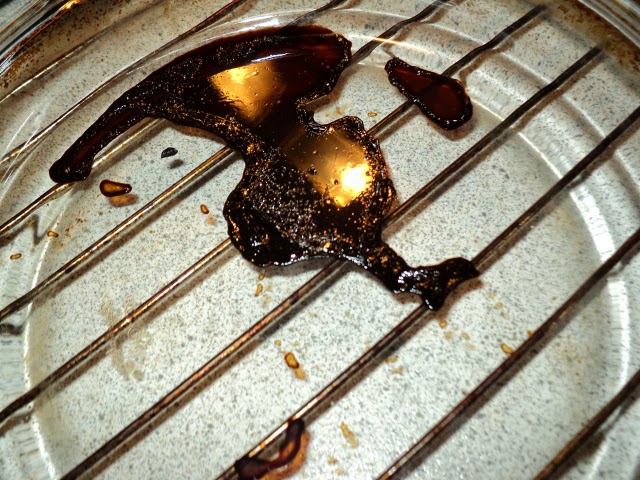
 Here's what happens when one heats lemon juice in a Pyrex dish in an oven, with no further additions. The intensity of the colour change from pale yellow to treacly-looking brown or black is simply amazing.


Might I (and plenty of others) have been barking up the wrong tree in fingering acids (primarily) with the unspoken suggestion that acids are chemically or thermochemically etching the linen  fibres to produce an enhanced 'scorching' effect. Who's to say that it's the linen fibres themselves that are chemically modified, at least at the lower temperatures?

I shall now be reporting the results of literature searches which, as indicated earlier, suggest that phenolics, not acids and sugars, may be the causative agent of the invisible ink effect.

Here's the relevant section from the wiki entry on Invisible Ink (my red bolding)

Inks developed by heat

Some of these are organic substances that oxidize when heated, which usually turns them brown. For this type of "heat fixed" ink, any acidic fluid will work. The most secure way to use any of the following substances for invisible ink is by dilution, usually with water, close to the point when they become difficult to develop.

Cola drink
Honey solution, sugar solution(sugar turns into caramel by dehydration)
Lemon, apple, orange or onion juice (organic acids and the paper forms ester under heat)
Milk (lactose dehydrates)
Bodily fluids such as urine, semen, saliva or blood serum.
Soap water (carboxylate partially oxidises)
Wine, or vinegar
Cobalt chloride, which turns blue when heated and becomes invisible again after a while (if not overly heated)

The writing is rendered visible by heating the paper, either on a radiator, by ironing it, or by placing it in an oven. A 100-watt light bulb is less likely to damage the paper.


But there's no earthly reason why ester formation should produce a colour change. One can esterify ethanol with acetic (ethanoic) acid, but the resulting ester, ethyl acetate,  is colorless, the same as the reactants.

Hey. Look what I've just come across (my red bolding):


History

Lemons


Lemons were originally developed as a cross between the lime and the citron and are thought to have originated in China or India, having been cultivated in these regions for about 2,500 years. Their first introduction to Europe was by Arabs who brought them to Spain in the 11th century around the same time that they were introduced into Northern Africa. The Crusaders, who found the fruit growing in Palestine, are credited with bringing the lemon to other countries across Europe. Like many other fruits and vegetables, lemons were brought to the Americas by Christopher Columbus in his second voyage to the New World in 1493, and have been grown in Florida since the 16th century.
Lemons, like other vitamin-C rich fruits, were highly prized by the miners and developers during the California Gold Rush in the mid-19th century, since they were used to protect against the development of scurvy. They were in such demand that people were willing to pay up to $1 per lemon, a price that would still be considered costly today and was extremely expensive back in 1849. The major producers of lemons today are the United States, Italy, Spain, Greece, Israel and Turkey.
 
Link 


"Other countries across Europe"? Like France for example?  Like small villages tucked away in Champagne country south-east of Paris? Like, you know, that there Lirey, in the bishopric of Troyes, which is where the TS had its first documented appearance (and immediate public display!) in western Europe. Allez figurer, as the French don't say...


Might there be a specific Templar connection to be found that might link lemons and their introduction to northern Europe one wonders?

The Lord of Lirey immediately prior to the first showing (1355 approx) was Geoffroi de Charny, a highly regarded Crusader knight recently returned from the Middle East. Some say that despite the small spelling difference, he was the nephew of Geoffroi de Charney, Templar Preceptor of Normandy, who was burned at the stake in Paris alongside Templar Grand Master Jacques de Molay in 1314.

It's the crusader connection that is of chief interest and possible relevance in the present lemony context, but some will know of my attempts to work the Knights Templar and their major personalities into the narrative, set out on my specialist Shroudie site.

For chemical buffs, see the wiki entry on flavonoids, which points out the difference between the class of compounds in the title (flavonoids) and the similarly named by subtly different flavanoids. While they both have the same 3 ring structure, the flavonoids have keto groups (-C=O) whereas the flavanoids have phenolic OH groups instead.


Hesperidin
Hesperidin is a flavanone glycoside found abundantly in citrus fruits. Its aglycone form is called hesperetin (the right half of the molecule shown).  Its name is derived from the word "hesperidium", the kind of fruit produced by citrus trees. from Wikipedia

A major flavanoid of citrus fruits is hesperedin (above) which is classed as a  polyphenol. I now need to see if it goes brown or black on heating. If not, I'll need to search elsewhere for the secret of the invisible ink effect.

 Casual aside:

Each time I pull a certain short-sleeved shirt out the wardrobe, I look at it ruefully, because I'm immediately reminded what I was doing a year or two ago when wearing it. I was helping clear a garden that got wild and overgrown with weeds - waist high thistles, nettles  etc. I and my shirt got splattered with an assortment of plant juices from stems etc as we slashed our way through, and those spots and splashes are now permanently and indelibly present on that shirt, having resisted all attempts to wash them out. So there is a chemical interaction between textiles (cotton etc) and the assorted chemicals that plants make as a defence mechanism against grazing animals, insects, bacteria and fungi etc, all classified as non-nutrient secondary metabolites etc. I'm willing to bet that phenolics feature prominently in that list. Those chemicals probably bonded onto fabric without the need for a source of heat (though sunshine and first laundering in hot water may have helped). 

As stressed previously, we have to keep in mind three imprinting mechanism - thermal, chemical and thermochemical.


Afterthought: thinking of thermochemical reactions, one must not overlook the possibility of a conventional non-enzymatic browning, i.e. Maillard reaction, but one that is crucially different from that of Rogers, inasmuch as both the essential ingredients are provided by the lemon juice, and need only a temperature rise to react together.

Reminder: there has to be:

(a) a reducing sugar. It could be glucose or fructose, or possibly sucrose too if it were to split into glucose and fructose at raised temperature.


(b)  a source of amino (-NH2) groups which can be provided as proteins, free amino acids or free amines.

It's going to take a while to get my head round all of the possible combinations, and decide what if any interventions a home-based experimentalist might make by way of distinguishing  between one mechanism from another.


All the "Ask any question you like" sites I've been checking online (quite a few now) assume (a) it's either citric acid  somehow "weakening" paper, rendering it more susceptible to heat and "burning" , OR (b) the acid itself is decomposing to carbon . All of them without exception confidently spout this mindless Mickey Mouse science without a shred of supporting evidence. Welcome to the internet-enabled modern world of casual misinformation.

I have one or two ideas up my sleeve for exploring the invisible ink phenomenon, and hopefully putting the explanation on a sounder chemical footing, but please don't expect results anytime soon.

Halleluja: Possible breakthrough in  my literature search, having entered (lemon juice maillard) into Google: it's apparently all due to the breakdown of ascorbic acid (Vitamin C) to a highly reactive sugar (threose) that then enters into Maillard browning reactions.

Here's a screen grab of the book page in question:


It looks a highly credible explanation. Does anyone disagree?

Threose - Wikipedia, the free encyclopedia

en.wikipedia.org/wiki/Threose
Threose is a four-carbon monosaccharide or carbohydrate with molecular formula C4H8O4. It has a terminal aldehyde group rather than a ketone in its linear ...


Other papers propose that the degradation product of ascorbic acid giving rise to non-enyzymatic browning reactions is furfural (similar to threose in possessing a  reducing aldehyde group, able to react with amino groups to form brown melanoidins OR able to polymerise). Here's a link (pdf) to just one paper (for now) from a Turkish group, making a case for furfural.

New addition: October 1st

So let's take stock, shall we? I began with the hypothesis that the TS image might have used 'invisible ink' chemistry (about which I could find nothing that looked in the least bit authoritative). But lemon juice is the agent most often recommended for invisible ink, and the major consituents that spring to mind are citric acid and sugar. But a mixture of those two failed to show an invisible ink effect in the experiments reported here (confounding most of the internet-wisdom re how lemon juice works). But I've now recalled that lemon and other citrus fruits are a rich source of ascorbic acid (Vitamin C), and that there's a pre-existing literature that describes how breakdown products of ascorbic acid, notably the 4 carbon aldose sugar threose, can react with amino groups of lemon (in proteins, amino acids etc), and probably added amino groups as well,  to produce Maillard, non-enzymatic browning products. The latter are known collectively as melanoidins, and are formed by a series of complex polymerisation reactions.

If what I read is true, as I've no doubt it is, then the relevant mixture for modelling the action of lemon juice is NOT citric acid and reducing sugar. It's ascorbic acid and a source of amino-groups, maybe proteins, amino acids etc with the vital addition of THERMAL ENERGY.That's heat in plain common English, as can be supplied by bringing up a hot piece of metal template (good for producing a negative image!!!).

I'm at my pied-à-terre in the south of France right now, and separated from my 'scorching kit'. But it might just be possible to lay my hands on some Vitamin C at the pharmacists and some protein (egg white?) and see if an intense brown colour is produced on heating. If  it can, then a whole new rethink will be needed re the likely provenance of the TS image, assuming (rightly or wrongly) that the radiocarbon dating is broadly correct (as I'm inclined to think it is).

In passing, I mentioned my WordPress site earlier, which is where I posted initial thoughts re the 'invisible ink' effect and its possible relevance to the TS.

I've posted nothing new there since March of  this year. Despite that, and thanks mainly to search engines, the site still delivers typically some 25-30 clicks each day (38 on each of the last two full days, and the same 38 today, early evening).


No one particular posting dominates  over there (unlike this site where my CO2 thoughts- see sidebar-  routinely account for some 65% of daily visits). So, one post about suffocating gas  (prior to diffusion and mixing) on this 'ere Blogger-hosted site gets all the attention, while a portfolio of some 250 posts on another type of suffocating gas (shroudological pseudo-science)  over on WordPress has its work cut out to stand out from internet chatter, but is managing - just- to keep its head above water. It's a funny old world.

Thursday  October 2: things are looking up. Here's a page from a book in which it's claimed that it's ascorbic acid, not citric acid, which is the active ingredient in lemon where invisible writing is concerned.

Click to enlarge


...


The book's title page

Cautionary note: the passage assumes that the brown colour is due simply to the charred residues of organic compounds, with the implicit assumption that ascorbic acid decomposes to brown products more readily than citric acid. There is no mention of Maillard browning products, which not only requires a reducing sugar or some other reactive aldehyde functional group (-CHO) to be present but additionally a source of amino groups, e.g. free amino acids or proteins providing -NH2. Elsewhere I have seen lysine mentioned as a target in proteins - explainable by the fact that  lysine residues in proteins carry a free terminal -NH2 group on the amino acid side chain that is not in polypeptide linkage. So in that sense a lysine-containing protein probably behaves as if it were free lysine.

OK, so let's harden up on the working hypothesis (it being hypotheses that lead to new lines of enquiry, new experimental directions, so valuable if only to prevent stagnation (and heaven knows there's enough of that in Shroudology as a quick glance at conference programmes amply demonstrates).

Something extraordinary must have happened in the run up to 1355 and the first public showing of the TS in Lirey, an object that no one had seen or heard of previously, at least where written authenticated records are concerned (vague allusions, or minuscule artistic details on obscure manuscripts are another matter).

I believe that when lemons were introduced to northern Europe by returning Crusader knights, there was much novelty value centred around what one could do with them. Someone discovered they could be used to create an invisible image on paper (and linen) which could be developed, i.e. made visible by heat. Someone else was casting around for a technology that could be used to simulate a sweat imprint that would be of whole body size and thus trump the Veil of Veronica (face only) as a 'tourist' attraction.

The realization of the potential to created the TS using invisible ink technology required advanced thinking (for its time), commercial acumen, and a realization that there could only be ONE TS, and that the method of its fabrication had to remain a closely-guarded secret.

Testable? Potentially, yes, if the chemical  building blocks of the image - let's say ascorbic acid and amino-groups - were both derived from external agents, and NOT from linen constituents themselves. That would leave a chemical signature, one that could be deciphered by modern micro-analytical techniques.

Friday October 3

Let's assume, for the sake of argument, that I've got the chemistry right, i.e. that the TS image was created by a binary mix of lemon juice (or some other source of active aldehyde) and protein (or some other source of amino acids), and that elevated temperature was required to produce a Maillard non-enzymatic browning reaction.

What about the technology? How might the chemistry have been achieved while at the same time imprinting the negative image of a man that is both exceedingly superficial and which responds well to modern 3D-rendering software (e.g. ImageJ)?

What follows is pure speculation, but one has to start somewhere.

Let's imagine first that the sheet of linen was impregnated with a protein solution of some kind. It may have been something as simple and unsophisticated as milk that was painted on, or maybe egg white in water. That would have first been left to dry to form a thin surface skin.

One then drapes that linen over a human subject, living or maybe dead, with the protein coating facing outwards (other geometries are not excluded). One then takes lemons and cuts them in half to use directly as 'dabbers'. Alternatively (and more probably) the juice is squeezed from lemons, and applied with a sponge or swab of cloth. One then dabs with the juice over the subjects contours, so as to capture that all important negative image (I'm fairly convinced that a template was used, and see no reason why that template should not have been a real person (after Garlaschelli) in place of the metal effigy that has been assumed for modelling purposes thus far). One then heats the linen, maybe by holding it over hot charcoal, or possibly in an oven if there's one big enough. The ascorbic acid reacts with the protein at the places where the dabbing coincided with the subject's 3D relief, and at no other points. After baking, one has the image captured in the form of medium to dark brown melanoidins, i.e. Maillard products, but there will be a faint yellow background from non-assisted  thermal degradation of the protein too.

The superficiality was assured through use of a protein solution that was first allowed to dry and form a protective skin over the linen fibres. So what Rogers conjectured as a starch impurity coating was in my model a protein coating that provided the amino (-NH2) groups for the Maillard reaction.  Putrefaction amines were not needed in the protein/lemon juice model.

So, there you have it, in a few short paragraphs - the Invisible Ink model -  post-STURP Maillard reaction Mk2, one in which a corpse was non-obligatory - a marriage of science and medieval technology.

Interestingly, the model described allows for a 'blood before image' modus operandi Or at any rate, blood could be applied after the protein, but before the lemon juice. The latter could react with blood proteins of course, but that might be scarcely visible if only a superficial layer on top of much thicker blood..

Here's a link to a blog which  also attributes the invisible ink effect of lemon to its ascorbic acid content, and throws in the protein-enhancing effect for good measure (well done that man).

What came as a surprise was his claim that milk alone works better than lemon juice! However, that may only be true for certain ranges of temperature. Where modelling of the TS image is concerned, one is looking for the best effect at the LOWEST temperature.

Update: 20:00, Friday

Have just this minute confirmed the above result, using milk impregnation v ascorbic acid (+ other things)  from the local pharmacist!

The so-called invisible ink trick is not restricted to lemon juice, and indeed a number of recipes recommend milk per se.

What I did was either impregnate linen with milk, then hang out to dry, or paint milk on with a brush, and then dry. Either way the linen became almost board-like, and took a more intense image than the similarly ascorbic-acid treated control (> conc. than lemon juice) which was best seen with serial imprinting, as above, when the template has cooled down to temperatures below that needed to scorch untreated linen.

Mechanism with milk?  One can but speculate, but as before one suspects it's a Maillard reaction. Milk contains 'milk sugar' i.e. lactose, which is a discaccharide comprising two sugars, glucose and galactose. It also contains a lot of protein, needless to say (caseins etc). On being heated, all that's needed is for the lactose to split into its two constituent monosaccharide sugars, both reducing, and for those sugars then to
form brown Maillard reaction products with the proteins.

Here's something for the chemistry buffs. (It points out, correctly I think, that lactose is a reducing sugar without having to be split into monosaccharides, so can react directly with proteins, targeting the lysine reside side-chain amino groups mentioned earlier. It's sucrose that is the non-reducing disaccharide):


Maillard reaction in milk.  Effect of heat treatment

Tomoko Shimamura and Hiroyuki Ukeda


 Introduction

Milk is usually subjected to heat treatment to ensure microbiological safety before retail and consumption. There are three types of heat treatment; (1) low temperature long time (LTLT) pasteurization, (2) high temperature short time (HTST) pasteurization, and (3) ultra-high temperature (UHT) treatment. In all types of heat treatment, the Maillard reaction occurs in milk. 

The Maillard reaction (nonenzymatic glycation) is a chemical reaction between amino group and carbonyl group; it is the extremely complex reaction that usually takes place during food processing or storage. In the case of milk, lactose reacts with the free amino acid side chains of milk proteins (mainly ε-amino group of lysine residue) to proceed to early, intermediate, and advanced stages of Maillard reaction and forms enormous kinds of Maillard reaction products. The reactions of lactose and milk proteins have been frequently investigated and the formations of various Maillard reaction products in milk during heat treatment have been demonstrated . In the general Maillard reaction, firstly an Amadori product is generated, and it progresses to the 3-deoxyosone or 1-deoxyosone route depending on the reaction pH. In the case of the Maillard reaction of disaccharides such as lactose, there is a third reaction route. It is the 4-deoxyosone route. A main carbohydrate in milk is lactose. Thus, the Maillard reaction in milk progresses via the above described three routes. Finally, the Maillard reaction results in the formation of melanoidins (browning compounds).

Saturday October 4

So, one has at least two different types of invisible ink systems that one can play with, neither depending on the linen* itself  to supply a thing, and in that respect, and that respect only, comparable to Rogers' Maillard hypothesis.

*That's retted flax fibres, excluding Rogers' conjectured starch impurities

The two types? There's the milk system, which on the face of it is the simpler of the two, given that both ingredients of the Maillard reaction are provided, i.e. reducing sugar and protein amino- functions.

Then there's the lemon juice/protein system, which might be called  binary, inasmuch as there are separate added reactants, analogous to binary chemical weapons, one providing the reducing compound, i.e reducing sugars such as threose derived from breakdown of ascorbic acid. and, additionally,  proteins which may be in short supply or of the wrong type in lemon, thus requirng a supplementation from milk or other source of protein.

While the binary system looks more complex, it may if the truth be told be the preferred one for modelling a TS-like image. Why? Because it gives one superior control over where the image is to appear, and over the characteristics of that image (thickness, colour intensity etc.)

Saturday  10:20

There was one short waspish comment yesterday on shroudstory.com's  (otherwise favourable ) coverage of this posting, to the effect that I was ignoring temperature in my "30 months" of modelling. Knowing the individual concerned  (one of the usual suspects re trolling propensity), the intended meaning was this: the TS image was formed at low temperature- not any kind of heat scorch- and until or unless I produce coloration and images at low, presumably environmental temperatures relevant to a recently-deceased corpse in a rock tomb, then anything I present that has required elevated temperatures is totally irrelevant, and indeed, for the Madame in question, a source of  deliberate provocation.

Later in the day I may add a few home truths here regarding the alleged "low-temperature" provenance of the TS image. There will be references to circular arguments, and  expression of some deep misgivings as to whether certain folk know the difference between heat and temperature. I may feel the need to deploy my favourite analogy, namely the Finnish sauna.


  Saturday 11:45

The latest posting on shroudstory.com places the spotlight on a paper that  describes discrepancies in the radiocarbon dating of ancient spruce in Eurasian loess deposits.


"What price the reliability of the TS C-14 dating?" is the inevitable take-away message.

Humbug. The half life of C-14 is about 5,730 years. The timber residues tested (as charcoal) are an estimated 30,000+ years old. That's some 5 half -lives, so one's attempting to isolate and measure just 1/32 of the C-14 atoms that are present in new wood. It's simply not fair to compare an artefact that is at most 2000 years old (while almost certainly less than 600) with material that has been under the ground for at least 10 -13 times longer.

11:50  Have just checked back with the site. Someone else agrees with me.


in response to Dan:
The chronology of long Upper Pleistocene loess sequences in Eurasia is based on combined pedostratigraphy and radiocarbon dating of high-quality charcoal. The accuracy of such a chronology depends on the reproducibility and precision of the 14C dates. However, certain dates may show discrepancies with regard to their chronostratigraphic context based on series of coherent dates. […]
One cannot compare the dating of the Shroud with the dating of a 30,000 years old wood remain.


in response to Dan:
The chronology of long Upper Pleistocene loess sequences in Eurasia is based on combined pedostratigraphy and radiocarbon dating of high-quality charcoal. The accuracy of such a chronology depends on the reproducibility and precision of the 14C dates. However, certain dates may show discrepancies with regard to their chronostratigraphic context based on series of coherent dates. […]
In a nutshell, the ancient wood dated to 30000 years, plus or minus 3%. The shroud dated to 1300 years, plus or minus 4%. That’s how reliable radiocarbon dating is. The paper was not written in disappointment at how inaccurate radiocarbon is, but as research into making an accurate and reliable dating method even more so.
(Moi: couldn't have put it better myself - and didn't).

13:15

As I  was saying earlier, the wonderful thing about a binary Maillard system is not just the science that generates a brown coloration, simply and reliably (acknowledging that sufficient heat is needed to raise the temperature locally at the site of reaction)  but its versatility. Recalling that this present line of enquiry (depositional Maillard chemistry instead of linen fibre pyrolysis) was prompted by talk of the TS image having been painted on, with subsequent flaking-off to leave a ghost image, might our binary Maillard provide the wherewithal to reproduce such a scenario?

The thing with painting is that the "paint" must be good and stiff, so as to scarcely wet the surface fibres, while providing a target and anchorage point for the second ingredient. Even if the first formed Maillard product is a heavy encrustation, who's to say that most but not all does not then detach, with or without some encouragement, to leave a 'pale shadow' of its former glory?

Thinks: a viscous component that can participate in a Maillard reaction...   Why not try egg white for starters. Either paint or stencil an image onto linen with egg white, let it dry, then apply some lemon juice (or ascorbic acid), or maybe the latter is not needed. Then,, when everything is bone dry, or maybe still slightly moist, go over with a heated flat iron (or modern electric iron).  What kind of image is formed? Can it easily detach, or even be washed out to leave a 'ghost'?  How does it look under the microscope?

I may have a go at doing this soon, and will report the results here.

14:00

I mentioned a day or two ago the problems I've been ahving with Planet Microsoft re their attempts to improve security (I'll spare you the details dear reader, except to say that MS has its excelled itself in clunky don't work procedures, and tries to deal with problems via automated Q/A software).

For those of you who have been communicating with me via my (initially) French dbmail address (subsequently absorbed into the MS Death Star), then the new address is sciencebod01 ( insert the at sign ) aol.com.

 Saturday October 4 15:13 (local time, S. of France)

OK, so I've just this minute done that experiment planned earlier, using an electric iron to bring up colour of Maillard reaction products.

Here's the single picture that sums up the take-away message:


Going left to right, what you see is Egg White (EW), Ascorbic Acid (ASC), Egg White first, then Ascorbic Acid (EW1 + ASC2), then (lower row) Ascorbic Acid First, then Egg White (ASC + EW2) then Untreated Control (CON).

Interpretation will be along shortly.

Sat 15:30 (latest add-on)


First, let me stress that what you see is NOT a valid model. Why not? Because there's been soaking through and coloration on the opposite side of the linen (not shown). But what this experiment does do is to flag up the potential for creating an image on cloth via a temperature-rise effect that is NOT sufficient in itself to scorch linen per se, noted before, but which CAN produce browning reactions in biological extracts (protein especially, with ascorbic acid becoming less and less interesting).  Mechanism? Maillard reactions? Caramelisation? Pyrolysis? Who knows?


Methinks there's a long and stony road ahead. Maybe I need to focus more on milk, and put egg white and ascorbic acid and lemon juice (especially) on the back burner. But if this Mk2 Maillard approach leads to an answer to the world's "most studied object", then why expect an easy path? Who said science was ever easy? I'd rather try reading the mind of medieval artifact-fabricators than that of Planet Microsoft software designers.

18:30

October 4, 2014 at 12:10 pm
I know your stance and I agree. I think many sindonists have an exceedingly broad insight on what an expert is. I have discussed this point in my blog in several entries.
 
This blogger's private thoughts (except here on his own site):


Agreed. There is no such thing as an expert in the field of sindonology (or shroudology as I prefer to call it. We are all beginners. Some begin better than others. The TS is a test of our ability to separate the wishful thinking that comes with appealing imagery from that of cold hard reality. Sadly there is no part of the human mind that is devoted to detecting CHR. The human mind is programmed to respond on a more immediate like/dislike response to what it sees. It's part and parcel of the human condition to instantly add layers of fancy to what cunningly or otherwise seduces, or attempts to seduce the eye.


October 5, !7:41

Oh dear. It's not often I go back on my word, but here I am, in my HOLIDAY apartment in France, and I'm going to have to do so. I said a while ago that it would take me till October 10, doing 20 pages a day, to go through Adrie Van Der Hoeven's pdf, all 243 pages of it:


http://www.academia.edu/8431835/Authentic_acid_blood_mordanted_the_madder-dyed_Shroud_of_Turin_pinkish_red_before_image


Well, I've tried  Believe me I've tried. But it's not just the length (which some might consider somewhat excessive when the aim is to fly a hypothetical kite, in this instance to assert/maintain that many disparate features of the bloodstains on the TS are explainable if one supposes that the linen had been pre-treated with a madder-derived dye, and that it had  mordanted, i.e.cemented a union, with oxidized blood). There's a wealth of supporting argument, indeed a positive cornucopia.  But it's the sheer density of detail - chemical, spectroscopic etc etc- that has been inflicted upon and overwhelmed this senescent brain that puts me in mind of what my naturalized US brother, a retired Army major, on being shown around St.George's Chapel, Windsor Castle, memorably described as " awesome, but sensory overload".

I do have an opinion on the central hypothesis, based not on what I have read, but on what I don't recall having read. But the task of going back through 243 pages to make absolutely sure I have not missed something when one is ON HOLIDAY (yes, even grandparents need an occasional break) is simply too much.

Sorry Adrie. Impressive. Truly impressive. But somewhat OTT if you don't mind me saying ("over the top"). It's like having one's latest Amazon purchase delivered to one's door in a juggernaut, all to itself.

It's maybe time to close this posting.  I shall continue to potter around, testing various aspects of my scorching model, modified now to include Maillard reactions. Preliminary findings with additives to linen like milk, flour, egg white etc are interesting, but best I keep them under wraps until some kind of firm conclusions are possible.

No more postings for a few more days at least (am off to central France shortly to look up old friends).