* * |
| There's generally scope for fine-tuning models in science... |
Summary: What we see today is not what the putative 14th century fabricator of the Shroud intended us or rather his contemporaries to see. The Mark1 image was a more prominent dye/mordant combination, essentially as proposed by STURP's Joseph Accetta, imprinted onto linen possibly to resemble dried, ancient sweat (with blood pre-additions too). (See earlier ideas onthis site re the Shroud being an attempt to produce a life-size rival to the fabled “Veil of Veronica”). That Mark 1 Accetta image has largely if not entirely disappeared, as a result of natural wear and tear, bleaching by sunlight, detachment of mordant etc etc, possibly even laundering. What remains is a Mark 2 ghost image, still a negative “photograph-like” imprint, one that formed gradually under the dye mordant via chemical action that mimics the effect of scorching with a hot metal template. The chemistry would be similar (dehydration, oxidation of linen carbohydrates) but achieved slowly at environmental temperatures by chemical reaction with or without catalysis.
The chemicals used in medieval bleaching offer ample scope
for modelling of slow superficial “scorching” of linen fibres, especially the
acid mordants like aluminium and iron sulphates that easily hydrolyse initially
to dilute sulphuric acid. The latter becomes steadily more concentrated when exposed to air due to progressive evaporation of water, the sulphuric acid being relatively involatile. and increasing
concentration to largely anhydrous H2SO4 with a powerful dehydrating, caramelising and finally charring action on
carbohydrates is well. Caveat (an afterthought): It never becomes standard "concentrated" sulphuric acid (98%) however, which is what I call "The Beast" give its violent affinity for water, as witnessed by its ferocious charring of carbohydrates (see photograph below). Why not? Because maximally concentrated 98% H2SO4 is highly hygroscopic: it picks up moisture from the air, increasing its volume considerably as it does so. It's self-evident therefore that dilute sulphuric acid can never evaporate all the way down to the 98% level when exposed to the air (ordinary moist air that is). It simply becomes more concentrated - though I can't as yet put a figure on it.
 |
| This is what concentrated sulphuric acid does quickly to cotton (wiki). This blogger has placed an order for modern car battery acid (37% H2SO4) which will be used for observing the time-course on linen as water gradually evaporates off to leave conc. H2SO4. Might one see subtle sepia-coloured caramelization rather than charring? (Update: yes, but barely perceptible if tested at room temperature: elevated temperatures are needed for clearly visible browning). |
Catalysis of oxidation by iron salts is an added
possibility, given the ability of variable-valency iron salts (Fe++ and Fe+++) to
facilitate organic redox cycles, acting as intermediary electron acceptor/donors
between atmospheric oxygen and oxidisable substrate.The traces of iron
oxide that Walter McCrone and his microscope detected on the Shroud may
not have been artist's red ochre, as was proposed, but oxidized iron mordant, e.g. iron
(III) oxide-hydroxide, FeO(OH).H2O, more commonly written as Fe(OH)3. See the wiki entry.
More to follow (much more!) in short time-spaced instalments. Sorry, it's the way I work.
Still Thursday 19 March, 11:50
Sulphuric acid, H2SO4, the most common mineral acid of commerce, with thousands of applications, has always lurked in the Shroud literature. Take this extract, for example, from the 1981 Summary of conclusions from the Shroud of Turin Research Project (STURP):
Quote (STURP 1981) : The scientific consensus is that the image was produced by something which resulted in oxidation, dehydration and conjugation of the polysaccharide structure of the microfibrils of the linen itself. Such changes can be duplicated in the laboratory by certain chemical and physical processes. A similar type of change in linen can be obtained by sulfuric acid or heat. However, there are no chemical or physical methods known which can account for the totality of the image, nor can any combination of physical, chemical, biological or medical circumstances explain the image adequately.
Sulphuric acid pops up again in that stunningly original and inventive attempt by Professor Luigi Garlaschelli and his students to model a Shroud-like image. I shall look out his paper (a copy of which he sent me personally) and quote a few of his own words. In the meantime, here's a comment I left on Dan Porter's shroudstory site last summer that is highly germane to what follows:
Then there was my stumbling for the first time on the unique approach of STURP's Joseph Accetta. PhD.
Yup, that's Joseph Accetta PhD, electro-optics/laser/imaging expert, not to be confused with another Shroud researcher - August Accetta MD.
Again, it saves time if I simply cut-and-paste a comment I posted to shroudstory in June 2014, with the key passage from Accetta's 2008 Ohio Shroud conference referring to H2SO4 highlighted in red:
Still Thursday, 12:50
We then learned that this STURP veteran was scheduled to present a paper at the October 2015 St.Louis Shroud conference. What would he say? What was his current focus, some 35 years on from that celebrated week in intense activity in Turin?
Well, here was the abstract he submitted for the St.Louis meeting.
Here it is: Origins of a 14th Century Turin Shroud Image (pdf)
First, the disappointing feature. There's no further mention of sulphuric acid. Indeed, there's only a single reference when one searches "acid" - to tannic acid.
But acids, or at any rate "corrosive" agents, are implicated, and importantly it seems, in this intriguing passage, one that sets the tone for an entire new slant (at least that this blogger is aware of) on the possible origins of the 'enigmatic' Shroud image:
Having no easy access to oak galls, I'm using pomegranate rind/pith to make a syrupy extract of yellow tannins, with or without alum as mordant that can be painted onto bas relief templates to get imprints. (Yes, they are tone-reversed negatives, needless to say, and respond reasonably well to 3D enhancement). See the blog posting that precedes this one for preliminary results.
Friday 20 March
Before discussing anything else, let's see how this double imprint, fast dye/slow chemical scorch mechanism offers an explanation for that "blood first/image second" finding of Adler and Heller. I allude to their experiment with the protease in which blood proteins were digested off TS linen fibres with proteolytic enzymes to reveal colorless fibres underneath. That finding has always been an embarrassment for those of us who provisionally accept the radiocarbon dating, warts an' all (while wondering why there was no Phase 2 sampling from additional sites). How could a forger know where to paint on bloodstains if the linen had initially been image-free? OK, here's an explanation, or at any rate a get-out- of- jail-free card. The blood was NOT painted on first. The image was dye-imprinted, and the blood painted on top (the easy way). Then the Mark2 image gradually formed under the dye imprint, due to chemical action on the linen carbohydrates. But that did NOT happen where there was blood overlying the body image. Why not? Because the reactive chemicals (H2SO4, iron salts etc) had an easier substrate ON TOP than underneath with which to react, so were constantly mopped up by that overlying blood leaving the linen fibres in their original pristine condition. So when STURP scientists came along centuries later and digested away the blood to find those pristine linen fibres exposed, they quite reasonably supposed that the blood was acquired first, not second. They weren't to know that there had originally been a long-gone Mark1 dye-imprint between blood and Mark2 chemical scorch, were they?
Thought-provoking quote on this morning's BBC site under an article headed : "Can Religion and Science Bury the Hatchet?"
"'Simplistic' distinctions
Interestingly, just yesterday I came across a site for secondary teachers in England and Wales that has "Understanding Science 101" in the title bar (yes, really). There's some amazingly perceptive stuff in there that one rarely meets elsewhere. It should be required reading for anyone who is not a scientist, but thinks they know and understand how science operates and makes progress - or tries to, or who imagines that just anyone can do science. The expression "they don't know the half of it" springs to mind. This blogger is a 70 year old retired scientist, but is still learning more about dos and donts of research strategy with each new passing day. Might he have arrived where he is now but much sooner?

Back to practicalities: what about that suggestion from last night - using moulded clay instead of Accetta's carved/engraved woodcut as template for dye/ink imprinting?
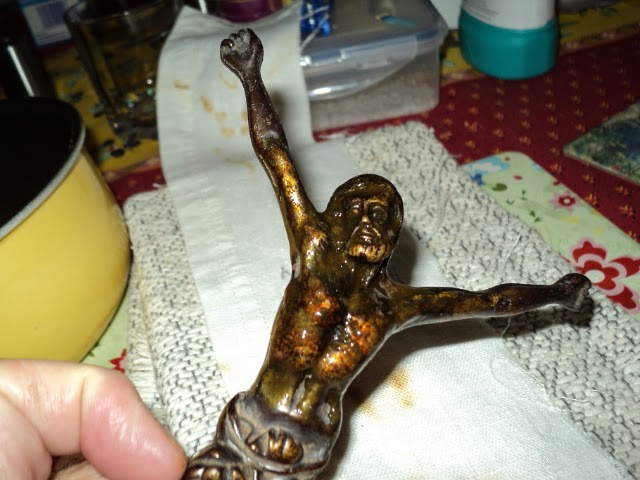
If clay, did it need to look like this?

It's taken from the Home Page of Rolfe's Enigma site (see previous posting for this blogger's view on those allegedly 'enigmatic' features that are supposed to equate on suspects with 'unique', but don't really). Yes, I realize I've been a bit mischievous in using that image, which in the Rolfe narrative would be a model derived from scanning the Shroud image, not a model used in reverse to make it! (We'll overlook the small matter of it having complete arms, as if there had been no 1532 fire)
Now then, if you, dear reader, had been a medieval artisan supplied with a cartload of wet clay and been told to fashion a life-size effigy of the lifeless Jesus recently taken down from the cross, would you have attempted to reproduce the above? Suppose you had a rough idea about how the imprint was to made, e.g. by painting dye onto the highest features of the relief, then spreading linen on top, then manually pressing the linen into all the hollows and crevices to get best most intimate contact between template and fabric. Would you have then proceeded to mould (or attempt to mould) a fully 3D effigy. The answer is obvious - NO. It's impractical to do that. Wet clay, whilst stiff, would not allow one to do that - gravity would cause sagging of those parts not in contact with the supporting surface. But here's the crucial point. One does not need a fully 3D effigy. A bas relief is sufficient, or rather two, one for frontal, one for dorsal side, if one look at the Shroud. There are no sides! Indeed, that's just as well, since any attempt to imprint off the sides of that effigy one sees above would introduce lateral distortion.
Take away message: not only was wet clay (later left to set) the likely template material. It was fashioned as two separate bas relief templates, one frontal, the other dorsal. That incidentally would account for why one is said to be some 7cm taller/longer than the other (the source of much 'creative accounting' on the part of the pro-authenticity tendency that need not concern us right now).
Might there be practical difficulties in imprinting off a clay bas relief template instead of woodcut? It's a moot point. I shall try to get hold of modelling clay and do some crude experiments to see how well the dye/mordant mix sticks to the template and how well it then transfers to linen. Having already experimented with metal templates in dye as well as scorch-imprinting, I'm not expecting there to be insuperable problems, especially as there's the possibility of making additions, e.g. soap or other wetting agents etc.that might improve the outcome.
It's the imprinting off a bas relief, or less probably fully 3D template that generates the image with negative (dark/light reversed) properties AND reasonable response in 3D-rendering progeams like ImageJ. It shouldn't be necessary to have to say this in 2015, but still we have to endure lectures from so-called historians (with amazing blindspots for the historical record) telling us the Shroud is just a degraded painting or that we have overlooked the effects of ageing, wear and tear etc. (Not so. Some of us, notably Hugh Farey and myself have been exchanging views on bloodstain and image-fibre attrition for YEARS.) This might be a good point at which to slip in a couple of cut-and-paste items of historical interest and relevance.
Here for starters is the celebrated, some say suspect d'Arcis memorandum, kindly translated initially from the medieval Latin into the French you see here (red) and a DIY-makeover (black) of the Google translation. We're told emphatically by a self-styled academic historian that no one in the 14th century would have been taken in by claims for the Shroud being the authentic burial cloth of Jesus. Is that the impression one gets from reading this?
sa juridiction ordinaire, se mit à l’oeuvre pour découvrir la vérité dans cette affaire.
puisque les saints Evangiles faisaient pas mention d’une telle impression, alors que si elle s’était produite,
as holy Gospels did not mention such an impression, whereas if it had occurred,
il semblait bien évident que les saints évangélistes n’auraient pas omis de le rapporter,
it seemed obvious that the Evangelists would not have omitted to report it,
En fin de compte, après avoir
déployé une grande diligence dans son enquête et ses interrogatoires,
xxxxxx (expect a few carefully-chosen words to appear here later).
Then there's this passage from Barrie Schwortz's shroud.com site (history page). I'll quote it in full, so as not to deprive readers of essential context, but the crucial few words come right at the end (highlighted in red):
April 14, 1503 Good Friday: Exposition of the Shroud at Bourg-en-Bresse for Archduke Philip the Handsome, grand-master of Flanders, on his return from a journey to Spain. The Shroud, which has been specially brought from Chambéry, with great ceremony, by Duke Philibert of Savoy and Duchess Marguerite, is exposed on an altar in one of the great halls of the Duke's palace. Savoy courtier Antoine de Lalaing records of the events of that day: "The day of the great and holy Friday, the Passion was preached in Monsignor's chapel by his confessor, the duke and duchess attending. Then they went with great devotion to the market halls of the town, where a great number of people heard the Passion preached by a Cordeilier. After that three bishops showed to the public the Holy Shroud of Our Lord Jesus Christ, and after the service it was shown in Monsignor's chapel." Lalaing adds that the Shroud's authenticity has been confirmed by its having been tried by fire, boiled in oil, laundered many times 'but it was not possible to efface or remove the imprint and image.'
This blogger has previously taken that account with a pinch of salt. But he'd now reconsidering in the light of the new model, when a Mark 1 image may have been gradually fading from view some 150 years after manufacture, but a ghost Mark2 image was being seen to take its place. Is it not perhaps unsurprising that an attempt would be made to achieve uniformity by speeding the removal of the degraded Mark1 image, especially if cautious testing had determined that the Mark2 image, while faint, was a lot more permanent and resistant to removal? Why would that be? This little experiment with bleach and a thermal scorch may give a clue:
Those thermal scorches are not totally resistant to the bleach, though some of the loss may be due to mechanical effects (breaking off due to swelling of fibres). Irrespective, it's clear that thermal scorches can at least partly resist a harsh chemical like bleach, when the same agent decolorises my pomegranate dye extracts within a few minutes at most. Is it a mistake to imagine that a chemical scorch producing the hypothesized Mark2 ghost image has a similar chemical make-up to the thermal one above, i.e. dehydrated and oxidized linen carbohydrates, and while fainter than the Mark1 image is essentially permanent, resisting atmospheric oxygen, moisture, acidic pollutants etc and thus still visible (just) after many centuries, despite fires and the alleged treatments described above by courtier Lalaing?
Next experiment?
Watch this space.
OK, that didn't take too long. The imprinting medium was pomegranate extract, alum and gum arabic. The template was painted iron, with some interesting rust patches even after giving a coat of metal undercoat. A litle iron does not hurt in this ranging shot experiment (see title). The imprinting was done two ways, using methodology developed in my earlier heat scorch experiments: LUWU (Linen Underneath with Underlay) and LOTTO (Linen On Top with Overlay).
More later, but please remember: what you see above are only the primary Mark1 images. They are of no relevance to the present TS image if, as hypothesized, we are now seeing only the secondary Mark2 ghost images formed by slow chemical action of dye/mordant imprinting chemicals, e.g. alum, sulphuric acid, iron salts etc., the Mark 1 image having disappeared long ago.
This posting is long enough as it is: so don't be surprised to see a new posting in due course in which the above images are tone-reversed and 3D-rendered, simply to see how well they compare with the thermal scorches. They will then be put away for months, maybe years to monitor the effects of time.
Afterthought: there's a major problem still to be addressed with the new model - the 'reverse side'. Even with the viscosity aid recommended by Accetta (gum arabic) there was extensive reverse side imaging.
Pigment/mordant on the reverse side should surely generate a reverse-side Mark 2 image in the fullness of time - as acknowledged at least nominally in the earlier graphic. Can the problem be resolved? Maybe. The linen used in this experiment was very thin compared with others used in this ongoing project. Maybe viscosity aids like gum arabic* are not sufficient. Maybe the interstices of the weave need to be plugged with a cement-like substance. But with what? Dare on suggest that there's a potential role here for Rogers' starch* - not as a technological weaving aid, but as aid to unilateral printing. Would that be raw starch, with intact discrete starch granules, or gelatinized starch, with dispersed starch? Granted, adding starch to the formulation introduces yet another ingredient, another variable, another complication, and the inevitable references to Occam's razor. But there's a upside too - if there were a starch 'skin' on the linen first, then a second aspect of the TS image can be explained, namely Rogers' observation that the image layer can be stripped off, and is exceedingly thin (estimated at 200-600nm based on failure to see in cross-section under a light microscope). In this scenario, the Mark 1 image layer could be on a starch coating, or linen fibres or both, with mordant acting as a bridge between dye and binding substrate. Where would the Mark 2 image form? Starch? Fibres? At least the model offers possibilities for testing these alternatives using adhesive tape, microscopy etc, essentially as deployed by Rogers and his STURP colleagues.
It was the reverse side problem that persuaded this blogger against going down the soluble dye road, to say nothing of STURP's failure to link the body image with external pigments of any kind, and instead to focus on thermal scorching. The latter coudl be said to be 'on the back burner' while the strengths and weaknesses of the current dye/mordant model are investigated more thoroughly, especially when assisted by starch, viscosity agents etc if able to prevent dye migration across the weave,
* Here's what Joseph Accetta had to say re starch and gum arabic in his St.Louis paper (I've corrected his spelling of 'Rogers').
Still Thursday 19 March, 11:50
Sulphuric acid, H2SO4, the most common mineral acid of commerce, with thousands of applications, has always lurked in the Shroud literature. Take this extract, for example, from the 1981 Summary of conclusions from the Shroud of Turin Research Project (STURP):
Quote (STURP 1981) : The scientific consensus is that the image was produced by something which resulted in oxidation, dehydration and conjugation of the polysaccharide structure of the microfibrils of the linen itself. Such changes can be duplicated in the laboratory by certain chemical and physical processes. A similar type of change in linen can be obtained by sulfuric acid or heat. However, there are no chemical or physical methods known which can account for the totality of the image, nor can any combination of physical, chemical, biological or medical circumstances explain the image adequately.
Sulphuric acid pops up again in that stunningly original and inventive attempt by Professor Luigi Garlaschelli and his students to model a Shroud-like image. I shall look out his paper (a copy of which he sent me personally) and quote a few of his own words. In the meantime, here's a comment I left on Dan Porter's shroudstory site last summer that is highly germane to what follows:

July 17, 2014 at 3:13 pm
Luigi Garlaschelli’s powder-rubbing model, even if incorrect,
gives a pointer to the kind of subtlety that is possible if wishing to
leave a “stamp” (good, straightforward term)
on linen.
He proposed that the kind of ochre (red-brown ferric oxide, Fe2O3, available in medieval times, made by decomposing green vitriol, hydrated ferrous sulphate, FeSO4. 7H2O), would have contained acidic impurities, notably sulphuric acid, which becomes conc H2SO4 when one drives off water.
He reckoned that the acidic ochre was used to produce a negative image from a human subject, and the linen then heated in an air oven to make it seem older than it really was. But the heat might also have caused the acidic impurities to chemically etch the linen, via the same kind of pyrolytic chemistry (dehydration reactions etc) that occurs when linen is scorched directly with a hot metal template. Later the solid ochre flaked off, or was scrubbed off, leaving just the ghostly image (Hugh Farey has also flagged up this kind of erosion scenario as a possible explanation).
In other words, there’s a mechanistic spectrum that runs between a purely thermal action (scorching from a hot template) or a chemical mechanism (traces of sulphuric acid etc) or any number of in-between mechanisms that rely on a combination of chemistry and heat.
Despite these uncertainties re precise mechanism, the narrative may hinge on the credibility or otherwise of a medieval artisan asking himself a simple question: “How can I produce a whole-body version of the Veil? How can I simulate a post-Criucifixion sweat imprint that might be left on linen as a yellow discoloration?”
It didn’t need to be a real sweat imprint – merely a yellow-brown image that could be represented as an ancient degraded sweat image.
My own preferred scenario is that of a post 1314 scorch-imprint
designed to simulate a slow-roasted Knight Templar, possibly a Knight
Templar (Jacques de Molay?) being “reinvented” as a sweat imprint of the
crucified Jesus.
on linen.
He proposed that the kind of ochre (red-brown ferric oxide, Fe2O3, available in medieval times, made by decomposing green vitriol, hydrated ferrous sulphate, FeSO4. 7H2O), would have contained acidic impurities, notably sulphuric acid, which becomes conc H2SO4 when one drives off water.
He reckoned that the acidic ochre was used to produce a negative image from a human subject, and the linen then heated in an air oven to make it seem older than it really was. But the heat might also have caused the acidic impurities to chemically etch the linen, via the same kind of pyrolytic chemistry (dehydration reactions etc) that occurs when linen is scorched directly with a hot metal template. Later the solid ochre flaked off, or was scrubbed off, leaving just the ghostly image (Hugh Farey has also flagged up this kind of erosion scenario as a possible explanation).
In other words, there’s a mechanistic spectrum that runs between a purely thermal action (scorching from a hot template) or a chemical mechanism (traces of sulphuric acid etc) or any number of in-between mechanisms that rely on a combination of chemistry and heat.
Despite these uncertainties re precise mechanism, the narrative may hinge on the credibility or otherwise of a medieval artisan asking himself a simple question: “How can I produce a whole-body version of the Veil? How can I simulate a post-Criucifixion sweat imprint that might be left on linen as a yellow discoloration?”
It didn’t need to be a real sweat imprint – merely a yellow-brown image that could be represented as an ancient degraded sweat image.
Then there was my stumbling for the first time on the unique approach of STURP's Joseph Accetta. PhD.
Yup, that's Joseph Accetta PhD, electro-optics/laser/imaging expert, not to be confused with another Shroud researcher - August Accetta MD.
Again, it saves time if I simply cut-and-paste a comment I posted to shroudstory in June 2014, with the key passage from Accetta's 2008 Ohio Shroud conference referring to H2SO4 highlighted in red:
June 5, 2014 at 12:55 pm
Try downloading this PowerPoint presentation from Joseph
Accetta, David (he being the subject of a recent posting here, and one
of STURP’s genuinely scientific, non-agenda driven, non grandstanding
participants in my view).
Go to the last few pages (approx 24/25). There you will see model spectroscopic (ir) studies not just with thermally-imprinted scorches, but also with linen that has been chemically dehydrated with 36% H2SO4 and even your invisible ink (lemon juice).
I’d be the first to admit there may be little to distinguish between an image produced by chemical as distinct from thermal dehydration (especially if chemical action was heat-assisted – see Luigi Garlaschelli’s model ‘frottage’ imprinting with acid-contaminated red iron oxide). It’s the vehicle for acid that is important (not too runny, not too viscous).
Some of us eagerly await details of what JA will say at St.Louis. Let’s hope it receives more attention than his meticulous and detailed studies to date.
Nuff said. I’m thinking of doing a post dedicated entirely to JA (he being my kind of scientist).
Go to the last few pages (approx 24/25). There you will see model spectroscopic (ir) studies not just with thermally-imprinted scorches, but also with linen that has been chemically dehydrated with 36% H2SO4 and even your invisible ink (lemon juice).
I’d be the first to admit there may be little to distinguish between an image produced by chemical as distinct from thermal dehydration (especially if chemical action was heat-assisted – see Luigi Garlaschelli’s model ‘frottage’ imprinting with acid-contaminated red iron oxide). It’s the vehicle for acid that is important (not too runny, not too viscous).
Some of us eagerly await details of what JA will say at St.Louis. Let’s hope it receives more attention than his meticulous and detailed studies to date.
Nuff said. I’m thinking of doing a post dedicated entirely to JA (he being my kind of scientist).
Still Thursday, 12:50
We then learned that this STURP veteran was scheduled to present a paper at the October 2015 St.Louis Shroud conference. What would he say? What was his current focus, some 35 years on from that celebrated week in intense activity in Turin?
Well, here was the abstract he submitted for the St.Louis meeting.
No further) references (as yet) to H2SO4 note, But there was that intriguing allusion to "printing techniques". What was that about? Had anyone mentioned printing before (barring my preferred scorch imprinting)? Hadn't STURP excluded not just artists' pigments, but inks and dyes too? What did this Joseph Accetta have up his sleeve?Abstract:
This paper is based on the assumption that the Shroud is of 14th century origins consistent with its radiocarbon date and thus must be explained within the technology and historical context of that era. Avoiding the controversy surrounding the date, the author presents a plausibility argument to reconcile its visual and forensic properties with extent 14th century printing technology, geographical circumstance and historical context. The observed 3-d properties of the image are discussed in relationship to physical image formation processes and a plausible explanation for this extraordinary effect is given based printing techniques known to exist at that time and in that locale. Further the argument is reinforced with analytical results showing that under any reasonable assumption about the surface bi-directional reflectance distribution function (BRDF) including the use of measured human skin data, the observed 3-d properties cannot be reconciled with any known radiative imaging process and thus must be a contact process.
Here it is: Origins of a 14th Century Turin Shroud Image (pdf)
First, the disappointing feature. There's no further mention of sulphuric acid. Indeed, there's only a single reference when one searches "acid" - to tannic acid.
But acids, or at any rate "corrosive" agents, are implicated, and importantly it seems, in this intriguing passage, one that sets the tone for an entire new slant (at least that this blogger is aware of) on the possible origins of the 'enigmatic' Shroud image:
"Iron gallate and carbon inks of which there are reportedly several hundred recipes are seemingly plausible candidates for coloring agents because they were the ink of choice during the medieval period and could be made sufficiently viscous with gum Arabic, linseed oil or a number other binders to serve as suitable colorant for textiles. It should be noted that the penetration of the colorant into the textile was not a primary consideration during the printing process because mechanical stresses would have flaked almost all of the ink away. Many of these formulations are corrosive and would have over time either caused cellulosic degradation or reacted with some other substance on the linen such as a mordant or starch. Some of these inks are known to create time dependent contrast effects depending on the formulation and there are several hundred papers dealing with the conservation issues on rare documents relative to these inks."
So what are these corrosive agents? Are they the dyes themselves, or the mordants that attach them to cloth? Why would corrosive action be necessary? Dyes are dyes, surely, that can be used to imprint an image without having corrosive action, the latter being unnecessary and undesirable surely?
Accetta has also put his St.Louis slide presentation online.

There are details there that are not in the pdf:

So the original image was prominent. What we see today is a degraded image. Presumably the corrosive ink (iron gall?) was corrosive and contributed to the degradation. Does that narrative fit with what we know about the TS image, notably the lack of reverse (aka obverse) side image? Would not inks or other soluble dyes penetrate, even if thickened with gum arabic or some other viscosity-increasing agent? Would not some of that cross-over have survived to be spotted and reported on by STURP and others?
Before addressing those issues in more detail, reference must be made to another slide in Accetta's presentation , alluding to work done by a French group on the stability of medieval documents written in the standard iron gall ink:
Here's a cut and paste from the slide:
Iron gall
ink corrosion of paper is one of the largest threat for our graphic
patrimony. A great work has been done in this field to explain the
possible mechanism of paper degradation and to propose curative methods The main
degradation mechanism proposed in the literature is the following : iron gall
ink prepared with different ingredients including tannins and vitriol causes
both acidic hydrolysis and Fe2+catalysed oxidation
of cellulose. Paper turns brown and loses its mechanical properties. Yet the
great variety of iron gall ink recipes , and the great variety of visual
aspects of manuscripts suggest that many side effects could occur and
contribute to the different aspects of paper degradation (colour changes,
halos, mechanical properties).
...
So, whilst one has to look quite hard, there are two additional gems of information in that French paper - first the reference to "vitriol" (SULPHURIC ACID) lacking in the main presentation AND the recognition that iron salts are capable of catalysing redox reactions sufficient to oxidize chemically inert cellulose (though that need not be the target polymer in linen, despite being the major constituent - there being more sensitive ones, notably the hemicelluloses of the superficial primary cell wall).
Time now to put cards on the table. First, this blogger suspects that Accetta with some French back-up was right: the Shroud image began life as wet imprint - not the dry scorch imprint that has been my model thus far (though its proved handy in de-mystifying the negative image and, especially, 3D properties). Iron gall ink, with its mixture of plant tannins and iron salt mordants serves as a handy model for the imprinting medium - but no more. Any number of soluble dyes could have been used, probably mordant-assisted, e.g. with commonplace alum (potassium aluminium sulpahe) or with iron or chromium salts. But here's where I diverge from Accetta. He thinks the corrosive agents, whatever they might be (mordants? vitriol?) partially degraded the original image. leaving a remnant that we still see today. I beg to differ. I consider that the entire dye/mordant combination has vanished entirely, for a combination of physical and chemical reasons (crumbling away, bleaching by sunlight, loss on laundering, however infrequent). But we still see a 'ghost' image that is NOT the original. Here's a schematic as visual aid:
What in a generic sense could have produced a secondary 'ghost' image, probably quite slowly, but fast enough (decades, centuries) such that when the primary Mark 1 dye/mordant image has faded from a view a faint but STABLE ghost is revealed?
There are two candidates, close chemical cousins with similar properties, that are in the frame. One is alum, with aluminium sulphate as 'active ingredient', that is well known for releasing SULPHURIC ACID in solution or exposed to moist air, due to chemical hydrolysis:
(Aluminium hydroxide can also be regarded and/or named as hydrated aluminium oxide, the two being equivalent in terms of atomic makeup)
Let's suppose for the sake of simplicity that a plant-dye had been used with alum as mordant. The mordant would have attached the dye firmly to the fabric, but not prevented bleaching and other deterioration of the colour over decades and centuries. Meanwhile any alum excess in the cloth could have slowly released sulphuric acid which , acting on the superficial linen fibres under the dye -coating, would (or could) have generated a ghost image , invisible to the first cohorts of pilgrim spectators. However, one is relying purely on H2SO4 to degrade the linen fibres. It can do that via chemical dehydration, at least in principle. But scorching of linen, whether by thermal or chemical means, is generally assumed to require oxidation as well as dehydration. STURP acknowledged as much in its 1981 summary. Maybe it assumed that atmospheric oxygen would produce the oxidation (cold sulphuric acid alone is unlikely to result in oxidation). But contrary to popular belief, atmospheric oxygen is not very reactive chemically, due to its triplet electronic state, which is why one has to raise temperature to kick-start combustion and other oxidation reactions. Organic compounds, even complex ones, can often survive indefinitely if there's no flame or other source of ignition. That's where iron salts come in handy if one is wishing to implicate atmospheric oxygen as the ultimate oxidant - they CATALYSE oxidative reactions, as those French workers recognized. Why? How?
So what are these corrosive agents? Are they the dyes themselves, or the mordants that attach them to cloth? Why would corrosive action be necessary? Dyes are dyes, surely, that can be used to imprint an image without having corrosive action, the latter being unnecessary and undesirable surely?
Accetta has also put his St.Louis slide presentation online.
There are details there that are not in the pdf:
So the original image was prominent. What we see today is a degraded image. Presumably the corrosive ink (iron gall?) was corrosive and contributed to the degradation. Does that narrative fit with what we know about the TS image, notably the lack of reverse (aka obverse) side image? Would not inks or other soluble dyes penetrate, even if thickened with gum arabic or some other viscosity-increasing agent? Would not some of that cross-over have survived to be spotted and reported on by STURP and others?
Before addressing those issues in more detail, reference must be made to another slide in Accetta's presentation , alluding to work done by a French group on the stability of medieval documents written in the standard iron gall ink:
Here's a cut and paste from the slide:
FTIR
techniques applied to iron gall inked damaged paper
REMAZEILLES Céline, QUILLET Véronique , BERNARD Jacky LEMMA,
Université de La Rochelle
INTRODUCTION
...
So, whilst one has to look quite hard, there are two additional gems of information in that French paper - first the reference to "vitriol" (SULPHURIC ACID) lacking in the main presentation AND the recognition that iron salts are capable of catalysing redox reactions sufficient to oxidize chemically inert cellulose (though that need not be the target polymer in linen, despite being the major constituent - there being more sensitive ones, notably the hemicelluloses of the superficial primary cell wall).
Time now to put cards on the table. First, this blogger suspects that Accetta with some French back-up was right: the Shroud image began life as wet imprint - not the dry scorch imprint that has been my model thus far (though its proved handy in de-mystifying the negative image and, especially, 3D properties). Iron gall ink, with its mixture of plant tannins and iron salt mordants serves as a handy model for the imprinting medium - but no more. Any number of soluble dyes could have been used, probably mordant-assisted, e.g. with commonplace alum (potassium aluminium sulpahe) or with iron or chromium salts. But here's where I diverge from Accetta. He thinks the corrosive agents, whatever they might be (mordants? vitriol?) partially degraded the original image. leaving a remnant that we still see today. I beg to differ. I consider that the entire dye/mordant combination has vanished entirely, for a combination of physical and chemical reasons (crumbling away, bleaching by sunlight, loss on laundering, however infrequent). But we still see a 'ghost' image that is NOT the original. Here's a schematic as visual aid:
 |
| 3 stages in formation of the present ghost image on the Turin Shroud, with disappearance of the initial more prominent dye/mordant image |
What in a generic sense could have produced a secondary 'ghost' image, probably quite slowly, but fast enough (decades, centuries) such that when the primary Mark 1 dye/mordant image has faded from a view a faint but STABLE ghost is revealed?
There are two candidates, close chemical cousins with similar properties, that are in the frame. One is alum, with aluminium sulphate as 'active ingredient', that is well known for releasing SULPHURIC ACID in solution or exposed to moist air, due to chemical hydrolysis:
aluminium sulphate + water -> colloidal aluminium hydroxide (the true dye-binding mordant) + sulphuric acid
Al2(SO4)3 + 6H2O -> 2Al(OH)3 + 3H2SO4
But there's the iron, at least in iron gall ink. How
did it get there? It could have been added as green vitriol, aka ferrous
sulphate, aka iron (II) sulphate, FeSO4.7H20. There are other more rustic ways
of introducing iron, even as elemental iron and crude vitriol (sulphuric acid).
In time, it oxidizes in air to orange-brown ferric sulphate aka iron (III)
sulphate. That plays different roles, depending on whether it's an adjunct for
use with an ink (e.g. oak gall) or a plant dye for fabric printing. In ink, it
helps give a darker colour, quickly visible. In fabric-dyeing it acts as a
mordant, in addition to effects on colour, which can vary, and serves as a
mordant for the same reasons as alum above. Why? Because it also undergoes an
analogous hydrolysis in water, producing iron hydroxide, aka iron
oxide-hydroxide, the true mordant AND again that ubiquitous SULPHURIC ACID that
have can have other actions, whether intended or otherwise:
Fe2(SO4)3 + 6H2O -> 2Fe(OH)3 + 3H2SO4
Let's suppose for the sake of simplicity that a plant-dye had been used with alum as mordant. The mordant would have attached the dye firmly to the fabric, but not prevented bleaching and other deterioration of the colour over decades and centuries. Meanwhile any alum excess in the cloth could have slowly released sulphuric acid which , acting on the superficial linen fibres under the dye -coating, would (or could) have generated a ghost image , invisible to the first cohorts of pilgrim spectators. However, one is relying purely on H2SO4 to degrade the linen fibres. It can do that via chemical dehydration, at least in principle. But scorching of linen, whether by thermal or chemical means, is generally assumed to require oxidation as well as dehydration. STURP acknowledged as much in its 1981 summary. Maybe it assumed that atmospheric oxygen would produce the oxidation (cold sulphuric acid alone is unlikely to result in oxidation). But contrary to popular belief, atmospheric oxygen is not very reactive chemically, due to its triplet electronic state, which is why one has to raise temperature to kick-start combustion and other oxidation reactions. Organic compounds, even complex ones, can often survive indefinitely if there's no flame or other source of ignition. That's where iron salts come in handy if one is wishing to implicate atmospheric oxygen as the ultimate oxidant - they CATALYSE oxidative reactions, as those French workers recognized. Why? How?
Well, let's not turn this posting into a chemistry lesson. Suffice it to say that iron, unlike aluminium, can exist in solution as Fe++or Fe+++. The first can act as a reducing agent by donating an electron to an organic or other compound ( like linen carbohydrate!) become Fe+++, and the second as an oxidizing agent by accepting an electron. One can have s0-called redox cycles, in which iron shuttles between the two forms, using atmospheric oxygen to convert any temporary surplus of Fe++ back to the oxidizing Fe+++.
One would not be so focused on iron if it were not for the fact that Walter McCrone discovered flecks of iron (III) oxide on sticky-tape samples of Shroud fibres supplied to him by Raymond Rogers. He assumed it was artists' red ochre, and quickly dismissed the TS as a medieval painting. But the iron oxide's crystallinity suggested it was too pure to be artist's pigment (often ground up natural mineral in medieval times and thus impure). Might it have been iron oxide that formed from use of an iron mordant in dyeing, or, as Accetta would prefer, as an adjunct in oak gall ink or similar?
If iron had been present, for whatever reason, it greatly increases the probability of converting linen to yellow or sepia products resembling a superficial scorch, because the probability of there being oxidation as well as dehydration is greatly increased. What's more, the iron does not get used up if the redox cycle is linked to atmospheric oxygen as ultimate electron acceptor, becoming oxide or hydroxide ions. In other words, the oxidation can be CATALYSED by mere traces of iron that cycles between its two valence states.
So we have a new model to explain why the TS image looks the way it does - faint, almost to the point of invisibility, at least close-up, because it's not the Mark 1 image we see, but a ghost left by acid and/or iron impurities in the putative dyes and mordant mixes. That ghost is a kind of chemically scorched or 'caramelized' carbohydrate.
Are there features of the Shroud image that are not explained?
Fluorescence under ultraviolet light, or rather lack thereof?
Fluorescence was always the Achilles heel of the dry thermal scorch imprint model. Thermal scorches fluoresce, we are told, at least the 1532 "scorch" margins on the TS, while the TS body image does not. What about chemically-induced scorches? Well, there's some confort to be had from Luigi Garlaschelli's modelling of the Shroud image, using metal oxides in slurry form with added acids (sulphuric included) as imprinting medium. The final images did NOT fluoresce (he was keen for us to know that).
What about image superficiality (allegedly 200-600nm in thickness )? What about ease of 'strippability' with adhesive tapes? What about mechanical strength of image-bearing fibres? What about the claimed blood first-image second chronology/ Can that be better accommodated in the H2SO4 and/or iron model? (yes, I believe it can). Nature of the template? Woodcut? Customised one-off, or one that if preserved would be recognized as consistent with art history or early attempts at fabric printing? Did it really need to be wood? Might not easily mouldable clay have been a more convenient material for a one-off, and then quickly hammered into small pieces, destroying the only evidence as to method of manufacture?
More to follow. But that's enough for one day methinks. Experimental testing? A start has been made, and more chemicals are on order (sulphuric acid, iron sulphates, gum arabic).
One would not be so focused on iron if it were not for the fact that Walter McCrone discovered flecks of iron (III) oxide on sticky-tape samples of Shroud fibres supplied to him by Raymond Rogers. He assumed it was artists' red ochre, and quickly dismissed the TS as a medieval painting. But the iron oxide's crystallinity suggested it was too pure to be artist's pigment (often ground up natural mineral in medieval times and thus impure). Might it have been iron oxide that formed from use of an iron mordant in dyeing, or, as Accetta would prefer, as an adjunct in oak gall ink or similar?
If iron had been present, for whatever reason, it greatly increases the probability of converting linen to yellow or sepia products resembling a superficial scorch, because the probability of there being oxidation as well as dehydration is greatly increased. What's more, the iron does not get used up if the redox cycle is linked to atmospheric oxygen as ultimate electron acceptor, becoming oxide or hydroxide ions. In other words, the oxidation can be CATALYSED by mere traces of iron that cycles between its two valence states.
So we have a new model to explain why the TS image looks the way it does - faint, almost to the point of invisibility, at least close-up, because it's not the Mark 1 image we see, but a ghost left by acid and/or iron impurities in the putative dyes and mordant mixes. That ghost is a kind of chemically scorched or 'caramelized' carbohydrate.
Are there features of the Shroud image that are not explained?
Fluorescence under ultraviolet light, or rather lack thereof?
Fluorescence was always the Achilles heel of the dry thermal scorch imprint model. Thermal scorches fluoresce, we are told, at least the 1532 "scorch" margins on the TS, while the TS body image does not. What about chemically-induced scorches? Well, there's some confort to be had from Luigi Garlaschelli's modelling of the Shroud image, using metal oxides in slurry form with added acids (sulphuric included) as imprinting medium. The final images did NOT fluoresce (he was keen for us to know that).
What about image superficiality (allegedly 200-600nm in thickness )? What about ease of 'strippability' with adhesive tapes? What about mechanical strength of image-bearing fibres? What about the claimed blood first-image second chronology/ Can that be better accommodated in the H2SO4 and/or iron model? (yes, I believe it can). Nature of the template? Woodcut? Customised one-off, or one that if preserved would be recognized as consistent with art history or early attempts at fabric printing? Did it really need to be wood? Might not easily mouldable clay have been a more convenient material for a one-off, and then quickly hammered into small pieces, destroying the only evidence as to method of manufacture?
More to follow. But that's enough for one day methinks. Experimental testing? A start has been made, and more chemicals are on order (sulphuric acid, iron sulphates, gum arabic).
 |
| Freshly-prepared extract of pomegranate rind/pith, boiled down to thin syrup. |
Having no easy access to oak galls, I'm using pomegranate rind/pith to make a syrupy extract of yellow tannins, with or without alum as mordant that can be painted onto bas relief templates to get imprints. (Yes, they are tone-reversed negatives, needless to say, and respond reasonably well to 3D enhancement). See the blog posting that precedes this one for preliminary results.
Friday 20 March
Before discussing anything else, let's see how this double imprint, fast dye/slow chemical scorch mechanism offers an explanation for that "blood first/image second" finding of Adler and Heller. I allude to their experiment with the protease in which blood proteins were digested off TS linen fibres with proteolytic enzymes to reveal colorless fibres underneath. That finding has always been an embarrassment for those of us who provisionally accept the radiocarbon dating, warts an' all (while wondering why there was no Phase 2 sampling from additional sites). How could a forger know where to paint on bloodstains if the linen had initially been image-free? OK, here's an explanation, or at any rate a get-out- of- jail-free card. The blood was NOT painted on first. The image was dye-imprinted, and the blood painted on top (the easy way). Then the Mark2 image gradually formed under the dye imprint, due to chemical action on the linen carbohydrates. But that did NOT happen where there was blood overlying the body image. Why not? Because the reactive chemicals (H2SO4, iron salts etc) had an easier substrate ON TOP than underneath with which to react, so were constantly mopped up by that overlying blood leaving the linen fibres in their original pristine condition. So when STURP scientists came along centuries later and digested away the blood to find those pristine linen fibres exposed, they quite reasonably supposed that the blood was acquired first, not second. They weren't to know that there had originally been a long-gone Mark1 dye-imprint between blood and Mark2 chemical scorch, were they?
Thought-provoking quote on this morning's BBC site under an article headed : "Can Religion and Science Bury the Hatchet?"
"'Simplistic' distinctions
"The old distinction that science is about facts and religious
belief is about faith is far too simplistic," says Prof Wilkinson.
"Science involves evidence, but it also involves skills of judgement, and skills of assessing evidence.
"After all, you only have a limited amount of evidence to
base your theory, and you have to trust your evidence - which isn't far
from being Christian.
"It doesn't involve blind faith - and indeed religion is not good religion if it is simply based on blind faith.
"Christianity has to be open to interpretation about its claims about the world and experience."
For Prof Wilkinson, the two are absolutely not mutually exclusive."
Interestingly, just yesterday I came across a site for secondary teachers in England and Wales that has "Understanding Science 101" in the title bar (yes, really). There's some amazingly perceptive stuff in there that one rarely meets elsewhere. It should be required reading for anyone who is not a scientist, but thinks they know and understand how science operates and makes progress - or tries to, or who imagines that just anyone can do science. The expression "they don't know the half of it" springs to mind. This blogger is a 70 year old retired scientist, but is still learning more about dos and donts of research strategy with each new passing day. Might he have arrived where he is now but much sooner?
Back to practicalities: what about that suggestion from last night - using moulded clay instead of Accetta's carved/engraved woodcut as template for dye/ink imprinting?
If clay, did it need to look like this?
It's taken from the Home Page of Rolfe's Enigma site (see previous posting for this blogger's view on those allegedly 'enigmatic' features that are supposed to equate on suspects with 'unique', but don't really). Yes, I realize I've been a bit mischievous in using that image, which in the Rolfe narrative would be a model derived from scanning the Shroud image, not a model used in reverse to make it! (We'll overlook the small matter of it having complete arms, as if there had been no 1532 fire)
Now then, if you, dear reader, had been a medieval artisan supplied with a cartload of wet clay and been told to fashion a life-size effigy of the lifeless Jesus recently taken down from the cross, would you have attempted to reproduce the above? Suppose you had a rough idea about how the imprint was to made, e.g. by painting dye onto the highest features of the relief, then spreading linen on top, then manually pressing the linen into all the hollows and crevices to get best most intimate contact between template and fabric. Would you have then proceeded to mould (or attempt to mould) a fully 3D effigy. The answer is obvious - NO. It's impractical to do that. Wet clay, whilst stiff, would not allow one to do that - gravity would cause sagging of those parts not in contact with the supporting surface. But here's the crucial point. One does not need a fully 3D effigy. A bas relief is sufficient, or rather two, one for frontal, one for dorsal side, if one look at the Shroud. There are no sides! Indeed, that's just as well, since any attempt to imprint off the sides of that effigy one sees above would introduce lateral distortion.
Take away message: not only was wet clay (later left to set) the likely template material. It was fashioned as two separate bas relief templates, one frontal, the other dorsal. That incidentally would account for why one is said to be some 7cm taller/longer than the other (the source of much 'creative accounting' on the part of the pro-authenticity tendency that need not concern us right now).
Might there be practical difficulties in imprinting off a clay bas relief template instead of woodcut? It's a moot point. I shall try to get hold of modelling clay and do some crude experiments to see how well the dye/mordant mix sticks to the template and how well it then transfers to linen. Having already experimented with metal templates in dye as well as scorch-imprinting, I'm not expecting there to be insuperable problems, especially as there's the possibility of making additions, e.g. soap or other wetting agents etc.that might improve the outcome.
It's the imprinting off a bas relief, or less probably fully 3D template that generates the image with negative (dark/light reversed) properties AND reasonable response in 3D-rendering progeams like ImageJ. It shouldn't be necessary to have to say this in 2015, but still we have to endure lectures from so-called historians (with amazing blindspots for the historical record) telling us the Shroud is just a degraded painting or that we have overlooked the effects of ageing, wear and tear etc. (Not so. Some of us, notably Hugh Farey and myself have been exchanging views on bloodstain and image-fibre attrition for YEARS.) This might be a good point at which to slip in a couple of cut-and-paste items of historical interest and relevance.
Here for starters is the celebrated, some say suspect d'Arcis memorandum, kindly translated initially from the medieval Latin into the French you see here (red) and a DIY-makeover (black) of the Google translation. We're told emphatically by a self-styled academic historian that no one in the 14th century would have been taken in by claims for the Shroud being the authentic burial cloth of Jesus. Is that the impression one gets from reading this?
From the letter
of Bishop Pierre d'Arcis, addressed to Pope Clement VII, residing in Avignon (Letter written
in 1389):
« L’affaire, Saint Père, se présente ainsi. Depuis quelque
temps dans ce diocèse de Troyes, le doyen
"The case, Holy Father, is as follows. For some time in the diocese of Troyes, the dean
"The case, Holy Father, is as follows. For some time in the diocese of Troyes, the dean
d’une certaine église collégiale, à
savoir celle de Lirey, faussement et mensongèrement, consumé par la
of a certain collegiate church, namely that of Lirey, falsely and untruthfully, consumed by the
of a certain collegiate church, namely that of Lirey, falsely and untruthfully, consumed by the
passion de
l’avarice, animé non par quelque motif de dévotion mais uniquement de profit,
s’est procuré
passion of avarice, driven not by any reason of devotion but only of profit, procured
passion of avarice, driven not by any reason of devotion but only of profit, procured
pour son église un certain linge habilement peint sur lequel, par
une adroite prestidigitation, était la
for his church a certain cloth cleverly/cunningly painted on which, by a clever sleight of hand, was
for his church a certain cloth cleverly/cunningly painted on which, by a clever sleight of hand, was
représentée la double image d’un homme,
c’est-à-dire le dos et le devant, le doyen déclarant et
shown the double image of a man, that is to say the back and the front, the dean declaring and
prétendant menteusement
que c’était le véritable suaire dans lequel notre Sauveur Jésus-Christ avait
claiming untruthfully that it was the true burial shroud in which our Saviour Jesus Christ had
claiming untruthfully that it was the true burial shroud in which our Saviour Jesus Christ had
été enveloppé dans le tombeau, et sur lequel le portrait de Sauveur était resté
imprimé avec les plaies
been wrapped inside the tomb, on which the Saviour's portrait had been imprinted with the wounds
been wrapped inside the tomb, on which the Saviour's portrait had been imprinted with the wounds
qu’il portait.
that he bore.
that he bore.
[...] En outre, pour attirer les foules
afin de leur extorquer sournoisement de l’argent,
In addition, to draw crowds for the purpose of extorting money slyly,
In addition, to draw crowds for the purpose of extorting money slyly,
de prétendus miracles ont eu
lieu, certains hommes étant loués afin de se donner pour guéris
so as to claim that miracles have occurred, using hired men as to make it appear they had
so as to claim that miracles have occurred, using hired men as to make it appear they had
lors de l’exposition du suaire, dont chacun croit qu’il est le suaire de
Notre-Seigneur.
been cured upon exposure of the shroud, each convinced it is the shroud of Our Lord.
been cured upon exposure of the shroud, each convinced it is the shroud of Our Lord.
Mgr Henri de Poitiers de pieuse mémoire, alors évêque de Troyes,
étant mis au courant de ces faits
Bishop Henri de Poitiers of pious renown, then bishop of Troyes, being made aware of these facts
Bishop Henri de Poitiers of pious renown, then bishop of Troyes, being made aware of these facts
et pressé d’agir par de nombreuses personnes
prudentes, comme c’était en effet son devoir
and urged to act by many responsible people, as was indeed his duty
and urged to act by many responsible people, as was indeed his duty
sa juridiction ordinaire, se mit à l’oeuvre pour découvrir la vérité dans cette affaire.
in the exercise of his ordinary jurisdiction, set to work to uncover the truth in this matter.
Car beaucoup de théologiens et de personnes visées déclaraient qu’il ne pouvait s’agir
For many theologians and persons who were consulted (had) declared that it could not be
Car beaucoup de théologiens et de personnes visées déclaraient qu’il ne pouvait s’agir
For many theologians and persons who were consulted (had) declared that it could not be
du suaire authentique de Notre-Seigneur dont le portrait se serait ainsi
imprimé dessus,
the authentic shroud of Our Lord whose likeness had been imprinted upon it,
the authentic shroud of Our Lord whose likeness had been imprinted upon it,
puisque les saints Evangiles faisaient pas mention d’une telle impression, alors que si elle s’était produite,
as holy Gospels did not mention such an impression, whereas if it had occurred,
il semblait bien évident que les saints évangélistes n’auraient pas omis de le rapporter,
it seemed obvious that the Evangelists would not have omitted to report it,
In the end, after a thorough investigation and interrogation,
et que le fait ne serait pas demeuré caché jusqu’à nos jours.
and that the fact would not remained hidden until today.
et que le fait ne serait pas demeuré caché jusqu’à nos jours.
and that the fact would not remained hidden until today.
il a
découvert la fraude et comment ledit linge avait été astucieusement peint,
he discovered the fraud and how the said cloth had been
cunningly painted,
la vérité étant attestée par l’artiste qui l’a peint, autrement dit que c’était
une oeuvre due au talent d’un
the truth being attested by the artist who painted it, namely that it was the talented work of said
the truth being attested by the artist who painted it, namely that it was the talented work of said
homme, et non point miraculeusement forgée ou octroyée
par grâce divine»
man, and not miraculously wrought or bestowed by divine grace "
man, and not miraculously wrought or bestowed by divine grace "
(Texte latin reproduit par U. Chevalier, Etude critique sur
l’origine du Saint Suaire de Lirey-Chambéry-Turin, 1900, Annexe, document G, p.
VII-VIII).
(Latin text reproduced by U. Chevalier, Critical study on the origin of the Shroud of Lirey-Chambéry-Turin, 1900 Annex G, p. VII-VIII).
(Latin text reproduced by U. Chevalier, Critical study on the origin of the Shroud of Lirey-Chambéry-Turin, 1900 Annex G, p. VII-VIII).
xxxxxx (expect a few carefully-chosen words to appear here later).
Then there's this passage from Barrie Schwortz's shroud.com site (history page). I'll quote it in full, so as not to deprive readers of essential context, but the crucial few words come right at the end (highlighted in red):
April 14, 1503 Good Friday: Exposition of the Shroud at Bourg-en-Bresse for Archduke Philip the Handsome, grand-master of Flanders, on his return from a journey to Spain. The Shroud, which has been specially brought from Chambéry, with great ceremony, by Duke Philibert of Savoy and Duchess Marguerite, is exposed on an altar in one of the great halls of the Duke's palace. Savoy courtier Antoine de Lalaing records of the events of that day: "The day of the great and holy Friday, the Passion was preached in Monsignor's chapel by his confessor, the duke and duchess attending. Then they went with great devotion to the market halls of the town, where a great number of people heard the Passion preached by a Cordeilier. After that three bishops showed to the public the Holy Shroud of Our Lord Jesus Christ, and after the service it was shown in Monsignor's chapel." Lalaing adds that the Shroud's authenticity has been confirmed by its having been tried by fire, boiled in oil, laundered many times 'but it was not possible to efface or remove the imprint and image.'
This blogger has previously taken that account with a pinch of salt. But he'd now reconsidering in the light of the new model, when a Mark 1 image may have been gradually fading from view some 150 years after manufacture, but a ghost Mark2 image was being seen to take its place. Is it not perhaps unsurprising that an attempt would be made to achieve uniformity by speeding the removal of the degraded Mark1 image, especially if cautious testing had determined that the Mark2 image, while faint, was a lot more permanent and resistant to removal? Why would that be? This little experiment with bleach and a thermal scorch may give a clue:
 |
| Top half: thermal scorches untreated. Lower half: excised portions of same scorches after steeping in bleach for 1 hour. |
 |
| Close-up view of above |
Those thermal scorches are not totally resistant to the bleach, though some of the loss may be due to mechanical effects (breaking off due to swelling of fibres). Irrespective, it's clear that thermal scorches can at least partly resist a harsh chemical like bleach, when the same agent decolorises my pomegranate dye extracts within a few minutes at most. Is it a mistake to imagine that a chemical scorch producing the hypothesized Mark2 ghost image has a similar chemical make-up to the thermal one above, i.e. dehydrated and oxidized linen carbohydrates, and while fainter than the Mark1 image is essentially permanent, resisting atmospheric oxygen, moisture, acidic pollutants etc and thus still visible (just) after many centuries, despite fires and the alleged treatments described above by courtier Lalaing?
Next experiment?
 |
| Linen, pomegranate, gum arabic crystals and bas relief template |
OK, that didn't take too long. The imprinting medium was pomegranate extract, alum and gum arabic. The template was painted iron, with some interesting rust patches even after giving a coat of metal undercoat. A litle iron does not hurt in this ranging shot experiment (see title). The imprinting was done two ways, using methodology developed in my earlier heat scorch experiments: LUWU (Linen Underneath with Underlay) and LOTTO (Linen On Top with Overlay).
 |
| That's the template being removed in the LUWU configuration; the completed imprint on the right was performed using LOTTO (see above). |
More later, but please remember: what you see above are only the primary Mark1 images. They are of no relevance to the present TS image if, as hypothesized, we are now seeing only the secondary Mark2 ghost images formed by slow chemical action of dye/mordant imprinting chemicals, e.g. alum, sulphuric acid, iron salts etc., the Mark 1 image having disappeared long ago.
This posting is long enough as it is: so don't be surprised to see a new posting in due course in which the above images are tone-reversed and 3D-rendered, simply to see how well they compare with the thermal scorches. They will then be put away for months, maybe years to monitor the effects of time.
Afterthought: there's a major problem still to be addressed with the new model - the 'reverse side'. Even with the viscosity aid recommended by Accetta (gum arabic) there was extensive reverse side imaging.
 |
| Reverse side Mark1 images. Yes, they might disappear with time, maybe decades, maybe centuries, but would they not leave Mark 2 images on that same reverse side, which are NOT a feature of the TS? |
Pigment/mordant on the reverse side should surely generate a reverse-side Mark 2 image in the fullness of time - as acknowledged at least nominally in the earlier graphic. Can the problem be resolved? Maybe. The linen used in this experiment was very thin compared with others used in this ongoing project. Maybe viscosity aids like gum arabic* are not sufficient. Maybe the interstices of the weave need to be plugged with a cement-like substance. But with what? Dare on suggest that there's a potential role here for Rogers' starch* - not as a technological weaving aid, but as aid to unilateral printing. Would that be raw starch, with intact discrete starch granules, or gelatinized starch, with dispersed starch? Granted, adding starch to the formulation introduces yet another ingredient, another variable, another complication, and the inevitable references to Occam's razor. But there's a upside too - if there were a starch 'skin' on the linen first, then a second aspect of the TS image can be explained, namely Rogers' observation that the image layer can be stripped off, and is exceedingly thin (estimated at 200-600nm based on failure to see in cross-section under a light microscope). In this scenario, the Mark 1 image layer could be on a starch coating, or linen fibres or both, with mordant acting as a bridge between dye and binding substrate. Where would the Mark 2 image form? Starch? Fibres? At least the model offers possibilities for testing these alternatives using adhesive tape, microscopy etc, essentially as deployed by Rogers and his STURP colleagues.
It was the reverse side problem that persuaded this blogger against going down the soluble dye road, to say nothing of STURP's failure to link the body image with external pigments of any kind, and instead to focus on thermal scorching. The latter coudl be said to be 'on the back burner' while the strengths and weaknesses of the current dye/mordant model are investigated more thoroughly, especially when assisted by starch, viscosity agents etc if able to prevent dye migration across the weave,
* Here's what Joseph Accetta had to say re starch and gum arabic in his St.Louis paper (I've corrected his spelling of 'Rogers').
We could speculate that the starch likely present in the cloth reacted with the gallate ink rather then the cellulose itself. Gum Arabic which is a complex and variable mixture of arabinogalactan oligosaccharides, polysaccharides and glycoproteins and a common binder for coloring agents and may have been responsible for the effect observed by Rogers and Adler that the sepia coloring agent literally peeled off from the fiber leaving only the uncolored underlying fiber however no protein in the image areas was found . The initial protein may be bound chemically in ways not amenable to test . In summary, there is a relatively wide range of chemical reactions that that have not been investigated and further the colored fibrils should be subjected to all of the means of modern analytical techniques to specifically define the molecular composition of the coloring and this will require attendant access to the cloth for further sampling.