Sunday, January 8, 2012

The Shroud of Turin- was a lightly baked mummified skeleton and thermosensitized fabric used to produce the image by thermo-stencilling?

 Yup, I think I know how it was done - faking, that is, the crucified body of Christ as a faint sepia image on cloth in the holy-relic obsessed 14th century. The initial inspiration may have been
mummified human bodies, near skeletons in some cases, with which at least some medieval monks (say) may have been well acquainted.

Yes, mummified skeletons were probably a plentiful commodity in your medieval monastery, if one in Brno (the Czech Republic's second city) is anything to go by.  I was one of numerous tourists who visited there some three years ago to see the ghoulish spectacle of more recently mummified monks, still on display.


Capuchin Monastery, Brno


Here, very briefly, is what I think those monks did,. (I'll, er, flesh out the details later). They put one of their long deceased brothers in an oven (bread-baking?) and baked him until he was hot enough to quickly scorch cloth pressed against it. They probably did not have a thermometer, but if they did they would have opted perhaps for somewhere in the region of, say,  250 to 350 degrees Celsius, well below even the dullest red heat at approx. 500C  (the max temperature on an electric iron is said to be about 200 -220C, capable of scorching if one's not careful, needless to say).

The crucial next step, omitting details for the moment like hair, blood etc, was as follows. The hot skeleton was laid on the lower half or a 14ft x 3ft length of  impregnated linen, which was then doubled back at the head end and rolled back to the feet  so that both dorsal and ventral surface were "enshrouded".

The treated cloth would then be monitored closely. In a short while it would have begun to acquire a scorch-like image  (I hesitate to say "scorch" for reasons that will shortly become apparent). What's more the image would be comparable to a photographic negative - with a reversal of the light and dark one would see in a portrait or modern photograph. Why? Imagine a prominent (protuberating p) part of the body, say the hands folded over the groin region. They would be closest to the clothand produce a dark brown image, unlike the lighter image in a photo. But the eye sockets, furthest from the cloth, would leave little impression, which is the opposite a photo where they appear dark through being in shade, so to speak.


Starting with a skeleton and the technique described not only accounts for the negative image, and the 3D properties revealed by image analysis (inasmuch as the "subject" is 3D, absorbing radiant heat in inverse proportion to its distance from the shroud) but also explain the claimed X-ray like properties of the image:


See following link for an account of those X-ray like properties

I add a section later on the blood and hair. For the moment, let's address just two extra details. How was the cloth sensitised to scorch superficially in those parts closest to the hot skeleton? Check my 5 or 6 previous posts and you will find one possible method, using linen that had been lightly coated with charcoal slurry ( maybe starch and/or simple sugars too) and then dried. The charcoal acts as a thermosensitiser, absorbing heat rays (infrared), producing a light tanning effect on the part of the cloth in immediate contact with the charcoal. The chemistry might involve caramelisation, or a carbohydrate/protein reaction to form Maillard reaction products). The latter can be washed out later, leaving just the sepia "stencil" and  the bemused (overawed) medieval religious pilgrim with no clue as how it was produced. It's a process that I have dubbed thermo-stencilling.


 A thermo-stencilled image (see earlier post)

Alternatively, the cloth may simply have been impregnated with lemon juice or similar, relying on the old "invisible writing" trick we used to so as children with paper, lemon juice, a pen nib and a hot clothes iron.

What about the blood on the wrist instead of palms, which some see as lending authenticity to the Shroud (on the grounds that medieval fakers would have assumed like most that it was the palms that had been pierced by nails, rather than the wrists that would seem better able to support weight)?

Well, here's an argument that kills two birds with one stone. Firstly, the metacarpal bones of the hand are highly prominent in the Shroud image, despite being flesh-covered in life, which reinforces my skeleton theory.

But the medieval monks, looking at those metacarpals may have made an all to common mistake in assuming them to be finger bones, so placed their blood below the metacarpals, imagining they were centre- palm, when in fact they were nearer the wrist.

This explanation can account for the image being located on both sides of the cloth, as an exceedingly thin layer, with no intermediate layer. It depends on the cloth having been coated with carbohydrates that are more susceptible to scorching than cellulose, especially reducing free reducing sugars like glucose. Indeed, fruit juice (white grape juice?) may have been used. Again, that "invisible ink" effect.

Yup, this has been hastily written, I freely admit. This retired scientist knows that a new idea should be published quickly, before it becomes someone else's idea...  ;-) That's enough for now. More tomorrow.

Saturday, January 7, 2012

The Turin Shroud elicits ever more bad science... which the media dutifully reports as cutting-edge...


Why did those Italian scientists choose the uv region of the spectrum to model their improbable hypothesis for the Turin Shroud's image?

Nothing, apart from the Blair/Brown legacy,  infuriates this retired scientist more than seeing New Age so-called scientists straying over the line between science and religion. Yet that is what a group of Italian scientists have done in spectacular fashion. What’s more they have done it in such a manner as to create confusion and misunderstanding as to precisely what role they see for (wait for it) supernatural processes having produced the image, allegedly of the crucified Christ, on the Shroud of Turin. 

On the one hand their spokesman says he is unwilling to go beyond the science, yet that is precisely what he proceeds to do with his references to “philosophy and theology”. OK, so he is not the first to do that – Stephen Hawking did so in his “Brief History of Time”, but he is a cosmologist who, usually in the absence of hard data, and dependent as he is on mathematical modelling,  has to think the unthinkable.  The Turin Shroud, on the other hand is a physical object, much damaged by the 1532 fire, the subject we are told of repair processes (that have conveniently “falsified” the carbon dating of 3 independent laboratories due we are told to contamination)  yet here we have scientists speculating, yes speculating on intense flashes of ultraviolet light with all the implied supernatural intervention from on high..

Is this objective science?  I say no. It’s in the same league as Uri Geller’s spoon-bending (and I say that in the knowledge there are those who still think that was “magic”, as distinct from a conjurer’s trick, using  suggestion, distraction etc.).

Why did those Italians - ostensibly employed to research new technology in the public sphere -  break off to beam ultraviolet light from a laser at linen?  Why that particular region of the electromagentic spectrum (see diagram) , given that whatever findings they made, or claim to have made, there would be the inevitable conclusion that no medieval forger had access to a coherent beam of uv light? Does it not sound like a placing of a conceptual cart in front of a well-flogged,  indeed knackered horse?  Their credo is  "Let’s discount any technology that was available to medieval forgers , because it would be unable to simulate the peculiar properties of the shroud revealed by 20th century science – the superficiality of the image on the cloth, its appearance on the reverse side too (whether cloth of individual fibrils is not clear)?  Let’s skip a whole raft of experiments that might be performed with accessible regions of the em spectrum, notably non-coherent infrared, visible or uv light, with or without the presence of putative photosensitizers".  (See note at bottom re importance of photosensitizers in any discussion of cellulose and ultraviolet radiation)*. You know the sort of thing:  certain drugs in the body -  tetracyclin antibiotics, statins etc. - can sensitize certain susceptible folk to uv rays from the sun, producing phototoxicity, skin lesions etc.  How can those Italians be so certain that there is not a more mundane explanation for that faint sepia image on the shroud. Why rush straight to a uv light, and state-of-the-art coherent uv light at that, from a laser, with all the wave peaks and troughs in perfect hi-tech step?

Here’s a question to ponder: why even contemplate uv light as a candidate for producing superficial images on fabric?  That flies in the face of what we know about the interaction between uv light on organic molecules. Ultraviolet light covers a range of frequencies whose energy corresponds with the bond energies (C-C, C-H, C=O, O-H etc) in organic molecules. In other words, uv light causes those bonds to rupture - by promoting electrons to higher non-bonding molecular orbitals – resulting in reactive free radical being formed – i.e. atoms or functional groups carrying an unpaired electron.

Uv light penetrates to the very heart of molecules, breaking them up from within.  Think of it like a torpedo aimed at a warship’s store of weaponry. That’s as distinct from infrared rays say, say, which do not carry enough energy to break bonds directly. What they do is cause  chemical bonds (shared pairs of electrons)  to vibrate in various modes, not break, but a small proportion of that energy can so agitate molecules as to make some collide. If the collision energy exceeds the activation energy required for chemical reaction (needing bonds to be broken before new ones can be formed) then infrared radiation can producing the kind of reactions that producing scorching (dehydration, chemical condensation reactions etc).

These days one sees the expression “to beg the question” used wrongly to mean “to invite the question” when it really means to give a response that merely rephrases the question in a different form, e.g. "Opium induces sleep because it has a soporific quality”.

Those Italian scientists have (temporarily I hope) forsaken the objectivity that is expected of scientists. Their beaming of ultraviolet rays at cellulose - and the way they have reported their results to the media - in order to preempt or dismiss  other scientists is, to put it mildly, merely “begging the question”.

*  "Cellulose undergoes auto-oxidation in the presence of UV radiation  leading to bleaching of the surface. Cellulose itself does not absorb UV, however, lignin, hemi-celluloses and some dyes and pigments act as photo-sensitizers. (Photo-sensitizers absorb UV radiation and transfer the energy to the cellulose, initiating a reaction.)  As a result some of the long molecular chains break up, lowering the degree of polymerisation, and weakening the material."

Taken from: link 

It is important to keep this is mind when one reads of so much emphasis, possibly over-emphasis on the Shroud image being superficial, exceedingly thin, or present on opposite faces of cellulose fibres/fibrils but not in between. Any photodynamic action involving visible or uv light is likely to be confined to a very small distance from the interface between putative photosensitizer and cellulose. 


In my recent previous posts (see link to posts with the keyword thermo-stencilling), I have described the use of "charcoal paint", subsequently washed out after heat-irradiation, to produce a thermo-stencil. It has just occured to me that the charcoal might be described as a "thermosensitizer", producing a highly localised scorch mark. A thermosensitizer would be to the infrared region of the em spectrum what a photosensitizer would be to the visible or uv regions. 

Did the production of the Shroud image require the presence of sensitizer? If so, was it a photosensitizer or thermosensitizer?

Friday, January 6, 2012

Weblog: further experiments to reproduce, albeit approximately, the Turin Shroud by non-supernatural means, e.g. by thermo-stencilling

I ended the previous blog, posted earlier this morning, with the following words:

"Experiments are underway, which I shall report in real time, i.e. as a (web)log, which was the original meaning and intention of the “blog”, with new items being added to the top, rather bottom.  It’s a little self-indulgent, I grant you, since it supposes that visitors come back for a second or third look. Neither is the end product terribly user-friendly to someone reading a reverse chronology, so to speak. But it’s a suitable format for a reporting a lot of bitty experiments in real time – as evidence that one is still busy and interested – and more user-friendly summaries of chief findings and conclusions can come later. I’ll call it : Weblog: further experiments to reproduce, albeit approximately,  the Turin Shroud by non-supernatural means, e.g. by thermo-stencilling."

So here we go with the weblog, posted in reverse chronological order:


Experiment 2: Given that starch (from white flour") did not increase the charring of cotton by charcoal-mediated thermo-stencilling in Experiment 1, does further addition of glucose have an effect?


Here you see a 4g tablet of glucose (Boots, 92% glucose plus additives) ready to be added to the white flour suspension.


Here's the result, hoping that my make-shift labelling is legible (click picture to enlarge). Note the brown fringe on the glucose+starch area, irradiated with charcoal in columns 1 and 3, but not in the centre column 2. The enhancing effect of glucose was much clearer when viewed from the oppposite side of the cloth, without being obscured by charcoal:


Glucose/starch had a major effect, allowing an intense char patch to form after just 1 minute under the ceiling spot, not seen with starch alone How will the cloth look after washing out the charcoal?


Here's one of the strips after rinsing in cold tap water and drying. One is looking at the top surface, i.e. the one to which the charcoal was applied, the one that was irradiated. With just 1 minute irradiation, with scarcely any charring in the starch/no glucose control (upper half) there is heavy charring in the starch/glucose impregnated area.


Conclusions (and discussion) so far: 


There is a rapid browning reaction dependent on free glucose (as distinct from  starch or cellulose) that requires both the charcoal and the source of radiant heat. It may or may not require oxygen. The brown product seems to adhere firmly to the fabric, i.e. does not strip off with adhesive tape, so one still does not have a match with the reported properties of the Shroud image, but never mind, these are early days. It may well be that the product is simply caramelised sugar, comparable to what is obtained by holding a spoonful of sugar (sucrose) over a flame.

But simulating all the characteristics of the Shroud image is not the sole objective. I used an analogy on another site involving cheese, addressed to an individual who called himself “MouseinaHouse”. If one had discovered, say, Stilton cheese for the first time, and knew nothing of its origin, one might start by discovering how the pale component was formed first, from what ingredients, which starting materials, and worry about the blue veins later.

Why even bother trying to simulate anything regarding the Shroud? Why not let those who wish to regard it as the real Shroud of Christ, and formed moreover by supernatural processes (by no means axiomatic, even if it were Christ’s) ?   Three reasons. Firstly, it was the investigations by scientists back in the 80s that lent a great deal of credibility to the idea that the Shroud may be authentic – that was before the C dating. Secondly, the reasons given for rejecting the C dating that fixed it as 14th century seems perverse to this individual – e.g. to claim that the Shroud had been repaired at the one tiny area that the Vatican had allowed to be sampled.  Thirdly, and the last straw, so to speak, was the manner in which the research by the Italian group was reported to the media, and subsequently received by the blogging community. To say that I am disheartened by the “imaginification”  (provisional term) of science is an understatement to say the least. There are times when modern so-called science, at least in the hands of certain individuals with an over-developed, some might say lurid  imagination seems determined to take us back to pre- Renaissance era.  The fact that the RC Church seems to be playing some kind of role in this, even a relatively non-aggressive one ( I hesitate to describe it as passive) comes as no surprise, given its stick-in-the-mud stance on so many other key issues, notably contraception.
The immediate aim then is to scotch the idea that because “science has not explained the Shroud ” then it’s somehow defied science, and ipso facto there must be a supernatural explanation. For a start, science has much better ways of occupying its time, now that the Shroud has been dated to the 14th century. (Those who claim the sample was contaminated with more modern carbon should realise that the ball is in their court on that one). Secondly, it is unrealistic to expect science to explain every centuries-old item, artefact or otherwise, given no clues as to the materials used, given that age and original processing can alter the characteristics of familiar materials out of all recognition (a cooked onion is an entirely different eating experience from a raw one, and stale bread, even 10 days old, entirely different from bread that is still fresh).


Experiment 1: Does cotton char more quickly under a source of radiant heat if impregnated with a medieval source of "starch"?


What to use a source of starch? Potato starch is ruled out (Sir Walter Raleigh coming along much later). There is one reference I came across suggesting that starch for "starching" clothes in medieval times, and perhaps earlier, might have come from wheat bran. That would makle sense, given that bran has adhering flakes of starchy endosperm, i.e. white flour  - which is not pure starch, needless to say, having some protein there as well. But i was not too worried about the latter, since protein would be necessary if the browning effect with impure starch depended on protein as well to generate Maillard type reaction products. So a level teaspoonful of white flour (self-raising, since no plain flour in cupboard) was added to 250 ml water, heated just to boiling with stirring, then cooled to room temperature. I then steeped half a cotton square in the cloudy suspension, allowed to drain, then dried over the radiator, and then applied my charcoal "paint" as previously described, i.e. a slurry of powdered barbecue charcoal. When the charcoal paint had dried, each black circle was held for 1 minute under a 60W ceiling spot. The charcoal was then washed out with tap water, and the strip of cloth dried and photographed.


Result after 1 minute of irradiation:  the charred area was if anything lighter in the lower flour-impregnated half than the upper control (no flour). That admittedly qualitative result was confirmed a second time.

So despite starch being chemically more reactive than cellulose, there was no enhancement of charring by impregnating with starch. Indeed, there was possibly a little less charring.  I am relieved in a way, since the fewer variables from hypothesised pre- treatments of ancient linen, e.g. during weaving, the better.

The next experiment will be to see whether a simple reducing sugar, e.g. glucose  would affect the outcome. For that I decided to add glucose to the flour suspension, rather than test glucose alone (isolating variables one at a time can come later).

Overview - attempts to reproduce the image on the Shroud of Turin with simple technology available to medieval forgers

Is it still worth attempting to reproduce a Turin Shroud-like artefact with modern materials and techniques? Could thermo-stencilling be a valid approach?


Scorching the charcoal image onto fabric using ceiling spotlight


Appearance after washing out the charcoal - drying in progress


We have been told repeatedly that the image on the Turin Shroud has features that have never been satisfactorily reproduced. Increasingly the message has become one of: “Don’t even think about it. That image could only have been made by supernatural means”

Whilst not verbatim, words to that effect have come recently  from a group of Italian scientists no less (YES SCIENTISTS would you believe it?) who are talking about  a miraculous corona discharge, producing ultraviolet or maybe some other high energy radiation. That shows the extent to which magic is now permeating into science. (We shall overlook the tiny fact that forming an image requires not just a source of light, regardless of which part of the electromagnetic spectrum – infrared, visible, uv etc. but in addition a means of focusing that light – see my previous post). 

Am I the only one to be deeply disturbed by the blurring of the boundary between science and magic? And whilst the Vatican, to its credit, has never claimed that the Shroud is the burial cloth of Christ, or indeed of anyone from that era (its first response being to dismiss it as a fraud) is it not time for the Vatican to stop treating it as if it WERE a holy relic, and allow scientists access to more of the fabric. Is it not absurd that the C dating should be rubbished on the grounds that the sample was from a corner of the cloth that had allegedly become contaminated by frequent handling or, with even more brass neck, that it was not the original fabric, but a repair job that had used “invisible re-weaving”. It is quite simply ludicrous that scientific time and resources should be wasted in this manner.

This series of posts began with a prediction – that an image could be scorched onto linen (or other cellulosic fabrics, e.g. cotton) by drawing or painting with a black pigment, exposing the image to radiant heat, and then washing out the pigment, leaving just the scorch mark, and no clue as to its origin. That prediction was quickly confirmed using lump charcoal as the pigment initially applied dry, i.e. drawing, and then more effectively by applying as a  pasty slurry in water, i.e. as charcoal paint.

So straightaway some pretty elementary science (black things absorbs heat) could be used to undermine one of the key claims made re the Shroud, namely that it was not “painted” on the cloth, that there are no brush marks, there are no residual traces of pigment.  Using the ‘thermo-stencilling’ procedure I have described, one can indeed paint with a substance that can then be removed, leaving nothing except scorched cellulose with NO CLUE AS TO ITS ORIGIN.  

That is just a beginning. There are further claims regarding the shroud (based it has to be stressed on that tiny, possibly unrepresentative sample of material). The crucial one is that the image is not a scorch mark, at least not a typical one (whatever that is – my own reading suggests that scorching of fabric has not been a major preoccupation of carbohydrate research). We are told that the coloration does not extend the entire width of the cloth, i.e. the total diameter of cellulose fibres- that it is confined to each of the external surfaces, with no coloration in between. We are told that the coloured material can be stripped off the surface with adhesive tape. We are even shown phase-contrast microscopy of a supposed coating on the surface of the fabric, with suggestions that it represents something acquired or added in weaving, possibly starch and simple sugars used as a processing aid for weaving, and that the image is confined to that layer.

Once you envisage the image being on an applied  or accidentally  acquired coating, rather than the cloth itself, then the number of formative mechanisms increases exponentially, and it becomes increasingly less worthwhile as a scientific exercise to explain images, if one does not know the starting materials. Indeed, some might say, especially in view of the C-dating, that the onus now rest entirely on the magicians to explain how the image was formed if wishing to prove a supernatural origin, as distinct from placing the onus on scientists to disprove a supernatural origin. Scientists do not like being asked to prove negatives, i.e. that there is no known non-supernatural means of reproducing the image, that exoplanets are not made of green cheese.

However, there is still some science that can be done, based on some rudimentary info we have re the nature of early linen, whether it be medieval in origin, or even 1st century AD. It is said that it was treated with starch, accompanied perhaps by simple sugars, which are, needless to say, close chemical relatives of cellulose.

Experiments are underway, which I shall report in real time, i.e. as a (web)log, which was the original meaning and intention of the “blog”, with new items being added to the top, rather bottom.  It’s a little self-indulgent, I grant you, since it supposes that visitors come back for a second or third look. Neither is the end product terribly user-friendly to someone reading a reverse chronology, so to speak. But it’s a suitable format for a reporting a lot of bitty experiments in real time – as evidence that one is still busy and interested – and more user-friendly summaries of chief findings and conclusions can come later. I’ll call it : Weblog: further experiments to reproduce, albeit approximately,  the Turin Shroud by non-supernatural means, e.g. by thermo-stencilling.

Thursday, January 5, 2012

What produced the image of a crucified man on the Shroud of Turin? Was it really formed from a corona discharge of ultraviolet light?

Yes, according to some Italian scientists, the closest they have come to reproducing the image on the Turin Shroud is by means of ultraviolet light. That has reignited all the wild speculation about the image, supposedly of the crucified Jesus Christ, of it having been formed at the instant of resurrection, with talk about corona discharges and intense ultraviolet light. The scientists themselves have sadly been complicit in disseminating these weird, totally unscientific interpretations of their data, despite sending Tom Chivers of the Telegraph an email, claiming they had been misquoted. That's a imbroglio (that's Italian word, appropriately enough!) in which I am not keen to get involved, being just a retired science bod - one who prefers ideas and experimentation to conjuring tricks.

Here's a question I would put to those scientists. OK, so it may have been ultraviolet light that produced the image on the linen. But have you not forgotten something? To form an image requires not just a source of radiation. It requires a means of bringing rays to a focus (think converging lens, or concave mirror, or even a simple pinhole camera). How would a burst of uv light be able to produce an image without that necessary adjunct - a focusing device?

Reminder: here's a short series of pictures that I took a few minutes ago:


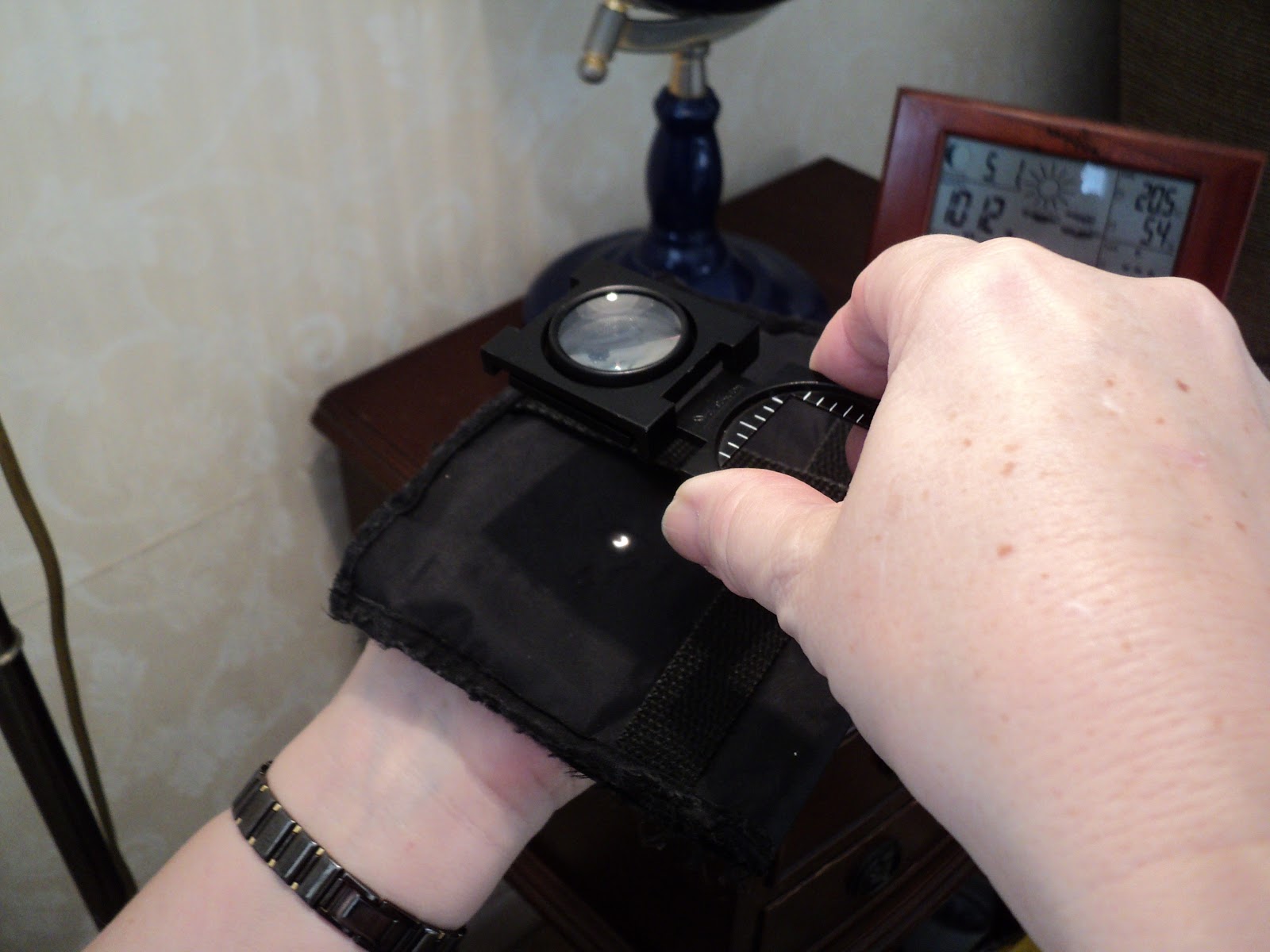
Here's a black surface (my camera case) being held under a standard lamp, emitting visible white light, with nothing except soft diffused light, certainly no image of the source of light.


Interpose a converging lens, aka "burning glass", and one sees the familiar spot of concentrated (focused) light. Let's now take a closer look.


Can you see what it is yet? 


Ah, that's better. Looks a bit embryo-like. Have you guessed what it is (assuming you do not already know?)


I'll try doing an enlargement (update: result below).  In the meantime, please take my word that it is an image of the incandescent filament in the lamp. But there was no visible image of that filament until the lens was interposed. (If you know your optics, and recall the means by which the pinhole camera works, you will know that an illuminated object does in fact cast  images of itself on every surface with which those rays subsequently come into contact, but note the plural - images. Without a lens or single pinhole there is a multiplicity of overlapping images, such that all one sees is a patch of suffused light.

The conclusion should be obvious, even from this GCSE-level experiment: a source of radiation on its own, even a gee-whizz uv source that can allegedly leave a signature of its source on fabric  - is no use on its own without some means of focusing the rays to form a single sharp image.


Yup, it's the filament. You can just about make out the helical turns of tungsten filament.

Tuesday, January 3, 2012

More progress in improving my thermo-stencilling technology for simulating the Turin Shroud

Previously I used a charcoal stick to sketch pictures on cloth, prior to fixing those images with thermal radiation (charcoal absorbs heat and light rays). But the images were rather faint, and it was difficult to remove all the charcoal by washing (thus disguising the methodology) probably because of pressure needed to draw with a stick.

As suggested earlier, I figured that a better result might be obtained by painting with  aqueous charcoal suspension ("charcoal paint") , and that has indeed proved to be the case, as should be apparent from what follows.

The lump charcoal was first reduced to a powder with a hammer, and then a little water added to the powder. That did not give a satisfactory "paint", with a lot of charcoal floating on top. As soon as a few drops of detergent were added (washing-up liquid) a relatively homogenous paste was obtained that could easily be applied to fabric with a brush as if painting.

The following pictures should be self-explanatory:


 Charcoal painted onto cloth, with paint pot in background


The next step is to dry the paint over a radiator.


Each letter of the painted word was then exposed to a few minutes radiant heat from a 60W ceiling spot lamp, and here it is viewed from the rear before washing out the charcoal "stencil". Faint smoke was visible during the roasting procedure, but nothing burst into flame. The pyrolysis (charring) seems to be self-limiting, and greatest in the regions with most paint.


Here it is, back on the radiator, drying off, after washing out the charcoal with soap and water (which proved exceptionally quick and easy). So that's a scorch image that is visible now, instead of the original charcoal.


Here we are, back on the dining table. looking at the thermo-stencilled image,and  with no trace of charcoal visible that might give a clue as to how it was formed. Painting is definitely the way to go, as distinct  from drawing, allowing one to build up the  density of heat-absorbing pigment in stages until one gets the desired intensity of  scorching. And it's much easier to wash out the charcoal, due presumably  to far less pressure from painting with a brush.Could this be how the Turin Shroud was produced?


Next experiment? It is said that the image is not formed on the cellulose fibres, but on a surface coating of starch, the latter having been used as an aid to weaving:

Link

Evidence for this is that the image can apparently be stripped off physically with adhesive tape (which is certainly not the case for scorched cotton) or reduced chemically with diimide, N2H2.

So the next step is to repeat the experiments with a starch-coated fabric. It's my guess that scorching will occur more readily with starch, which is chemically more reactive alpha-linked glucan, than with cellulose (beta-linked glucan), the latter having more extensive crystallinity due to  multiple intermolecular hydrogen bonding interactions. If scorching can be achieved quickly, then it may indeed be possible to strip off a superficial scorched layer from underlying cellulose, simulating more closely the characteristics of the Shroud. I shall have to think of an authentic (historically credible) source of starch. It certainly won't be potato starch!

Tom Chivers - re that Turin Shroud: you are the first (possibly second) person to be thermo-stencilled ...

"Tom Chivers is the Telegraph's assistant comment editor. He writes on science, culture and anything that crosses his mind."


 That's what it says at the top of Tom Chivers' Telegraph blogsite - he of the commendable breadth of interest, taking in, unusually for this day and age, a range of scientific topics (and much else besides).

But he was not always called that. In fact I once pulled his leg re his previous somewhat grandiose title ("Strategic Events Editor) - how to win friends, ha ha.... ;-)

Maybe Tom ran out of strategic events to report. Well, here's a possible candidate, says I immodestly - a simple procedure that one CAN safely try at home and which might, and may, just may, have been the technology by which the Shroud of Turin was produced in the 14th century as a fake "holy relic".

Here is a series of pictures that should tell the story without needing a lot of words.

Photograph, "shroud cloth", charcoal


Place photograph under fabric, place on glass sheet, illuminate from beneath


Completed charcoal tracing

After radiating from a 60W spot light for about 5-10 mins, viewed from reverse side before washing - selective scorching apparent.


 After washing out the charcoal and drying.  OK, so the image is faint (but then so is the Turin Shroud's!)


Hiya Tom. You're not looking your usual self today... Feeling a bit browned off?


The next step is to improve the image intensity. I've just made some charcoal paint, using a slurry of powdered charcoal in water with a dash of wetting agent. It paints beautifully onto cloth. The next step is to grill under a source of radiant heat, and wash out the charcoal "stencil".

(Oops. I had meant to add this to the end of the next post, the one describing use of charcoal paint. Never mind.)   Next experiment? It is said that the image is not formed on the cellulose fibres, but on a surface coating of starch, the latter having been used as an aid to weaving:


Link

Evidence for this is that the image can apparently be stripped off physically with adhesive tape (which is certainly not the case for scorched cotton) or reduced chemically with diimide, N2H2.

So the next step is to repeat the experiments with a starch-coated fabric. It's my guess that scorching will occur more readily with starch, which is chemically more reactive alpha-linked glucan, than with cellulose (beta-linked glucan), the latter having more extensive crystallinity due to  multiple intermolecular hydrogen bonding interactions. If scorching can be achieved quickly, then it may indeed be possible to strip off a superficial scorched layer from underlying cellulose, simulating more closely the characetristics of the Shroud. I shall have to think of an authentic (historically credible) source of starch. It certainly won't be potato starch!

Sunday, January 1, 2012

How to make your very own Turin Shroud at home - while choosing your own image

This is a brief synopsis of the previous post. OK,  so it was a bit wordy on account of my relating the progression of an idea to a finished product, blow-by-blow so to speak.  The finished product was a recognizable image, scorched onto fabric, with no clues as to how it was created.


Well, here's my home-made "Turin shroud" with a recognizable image of a smiley.

How was it produced?  Simple. Sketch the image in charcoal on some cloth (barbecue lump charcoal will do). Then hold the cloth up close to a source of radiant heat, eg, a ceiling spot light.


Observe the rear side closely. When you see it scorch, but only in the charcoal coated areas (black pigments absorb heat, white areas reflect and stay relatively cool), remove, then wash out the charcoal with soap and water. For fuller details, see the previous post.


Here by the way is a link to an excellent site that I cannot recommend too highly, discovered purely by accident. The site's name is Silly Beliefs, and its page on the Turin Shroud is packed with telling observations.

So what next?  Posting to Tom Chivers is a complete waste of time. Not one of the 10 comments I have posted so far - describing the genesis of an idea to its practical demonstration - has earned me a single recommend, while those who snipe or nitpick are rewarded. It would be nice if Tom himself, who frequently enters the fray on his own posts, were to proffer a word or two.


So what next on the experimental front?  There's a detail that needs attending to - minor perhaps, but irritating. It is difficult to wash out all traces of the orginal charcoal - not surprising perhaps, given that it is microcrystalline graphite. That faint but residual sketch detracts somewhat from the "Turin Shroud- like" simulation.

Today I might try grinding up some charcoal, and making it into a water or oil-based paint that can then be lightly brushed on the fabric. The trouble with yesterday's procedure, using lump charcoal, unlike the artists' charcoal stick intended originally, is that one has to press quite hard to draw the image, thus grinding carbon particles into the body of the fabric.

Update October 14, 2018

First, ignore the comment below about using a desiccated 'mummy' as template. That was (over)influenced by a visit to Brno,  Czech Republic, where my wife and I saw those mummified monks in the flesh, so to speak.

No, after a further 7 or so years  of  hands-on reseacrh,  progressing from thermostencilling (Model 1) to current Model 10 (arrived at 3 or more  years ago), I'm now firmly of the belief that the TS body image is a SIMULATED ('faked') sweat imprint of the newly crucified Jesus onto Joseph of Arimatheas's 'fine linen') . It was created in the 14th century, probably by the clerics and their helpers at Geoffroy de Charny's generously-staffed private chapel in Lirey, France, and made to look as if the sweat imprint had been yellowed with 13 centuries of age. How made? Probably as a flour imprint from two recumbent adult male volunteers, aligned head to head, one face up, the other face down, smeared with oil, sprinkled with white flour, draped with wet linen, the latter then pressed down manually to access and imprint as much of the body relief as possible. Blood (correction, 'blood' ) was then added and the the linen with flour imprint was then roasted gently over red hot embers to produce the straw image colour (via Maillard reactions and final melanoidin formation comparable to bread baking) and then given a final wash with soap and water to dislodge loose surface encrustation, leaving just the faint negative (light/dark reversed) image.  (I have deliberately omitted details re the "blood" for now. Suffice it to say that a thermostable blood substitutre. eg. red clay slurry, was perhaps used in place of real blood initially,and later touched up with real blood later, after the roasting step).

Takeaway message: the TS is an ingenious SIMULATED SWEAT/BLOOD IMPRINT of medieval (14th century) fabrication. It may have been inspired by the then-celebrated 'Veil of Veronica' - alleged to be an analogous sweat/blood imprint  (face only) acquired en route to the cross. The TS trumped that, being the whole body post-crucifixion image acquired en route from cross to tomb.


Friday, December 30, 2011

The Turin Shroud - could it have been produced by thermo-stencilling?


Photographic negative with enhancement: Image now a "positive".


See tail-end for some October 2018 updates (yes, some 7 years after this, my initial Shroud posting!)

Even now, that  faint, so-called "enigmatic" negative (tone-reversed) Shroud image is not instantly and easily explainable (especially as scientific access has been denied  by the Vatican these last 40 years since that  inconclusive STURP exploratory 5 -day visit in 1978) !

Why not?  Because one has to be willing to think 'outside the box'.  ( Seems it's no longer taught in schools and universities).

'Thinking  outside the box'  is - and always has been - this retired scientists's speciality.  So be prepared for surprises... 

Key words to look for are : SIMULATED SWEAT IMPRINT (seemingly dried and subsequently yellowed with age). You read it here first...


Start of 2011 posting: 

This is a quickie post. I'll tidy it up later. It's to show some comments I have today posted to Tom Chivers blog on the Daily Telegraph with the germ of an idea (that may or may not be original).

Tom's topic title: 

The Shroud of Turin: forgery or divine? A scientist writes


The comments set out briefly an idea that came to me suddenly this afternoon as to how that image on the Turin Shroud may/might have been produced in the 14th century by medieval "forgers", intent on producing yet another 'holy relic' to add to fragments of the 'real cross'  etc etc. Yes, holy relics were a major growth industry in the 14th century, given they could attract thousands of pilgrims to your cathedral or whatever each year - the beginnings of the travel industry...

Comment 1:


'THERMO-STENCILLING'? (don't bother googling - you read it here first ;-)

The crucial detail is that the image is a negative, i.e. parts of the original object that were well illuminated ("light") look dark and vice versa.

A negative image might at first sight suggest some kind of photography, either early primitive, or entirely accidental, or a combination of the two.

Leaving aside the nature of the photographic emulsion and photosensitive compound there is a problem with production of any image by photography. It needs either a good convex (converging) lens to bring light rays to a focus, or failing that a pinhole camera. It seems improbable(though not impossible) that either of those technologies were available even 800 years ago at a sufficient state of development, since if there had been there would surely be a host of other artefacts available from that era (e.g. grainy photographs of royalty?).

But there is another means by which an image can be produced that does not need photography, or at any rate the focusing of light from an object. One could use 'thermo-stencilling" instead. How? By taking some white fabric, and fashioning an image using black charcoal as one would a portrait, using degrees of shading rather than a line image. One would then expose the cloth to radiant heat, say from a furnace. The black areas would absorb heat and partially scorch the cloth in immediate contact with the charcoal while the white areas would reflect light and remain unscorched. The final step would then be to wash the particles of charcoal completely out of the cloth, leaving just the brown image - and  if I am not mistaken it would be a negative image, assuming the artist used the charcoal lightly for light-reflecting features of  a man's body, and more heavily for the bas-relief features that are in partial shade or reflect less light     Oops - sorry about that. Thanks Mouse (comments)  for pointing out that silly error.


By washing out the charcoal, the observer sees no evidence of the the image having been "painted" on the cloth. All that is left is a scorch mark - and being formed under a charcoal coating, it may be subtly different perhaps from one formed by direct action of hot iron or heat rays onto fabric.

Comment 2 (omitted, largely clarification in response to a query from xxxxxxx)

Comment 3 - further clarification:

Sorry, xxxxxxx  , but I don't understand your difficulty re charcoal. If you had been barbecuing, and had got charcoal dust on your shirt, would you throw your shirt away, on the assumption that it was impossible to wash out? Surely not. Even without modern detergents, charcoal, which is simply microcrystalline graphite, i.e. sheets of carbon atoms arranged as fused hexagons, giant molecules in fact, should be relatively easy to wash out.

You are not by any chance confusing charcoal with scorched or charred cloth by any chance? The procedure I propose starts by drawing on a cloth with the kind of charcoal given out in school art classes - carbonised twigs. The cloth is then "grilled", i.e. exposed to radiant heat, e.g. from red hot coals, or again, charcoal, though I hesitate to mention it, and the black, charcoal-coated areas on the cloth will heat up - and become scorched - in contrast to the white reflective areas without charcoal that will remain relatively unscorched, at least with short exposure times.

I only suggested charcoal because it is "right for the period" and probably does the job, but other black substances might serve equally well, given that black subsrtances absorb heat as well as light, provided they can be washed out after heating so as to "dispose of the evidence" so to speak as to how the negative image was produced. Please tell me if I am not making sense.

Again, I thank you for your interest, but have to say I am somewhat disappointed by the response so far. Any feasible mechanism should surely place a big question mark over the assertion of those Italian scientists that there is no known mechanism by which the image could have been produced. I maintain there is - and I have chosen to call it "thermo-stencilling".

 ......................................................................................................................................

Tomorrow I must get hold of some charcoal, and see whether or not  the idea works as predicted. I'll use a hot ring on the cooker hob as a source of radiant heat.

Update: Saturday 31 Dec 2011    I've just this minute cut up some cotton pillowcase (OK, so it's not flax/linen as per original Turin Shroud) and then cut some batten as per piccy below to create grips - left and right - that allow the cloth to be held close to a source of radiant heat without barbecuing knuckles.  Missus will add artist's charcoal to her shopping list when she goes into town this afternoon.


While waiting for the charcoal. I have been giving thought to what to use as a source of radiant heat.  The initial idea was to use the cooker hob:


But there's a potential complication there - it's not just radiant heat, but hot rising convection currents as well. It's better to isolate and study one variable at a time.

The new ceiling spots in my bathroom throw off a lot of radiant heat - downwards - in the opposite direction from rising convection currents, so I will try holding my "miniature shroud" up close to a spot.


Update  Sunday 1st Jan 2012

Well, missus was unable to get hold of artists' charcoal stick, but never mind, we'll try barbecue lump charcoal:


Watch this space folks (will try "grilling" under a spotlight as soon as missus has vacated the bathroom).


OK, so here's the charcoal outline being exposed to radiant heat from a ceiling spot, with the charcoal-side facing the lamp. Within a few minutes I began to see a sepia smile appearing on my side.


And here is the reverse side back on the table after just a few minutes of gentle grilling.  Prediction confirmed!  'Thermo-stencilling' WORKS - and given the utter simplicity of the procedure may or might well have been the method used 800 years ago to produce the Turin Shroud.

The final step is to wash out the charcoal, leaving hopefully just the scorch mark (with no clue as to how it was formed!)


Here it is after a brief rub with soap and a rinse. Not all the charcoal is removed, but enough to see that the image is now mainly in the form of a scorch mark.

The final step is to dry over the heated towel rail:


Incidentally, if you are wondering why the whole face (and those ears) are not brown, it's because of the limited diameter of my ceiling spots. I used one (60W) in the living room - bigger than the bathroom I had originally intended to use but the diameter is still only 7cm approx.

What might have been used as a souce of heat 800 years ago? Maybe a kiln or furnace (lime? glass?) with the door open...

Have just this minute posted this to Tom Chivers blog:


"Hello again everyone (and a Happy New Year to Tom). Guess what? I have just reproduced a downmarket version of the "Turin Shroud" in miniature, using simply a cotton sheet, a lump of barbecue charcoal, a source of radiant heat and a bar of soap. It's all on my own science buzz blog:

http://colinb-sciencebuzz.blog...

newsjunkie aka sciencebod

PS: Methinks, or rather mesuspects, that none of this will come as a surprise to the canny, well-informed Vatican ...    ;-)"

Update, nay, new angle, posted October 11, 2018 (nearly 7 years after this my initial Shroud posting - some 350 or more postings later!)


I drew freehand using a stick of  artist's charcoal in the initial experiment described  - Model 1 as I now call thermostencilling.

Yesterday I discovered one can IMPRINT with solid charcoal powder. What's more the imprints (of my fingers) bear an uncanny resemblance to the real things - essentially negative photograph-like images (ring any bells)?


Left: imprinted fingers onto DRY linen with powdered charcoal. Right: same but imprinted onto WET linen, as used with white flour imprinting medium in my Model 10.


Not bad eh? In fact I'm publishing the charcoal imprints here first, being in no hurry now to release new data to sindonology (which continues to ignore or indeed suppress  my Model 10, i.e. simulated sweat imprint theory). Nuff said.

Here's a link to my current posting which explains what got me thinking about charcoal imprints (if only to better visualize what one is producing with the white flour imprints in my current Model 10, now some 3 years old and more).

https://shroudofturinwithoutallthehype.wordpress.com/2018/10/05/no-mr-barrie-m-schwortz-sturp-did-not-provide-an-example-that-future-shroud-researchers-can-use-to-carefully-plan-their-own-work-sturp-showed-how-not-to-plan-or-execute-objectiv/

Saturday October 13, 2018 

Afterthought: It's suddenly occurred to me that I now have a means of comparing two entirely different mechanisms of generating a Shroud-like body-image chromophore.  The first  involves the linen only as source of raw material, the other involves an extraneous imprinting medium.

The first is the technique reported here  on this very posting back in December 2011, i.e. "thermostencilling", which I  now refer to as Model 1', but using the modification now appended, namely to imprint with finely powdered charcoal, rather than 'draw' with a charcoal stick, or, as later,  apply as wet suspension.   A source of dry radiant heat is used to 'scorch' the linen that is in immediate contct with the radiation-absorbing  elemental carbon.

The second substitutes powdered white flour for charcoal, i.e. my Model 10, developed and reported  in 2015, but again using a source of dry radiant heat for image development.

Both are expected to give a final yellow or yellow-brown imprint (after washing to remove either charcoal or loose 'toast-like' brown encrustation  in the case of Model 10).

The key question is then how the two end-results compare chemically and spectrally. At the very least,  they can potentially serve as reference standards for any future investigation of the TS body image, i.e. STURP Mark 2, Vatican-permitting.

Which Model do I consider closer to the TS body image?  Model 10, with flour imprinting, without a doubt.  I consider imprinting with flour (or some other organic, i.e. carbon/hydroge/oxygen etc -based medium in solid, powdered form being the likely means chosen by 14th century 'fakers'  to simulate, a claimed (then) 13 centuries  whole body sweat imprint  after drying and yellowing with age. The initial near invisibpe imprint (+ more visible blood) was imagined as  having been  left by the  newly crucified Jesus on Joseph of Arimathea's 'fine linen', en route from cross to rock tomb. The tone-reversed negative image, almost certainly produced by actual 14th century imprinting (NOT free-hand painting!) added that genius touch of authenticity, with a body image that was only just visible (and even then it was necessary to stand back a couple of metres to see it against off-white background).

I reckon the problem of the TS is now solved -  just think simulated sweat imprint, seemingly yellowed with age. How much longer must one wait for authenticity-fixated sindonologists to sit up and take notice one wonders?

Tuesday, April 5, 2011

Fukushima - growing nuclear catastrophe in slow motion

.
 Fukushima- planetary hotspot


The Guardian has invited readers with a relevant or specialist scientific background to suggest ideas for how the dire situation at Fukushima's crippled and leaking nuclear power station might be contained.

At present, the now highly-contaminated site is storing vast quantities of water that have been hosed in, a desperate and makeshift attempt to cool the reactor cores - and even spent fuel rods.

That is the dire situation that has arisen, following the breakdown in normal cooling systems. Fukushima has been hit with a double whammy from both earthquake and tsunami damage.  The earthquake, at a massive 9.0 magnitude, damaged the reactor cores, and the tsunami knocked out power supply to the coolant systems.

It's easy to propose solutions, from the comfort of one's armchair, without worrying about one's exposure to hard penetrating radiation, but here, for what it is worth, is my advice, posting as sciencebod,  to those brave workers, who suddenly find themselves in the wrong place and at the wrong time:

"First of all, stop thinking about quick fixes, panaceas etc. Fission products continue to give off decay heat long after the control rods are inserted to absorb neutrons and stop the chain reaction. Secondly, any leakage from reactor core sends the primary fission products – notably I -131 and Cs -137 into the air, which then get incorporated into the thyroid and other body tissues, bombarding with radiation from WITHIN, so the issue is one of containment – attempting to keep the nasties on site, while protecting the workers from external radiation (they are not at risk from internal, since the hazard of ingested I-131 and Cs-137 is well known and preventable).

So how does one contain, given there are accumulations of hosed water – a make-shift remedy in view of failed pumps etc – and cracks in concrete containment ponds etc?

Desperate situations call for desperate measures – remember Red Adair, and how liquid nitrogen was finally used to tame the Kuwaiti fires started by Saddam’s retreating troops.
The chief problem at present is radioactive contaminated water that has to be disposed of to free up space for more contaminated water. Dumping it in the ocean may seem acceptable, given the diluting power of the Pacific, but it is not. It is polluting the planet. Contaminated water must be kept on site for as long as possible. But how?

Here’s the answer. When you cool water, the ice that is first formed tends to be pure water. Dissolved substances tend to stay in the water that has not yet frozen. Import ice-making machines into Fukushima, powered of diesel generators, and then periodically drain off the highly radioactive liquid below the ice (remembering that ice floats on top) and store that on site. Flush the ice briefly with fresh water to cleanse of contaminants, then let it melt in situ, and run the weakly radioactive melt into the sea.

Nope, it’s not a panacea, just an Elastoplast job, but it might help preserve a shred of credibility for the nuclear industry if it can contain its problem, instead of using the sea as a convenient dump. And let’s not forget that not all nuclear reactors are situated on coastlines, so my “ice solution” might be one they should consider on inland river locations etc. in the event of a problem comparable to Fukushima.


I have also posted a copy to the Independent, where I blog as newsjunkie.

Wednesday, April 28, 2010

"Controlled" burn- off of spilt oil in Gulf of Mexico - a warning!

  
Spilt oil from Torrey Canyon, 1967, deliberately bombed by RAF in attempt to protect Cornish beaches

A similar thing  was tried when the Torrey Canyon oil tanker ran aground off Cornwall, SW England back in 1967  when Harold Wilson was Prime Minister. The pollution from black smoke was reckoned to be as bad, if not worse, than the spill itself.

Years later, I was pals with one Don H, who had a co-share in our hot-air ballooning syndicate. Don had recently retired from the RAF as an air-commodore, and had been a squadron leader at the time of the Torrey Canyon.  The initial attempts to set fire to the oil had failed, he said, and he had been part of a dive-bombing team which had attempted to encourage combustion by bombing the wreck with sodium (potassium?) chlorate - containig incendiary devices.

Attempts to burn off the crude oil failed - and it ended with thousands of gallons of detergent dispersants being sprayed into the ocean - with devastating effects on marine life that lasted for years.


Chlorates are  powerful oxidsing agents,  an ingredient of the notorious "weedkiller' bombs. This retired scientist had much entertainment from sodium chlorate as a teenager when it was still available - pre-IRA - as a weedkiller, as did the lads on a neighbouring estate, who used to make "pipe-bombs" from it (sugar/weedkiller mixture).

Tuesday, January 12, 2010

If CO2 is so heavy, why doesn't it sink and suffocate us?

A note about the author (added October 6, 2016):

 Thanks for visiting this post, penned some 6 years ago. It's still attracting 15-20 visits per day! (Maybe it's that graphic below of those thermally-agitated  gas molecules that attract visitors, rather than the wordy science  per se - yup, I'm a down-to-earth realist).

Before proceeding onto your perilous journey into the intricaies of how molecules - light versus heavy-  respond  (or don't) to the Earth's gravitational field, please be advised that this investigative blogger/retired scientist has made other contributions to knowledge (or as some unkind folk would say - fantasy). There are two in particular I wish to flag up:

1. Stonehenge. I believe it to have been designed initially for SKY BURIAL, or as I prefer to call it, AFS (avian-facilitated skeletonization). 

See most recent posting on this site.


Ugh! Yes, I know - hardly the stuff of after-dinner conversation.

2. The Shroud of Turin. I believe it to be a medieval fake, consistent with the radiocarbon dating (1260-1390). I believe it was intended to reproduce what Joseph of Arimathea's 'fine linen'  - used simply to transport the crucified Jesus from cross to tomb -  would have looked like 13 centuries later if it had captured a body imprint in SWEAT and BLOOD. I have demonstrated in my own home how the enigmatic body image could have been imprinted onto wet linen using an adult male volunteer.  The lucky fellow was first smeared with vegetable oil, then coated with a dusting of white flour.  Heating in a bread-making oven or similar (the linen, not the bloke) would have produced the sepia body image, later attenuated  to its final 'ghostly' appearance by vigorous washing with soap and water.

See this recent posting on my specialist Shroud site.
 
Naughty, I know,  inserting this 'commercial'. Thanking you for your forebearance (but do please visit those two sites if you're interested in cutting-edge stuff that's still to be picked up by the meeja)

 Back now to those bustling molecules.

Thanks to kinetic energy, there will be no appreciable 'unmixing' - or even partial stratification,- at least under  normal g values. That's the case even if one type of molecule is much heavier than the other

The question in the title was inspired by a comment on a site I visit a lot, one to which I've posted a lot in nigh on three years. More about that later. Suffice it to say that I shall reply to here, rather than there, and attempt to place a link on the other site. There will be no more posting to that site until such time as its moderation policies are given a thorough overhaul! Nuff said for now...

The question was essentially this:  given that we all know that petrol fumes sink to the ground at a filling station, why doesn't CO2 - which we also know is denser than air - also settle at ground level? Why are we not suffocated by the stuff - or does it only come up to ankle or knee level?

Imagine one were to trap gases inside balloons - one for hydrogen, one for oxygen, one for nitrogen, one for carbon dioxide - and then release them. The four balloons would behave exactly as the questioner supposes. The hydrogen balloon would quickly ascend, the CO2 balloon would rapidly descend, and the nitrogen and oxygen  balloons  would probably hover or sink slowly - due mainly to the weight of the balloon rubber - not the contents. The relative densities of hydrogen :nitrogen: oxygen: air::carbon dioxide are approximately 1 : 7 : 8 : 7.2 : 22. Gases lighter than air rise, those heavier than air sink. No surprises there.

When petrol fumes are released, they too sink quickly, at least to start with. A typical molecule in petrol is  one of the isomeric octanes,  general formula C8H18, with a relative vapour density of 57 - some 4 times greater than air.


But the petrol fumes would  not stay for very long at ground level. Convection current carry them upwards, and gaseous diffusion would cause mixing with air even without convection. That's because gas molecules are in a state of constant motion, colliding with other molecules, millions of times a second, causing them gradually to diffuse ("spread") in all directions. The fumes gradually spread into all the space available - which could be a jar, a garage, a hangar, the entire atmosphere. Once the space is evenly occupied, the molecules then show no tendency to unmix. Why not? Answer: because the 1g force that acts on all molecules in air at sea level is insufficient to overcome the kinetic forces due to collision between molecules. Put more simply - a molecule that gets a strong bump from below will be knocked upwards, against the weaker force of gravity.

This is true for g=1, but is not true for progressively higher g forces.

Here's an example - always a a controversial one. Enrichment of the fissile uranium isotope U-235 needed for atomic power stations OR Hiroshima-type A bombs, requires separation from the more abundant U-238. This can be accomplished in gaseous diffusion plants, or in centrifuges that generate an intense g force. Either process requires that solid metallic uranium  first be converted to the gaseous uranium hexafluoride (UF6).

There is a well known experiment that is done in schools, at any rate, those that still have  a fume cupboard, to demonstrate that dense gases and/or vapours gradually diffuse to fill the space available, and then do not subsequently unmix from air.


One places of few drops of elemental bromine, Br2, a fuming red liquid in the lower jar, which is separated from the upper jar by a glass divider. One waits for the lower jar to fill completely with red-brown fumes. One then removes the separator. The fumes gradually fill both jars evenly, despite bromine vapour being 5 times denser than air.

There's a variant on the experiment that I devised while teaching to demonstrate the petrol vapour effect. One places a jar of bromine on top, and then removes the divider. Most of the bromine fumes sink immediately into the lower jar, behaving as if they were enclosed in a balloon. But the fumes then gradually diffuse back upwards to produce the same end-result as before.

The short term behaviour of the petrol fumes is called a bulk phase effect. It's the temporary behaviour of heavy molecules in close proximity, which behave briefly as if enclosed in a balloon. But once diffusion has caused mixing of heavy molecules with the lighter molecules of nitrogen and oxygen, unmixing does not occur at normal values of g.

Think then of a gas before diffusion and mixing as a kind of ghost fluid, with its own density and  buoyancy characteristics. In fact, while the term "fluid" in everyday life is synonymous with "liquid", in physics it applies to both gases and liquids. But a gas  loses the distinguishing characteristics of its original 'fluidity' once it's had time to spread sufficient for its own kind of molecules to become separated and  irreversibly mixed with other kinds of molecules.


Further reading:

Will mixed gases spontaneously unmix?

http://www.quora.com/Chemistry/Will-mixed-gases-spontaneously-unmix

Here's another that's quite thought-provoking, once you get past the unpromising preamble


It has some useful qualifying material at the end re altering the composition of  atmospheric gases with increasing altitude, which I've quoted below:


Finally, even if the air were completely and 
perfectly still, the carbon dioxide would 
not form a pool on the surface. There is a 
"dynamic equilibrium" set up between 
gravitation -- the tendency for the denser 
material to go to the bottom -- and diffusion 
– the tendency for a material not to 
concentrate in one place, but to spread 
itself out. The atmosphere we have contains 
roughly 78% nitrogen, 21% oxygen, 
0.93% argon, and 0.036% carbon dioxide.
Its composition does not vary until 
you get above 80 km in height. If the air 
were perfectly still,
its composition would be
 
Ground level: 75% nitrogen, 23% oxygen,
1.3% argon, 0.055% carbon dioxide 
 
10 km high: 79% nitrogen, 20% oxygen, 0.75% argon, 
0.026% carbon dioxide
 
20 km high: 82.5% nitrogen, 17% oxygen, 0.43% argon,
 0.012% carbon dioxide
 
So even in these circumstances, the 
heavier gases like carbon dioxide would 
have higher concentrations
lower down, but could not form a lethal pool.


So there is an effect (of sorts) that relates to molecular mass ("heaviness"),
even if there is no unmixing as such. Does that contradict anything that precedes
it in this posting?  Discuss. :-)

Here's my own interpretation, for what it's worth, of the grading by molecular size/mass with increasing altitude (added September 17 2014)?

As one gets higher, the air thins (this being due to decreasing gravitational pull on everything, gases included, such that most gas is held relatively close to the Earth's surface (a few tens of  kilometres). But another effect can then operate that discriminates according to molecular mass. It's to do with the average spacing between molecules and their average speed (best measured we're told as the root mean square velocity). As the molecules become further apart they can travel further using their own intrinsic motion before colliding with another to be deflected off in a different direction, impeding upward progress.

 But a light molecule travels faster at a given temperature than a heavier one. It's one of the givens of kinetic molecular theory. It explains why hydrogen gas diffuses faster than carbon dioxide. Thus there is a greater probability that a lighter molecule like hydrogen will be able to cross a given transient empty space faster than a heavier one before the gap, so to speak, closes up.  Ipso facto, light molecules have a greater probability of  "winning the race" to the top of the Earth's atmosphere.  But having got there they will find they are still held by the Earth's gravitational field  albeit much weaker than at ground level, unless exceptionally light, like hydrogen and/or helium atoms which we are told can and do escape from the Earth's atmosphere, leaking off into interplanetary space.

 Summary: what's operating is not settling out of heavier molecules in response to gravity. It's the speedier motion in an otherwise unfavoured direction (upwards) of molecules that are LIGHTER and thus able to DIFFUSE faster!   (They would diffuse anyway, whether or not a gravitational field was present, so gravitation becomes a secondary consideration).

Even further reading: see the excellent wiki entry on 'Atmospheric Escape" which also focuses on differential rates of gaseous diffusion.


Note: I'm pushing the limits of my physics in offering the above interpretation. If folk find it faulty, and/or can offer a better explanation for the sorting-by-size effect with altitude, then please feel free to comment. However, I do not consider the phenomenon is serious enough to challenge the generalization that gases do not spontaneously and efficiently unmix of their own accord, at least in a natural gravitational field around a planet-size object. Random molecular motion with constant collisions always ensures that molecules will never completely unmix, while accepting there can be concentrating effects of the kind described under normal or elevated g forces.

Here's a handy link to 'Physics for Dummies' with a section entitled "Using the Kinetic Energy Formula to Predict Air Molecule Speeds".

The takeaway message is the inverse square law that relates molecular mass to average speed at particular temperatures. A nitrogen molecule, N2, can be calculated to have an average speed of 508 metres per second  at 28 degrees C (301K), though it would have to be in a perfect vacuum to be able to traverse that distance. A molecule that was 4 times as heavy would travel at half that speed, a half being the inverse square root of 4. A molecule that was half as heavy would travel at, er, darn, where did I put that pencil? Off the top of my head I think the answer is root 2 times as fast. That's approx 1.4 times as fast, i.e. 40% faster or thereabouts. A hydrogen molecule, H2, has 1/14th the mass of a nitrogen molecule, N2, so would travel  (1/root 1/14) i.e. approx 3.75 times faster.

Addendum, 18th September 2014

I'm not sure I've adequately explained the difference between having a gas confined within a balloon or not, especially as regards the 'thought experiment' of taking the balloon away to watch the disappearance of density characteristics, "sinking" etc,

Here's a home-made diagram that will be used to describe my current (and still evolving) thinking on the subject:


Brace yourselves. More to come

First, look at the right-half of the balloon, and imagine the left were the same, i.e. an intact envelope enclosing gas all the way round. In that situation, the normal laws of buoyancy would apply, which as a revision exercise I shall now show in three diagrams (A-C)  filched from the internet, of increasing detail and complexity.

 Diagram A:

 Diagram A above shows an object (only) partly immersed in a fluid, which is subject to two forces: gravity, pulling it down, and "buoyancy" pushing it up. But what is the nature of the buoyancy force? The diagram does not explain. Let's look at another which does.


Diagram B:


 This diagram shows an object fully immersed in the fluid (I wish that Diagram A had too, but beggars/filchers can't be choosers). Note that the fluid exerts pressure on the object, that the pressure acts in all directions, that being the nature of pressure as a result of billions of random molecular collisions per second that have no single directionality. Note the upwards pointing arrow in the middle. Why is the nett force upwards ("buoyancy"). Again, the diagram does not explain. For that we need to go to the next diagram.


Diagram C:


 What this diagram shows is the imbalance of forces acting on the immersed object. The pressure at the bottom (pressure being force per unit area) is greater than at the top, and indeed greater than at all points between top and bottom. In other words, the nett force is upwards. the nett upwards force is called the UPTHRUST.

For the object to float, the upthrust needs to be greater than the weight of the object in air. For the object to sink, the upthrust must be less than the weight of the object. Upthrust can be measured as the weight of fluid displaced (handy for calculation, while not giving insights into the mechanism of upthrust which as explained is due to increasing pressure with depth producing an imbalance of forces between highest and lowest points).

Now let's return to our sealed/soon to become leaky balloon and compare with the three diagrams above:


Hopefully, dear reader, you can guess what is coming. While that balloon is intact, with the same kind of molecules all packed together, exerting their particular density characteristics, whether smaller or greater than the surrounding air, then the balloon goes up or down, following the laws of buoyancy, the gas behaving just the same as any other fluid.

However, imagine that balloon envelope suddenly becoming permeable, with gas escaping and mixing, then one no longer has a homogeneous fluid of characteristic density and buoyancy. As the escaping molecules begin to mix with the surrounding molecules of air, then the bulk effects disappear, the molecules then behaving more or less independently from their neighbours, now increasingly different.  What matters now are not the original bulk properties that respond to gravity, and/or the contingent pressure differences that depend on gravity,  but the behaviourof the individual particles comprising the originally-enclosed gas, which is now determined by their intrinsic molecular speed, which is in turn a function of temperature, kinetic energy, mass and velocity, summed up in the term diffusibility.

Interestingly, there's a transition period between release from a confining receptacle and complete mixing (whether by slow diffusion, or aided by air currents etc) when the body of gas is still sufficiently discrete to continue behaving as a fluid. Some of us recall the demo experiment in school chemistry labs where teacher takes a jar full of CO2 gas and "pours" it over a candle or lit Bunsen burner, the flame being instantly extinguished in both cases.

Come to think of it, might the idea that CO2 "sinks and suffocates" be based on reports where the gas has been released from underground, say,  or under water (as in the 1986 Lake Nyos disaster in Cameroon) , in both instances in regions of volcanic activity where the gas has vented from subterranean magma, and then flowed as a 'fluid' for a considerable time before there was time for mixing to occur?


Lake Nyos disaster, 1986
 But that is not CO2 settling out from a mixture, needless to say, which by now I hope is an idea that no one will entertain. The lethal invisible blanket of gas issuing from the Earth's bowels has been able to retain its density characteristics in the period between initial venting and  subsequent mixing with other gases in the atmosphere, notably oxygen and nitrogen.

Update: September 22 2014

I discovered today why this posting attracts far more visitors each day than any of my other postings, despite having been written some 5 years ago. Assuming that most visitors were finding it via their search engines, I tried entering strings of search terms that correspond with the title, and then whittling them down to a core set. To my surprise, I find that one has simply to enter (CO2 heavy)  and this posting tops the list of returns! It's clearly achieved that virtuous circle, aka critical mass, where its present prominence helps ensure continuing prominence!

Never one to rest on laurels, I've been making some additions by way of afterthoughts, and picking up on points that others have raised elsewhere, notably on science discussion forums where the content comes chiefly in serial additions from the participants themselves, starting with someone's primer question. In fact there's just such a forum that arrived three years after this one, posing essentially the same question, and is now third in my list of Google returns.

From 'spoogington' some 9 months ago, currently with 109 comments:

If CO2 is heavier than O2, why is our atmosphere not stratified with a layer of CO2 closer to earth?


Looking at the points made, I'm more than ever convinced that I was right to raise the question, since clearly there is some confusion in people's minds (as there was initially in my own) as to the importance or otherwise of bulk density v molecular weight where the behaviour of 'heavy' gases is concerned, before and after mixing in a gravitational field.

At the risk of giving this post an intimidating length, I  might try supplying my own answers to some of the points raised. Or there again, it might be wise to create a separate follow-up  post so as not to overload this one.

Oh, and here's a link to a climate change sceptic, maybe denialist even, who seems to think that CO2 is too heavy to get into the upper atmosphere.  In fact,the faux science  gets worse as one reads on, much worse.

Sample: (my italics)

 "How mad with power does a group of people become that they now want to control, CO2, a naturally occurring colorless, odorless, incombustible gas formed during respiration, decomposition of organic substances, volcanic emissions, decay of plant and soil organic matter? A gas that was intelligently designed to be heavier than air for a purpose. How crazy is that?

I invite him to read this posting and reconsider.

October 5, 2014:

Have just come across this blog, with a brief mention at the end of a delightful reductio ad absurdum argument. Look for the term "layer cake atmosphere".

October 6, 2014

And here's a must-see paper from a kindred spirit (an Italian caver at Turin University) who unlike myself has the maths to support the theory. The title says it all. Click to enlarge if you wish to read the abstract.


It's available as a pdf:


Note the date of first publication: April, 2009, i.e. some 9 months before I penned this posting. But I'm not a plagiarizer, honest, no, really, HONEST, not having spotted this paper until just a few days ago.

New addition

November 8th 2014

Here's an additional 'thought experiment'  using CO2 and helium filled balloons to demonstrate that once mixed, gases do not unmix.

I composed it yesterday as a new blog posting, and intended to add a brief summary here. Being somewhat busy right now, here's a cut-and-paste of the entire posting, which I shall endeavour to prune when I've some fee time.
------------------------------------------------------------------------------------------

Still they keep coming, to a posting I did nearly 5 years ago.

Posted on this site, Jan 12, 2010
It wasn't as if  CO2 and its behaviour in a gravitational field was a burning issue at the time. In fact that posting was a side-issue from my then preoccupation with the climate change/global warming debate (which I was glad to withdraw from, given the brow-beating denialist tendency on MSM forums).

It was provoked as I recall by a barmy comment to the effect that CO2 had been made "heavy" by a Benign Presence (Gaia? Guardian angel in attendance?)  so as to stay at lower altitudes, feeding our plants, not reaching higher altitudes where it might cause mischief!!!

Here's a snapshot from my sitemeter, showing that 11 of the last 20 visits have been to that posting  (13 is a more typical average).

The red tags are mine, pointing to the CO2 posting

  Quite why it still gets all the attention I haven't a clue. Maybe it's because  I'm a Londoner it's currently the second  listing one sees if entering (CO2 heavy) into Google. Sometimes it's the first he says in a rare moment of modesty-bypass.


To be honest, I've been somewhat embarrassed that a instant tutorial should now be seen as the first or second stop on a simple non-technical web search. So much so that I gave it a spring clean this last September, adding bits here and there to strengthen the case (as I'm only 99.9% certain about my conviction that  normal g forces - from the Earth's own pull - are insufficient to cause unmixing of CO2 and stratification, ONCE THE GAS has diffused and mixed with the nitrogen and oxygen of air).

With that as preamble, folk should perhaps understand why I'm back again, still fine-tuning, still whittling down that stubborn 0.1% of doubt.

What I wish to describe now is a thought experiment. (Yes, I  know it should or could have been a real one, but if thought experiments were good enough for Albert Einstein then they are good enough for me - that's my story and I'm sticking to it).

It's a development of the 'teaching aid' in the original posting, which began with a brief look at the behaviour of gases trapped inside balloons, where they do indeed show their heavier or lighter-than-air characteristics. That's before the gases have escaped from their balloons, then diffused and mixed with air and lost their ability to "sink", settle out, stratify, call it what you wish.


Last night I had a brainwave. Why not keep the gases trapped inside their balloons, and allow them to mix by diffusion (which may take a few minutes, possibly a lot of minutes for totally even and homogeneous mixing, but mix they will, such is the nature of gaseous diffusion).


 How might the behaviour of the balloons compare before and after mixing? Let's do that thought experiment.

Before opening the valve: the two attached balloons may ascend, descend, or stay put, depending on the relative size of the two balloons, and the average density of the two gases compared to that of the surrounding air. If the average density is less, the system ascends etc. (And it won't matter a jot whether the gases are separate or pre-mixed  or post-mixed for that to be true - important for what follows).

But one thing's for certain. The two balloons will remain oriented with respect to each other, as in the diagram, with the blue helium balloon on top. That's because it always experiences more upthrust than the red balloon, displacing a greater volume of air for a given weight of enclosed gas. If one attempts to alter the stacking geometry, the system will self-correct when released.


Now let's picture what happens if the valve is opened, or the fusible wax plug is melted, allowing the two gases to mix. One could allow mixing by diffusion only, which means a lot of waiting. Alternatively one can speed up mixing by inverting the balloons as shown below.


xx
The lighter gas helium, now underneath, will ascend; the heavier CO2 will descend, and being a two-way countercurrent system there will be faster mixing than if it were by diffusion alone. A series of inversion, re-righting, re-inversion etc should result in a homogeneous distribution of gases between the two balloons.

What happens when one releases the two (still attached) after mixing?


Answer:

If the original system ascended, so will the new one.

If the original system descended, so will the new one.

If the original system was perfectly balanced, neither ascending nor descending, so will the new one. 

But there will be a difference. Both balloons are now equally buoyant (or non-buoyant, depending on the proportions of the two gases). So there will be no tendency for one balloon to be above the other. In other words, the two balloons can adopt any configuration through 360 degrees (with a slight tendency maybe for the smaller balloon to 'lead the way'  if rising or sinking, due to aerodynamic differences).

So the two attached balloons might go up, go down, or stay put, looking like this:


or like this:


or any angles of rotation in between.

One thing's for certain. Restoring the original configuration to blue on top, red underneath will not cause reversion to the original self-correcting orientation, since that would require that the gases unmix, with CO2 going back into the red balloon, helium going back on top.That as we've seen. simply does NOT happen at normal values of g. Which is where we came in...